What is Security Analytics? Benefits & Use Cases
Learn why security analytics matters for your organization and how you can start implementing it. Find out its key benefits, challenges, best practices, tools and technologies, and more.

Security analytics assesses an organization’s ability to detect, manage, and remediate threats. It enhances efforts in maintaining regulatory compliance, averting data losses, and preventing potential threat intrusions. The market for advanced security analytics solutions is expanding and we have seen a shift from rule-based detection methods to machine learning and AI-driven threat action responses. Its market is estimated to reach a valuation of USD 25.4 billion by 2026 and grow at a CAGR of 16.2% between 2021-26. Therefore, organizations will be investing in the latest solutions and enhancing their cyber security efforts in the near future.
In this guide, we will discuss what is security analytics. We’ll explore security analytics meanings, the key benefits of security analytics for organizations, its challenges, how it compares with SIEM, and more below.
What is Security Analytics?
Security analytics is a cybersecurity approach that involves the collection, aggregation, and analysis of data to augment an organization’s ability to detect, analyze, manage, and mitigate threats. It is a proactive means of making sense of high volumes of security data flowing in and out of the organization.
Security analytics solutions are usually deployed in organizations to provide rapid threat-hunting capabilities, accelerate incident response, and prevent potentially costly data breaches. They are also used to conduct real-time risk assessments and to enhance an organization’s overall cybersecurity posture.
Why is Security Analytics Important?
Security analytics is important for organizations because it makes it easier to collect large volumes of security data, process, and transform it. In today’s competitive landscape, it is crucial to analyze diverse datasets from multiple sources and identify correlations and anomalies in data.
Security analysis allows experts to conduct root cause investigations and pinpoint various attack patterns. It enables them to generate comprehensive reports and save their findings for future use. Attackers are always on the constant lookout to locate vulnerabilities and exploit them. Security analytics helps disrupt their movement by prioritizing risks and keeping pace with their growing efforts.
How does Security Analytics Work?
Security analytics provides the tools and features needed to investigate incidents, find out how IT systems are compromised, and learn more about emerging threats. It raises the security awareness of an organization by granting deep real-time visibility into its current infrastructure.
No business can know when a threat is incoming, but with security analytics software, organizations can predict the next attack and take appropriate measures. It helps them stay one step ahead of cybercriminals, address hidden and known vulnerabilities, and close identified gaps in security.
There is huge pressure on IT teams to report their latest findings to stakeholders. Security analytics keeps track of threat patterns, monitors movements, and immediately alerts all users in the enterprise once an anomaly is detected.
Who uses Security Analytics?
Almost every modern organization with a digital architecture or presence uses security analytics. Security Operations Centers (SOCs) consist of teams that have analysts, engineers, and other frontline members who use security analytics. CISOs in companies use security analytics solutions to make sure that sensitive data gets adequate protection.
Security analytics is needed by companies because it allows them to detect threats before they escalate, become major issues, and cause data breaches. It is a preventive measure that adds an extra layer of protection, thus ensuring robust cyber security.
Types of Security Analytics Tools
Here are the different types of security analytics tools you should know about:
Behavioral Analytics
Behavioral analytics will examine the behavioral trends and patterns of users, apps, and devices. It will try to find abnormal behaviors, anomalies, and proof of anything that could indicate a potential security breach or incoming attack.
External Threat Intelligence
Sometimes the threat intelligence generated by your organization isn't enough, which is when you resort to external threat intelligence as part of your security portfolio. These are specialized platforms that can support your analytical process.
Forensics Tools
Forensics tools are used by every organization for evidence collection and to find out how attackers get into your organization and slip past defenses. They trace attack origins and can identify various security vulnerabilities and cyber threats. It can help you investigate ongoing incidents and also prevent system compromises.
Network Analysis and Visibility Tools
These tools are used to analyze end-user and application traffic, including network flows. You can also call them network security monitoring solutions.
Security information and event management solutions (SIEM)
Security information and event management solutions will help you with real-time analysis of security alerts. They can also do log analysis and aggregate data that is generated by apps and network devices. You can also use SIEM solutions for real-time data streaming and to ingest data from any source to clean it up.
Security orchestration automation and response (SOAR)
Security orchestration automation and response includes a team of security professionals who oversee your analytics and threat response strategy. They provide faster incident detection and response times and improve data context by combining it with automation. They will also use automated playbooks and consolidate various security systems dashboards into a single unified interface. So all workflows can help you meet scalability demands and boost analyst productivity.
Security Analytics vs SIEM
Millions of event and log data are generated on a daily basis and finding the Indicators of Compromise (IoC) can prove to be a huge challenge for enterprises. Security analytics provides full-stack visibility into infrastructures and analyzes mobile, social, information, and cloud-based channels.
SIEM is a great technology that deals with perimeter and signature-based cyber security. It is reflective of today’s dynamic threats. Many organizations choose between SIEM and security analytics and some combine both in an integrated fashion.
Below are the distinct differences between security analytics vs SIEM:
| Security Analytics | SIEM |
|---|---|
| Designed for modern business architectures, dynamic, microservices, and DevOps-friendly; is elastic, multi-tenant, and secure | Designed for monolithic business applications, static, and has long development and release cycles |
| For cloud-based infrastructure; | For on-premises infrastructure |
| Solutions can be deployed instantly and in near real-time | Takes 15 months on average to deploy |
| Uses continuous monitoring methodologies and behavioral-based modeling to protect against unknown and hidden threats. Identifies abstract threat patterns, anomalies, trends, and fraudulent activities in networks. | Delivers perimeter-based security by analyzing attack signatures; has fixed rule sets when it comes to threat detection |
| Holistic and enterprise-wide visibility with APIs, integrations, and cloud-native services | Limited visibility with port mirroring and security islands |

The Industry’s Leading AI SIEM
Target threats in real time and streamline day-to-day operations with the world’s most advanced AI SIEM from SentinelOne.
Security Analytics Components
There are various components to security analytics and they are as follows:
- Threat detection and incident response
- Compliance management
- Reports and dashboards
- Correlations and security events monitoring
- Identity and access management
- Anomaly detection
- Endpoint data security
- Data collection and user behavior analytics
- Cloud security and threat intelligence
- Enhanced incident investigation
- Cyber forensic analysis
Most SIEM solutions come with a security analytics component that features live dashboards that intuitively visualize data via graphs and charts. Security teams can update these dashboards automatically, get alerts and notifications, and map data trends and relationships. Another facet of security analytics is the generation of real-time reports. These reports provide enhanced visibility into infrastructure operations and can be customized to fit internal security requirements. They can be exported in different formats and are based on known Indicators of Compromises (IoCs).
Security Analytics for Detection and Response
Security analytics tools can help you detect and respond to threats faster because they can deal with a wide range of distributed and diverse data sources. They allow organizations to add context and connect alerts to anomalies. You can recognize adversarial behaviors quicker, and they provide improved visibility into your IT infrastructure.
You also get better visibility into internal network monitoring, regulatory compliance, and also are able to adhere best to the latest industry standards. This includes keeping up with emerging policy changes and complying with benchmarks like PCI DSS, HIPAA, and others. Security teams can also better detect insider threats thanks to these tools and stay multiple steps ahead of malicious actors.
They can detect unauthorized database requests, unusual login times, and abnormal data usage in real time, and also find out indicators of data theft. Security analytics technologies can constantly monitor traffic that flows in and out of your organization, especially high volumes. They provide a window or a bird's eye view of your entire traffic. And they work in conjunction with other cloud security monitoring tools to detect newer threats.
Benefits of Security Analytics
- One of the biggest benefits of security analytics is how it can analyze high volumes of security data coming from different sources. It flawlessly connects the dots between security events and alerts. Security analytics enables proactive threat discovery, response, and incident risk management.
- Good security analytics will limit the scope for data breaches by identifying and reducing attack surfaces. It will analyze threats from the attacker’s perspective and give users insights into where the next attack is targeting them. Businesses will be able to predict the frequency of attacks and better prepare for them.
- Security analytics can analyze a broad range of data such as endpoint and user behavior data, network traffic, cloud traffic, business applications, non-IT contextual data, external threat intelligence sources, third-party security data, and identity and access management information. It even provides proof of compliance during an audit and discovers hidden issues that may lead to policy violations, allowing organizations to effectively address them.
Key Challenges of Security Analytics
Some of the key challenges faced in security analytics are:
1. Shortage of Skilled Security Professionals
Although security analytics technologies are evolving, there is a shortage of skilled security professionals who can use them. In today’s digital threat landscape, the role of a threat hunter has become indispensable. A lack of skilled data scientists in the network security industry is a big problem.
2. Extrapolating Actionable Intelligence
Sometimes security analytics solutions don’t give the best security recommendations. Many services fall short and fail to deliver actionable insights via reporting. Simply handling and categorizing big data isn’t enough.
Many businesses are overwhelmed with the high volumes of data and need to analyze it in ways that benefit their business revenue growth and performance. Without reliable security analytics solutions, organizations will stay open to malicious threats. Security analytics platforms need to be managed properly so that companies know where to invest additional cybersecurity efforts or scale their resources accordingly.
Best Practices for Implementing Security Analytics
Here are some of the best practices for implementing security analytics:
- Password-protect your BIOS modifications. A malicious actor might try to change your boot parameters, so password protect the bootloader. Set passphrases for any chassis where you use self-encrypting drives. That way, if a drive is removed, it cannot be read.
- If you don’t set a passphrase, the data on the removed drive can still be read. However, you can use SEDs to encrypt data regardless of whether you choose to set a passphrase.
- When integrating security analytics with network shares, ensure that data streams between your provider and the security analytics management port cannot be intercepted.
- Enforce authentication with an API key for your external resources and account credentials. Change your API keys and user credentials regularly. Use methods like isolated subnets, VLANs, and user access controls for external servers and applications.
- If you are not using one of these, delete your firewall rules that may permit FTP data through a port or redirect all inbound HTTP requests to HTTPS.
- Disable root access via SSH and root logins. Review your log files regularly to check for root login attempts and malicious activities.
- Do not modify your system settings, such as CONF files, via the CLI unless you have proper technical documentation or support.
Security Analytics Use Cases
In today’s digital age, business continuity means everything, and operational failures can result in losing customers rapidly. Security analysis can make organizations more agile, responsive, and implement robust security measures to mitigate emerging threats.
The following are the most popular security analytics use cases for organizations:
1. Predictive Analytics and User Entity Behavior Analytics (UEBA)
UEBA goes beyond the traditional perimeters of detecting unknown risks, threats, signatures, and attack patterns. Machine learning models can detect false positives, anomalies, and generate predictive risk scores for threats.
Modern security analytics solutions models include great data ingestion capabilities. Advanced security analytics services provide features such as cyber fraud detection, stateful session tracking, privilege access monitoring, insider threat detection, IP protection, data exfiltration defenses, and more.
2. Identity Analytics (IA)
Identity analytics is quickly becoming the backbone of every organization. Security analytics helps users understand the role of identities in cloud environments. It identifies access outliers, orphan or dormant accounts, and defines intelligent roles. Besides confirming access privileges, it provides 360-degree visibility for identity groups, access entitlements, and helps establish baselines for normal and anomalous behaviors in networks. From risk-based authentication, risk account discovery, SoD intelligence, and more, identity analytics in security analytics safeguards users in organizations. It also prevents instances of cloud account hijacking, lateral movements, and licensing issues.
3. Compliance Management
When it comes to data protection and security, a company is expected to adhere to the latest industry norms and standards. There are different types of regulatory mandates and they can vary by region. Security analytics streamlines compliance management by enabling proactive measures and keeps companies up-to-date. They prevent potential compliance violations, lawsuits, and legal complications that may arise due to poor compliance practices. Most platforms support multi-cloud compliance and implement standards like PCI-DSS, HIPAA, ISO 27001, SOC 2, and others.
Security analytics solutions can store and archive log data for audit purposes as well. Besides this, they also generate compliance risk assessment scores and recommend remedial activities to be undertaken in the event of any gaps.
How SentinelOne Helps with Security Analytics
SentinelOne’s security analytics is a broader part of its unified AI-powered Singularity™ Platform. It provides machine-speed and autonomous defenses for your entire enterprise. You get Singularity™ Data Lake, which can gather security data from a wide range of sources, including cloud workloads, identities, networks, and third-party security tools. SentinelOne’s lightweight agent can be deployed, and you can also use agentless workflows like APIs and cloud-to-cloud connectors for SaaS apps and firewalls.
You can normalize and enrich data after collecting logs and events. SentinelOne can handle both structured and unstructured data formats and normalize them using standards like OCSF. All data is stored on a scalable cloud-native data lake architecture, and it can handle massive volumes and high-speed querying without compromising performance.
SentinelOne's Singularity™ AI-SIEM solution supports endless data retention and limitless scalability. Its storylines technology can automatically connect disparate security events across different sources and timelines and give you a clear visual storyline of your entire attack chain. You can understand your threat scope, root causes, and get rid of manual correlation efforts for analytics.
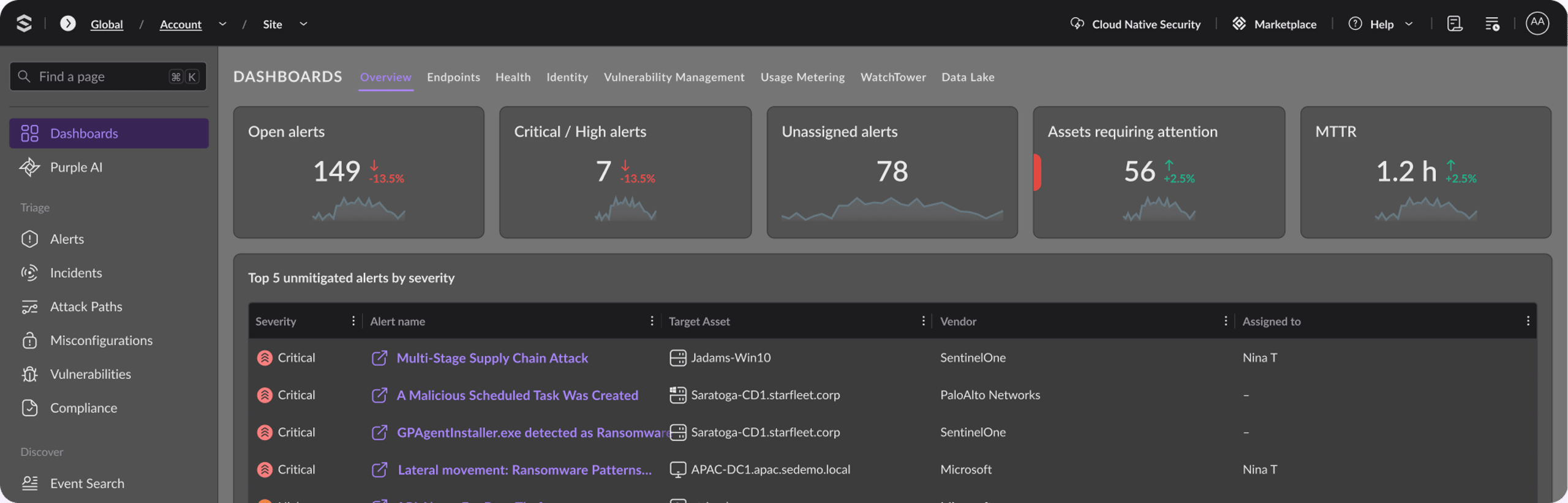
SentinelOne’s Purple AI is a world-class advanced cybersecurity analyst that can interact with your data by using natural language queries. It can speed up investigations, summarize alerts, suggest next steps, and perform complex threat hunting tasks. SentinelOne's Singularity™ Cloud Security features built-in no-code hyper-automation and Security Orchestration Automation and Response (SOAR) capabilities. Your security team can create customized workflows, playbooks, and streamline incident response. It also provides AI-Security Posture Management, Container and Kubernetes Security Posture Management, Cloud Workload Protection Platform (CWPP), Cloud Detection Response (CDR), Vulnerability Management, and other security features.
SentinelOne also offers external threat intelligence feeds, including frontline insights from Bandiant. It also provides a single centralized console from where you can get a real-time view of your entire security posture. For endpoints, clouds, and identities, you get intuitive dashboards and reports to help human analysts make informed decisions. SentinelOne also offers forensics and investigative tools to query historical data and track every stage of attacks. Prompt Security by SentinelOne can analyze agentic AI actions and provide model-agnostic security coverage for major LLM providers like OpenAI, Anthropic, and Google. It can detect and defend against denial of wallet/service attacks, prompt injection, model biases, and prevent malicious prompts from hijacking your AI tools and services. You can use Prompt Security to ensure AI compliance, detect, and prevent LLMs from generating harmful responses to users. It also identifies and eliminates shadow AI usage.
Singularity™ AI SIEM
Target threats in real time and streamline day-to-day operations with the world’s most advanced AI SIEM from SentinelOne.
Conclusion
Security analytics uses a blend of advanced tools and technologies to detect patterns and anomalies which could indicate signs of potential cyber attacks and threats. Its main goal is to prevent the next attack and address hidden vulnerabilities that have been left ignored or missed for a long time. Your organization can close critical security gaps and stay multiple steps ahead of adversaries. To know how to incorporate security analytics solutions as a part of your cloud and cyber security strategy, contact SentinelOne today.
FAQs
Security analytics capabilities are tools and processes that collect, process, and analyze security data across your network and systems. They help you identify threats, unusual activity, and potential breaches in real time. You can detect malicious behavior before it causes damage, investigate incidents when they happen, and understand what attackers are doing on your network.
These capabilities monitor logs, network traffic, and endpoint activity to give you visibility into your security posture.
Cyber security analytics is the practice of examining security data to find threats and vulnerabilities in your organization. It combines data collection from multiple sources—firewalls, endpoints, servers, and network traffic—and uses analytics to spot patterns that indicate compromise or attack.
You're essentially looking for indicators of compromise, unusual network behavior, and signs of unauthorized access. When done properly, it tells you what's happening on your network and helps you respond faster to incidents.
The primary goal of security analytics is to detect threats and respond to them before attackers cause real damage to your systems and data. You want visibility into what's happening across your entire network so you can identify compromises early. Security analytics helps you understand attack patterns, find vulnerabilities, and take action quickly. It transforms raw security data into actionable intelligence that your team can use to protect your organization.
Security teams, incident responders, and security operations center (SOC) analysts use security analytics every day. If you have security professionals on staff, they rely on these tools and processes to monitor your environment. Organizations of all sizes use security analytics—from large enterprises with dedicated teams to smaller businesses that outsource security monitoring. Basically, anyone responsible for protecting your network and data needs to use security analytics.
Security analytics examines multiple data sources to build a complete picture of your security environment. You'll analyze network traffic logs, endpoint activity, firewall logs, authentication attempts, and system events. Email and web gateway logs show you what users are accessing and communicating about. Database activity logs reveal who's accessing sensitive information. The more data sources you pull in, the better your visibility into threats and compromises.
Big data security analytics handles the massive volume of security data that modern organizations generate daily. When you have thousands of events, millions of log entries, and continuous data streams, big data analytics tools help you process and understand it all.
You're looking for meaningful patterns and threats in enormous datasets that traditional tools can't handle effectively. These platforms use machine learning and advanced processing to find what matters in all that noise.
Yes, small businesses absolutely benefit from security analytics. You don't need an enterprise budget to protect your network and data. There are solutions scaled for smaller organizations that will monitor your systems, detect threats, and help you respond to incidents. If you're a small business, you can use security analytics to catch breaches early before they become expensive problems. Attackers target small businesses just like they target large ones, so you need visibility into what's happening.
You should monitor metrics like the number of failed login attempts, which can indicate brute force attacks or credential stuffing. Track unusual network traffic patterns and data transfers that don't match normal behavior. Monitor the time it takes to detect and respond to incidents—faster response times mean less damage. Watch for alerts on file modifications, privilege escalations, and unauthorized access attempts. Also track how many security incidents your team detects and resolves compared to what attackers might have missed.
Discover More About Data and AI




Ready to Revolutionize Your Security Operations?
Discover how SentinelOne AI SIEM can transform your SOC into an autonomous powerhouse. Contact us today for a personalized demo and see the future of security in action.