AI-Powered Cybersecurity vs. Traditional Security Tools
Learn the key differences between AI-powered cybersecurity vs traditional security tools. See how they work, where they fall short, explore their use cases, and learn how they compare with each other.

Modern cyberattacks operate at machine speed, but the security tools most organizations have relied on for decades were not built for that reality.
Ransomware deploys in minutes, lateral movements happen under the radar across networks, and threat actors now use automation to scale attacks faster than human analysts can respond. These tools were built for a different era, when threats were slower and easier to categorize into known patterns.
The rise of AI in cybersecurity has changed what’s possible for security teams, but understanding the real-world differences in AI-powered cybersecurity vs traditional security tools requires looking closely at how each one works under the hood.
Traditional tools operate on rules and known signatures while AI-powered tools learn, adapt, and respond at a speed and scale that manual processes cannot match.
This article covers how traditional security tools function, where they fall short against modern attack patterns, how AI-powered security addresses those gaps, and what the shift means in practice for security operations teams managing threats across increasingly complex environments.
.jpg?width=2560&quality=90&format=auto)
How Traditional Security Tools Work?
Traditional security tools were designed around a straightforward premise where you define what a threat looks like, and then the system flags anything that matches the definition.
The major categories of traditional security tools include:
- Firewalls: Control incoming and outgoing network traffic based on predefined rules that determine what is allowed in and out of a network environment.
- Signature-based antivirus: Scans files and processes for patterns that match known malware signatures stored in a regularly updated threat database.
- IDS/IPS: Monitors network traffic in real time for suspicious activity that fits recognized attack signatures, with IPS going a step further to actively block detected threats.
- Legacy SIEM: Aggregates log data from across the environment, correlates events, and triggers alerts when activity matches a set of predefined rules or thresholds.
They all operate on rule-based or signature-matching logic, detecting threats by comparing observed activity against a database of known threat patterns.
These tools still deliver real value in specific areas. They provide predictable, consistent protection against known threats and are well understood by security teams with years of experience using them. They also align closely with compliance frameworks, making it easier for organizations to meet audit and regulatory requirements.
For environments with lower complexity or well-defined threat surfaces, the initial setup and operational overhead are relatively manageable compared to more advanced platforms.
Where Traditional Security Tools Fall Short
Traditional security tools perform well within their designed parameters, but modern attack environments have moved well beyond those parameters. That shift creates gaps in your security posture that cyberattackers are more than willing to exploit.
Here are the biggest traditional security tools limitations:
- Unknown threats: Signature-based detection is blind to zero-day exploits and novel malware. If a threat has not been catalogued, there is no signature to match against and no alert to trigger. Attackers who develop new techniques or modify existing malware can move through environments that rely solely on signature-based tools without ever being detected.
- Alert fatigue: Rule-based systems generate high volumes of alerts, and a significant portion of them are false positives. Security teams end up spending considerable time investigating activity that turns out to be benign, which pulls attention away from genuine threats and slows down response across the board.
- Speed gap: Manual investigation and response workflows cannot keep pace with modern attacks. Ransomware can encrypt critical systems within minutes of initial execution, and lateral movement can spread across a network before an analyst has finished triaging the first alert. The time between detection and response is where the most damage happens.
- Siloed visibility: Most traditional tools operate independently of each other, which creates blind spots across cloud, endpoint, identity, and network environments. Without a unified view, security teams are working with incomplete data, and threats that move across multiple environments can go undetected for longer than they should.
How AI-Powered Cybersecurity Works?
Unlike traditional tools, which match activity against known threat signatures, AI-powered security works differently. It combines machine learning, behavioral analytics, and automation to detect suspicious patterns in real time and trigger automated responses before threats and damage spread.
Rather than comparing unusual activities against a database of known threats, AI-powered tools learn what normal looks like across an environment and flag deviations from that baseline, shifting your security operations from reactive detection to proactive defense.
The core capabilities that make this possible include:
- Behavioral analysis and anomaly detection: Instead of relying on signatures, AI models establish baselines of normal activity and surface deviations that indicate potential threats. This catches what signature-based tools miss entirely, including novel malware, insider threats, and fileless attacks.
- Continuous learning: AI models improve over time as they process more data from the environment. Unlike rule-based systems that require manual updates to stay current, AI-powered tools adapt automatically as attack patterns and normal behavior evolve.
- Automated triage and response: When a threat is detected, AI-powered platforms can automatically prioritize, investigate, and initiate a response without waiting for analyst intervention. This reduces mean time to respond (MTTR) significantly, which matters most when attacks move at machine speed.
- Cross-source data correlation: AI-powered security ingests and correlates data across endpoints, cloud environments, identity systems, and networks in a unified view. This eliminates the siloed visibility problem that leaves gaps in traditional security architectures and gives security teams the full context needed to understand the scope and origin of a threat.
AI-Powered Cybersecurity vs. Traditional Security Tools: Key Differences
The table below provides insights into AI vs traditional cybersecurity, and where the limitations of legacy approaches become most apparent:
| Criteria | Traditional Security Tools | AI-powered Security Tools |
| Threat detection method | Signature and rule-based matching against known threat databases | Behavioral machine learning that identifies deviations from established baselines |
| Unknown threat / zero-day detection | Limited to threats with a matching signature in the database | Effective against previously unseen threats based on abnormal behavior, regardless of prior exposure |
| Response speed | Manual investigation and response workflows that can take hours | Automated triage and response that operates at machine speed |
| False positive rate | A high volume of alert noise is generated by rule-based systems | Lower noise levels through contextual analysis that surfaces genuine threats |
| Adaptability / learning over time | Static systems that require manual rule and signature updates to stay current | Continuous improvement as models process new data from the environment |
| Cross-environment visibility | Siloed tools with limited visibility across network, endpoint, and cloud | Unified correlation across endpoints, cloud, identity, and network in a single view |
| Analyst workload impact | Large alert volumes that demand significant manual triage and investigation | Reduced burden through automated prioritization, freeing analysts for confirmed threats |
How SentinelOne Approaches AI-Powered Security?
SentinelOne is an AI cybersecurity company that provides AI as a native capability rather than a layer added on top of existing architecture.
The Singularity Platform is designed to autonomously detect and respond to threats across the entire enterprise, addressing the speed and visibility gaps that typically emerge when working with traditional security tools.
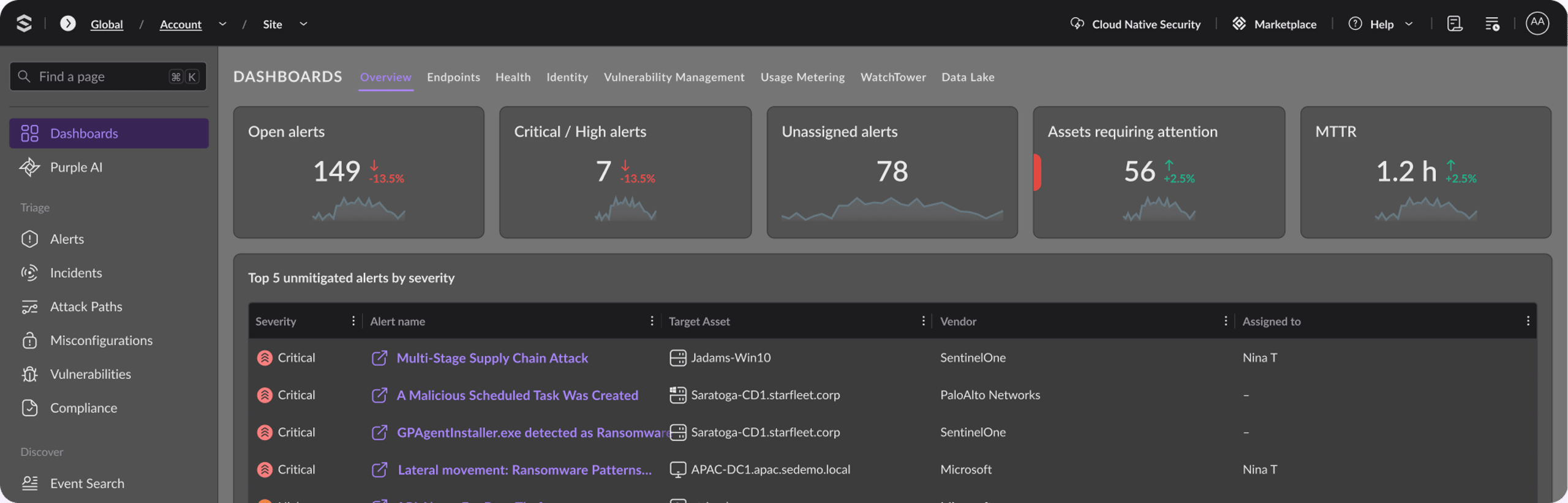
Purple AI acts as an intelligent analyst embedded directly in the platform. It analyzes native and third-party data across the security stack, translates natural language questions into threat-hunting queries, and automatically gathers and synthesizes evidence during investigations to generate clear, explainable reports.
Security teams that use Purple AI identify threats 63% faster and remediate them 55% faster, all without additional headcount.
Singularity Cloud Native Security takes a proactive approach through its Offensive Security Engine™ with Verified Exploit Paths™. Rather than waiting for threats to trigger alerts, it continuously simulates harmless attacks on cloud infrastructure to identify truly exploitable vulnerabilities and eliminate false positives. Security teams get evidence-based findings they can act on immediately instead of spending time validating theoretical risks.
Singularity XDR correlates data across endpoints, cloud workloads, and identity systems into a single unified view, giving analysts full incident context across the entire environment without switching between siloed tools.
Book a demo to see how SentinelOne's AI-powered platform can strengthen your security operations.
FAQs
Traditional security tools rely on predefined rules and known threat signatures to detect malicious activity, meaning they can only flag what they have already been programmed to recognize.
AI-powered cybersecurity uses machine learning and behavioral analytics to identify threats based on deviations from normal activity, including threats that have never been seen before. The core difference is reactive detection versus continuous, adaptive defense.
Yes, it can. AI-powered security tools analyze behavior rather than matching known signatures, allowing them to detect zero-day attacks even without prior knowledge of the exploit. If a process or user behaves outside established baselines, the system flags it.
Traditional signature-based tools cannot do this because if there is no known pattern, there is no alert.
Not entirely. AI-powered tools address the gap that traditional tools leave open, but both serve distinct roles in a mature security program.
AI-powered tools handle unknown threat detection, automated response, and cross-environment visibility at scale. Traditional tools, on the other hand, provide reliable protection against known threats, support compliance requirements, and maintain network perimeter control.
Most organizations run both, using AI to extend coverage where rule-based systems fall short.
Traditional rule-based systems generate high volumes of alerts, many of them false positives, leaving analysts to manually triage each one. AI reduces alert fatigue by:
- Correlating data across sources to surface meaningful patterns
- Filtering out noise and false positives
- Prioritizing alerts based on genuine risk levels
- Automating triage so analysts spend less time sorting and more time responding
Behavioral AI refers to machine learning models that establish a baseline of normal activity across users, devices, and systems, then flag deviations from that baseline as potential threats.
Rather than looking for known malicious signatures, behavioral AI detects unusual patterns such as a user accessing files outside their normal scope or a process making unexpected network calls. This approach is particularly effective against insider threats, novel malware, and fileless attacks that leave no signature trail.
Discover More About Data and AI




Ready to Revolutionize Your Security Operations?
Discover how SentinelOne AI SIEM can transform your SOC into an autonomous powerhouse. Contact us today for a personalized demo and see the future of security in action.