

Ryuk ransomware is a sophisticated strain of malware that targets organizations for financial gain. This guide explores how Ryuk operates, its distribution methods, and the potential impact on victims.
Learn about effective strategies for prevention and recovery. Understanding Ryuk ransomware is essential for organizations to enhance their cybersecurity defenses against ransomware attacks.
 What is Ryuk Ransomware?
Ryuk is one of the first ransomware families to have the ability to identify and encrypt network drives and resources and delete shadow copies on the victim endpoint.
This makes it incredibly difficult to recover from an attack if no external backups of the data exist.
The Origins of Ryuk Ransomware
The name “Ryuk” likely originates from the name of a character in the popular mystery manga and anime “Death Note” from the early 2000s. In this story, “Ryuk” was a death god, enabling targeted killings.
Ryuk Ransomware was first noticed in August of 2018 when it started targeting large organizations for high ransom amounts.
The responsible party is the Russian crime organization WIZARD SPIDER. Ryuk quickly established itself as a “Big game hunting” malware, which represented a change for the crime organization.
Previously, WIZARD SPIDER had focused on wire fraud attacks using their malware TrickBot. More specifically, Ryuk is believed to be operated by a subgroup of the crime organization known as “GRIM SPIDER.”
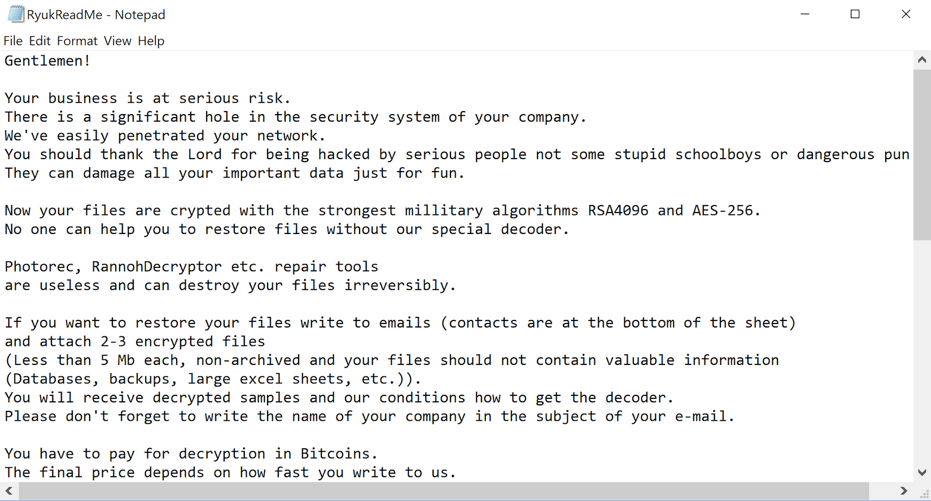
The name of the ransomware is dictated in the ransom note that accompanies attacks. They’re signed off: Ryuk no system is safe.
 Ryuk’s Victims To Date:
Ryuk targets high-profile organizations where they can find critical information that cripples the victim’s operations.
They’ve included targets like newspapers, hospitals, and city organizational functions, leading to hundreds of thousands of ransom payouts.
Because some of the attacks occurred around the US election and targeted such sensitive data, some suspect that there are hidden motives behind the cyber attacks.
High-profile Ryuk Ransomware Attacks:
October 2018: Ryuk targeted large organizations Onslow Water and Sewer Authority (OWASA), and disrupted their network.
December 2018: Tribune Publishing Newspapers became victims, affecting users like the Los Angeles Times.
2019-2020: Ryuk targeted a range of hospitals in California, New York, and Oregon. It also targeted British and German healthcare facilities, causing struggles in accessing patient records and even affecting critical care.
Overall, more than a dozen hospitals suffered ransomware attacks in late 2020. In June 2019, Lake City in Florida paid $460,000 in ransom because an employee opened an infected email.
How Ryuk Ransomware is Distributed
Ryuk ransomware takes a dynamic approach to distribution – incidents often use unique tactics that are tailored specifically for their targets. While other ransomware attacks cast a wide net and target a large number of different people and organizations in hopes that the attack will be successful in one or two, Ryuk ransomware deployments are bespoke to the network attackers are working to compromise.
Ryuk ransomware is distributed with one of the following initial attacks:
- By directly accessing an unprotected RDP port
- Utilizing email phishing to gain remote access
- Deploying email attachments and downloads to access the network
Ryuk ransomware is commonly distributed through Emotet or TrickBot malware. Only essential files are encrypted – making detection more difficult. The downloaded banking Emotet can add additional malware to the machine, with spyware as the primary payload. This allows the attackers to collect admin credentials.
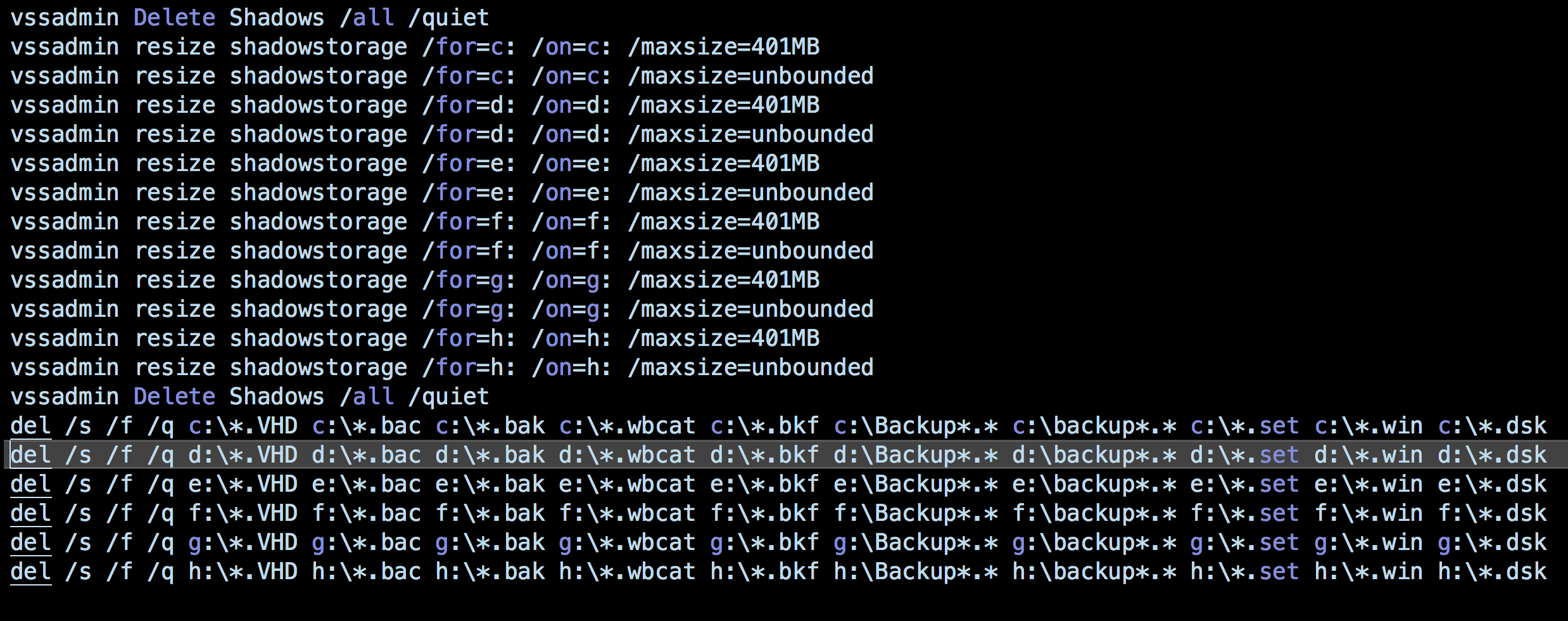
These, in turn, enable them to move across the network to access and move critical assets. Ryuk uses a .BAT file to stop the infected system from restoring. Before Ryuk begins its encryption process, it attempts to delete Windows VSS shadow copies.
By default, Windows makes up to 64 shadow copy backups of volumes and files, enabling users to recover data from snapshots at different points in time in the event of data loss or overwrite. Ryuk, however, begins by deleting the snapshots and resizing the storage space to zero-out any chance of recovery:
Additionally, Ryuk will attempt to disable services and processes, including databases, antivirus tools, backups, and more.
In SentinelOne’s demonstration, for example, Ryuk ensures that built-in backups are unavailable, and also disables several 3rd-party backup services, including Acronis, SQLSafe, VEEAM, and Zoolz.
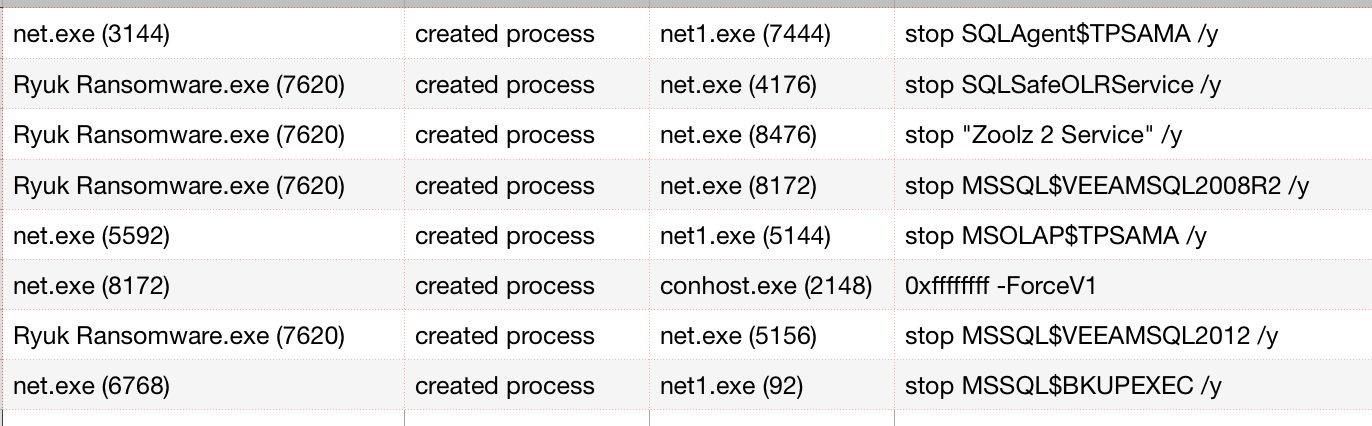
Ryuk also attempts to stop processes belonging to some legacy AV protection software, among them Sophos and Symantec System Recovery processes. Sophos comes in for particular attention, as this view from the SentinelOne Management Console shows:
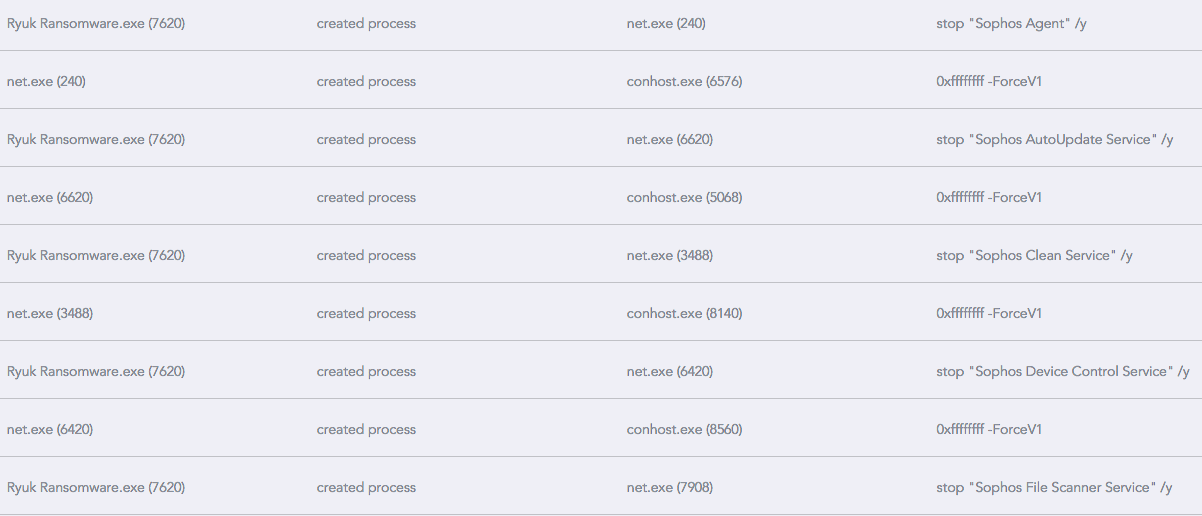
Next, Ryuk creates AES keys for the victim’s files, which are then encrypted again with a second RSA key. This affects each drive and network share on the system, before the malware eventually creates a text file titled “RyukReadMe.txt” in every folder on the system. This contains the ransom note.
Technical Analysis of Ryuk Ransomware Functionality
Ryuk ransomware files will be identified by their .ryk or .rcrypted file extensions. An encrypted file would follow the below pattern filename.xls.ryk.
Ryuk uses a three-tier trust encryption model.
- Tier 1: Global key pair held by attackers – this private key is revealed when the ransom is paid
- Tier 2: Victim specific key pair – this is generated during the ransomware encryption process
- Tier 3: Standard AES key – this be generated by Win32API function CryptGenKey, then subsequently encrypted into the Tier 1 and 2 key pairs
Ryuk attackers utilize encrypted email services to fly below the radar, changing addresses with each attack.
How to Remove Ryuk Ransomware
Because of the complexity of Ryuk, only experienced IT teams should remove it.
Even if you can remove Ryuk from your network, your files will still be encrypted. Only the threat actors hold the key to restoring the assets.
It’s possible to remove Ryuk in safe mode or via system restore, but ideally, the focus should be on preventing an attack before getting hold of critical assets.
Every employee should watch out carefully for phishing emails. Avoid clicking on any suspicious content in your inbox. Most importantly, organizations should establish a suitable cybersecurity protocol, strategy, and training program.
To keep your enterprise safe from attacks, an AI-powered endpoint security platform that detects and prevents threats is pertinent. Modern cybersecurity software can rank and triage threats based on an intimate knowledge of your environment and can perform a thorough investigation to re-engineer malware.
 Enhance Your Threat Intelligence
See how the SentinelOne threat-hunting service WatchTower can surface greater insights and help you outpace attacks.
Learn MoreHow SentinelOne Can Prevent Ryuk
Ryuk Ransomware is still a threat to high-profile organizations. This is especially true if you fit the existing victim profile. As such, hospitals and healthcare facilities should exercise caution to not fall victim to this threat. SentinelOne provides remediation and rollback functionality that can keep your enterprise safe from Ryuk Ransomware as well as other complex threats.
If you’ve experienced a breach in the past, it’s essential to update your cybersecurity. SentinelOne can provide you with post-mortem consultations to identify what went wrong.
Our software services also offer analysis and insight. This comes in handy for better understanding how to best protect your network and detect threats. Contact us today for more info.
Ryuk Ransomware FAQs
Ryuk is a targeted ransomware family that first appeared in August 2018. It’s operated by the Russian cybercriminal group WIZARD SPIDER and focuses on “big game hunting” – attacking large organizations for maximum financial gain. Unlike typical ransomware, Ryuk attacks are human-operated and highly sophisticated. The attackers manually deploy the ransomware after extensive reconnaissance and network infiltration.
Ryuk can encrypt network drives, delete shadow copies, and disable Windows System Restore, making recovery nearly impossible without external backups.
Ryuk operators typically start with phishing emails containing malicious links or attachments. They also exploit exposed Remote Desktop Protocol (RDP) connections through brute-force attacks. Once inside, they deploy TrickBot or Emotet malware to establish persistence and conduct reconnaissance.
After mapping the network and identifying valuable assets, attackers use tools like AdFind and Bloodhound to escalate privileges. Finally, they manually deploy Ryuk across the network using PowerShell, SMB, and other administrative tools.
Organizations can detect Ryuk through multiple indicators. Look for unusual network scanning activities targeting IP ranges 10.0.0.0/8, 172.16.0.0/16, and 192.168.0.0/16. Monitor for suspicious PowerShell execution, mass file operations, and attempts to delete volume shadow copies using vssadmin.exe.
Watch for the presence of files named "RyukReadMe.txt" and processes attempting to disable antivirus software. Advanced detection platforms like SentinelOne can identify these behavioral patterns before encryption begins.
Ryuk typically appends the .RYK extension to encrypted files. Some variants also use .rycrypted extension. All encrypted files contain the "HERMES" tag, a remnant from its parent ransomware. The ransomware creates "RyukReadMe.txt" ransom notes in every folder containing encrypted files.
These notes don’t specify ransom amounts but provide email addresses for victim contact. Ryuk deliberately avoids encrypting certain file types like .exe and .dll to keep systems functional.
Ryuk primarily targets large organizations with high annual revenues. The FBI reported that logistics companies, technology firms, and small municipalities are most frequently attacked. Healthcare organizations have been particularly hard hit, with over 20 hospitals attacked in late 2020.
Other targets include government agencies, educational institutions, manufacturing companies, and media organizations like Tribune Publishing. Ryuk attackers specifically research potential victims’ financial situations to set appropriate ransom demands.
Use multi-factor authentication and disable unnecessary RDP ports. Implement network segmentation to prevent lateral movement and maintain secure offline backups using the 3-2-1 method. You should also deploy extended endpoint detection and response (EDR) solutions like SentinelOne Singularity XDR. Conduct regular employee training on phishing recognition and maintain incident response plans.
Keep all systems patched, especially network-facing services, and monitor for indicators of compromise. Implement application whitelisting and restrict administrative privileges to essential personnel only.
