10 Best AI SOC Platforms for 2026: Top Tools Compared
See how an AI SOC platform reduces alert fatigue, speeds investigations, and helps SOC teams govern agentic response. Request a SentinelOne demo.

Key Takeaways
- An AI SOC platform triages, investigates and responds to alerts on its own, within guardrails analysts set; a security copilot acts only when prompted.
- Shortlist vendors on four tests: agentic AI depth, native telemetry and data lake economics, human-in-the-loop controls, and speed proven in production.
- The top 10 for 2026 are SentinelOne Singularity, Google Security Operations, Dropzone AI, Prophet Security, Radiant Security, Intezer, Stellar Cyber, CrowdStrike Charlotte AI, Microsoft Security Copilot and Palo Alto Cortex XSIAM.
- Avoid three common mistakes: treating chat assistants as agentic AI, adding AI before fixing the data foundation, and skipping oversight design. Validate every vendor with a proof of concept on your own live alerts.
What Is an AI SOC Platform?
On March 11, 2026, attackers turned Stryker Corporation’s own endpoint management systems against the medical technology company, and CISA’s alert on the attack warns that the activity misused legitimate endpoint management software. Activity that runs through trusted admin tools looks like routine work, and every minute it sits unexamined in a queue is a minute that belongs to the attacker. AI-driven security operations exist to close that window.
An AI SOC platform is a security operations center (SOC) platform where AI performs the core work itself under governed guardrails. It triages alerts, runs investigations, and executes or recommends response while your analysts set autonomy policies. A security copilot, by contrast, waits for a prompt before it acts.
ISACA’s 2026 State of Cybersecurity survey found that 58% of organizations believe their cybersecurity team is understaffed, so your team faces machine-speed attacks with human-speed staffing. This guide defines the category, hands you four criteria that separate agentic platforms from AI-labeled features, and evaluates the best AI SOC platforms for 2026.
How AI SOC Platforms Relate to Cybersecurity
You can treat the category as the layer that sits above the tools you already run and, increasingly, absorbs them. Security information and event management (SIEM) tools collect logs and generate alerts, but someone still has to investigate them. Security orchestration, automation, and response (SOAR) platforms take the next step with pre-written playbook scenarios for response, but those playbooks can struggle with novel alert types. Extended detection and response (XDR) goes further and correlates endpoint signals with identity and cloud data, often inside a single vendor environment.
An AI SOC platform picks up where all three stop. It reasons through novel scenarios, investigates end-to-end across those layers, and closes cases. You need that distinction when you compare tools that all claim AI but deliver very different SOC outcomes.
How to Choose an AI SOC Platform
The market rewards vendors for attaching an AI label to every feature, so you need a decision lens that separates marketing language from operational capability. Evaluate every candidate against four criteria before you shortlist:
- AI depth. Treat behavioral AI threat detection as the floor, then test whether the system can carry an investigation to a verdict. Established SIEM vendors have added alert clustering, anomaly scoring, and natural language search. Those features support analysts while agentic automation carries work forward on its own.
- Native telemetry and data lake scale. AI SOC tools work best when the data underneath them is clean, enriched, and consistently structured. Check ingestion pricing, retention, and query speed before you evaluate the AI layer.
- Human-in-the-loop controls. You need approval gates for high-impact actions plus verdicts the AI can explain for compliance audits. Analysts also need a feedback path to correct the AI.
- Measurable speed and consolidation. Ask vendors to prove automated alert triage, investigation speed, remediation speed, and cross-domain workflow automation in production environments.
These four tests separate AI threat detection features from platforms that can move investigation work out of your queue. Apply them to every entry in the list below, starting with how each vendor proves speed and oversight in production.
10 Best AI SOC Platforms for 2026
The ten platforms below run from full-stack consolidation plays to focused agentic investigation specialists. Each entry covers what the platform does, its standout AI capability, and the team it fits best, so you can shortlist against the four criteria above.
#1 SentinelOne Singularity™ Platform
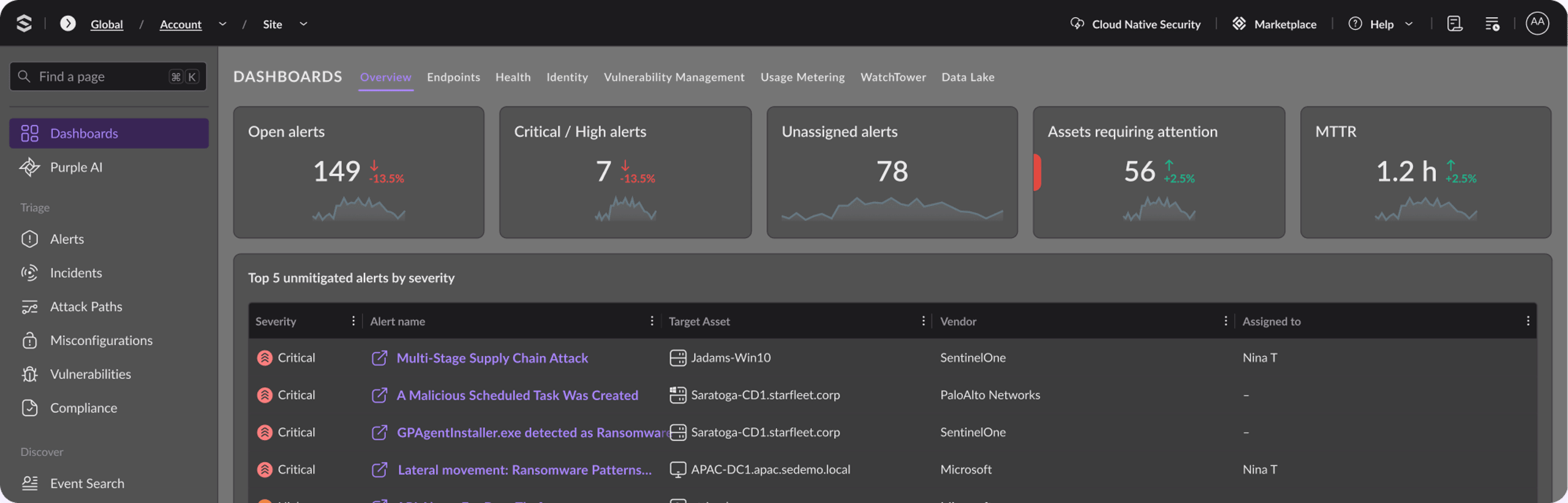
The Singularity Platform is SentinelOne’s AI-native security operations platform. It runs Behavioral AI across endpoint, identity, cloud, and SIEM workloads on a single data foundation with governed agentic response.
- What it does: Purple AI™, SentinelOne’s agentic security analyst, handles automated alert triage and Agentic Investigation. It runs the analysis, presents the evidence, and tells your team what to do next. Singularity AI SIEM adds AI-driven detection and response from one console over an open environment built on the Open Cybersecurity Schema Framework (OCSF).
- Standout capability: Agentic Investigation reasons natively in the Singularity Data Lake across sources. Independent security operations research firm Latio named SentinelOne a SOC Platform Leader in its 2026 Security Operations Market Report.
- Best for: Teams consolidating security operations onto one AI-native platform and regulated or government deployments, where Purple AI’s Federal Risk and Authorization Management Program (FedRAMP) High authorization applies.
If you are consolidating tooling and need agentic capability with governance controls built in, the Singularity Platform covers all four evaluation criteria from a single console.
#2 Google Security Operations
Google Security Operations combines SIEM and SOAR with Gemini-driven AI assistance, and runs on the search and storage infrastructure that Google built for its own global services.
- What it does: Investigation support includes natural language search, AI-generated case summaries, and recommended response steps, backed by threat intelligence from Mandiant and VirusTotal.
- Standout capability: Query speed over very large log volumes at predictable cost, which changes what investigations are practical once telemetry runs to petabytes.
- Best for: Organizations with heavy log estates, existing Google Cloud investment, or teams whose current SIEM makes historical hunting too slow or too expensive to do well.
- Limitations: Teams outside the Google Cloud ecosystem take on a new console and data model.
Google Security Operations earns its shortlist spot on data economics, so benchmark query cost and speed against your current SIEM using your own historical log volumes.
#3 Dropzone AI
Dropzone AI is an AI SOC analyst that investigates alerts from your existing stack without replacing it, so deployment risk stays low for lean security teams.
- What it does: The system picks up each alert, forms an investigation plan, gathers evidence across connected tools, and writes up a verdict with its reasoning documented end to end.
- Standout capability: Investigation transparency, since reports read like a careful analyst’s case notes, which makes verdicts easy to audit and correct.
- Best for: Lean teams buried in Tier 1 triage who want completed investigations, not another console to learn.
- Limitations: It investigates but leaves detection to the tools you already run, so it narrows the alert queue without consolidating your stack.
Dropzone fits when your problem is investigation capacity, not tooling, so run it against a week of live alerts and audit its verdicts to test the transparency claim.
#4 Prophet Security
Prophet Security runs an agentic AI SOC analyst that triages and investigates alerts across your SIEM, endpoint detection and response (EDR), identity, and cloud sources, then hands analysts decision-ready cases.
- What it does: It learns from your environment, where asset context and analyst feedback shape future verdicts, so the system gets more accurate the longer it runs.
- Standout capability: The feedback loop, because it addresses the trust problem that stalls AI SOC rollouts when analysts keep correcting the same mistake.
- Best for: Security teams that want automated Tier 1 coverage with a clear path for supervision and correction as confidence grows.
- Limitations: The learning model needs time and analyst engagement in your environment before verdict accuracy peaks, so early weeks demand active correction ahead of hands-off operation.
Prophet suits teams willing to invest supervision up front in exchange for compounding accuracy, so budget analyst time for the training period when you plan the rollout.
#5 Radiant Security
Radiant Security positions its platform as an AI SOC that triages every alert, escalates what matters, and drafts response actions for analyst approval.
- What it does: It stresses full-queue coverage, working each alert to a conclusion so nothing ages out overnight while your team sleeps.
- Standout capability: Guided remediation, which turns a verdict into a concrete, reviewable response plan your team approves or executes.
- Best for: Organizations that want a measurable reduction in unworked alerts without granting the AI unattended response authority on day one.
- Limitations: Response execution waits on analyst approval until you widen the policy, so time-to-containment gains arrive gradually as your governance matures.
Radiant fits a staged-trust rollout, so measure the reduction in unworked alerts first and expand approval policies as verdict quality proves out against your own analysts’ conclusions.
#6 Intezer
Intezer approaches the AI SOC from deep file and code analysis, and extends its genetic malware analysis roots into automated triage across endpoint alerts, phishing, and user-reported email.
- What it does: Every artifact gets dissected, with binaries, scripts, memory, and documents analyzed and mapped to known threat families before a verdict goes out.
- Standout capability: Forensic depth, since verdicts rest on evidence about what the code actually is.
- Best for: Malware-heavy environments, incident response teams, and SOCs that field a constant stream of suspicious files and phishing reports needing expert-level analysis at machine pace.
- Limitations: The platform’s center of gravity is artifact analysis, so alerts that carry no file, script, or email artifact gain less from its signature forensic depth.
Intezer earns a place on malware-centric shortlists, so test it against your own mix of suspicious files, phishing reports, and identity or cloud alerts to see where its forensic depth holds up.
#7 Stellar Cyber
Stellar Cyber pairs its Open XDR platform with Multi-Layer AI that auto-triages phishing, user behavior, and endpoint anomalies while keeping a human in the loop.
- What it does: The open architecture works with any EDR and any data source, so you add AI SOC capability without replacing tools you already own.
- Standout capability: Multi-tenancy for service providers, so one team can supervise automated investigation across client environments.
- Best for: Managed security service providers (MSSPs) and mid-market organizations that need AI-driven security operations across a mixed estate without vendor lock-in.
- Limitations: Pricing and packaging are built for the service-provider model as much as for a single enterprise, so standalone enterprises should model licensing fit carefully.
Stellar Cyber wins where estate diversity and multi-tenant supervision matter more than single-vendor depth, so weigh it first if you operate or buy through an MSSP.
#8 CrowdStrike Falcon (Charlotte AI)
Charlotte AI is CrowdStrike’s agentic AI family, embedded across the Falcon platform to bring triage, investigation, and response automation to teams already operating in the Falcon ecosystem.
- What it does: It triages detections, runs agentic investigation and response, and lets teams assemble custom security agents through a no-code builder.
- Standout capability: Detection triage benchmarked against decisions from CrowdStrike’s own Falcon Complete managed detection and response (MDR) team, which grounds the automation in real analyst judgment.
- Best for: Organizations whose endpoint estate already runs on Falcon and want agentic capability added to a stack the team knows.
- Limitations: Coverage is strongest inside the Falcon ecosystem, and third-party reach depends on what you route into the platform, so map your telemetry before you scope the deployment.
Falcon with Charlotte AI rewards existing CrowdStrike customers the fastest, so weigh how much of your telemetry already lives in the ecosystem before you shortlist it against more open alternatives.
#9 Microsoft Security Copilot
Microsoft Security Copilot is Microsoft’s AI layer for security operations, threaded through Defender XDR, Sentinel, Entra, and Intune with embedded assistance and a growing set of task agents.
- What it does: It pairs embedded AI assistance with agents for tasks such as phishing triage, and natural language querying opens hunting to analysts who never learned Kusto Query Language (KQL).
- Standout capability: Native reach, since the AI reasons over identity, email, endpoint, and cloud telemetry that Microsoft-centric estates already generate.
- Best for: Organizations standardized on Microsoft 365 E5 licensing that want AI capability in the SOC without adding a vendor.
- Limitations: Value concentrates in Microsoft-centric estates and thins out in heterogeneous stacks, so weigh how much of your telemetry lives outside Microsoft before you commit.
Security Copilot makes the strongest case where Microsoft already owns your identity, email, and endpoint layers. Anywhere else, test third-party coverage carefully during the proof of concept.
#10 Palo Alto Networks Cortex XSIAM
Cortex XSIAM is Palo Alto Networks’ consolidation play: SIEM, EDR, SOAR, and attack surface management rebuilt as one automation-first platform aimed at large enterprise SOCs.
- What it does: Machine learning handles correlation and grouping so analysts work incidents, not raw alerts, while agentic playbook automation carries routine response.
- Standout capability: Automation depth built from years of orchestration history across large deployments.
- Best for: Enterprises retiring point tools and consolidating security operations onto a single vendor.
- Limitations: The platform’s strongest AI features expect your telemetry inside its data lake, which puts ingestion pricing and retention terms at the center of the evaluation.
XSIAM pays off in proportion to how much of your stack you are willing to consolidate, so model data gravity and licensing costs before committing to the migration.
Key Benefits of AI SOC Platforms
An AI SOC platform earns its budget line by changing what happens to the alerts your team never gets to. When you deploy one on a sound data foundation, four operational gains follow:
- Faster identification and remediation. Investigation starts the moment an alert fires instead of waiting for an analyst to free up.
- Triage at machine scale. Every alert gets investigated, including the ones your queue currently drops overnight.
- Analyst time redirected to judgment work. Analysts spend more time on threat hunting, oversight, and hard escalations instead of repetitive front-line alert work.
- Consistent investigation quality. The same evidence-gathering rigor applies on weekends and holidays, with audit trails a shift-dependent process cannot match.
These benefits only hold when you can prove them against your own telemetry and the way your team approves and executes response. That proof depends on avoiding the evaluation mistakes covered in the next section.
Common Mistakes When Evaluating AI SOC Platforms
Chat assistants can look like agentic capability. Apply a practical test: when the alert fires at 2 a.m., does the model require your team to do something, or does it handle the investigation within policy? Evaluate specific claims because vendors across the capability spectrum use the same “agentic” language.
Data access and telemetry economics shape outcomes. Buying an agentic investigation layer before fixing your data architecture may leave alert fatigue unchanged and risks creating expensive, confident-sounding wrong answers. Ingestion pricing and retention limits directly constrain investigation quality, because agents can only reason over the telemetry you can afford to keep queryable.
Human-oversight design needs attention before deployment. In a June 2025 Gartner release on guardian agents, analyst Avivah Litan warned that “agentic AI will lead to unwanted outcomes if it is not controlled with the right guardrails.” Decide before deployment which actions require approval and how analysts correct wrong verdicts.
Production outcomes matter more than demos. AI SOC tools can impress in demos, but production value depends on your own telemetry and workflow fit. Run a proof of concept on your own alerts and compare the agent’s verdicts against your analysts’ conclusions.
Improve AI-Driven Security Operations with SentinelOne
The Singularity Platform puts detection, investigation, and response on one AI-native foundation. Purple AI runs Agentic Investigation, which executes cross-source forensic investigation at machine speed. In IDC’s Business Value study of Purple AI, Purple AI customers identified threats 63% faster and remediated 55% faster.
Singularity AI SIEM delivers AI-driven detection and response from a single console and ingests structured and unstructured data from SentinelOne offerings plus third-party tools over OCSF. Underneath it sits the Singularity Data Lake, a cloud-native, petabyte-scale data lake with real-time ingestion from any source using OCSF normalization.
Singularity Hyperautomation is SentinelOne’s response workflow tool, the add-on to Singularity AI SIEM that serves as the autonomous response layer of SIEM. It works in tight integration with AI SIEM and Purple AI. When Purple AI reaches an investigation verdict, Hyperautomation executes the response automatically within pre-approved policies. It ships a broad connector library, workflow templates, a no-code builder, and human-in-the-loop approval gates for high-impact actions.
The result is a governed path from alert to answer. Your team identifies threats faster, remediates sooner, and spends less time on repetitive investigations. Request a demo with SentinelOne and see for yourself today.

Singularity™ AI SIEM
Target threats in real time and streamline day-to-day operations with the world’s most advanced AI SIEM from SentinelOne.
Conclusion
An AI SOC platform performs triage, investigation, and response itself under human governance, while a copilot assists only when asked. Judge vendors on agentic depth, data foundation, human-in-the-loop controls, and production-measured speed, and test them on your own alerts instead of in demos.
SentinelOne’s Singularity Platform, with Purple AI’s Agentic Investigation, Singularity AI SIEM, and Hyperautomation, delivers that model with IDC-documented speed gains. Your analysts get their time back for the judgment calls only they can make.
AI SOC Platforms FAQs
An AI SOC platform pairs agentic AI that performs SOC work with a governance layer that controls how much of that work runs without a human. Autonomy is graduated: platforms typically start with read-only investigation, advance to recommended response, then earn automated execution within pre-approved policies for specific alert classes.
Every verdict and action is logged for audit, and analyst corrections feed back into future investigations. You set the policy, and the platform earns wider scope as its verdicts prove out.
The direction of work separates an AI SOC platform from a security copilot. A security copilot waits for an analyst’s prompt, while an agent initiates and completes work on its own within defined guardrails.
A copilot answers questions about an alert. An agentic platform has already investigated it, gathered evidence, and reached a verdict before an analyst opens the case, so the analyst starts from a completed investigation package instead of a raw alert.
An AI SOC platform can absorb both SIEM and SOAR roles over time. Platforms with native SIEM capability handle log ingestion, identification, and investigation in one system, and agentic reasoning covers the novel alert types where static SOAR playbooks can struggle.
Teams often start by layering the AI platform over existing SIEM investments, then consolidate as telemetry economics and retention terms favor the unified data lake.
An AI SOC platform should show return on investment (ROI) evidence during the proof of concept itself, within the first weeks of running on your live alerts, not after quarters of tuning. Before the evaluation, baseline your current triage time, mean time to respond (MTTR), overnight backlog, and analyst touches per case.
Then track mean time to triage, false positive reduction, alert closure rate without human touch, escalation quality, and investigation depth against that baseline. If the platform cannot demonstrate measurable gains during a short evaluation, it will struggle to scale in production.
A proof of concept for an AI SOC platform should run on your own live alerts and compare the platform’s verdicts against your analysts’ conclusions on the same cases. Include novel and unexpected activity, since benchmarks only catch what you already know to test for.
Measure investigation time, verdict accuracy, escalation quality, and automated alert triage quality, then confirm the platform integrates with your existing stack.
Discover More About Data and AI



Ready to Revolutionize Your Security Operations?
Discover how SentinelOne AI SIEM can transform your SOC into an autonomous powerhouse. Contact us today for a personalized demo and see the future of security in action.