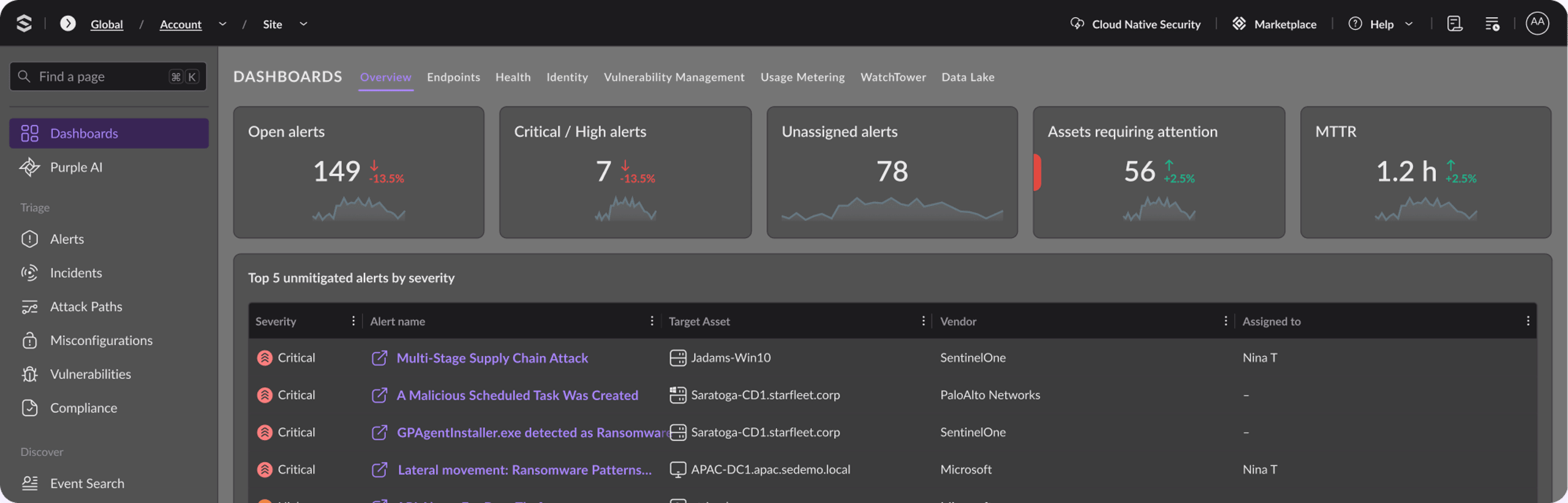
AI SOC Analyst: Capabilities, Use Cases & Limits
An AI SOC analyst helps your team triage alerts and correlate evidence for investigation summaries. Learn how SentinelOne pairs Purple AI with governed response.

Key Takeaways
- Faster triage and investigation: An AI SOC analyst automates alert triage, enrichment, and cross-telemetry correlation. It cuts noise and shortens the time it takes to investigate each alert.
- Clear use cases: It works best for alert prioritization, investigation summaries, threat hunting, and guided response. This frees human analysts to focus on complex threats.
- Limits matter: It can produce inaccurate or incomplete findings, depends on data quality and context, and needs human oversight for high-impact decisions. It augments analysts rather than replacing them.
- Adopt it deliberately: Teams should validate outputs, set clear guardrails and escalation paths, and integrate it with their existing SecOps workflows. The aim is to avoid common deployment mistakes.
What Is an AI SOC Analyst?
An AI SOC analyst, sometimes called an AI security analyst or virtual security analyst, is software that replicates the investigative workflows of human security operations center (SOC) analysts using machine learning and large language models (LLMs). It builds context by correlating evidence across systems and makes the judgment calls an experienced analyst would. Government guidance defines AI agents as software that processes data, makes decisions, and initiates actions independently. An AI SOC analyst does that work within defined guardrails.
The category is moving from experiment toward structured deployment: security operations research now defines five staged SOC autonomy levels, from level 0 (fully manual work) through supervised automation to level 4 (full independence). This guide covers the capabilities to expect, how the technology works, where it fails, and how to deploy it with analyst trust and oversight intact.
How the AI SOC Analyst Relates to Cybersecurity
You place the AI SOC analyst inside your security operations center at the investigation layer, above your telemetry sources and below your human decision-makers. Security orchestration, automation, and response (SOAR) automates response execution with deterministic playbooks. An AI SOC analyst automates investigation, and reasons through alerts it has never seen.
You can assign the AI Tier-1 and much of Tier-2 investigation work, while human analysts keep Tier-3 judgment. Empirical SOC research found analysts adopting LLMs for sensemaking while preserving decision authority. When you connect multiple AI agents into a coordinated operating model, that broader pattern is the agentic SOC.
Core Capabilities of an AI SOC Analyst
You should expect a mature AI SOC analyst to perform six kinds of work. As a virtual security analyst, it earns trust only when each capability produces evidence you can inspect.
Triage and Investigation
AI alert triage investigates every incoming alert so false positives close sooner and higher-risk cases receive a verdict with recommended next steps. Cross-source correlation connects events across endpoint security, network, cloud, identity, and email telemetry, and natural-language investigation translates plain-language questions into structured queries. Analysts stop hand-writing query syntax.
Context and Improvement
The same system compiles evidence, reasoning, and verdicts into decision-ready investigation summaries with a transparent audit log, ties observed behaviors to MITRE ATT&CK techniques, and highlights uncovered techniques. It also learns from analyst feedback: if your team repeatedly marks internal vulnerability-scan alerts benign, the model learns to suppress that pattern.
How an AI SOC Analyst Works
You should look for a ReAct-style agent architecture that combines chain-of-thought reasoning with tool calls selected during the investigation. Research presented at the NDSS Workshop on Security Operations Centers (2026) documents the pattern: the agent plans investigative steps, retrieves logs, performs enrichment through security information and event management (SIEM) queries and open-source intelligence (OSINT) lookups, then documents findings in structured reports for human review.
Well-designed systems follow an evidence-first principle: the platform first establishes facts through event correlation and severity scoring mapped to MITRE ATT&CK. Only then does the language model explain them.
The agent stages its recommended response for approval: your analyst reviews the verdict with the evidence attached, then approves or overrides it, and every decision remains auditable.
AI SOC Analyst Use Cases
An AI SOC analyst proves itself on routine work first: investigation tasks with clear evidence paths and high volume, and the alert queue tops that list.
Alert Triage and False-Positive Reduction
Phishing triage shows why false positives remain a recurring obstacle: nearly all reported emails are harmless, yet each manual investigation drags on. AI alert triage runs those checks in parallel workstreams: agents evaluate the email body for scam language while others analyze attachments and URLs. Verdicts arrive in minutes, and low-risk cases close without touching your queue.
Investigation Summaries
When the AI confirms a genuine threat, it compiles a decision-ready report covering what fired, the gathered evidence, correlated events, matching ATT&CK techniques, and its recommended response. Your analyst starts from a synthesized narrative instead of raw queries across multiple consoles.
Threat Hunting Assistance
AI-assisted threat hunting works from the MITRE ATT&CK knowledge base as a common language. The AI generates hunt hypotheses from technique mappings, converts them into hunt logic ready to run in your SIEM and endpoint detection and response (EDR) tools, and flags coverage blind spots. After the agent identifies a potential technique match, a validation workflow searches for related events or runs a sandboxed simulation, then hands your hunter a validated finding with full context. The human still owns the conclusions. AI-assisted threat hunting removes the query grunt work.
Reporting and Documentation
The AI drafts incident summaries and stakeholder or metric reports as a byproduct of investigation, so documentation no longer waits for the end of a shift. It can also draft automation scaffolding by turning a plain-language runbook description into structured orchestration logic. Humans decide when automation should run based on risk tolerance and action sensitivity.
Key Benefits of an AI SOC Analyst
Machine-speed investigation pays off in two ways once it reaches every alert in the queue, and both depend on the same thing: evidence your analysts can actually inspect.
Two gains show up first in overwhelmed SOCs. Every alert gets investigated, including the 2 a.m. alert that would otherwise age out untouched in a crowded queue, and each one receives a full evidence-based verdict. Investigations also compress because enrichment and correlation queries, including pivots, run in parallel.
The same SOC analyst augmentation model reduces false-positive burden and frees analyst hours for hunting and complex incident work. Documentation happens by default, and junior analysts learn faster because every verdict arrives with visible reasoning they can study.
Alert volume makes those gains urgent. A March 2026 SANS webcast citing SANS 2025 SOC Survey data describes enterprises facing “upwards of 3,000 security alerts daily,” with SOC teams unable to keep pace while alerts go uninvestigated. An AI SOC analyst absorbs that volume by investigating every alert at machine speed.
Limitations of AI SOC Analysts
These gains hold only when you plan for the failure modes that come with language models: hallucinated context, automation bias, and an expanded attack surface.
Model and Behavior Risks
Three risks originate in the model itself, and each one erodes analyst trust when it goes unmanaged, so weigh them before widening the system’s scope:
- Hallucinations: NIST AI 600-1 names confabulation, confidently stated but false content, among its core generative AI risks. Fabricated threat context can push analysts toward wrong determinations, so human review of AI-produced summaries is non-negotiable.
- Automation bias: NIST AI 600-1 names Human-AI Configuration as a risk category covering over-reliance on AI outputs. In a SOC, this means analysts accept verdicts without review, or ignore suspicious activity because the system stayed quiet.
- Missing business context: Feed agentic systems incomplete asset inventories or chaotic alert taxonomies and they deliver wrong decisions confidently.
You reduce all three risks the same way: force evidence review before consequential response decisions, and treat unreviewed AI output as a draft, never a verdict.
Security and Operational Risks
AI SOC systems introduce new attack surface: direct and indirect prompt injection, plus training-time data poisoning. These limits explain why SOC autonomy has to be earned in stages. The maturity model runs from Level 0 to Level 4, and each level adds governance before it adds independence. Teams that skip levels repeat the same deployment mistakes.
Common Mistakes When Deploying an AI SOC Analyst
The 2025 SANS SOC Survey found 40% of SOCs use AI/ML tools without making them a defined part of operations: AI is present, but nobody has decided where it belongs or how its output gets validated.
Operating Model Mistakes
Operating-model failures turn AI into another noisy SOC tool instead of an investigation layer your analysts can trust. Deploying on inconsistent telemetry or an unmapped asset inventory compounds the problem: the model inherits your data quality and executes it at machine speed, so normalize data first.
Validation Mistakes
A deployment also fails when it lacks a feedback loop: if analysts constantly reclassify severity or restore missing context, the system is not learning from your environment. Treating AI as a replacement removes the human-in-the-loop review that catches threats the model has never seen. Skipping adversarial testing leaves another blind spot: NIST AI 600-1 prescribes regular adversarial testing of generative AI systems, so red-team your AI SOC deployment like any other production system.
Use a controlled operating model that defines where AI acts, where humans approve, and how the system improves from analyst feedback.
AI SOC Analyst Best Practices
Effective programs treat this as SOC analyst augmentation with an explicit division of labor. The AI takes the volume work. Your team keeps the judgment:
The AI SOC analyst handles | Human analysts handle |
Full Tier-1 triage with enrichment and correlation | Response decisions and any action touching production or people |
Query execution and evidence gathering across telemetry | Validating hunt conclusions and complex investigations requiring judgment |
Drafting summaries, communications, and reports | Auditing AI decisions for accuracy and compliance |
Suppressing recurring false positives | Feedback that tunes triage precision over time |
Beyond the division of labor, start with high-confidence, well-understood workflows, then expand from measured baselines. Keep an override mechanism to halt any automated workflow when uncertainty arises, and apply established AI risk governance such as the NIST AI Risk Management Framework (AI RMF). Manage AI agents like junior analysts: mentor and refine them, then verify their accuracy improves.
Improve SOC Investigations with SentinelOne
SentinelOne builds the investigation layer around evidence your analysts can inspect. Purple AI™ is SentinelOne’s AI security analyst, built on the Singularity™ Platform. It translates natural-language questions into PowerQueries within seconds, reasons over data normalized to the Open Cybersecurity Schema Framework (OCSF) from native and third-party sources, and gives your team one-click hunting quickstarts and shareable investigation notebooks. Behavioral AI contributes endpoint-level analysis, so investigations rest on stronger evidence before the language model explains it. Auto-Triage prioritizes alert investigations for your analysts inside the same Purple AI workflow.
Purple AI Agentic Investigation extends this to full investigations. It autonomously gathers cross-stack evidence, correlates endpoint, cloud, and third-party telemetry, builds the attack timeline, and delivers an explainable verdict of True Positive, False Positive, or Inconclusive. Your analysts keep full visibility and control throughout. In IDC’s study of measured customer outcomes, Purple AI delivered 63% faster threat identification and 55% faster resolution.
Singularity Hyperautomation is SentinelOne’s response workflow engine. It executes governed actions across endpoints, identities, cloud workloads, and integrated tools. Together with Singularity AI SIEM, it connects investigation context to pre-approved response policies so your team moves from verdict to action without losing auditability.
This investigation-plus-response architecture has earned outside recognition: Latio named SentinelOne a SOC Platform Leader in its 2026 Security Operations Market Report.
If you manage a SOC drowning in uninvestigated alerts, request a SentinelOne demo to see Purple AI triage and investigate against your own telemetry. Pair agentic investigation with governed response, and your analysts can trust the verdict before action.
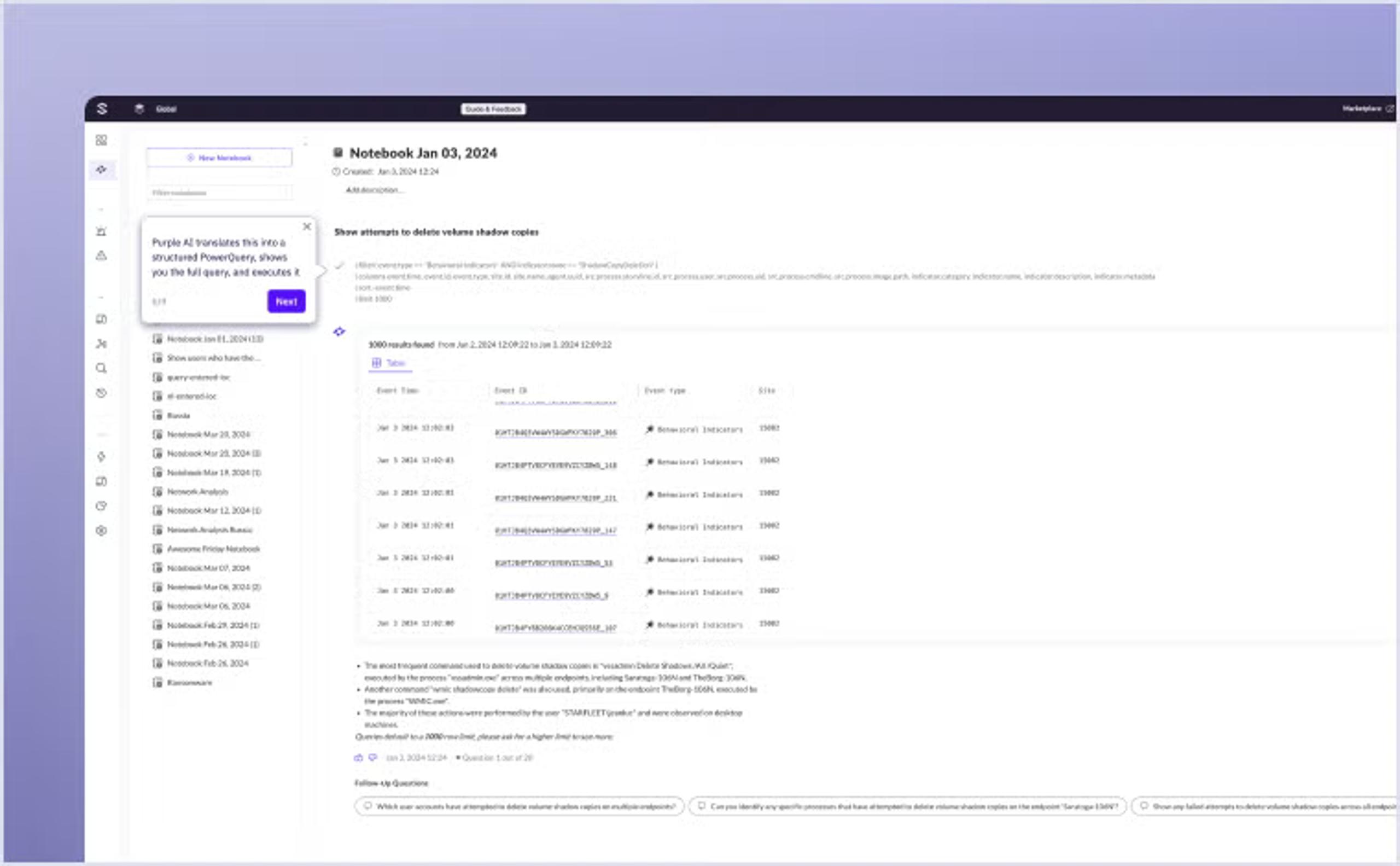
Your AI security analyst. Detect earlier, respond faster, and stay ahead of attacks.
Conclusion
An AI SOC analyst automates investigation and response support. It triages every alert with evidence-backed verdicts while your analysts keep judgment over consequential actions. Success depends on clean data, defined workflows, feedback loops, and adversarial testing. SentinelOne’s Purple AI delivers the verdict from agentic investigation, and Singularity Hyperautomation executes the governed response when deployed alongside it.
AI SOC analysts should accelerate your investigations and keep human accountability visible before any response. Your analysts gain machine-speed investigation, and the final call stays with them.
AI SOC Analyst FAQs
An AI SOC analyst is software that replicates the investigative workflows of human security analysts using machine learning and language-model techniques such as natural language processing and large language models. It triages alerts and correlates evidence into verdicts with recommended next steps.
It initiates and completes investigation work on its own within defined guardrails. Your analysts still review evidence and keep authority over high-impact response decisions.
An AI SOC analyst and SOAR divide the pipeline between investigation and response. SOAR runs predefined response playbooks that an engineer writes and maintains, so it excels at executing known action paths quickly.
An AI SOC analyst sits upstream and handles the open-ended investigation work that playbooks cannot script in advance. A common pattern chains them: the AI investigates and delivers a verdict, your analyst approves the response, and SOAR or a workflow engine carries it out.
No, an AI SOC analyst cannot replace human analysts, and treating it as a replacement is one of the fastest ways a deployment fails. The AI absorbs volume work: triage, enrichment, and first-pass investigation.
Humans keep high-stakes decisions, actions that touch production or people, hunt validation, and complex investigations requiring business context. Removing human review invites automation bias and leaves nobody to catch threats outside the model’s expectations.
An AI SOC analyst needs normalized, consistent telemetry across your security stack: SIEM, EDR, identity, cloud security, SaaS, email, and network sources, plus a complete asset inventory and a coherent alert taxonomy.
If telemetry is inconsistent or context is incomplete, the AI produces unreliable verdicts confidently and quickly. You should also map business-critical assets so escalation logic reflects operational risk. Invest in data normalization and hygiene before deployment.
You measure an AI SOC analyst by tracking analyst rework rate, escalation accuracy, investigation time, and auditability during pilot and production rollout. Rework rate captures how often your team edits entities, restores context, or reclassifies severity on AI verdicts.
Escalation accuracy shows whether escalated alerts turn out to be genuine threats, and investigation time compares end-to-end alert handling before and after deployment. Auditability confirms every automated action can be traced. Rising rework or falling escalation accuracy means the system is not learning from your environment.
Discover More About Data and AI



Ready to Revolutionize Your Security Operations?
Discover how SentinelOne AI SIEM can transform your SOC into an autonomous powerhouse. Contact us today for a personalized demo and see the future of security in action.