The 12 Best SOC Tools in 2026
SOC tools help you stop attacks across endpoint, cloud, identity, and network telemetry. This SentinelOne guide shows categories, criteria, mistakes, and workflows.

Key Takeaways
SOC tools are the platforms and technologies — SIEM, XDR, SOAR, and threat intelligence solutions — that security teams rely on to detect, investigate, and respond to threats. Choosing the right stack determines how fast a SOC can move and how well it scales.
- No single tool covers the full SOC workflow — most teams combine SIEM (log aggregation), XDR (detection and response across endpoint, identity, and cloud), and SOAR (automation and orchestration) rather than relying on one platform for everything.
- AI-powered detection is now the baseline, not a differentiator — leading SOC tools use machine learning and behavioral analytics to surface real threats from noise, cutting the manual triage that burns out analysts.
- Automated response separates modern tools from legacy ones — the best SOC tools don't just alert; they can isolate hosts, kill processes, or revoke access automatically, shrinking the gap between detection and containment.
- Fit matters more than feature count — the right choice depends on existing infrastructure, team size, and cloud footprint, so weigh integration depth and total cost of ownership, not just checkbox features.
What is a SOC Tool?
In June 2026, CISA’s FortiBleed advisory reported attackers using compromised credentials to sign in to internet-facing Fortinet devices, no software exploit required, with roughly 74,000 firewalls and VPN gateways exposed.
CISA told defenders to correlate firewall, VPN, authentication, and domain controller logs, because the lateral movement that follows a stolen login only becomes visible when those signals connect.
That is the work your SOC tools do. SOC tools, also called security operations center tools, are the software your security operations center uses to find, investigate, and stop threats across endpoints, networks, identities, and cloud environments. Run them as separate products and you get tool sprawl, alert fatigue, and a slow mean time to respond; correlate them and you see one attack storyline instead of disconnected alerts.
Why SOC tools matter for Cybersecurity
The right SOC tools decide whether you catch a real intrusion or bury it under noise. In high-volume environments, you can receive more alerts in a day than your analysts can work through in a shift, and each one left untouched is a decision to let something pass unexamined. Threat detection tools that consolidate telemetry and find behavioral anomalies are what keep that backlog from hiding a live attack.
Types of SOC Tools
SOC tooling splits into a handful of categories, and each one watches a different stage of an intrusion: the endpoint where code runs, the identity that signs in, the network where traffic moves, and the logs that tie them together.
Run them as isolated products and an attacker who crosses from a stolen login to an endpoint to lateral movement shows up as three unrelated alerts in three consoles. The value is in correlation, where one tool’s signal sharpens another’s, so the categories below are worth understanding both for what each does and for how well it shares context with the rest of your stack.
- EDR and XDR: EDR, a term defined by NIST, continuously monitors endpoint activity and finds fileless attacks, living-off-the-land techniques, and post-exploitation behavior that traditional antivirus misses. XDR tools extend that visibility across cloud, network, identity, and email into one correlated view.
- SOAR and automation: SOC automation tools, including SOAR, integrate separate tools, run repetitive tasks autonomously, and standardize incident response through playbooks. This cuts manual triage time.
- Threat intelligence platforms: These enrich your stack with attacker tactics, techniques, and procedures, which helps you anticipate, identify, and stop advanced threats.
- Network Detection and Response (NDR): NDR uses behavioral analytics to find east-west lateral movement and threats that bypass perimeter controls and endpoints.
- Vulnerability management: These tools prioritize exposures so you fix what attackers will actually exploit first.
- Identity Threat Detection and Response (ITDR): ITDR monitors authentication events, privilege use, and access behavior to find compromised credentials, identity-based threats, and privilege escalation.
On their own, these categories produce coverage on paper and blind spots in practice, because the data that proves an attack often sits in one tool while the alert fires in another. A stack earns its cost when the categories feed each other: identity signals enrich endpoint alerts, network telemetry confirms what an endpoint reports, and a single console shows the combined result. Selection then becomes a question of which tools connect and share context, which is the lens the next section sets out.
How to Choose the Best SOC Tools
The best SOC tools in 2026 are the ones that take work off your analysts instead of adding another console to watch. That standard rules out point products that look strong in a demo and then sit unintegrated, and it rewards tools that consolidate telemetry, run response autonomously, and hold up under a regulator’s questions.
The criteria below are the decision lens to apply before you shortlist anything, ordered by the impact each has on day-to-day SOC work.
- Platform consolidation. Tool sprawl is expensive and counterproductive. Evaluate total cost of ownership across license, integration, and staffing.
- Autonomous response and measurable MTTR impact. The shift in 2026 is toward risk-based response using unified telemetry and governed agentic AI with human-in-the-loop controls. One warning matters here: if your team is overwhelmed by poorly tuned rules, AI will only triage noise at machine speed. Identification engineering must come first.
- AI and behavioral analysis. Demand behavioral anomaly analysis from threat detection tools across user, endpoint, and cloud telemetry. Explainability is becoming a governance requirement: you should be able to test the reasoning behind AI decisions and the results.
- Scalability, retention, and open integration. NIST SP 800-53r5 control SI-7(7) sets a federal expectation for integrated response. Confirm your SIEM, EDR, identity, and cloud alerts correlate in one view, that pricing aligns with telemetry growth, and ask how many tools a platform natively connects to.
- Governance and regulatory exposure. SEC exam priorities for fiscal year 2026 cover governance, incident response, and controls for risks tied to AI and polymorphic malware. Your tool selection now carries defensible accountability.
These criteria are a buying lens you apply to your own environment: where your analysts lose the hours, which telemetry you cannot correlate today, and which controls a regulator could ask you to defend.
The tools below line up against those decision points. Start with the platform layer that consolidates endpoint, cloud, and identity, then add the specialized tools that bring telemetry the platform does not already cover.
12 Best SOC Tools in 2026
Your best SOC toolset depends on where your analysts lose time: endpoint triage, SIEM correlation, cloud telemetry, identity investigation, or response orchestration. Start with the platform layer, then keep only the specialized tools that add unique telemetry or workflow value.
#1 SentinelOne Singularity Platform
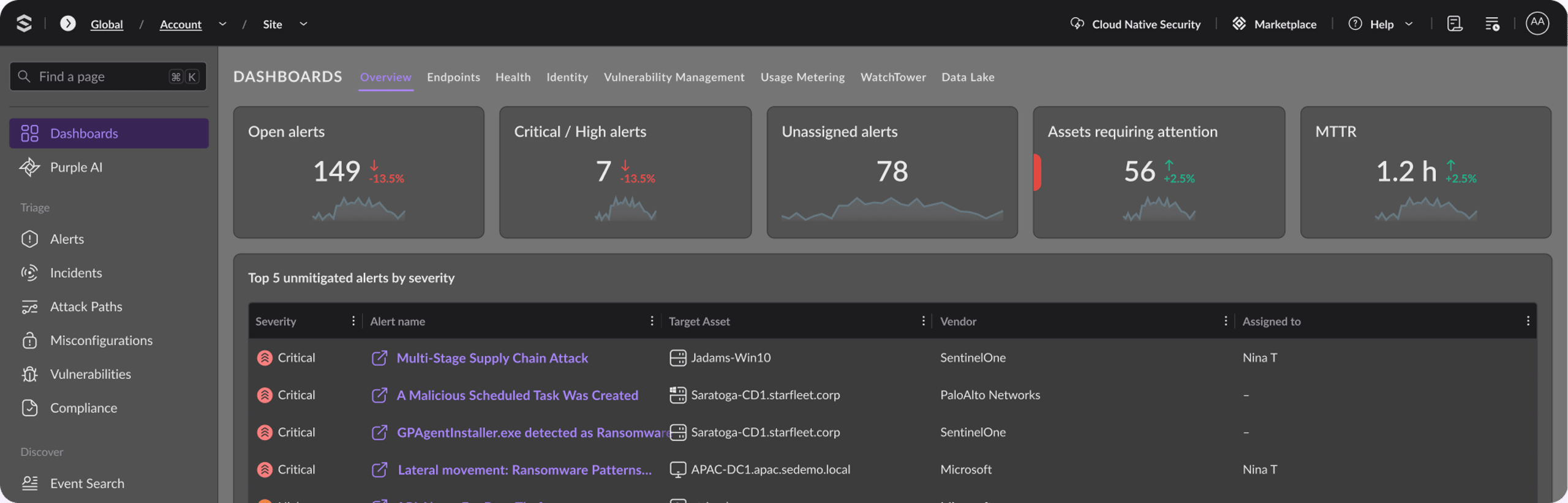
The Singularity Platform delivers autonomous threat identification and response across endpoints, cloud workloads, identity, network discovery, and third party data from a single console built on the Singularity Data Lake. Its behavioral AI correlates events into complete attack storylines automatically. This reduces the manual work of stitching together what happened. In the 2024 MITRE ATT&CK Evaluations, SentinelOne generated 88% fewer alerts than the median of vendors evaluated. Consider it when you want to consolidate endpoint, cloud, and identity coverage into one autonomous platform.
#2 Singularity AI-SIEM
Singularity AI-SIEM is an AI-native analytics engine that finds threats by ingesting and correlating security data from endpoint, cloud, identity, SaaS, network, and external third-party systems. Built on the Singularity Data Lake, it processes schemaless data at large scale and uses OCSF normalization for real-time data ingestion from any source. Consider it when your existing SIEM tools buckle under ingestion volume and manual correlation.
#3 Purple AI
Purple AI™ is the agentic analyst layer across the SentinelOne Platform. It supports autonomous investigations, AI threat hunting with a conversational interface, contextual alert summaries, suggested next steps, and investigation notebooks. An IDC business value study found Purple AI customers saw 63% faster threat identification and a 55% reduction in MTTR. Consider it when you want routine investigation handled autonomously so analysts can focus on advanced threat hunting.
#4 Splunk Enterprise Security
Splunk Enterprise Security is a SIEM platform with deep search and analytics, plus risk-based alerting that cuts alert volume for teams running mature Splunk deployments. Best for: large enterprises already standardized on Splunk.
#5 Microsoft Sentinel
Microsoft Sentinel is a cloud-native SIEM with built-in SOAR, UEBA, and Security Copilot for AI-assisted investigation. Best for: Microsoft-stack organizations on E5 licensing.
#6 Google SecOps
Google SecOps is a cloud-native SIEM and security analytics platform built for high-volume analytics, with petabyte-scale ingestion and Mandiant threat intelligence. Best for: cloud-native organizations that need large-scale analytics with intelligence enrichment.
#7 Cortex XSOAR
Cortex XSOAR from Palo Alto Networks is a SOAR platform with a collaborative investigation War Room, Unit 42 threat intelligence, and one of the broadest integration catalogs in the category. Deployment tends to be resource-heavy. Best for: large enterprises with in-house SOAR engineering.
#8 Tines
Tines is a security automation platform with a no-code builder that connects to any REST endpoint with a defined API, giving vendor-agnostic integration without prebuilt-connector dependency. Best for: teams that want automation without vendor lock-in.
#9 Vectra AI
Vectra AI is an NDR platform that uses behavioral analytics to find threats moving across hybrid network and identity environments, with prioritization that cuts alert noise. Best for: teams that need strong east-west traffic visibility.
#10 Darktrace
Darktrace is an NDR platform that applies self-learning AI to model normal network behavior and find anomalies, with autonomous response to contain threats. Best for: lean teams that want autonomous network anomaly findings.
#11 ExtraHop RevealX
ExtraHop RevealX is an NDR platform that pairs threat finding with network performance monitoring and decodes a wide range of protocols for forensic depth. Best for: teams that want NDR plus network performance insight.
#12 Tenable One
Tenable One is an exposure management platform that unifies vulnerability data across IT, cloud, OT, and identity, then prioritizes fixes by real-world attack risk using Nessus telemetry. Best for: teams that want proactive vulnerability reduction.
A tool list only matters if it moves the numbers your SOC reports every week. The point of consolidating telemetry and adding autonomous response is a smaller alert queue per analyst, faster time to find and contain an intrusion, and fewer real threats lost in noise. The section below puts concrete shape on those outcomes, so you can judge any tool against the operational change it should produce instead of the features on its datasheet.
Benefits of Using SOC Tools
SOC tools pay back in measurable operating terms once they sit on a tuned identification foundation: analyst hours returned, alerts removed from the queue, and intrusions caught earlier in the chain.
A platform that correlates across endpoint, cloud, and identity does work your team would otherwise do by hand, from stitching events into one storyline to running first-pass triage. The benefits below are the ones SOC teams report consistently when they move from disconnected tools to a correlated stack.
- Faster finding and response: You can use AI-assisted correlation and automation to shorten finding, investigation, and containment workflows.
- Reduced alert noise: You can use behavioral AI to filter false positives and prioritize real threats by risk and historical context, recovering analyst time.
- Tool consolidation: You can replace point tools with a correlated platform, remove integration overhead, and close the coverage gaps that come with siloed dashboards. The Singularity Platform uses a single agent, single console, and single data lake across endpoint, cloud, and identity.
- Broader coverage: You can extend visibility past the endpoint into cloud, network, and identity with XDR and identity-aware analysis, where post-perimeter intrusions often move.
These gains hold only when the foundation under the tools is sound. Pile autonomous response on top of noisy, poorly tuned rules and you speed up the triage of alerts that should never have fired. Buy another console before fixing the workflow and you add cost without adding coverage. The errors below are the ones that turn a tool budget into wasted spend, and each has a practice that prevents it.
Common Mistakes When Choosing SOC Tools
The fastest way to waste a security budget is to buy more tools without fixing the underlying workflow. Watch for these errors and the practices that prevent them.
- Buying point tools that do not integrate. If you juggle separate tools, sprawl creates integration problems and alert fatigue. Before buying, run a full inventory of every tool, the data it generates, and its integration support. Verify whether integrations both pull and push data and whether key workflows depend on fragile custom parsers.
- Ignoring autonomous response. When your SOC cannot keep pace with alert volume, autonomous response helps close the gap. Static dashboards and human-dependent processes cannot scale. Fix process maturity and identification engineering quality first, then layer autonomous response on top so it resolves debt instead of compounding it.
- Under-tuning alerts. High false positive rates and noisy alert queues keep your SOC from focusing on the threats that matter. Treat tuning as an ongoing process of adjusting rules, thresholds, and logic. Track alert volume per analyst, false positive rate, MTTA, and MTTR, all with a target direction of decrease.
- Neglecting identity. EDR and XDR tools watch endpoint, network, and email data, but few manage identities the same way, and that is the gap ITDR closes. Stolen credentials bypass perimeter defenses and endpoint tools and can enable account takeover and lateral movement. Enrich your SIEM and SOAR workflows with identity signals as a core SOC input. Get these right, and a consolidated platform turns your numbers around fast.
Build a Smarter SOC with SentinelOne
Autonomous threat detection changes the daily math for an overwhelmed SOC. The Singularity Platform brings endpoint, cloud, identity, and network coverage into a single console, the architecture that produced 88% fewer alerts than the median of vendors evaluated in the 2024 MITRE evaluations. This reduces the context switching that buries analysts. That keeps your analysts focused on hunting real threats.
Purple AI takes investigation further. It supports autonomous investigations, conversational threat hunting, contextual alert summaries, and documented investigation notebooks so your team can move from alert to evidence faster. Singularity AI-SIEM ingests and correlates first-party and third-party telemetry on the Singularity Data Lake at large scale. It can replace a legacy SIEM that cannot keep up with your data growth.
For SOC Managers, a SOC efficiency assessment shows exactly where autonomous response recovers analyst hours. For CISOs, an executive briefing maps these capabilities to SEC governance and reporting requirements. Request a SentinelOne demo to see autonomous threat identification across your SOC.

Singularity™ AI SIEM
Target threats in real time and streamline day-to-day operations with the world’s most advanced AI SIEM from SentinelOne.
Conclusion
SOC tools span SIEM, AI-SIEM, EDR, XDR, SOAR, threat intelligence, NDR, vulnerability management, and ITDR. The best choices in 2026 consolidate telemetry, find behavioral anomalies, run response autonomously with human-in-the-loop control, and integrate openly.
Choose for total cost of ownership, measurable MTTR impact, and governance fit. Avoid sprawl, under-tuning, and identity blind spots. Tuned identification plus autonomous AI is what turns alert noise into caught threats.
SOC Tools FAQs
A SIEM collects and correlates log data from across your environment to find threats, meet compliance needs, and run historical search; it depends on the rules and sources you feed it.
XDR (extended detection and response) starts from finding and stopping threats, correlating endpoint, identity, cloud, and network signals into one investigation without the heavy tuning a SIEM needs. Teams often run both: XDR for cross-surface response, a SIEM or AI-SIEM for retention and compliance at scale.
Consider migrating when ingestion volume outgrows your current capacity, manual correlation consumes more time than actual investigation, or false positives persist even after tuning. AI-SIEM adds behavioral anomaly analysis, autonomous correlation, and natural language queries that replace manual searches.
It also handles schemaless data well, which matters when you ingest cloud-native or SaaS telemetry that older, rule-based platforms struggle to normalize and analyze at scale.
There is no fixed number, but fewer well-integrated tools usually outperform many disconnected ones. Aim to cover endpoint, identity, network, and cloud telemetry with a correlated platform, then keep only specialized tools that add unique data or workflow value.
Audit your stack for overlap where multiple tools watch the same layer without adding visibility, and retire redundant tools as consolidation proves coverage.
Track mean time to detect, mean time to respond, mean time to acknowledge, false positive rate, and alert volume per analyst, all trending down over time. Go beyond speed and volume: measure containment effectiveness by asking whether threats reached their objective or were stopped mid-chain.
Map missed attack techniques to MITRE ATT&CK to expose coverage gaps, and watch how much time analysts spend on advanced hunting versus routine triage.
ITDR monitors authentication events, privilege escalation, and access behavior, giving you visibility into identity-based threats that endpoint controls can miss, since stolen credentials may produce no malicious file or process.
It correlates anomalous sign-in times, impossible travel, unusual privilege requests, and lateral access across identity stores, then feeds those signals into SIEM or XDR workflows. That closes the identity blind spot left when tools watch only endpoints, networks, and email.
No. Autonomous response handles repetitive triage, correlation, and containment at machine speed, so analysts spend less time on routine alerts. Human judgment still drives advanced threat hunting, investigation of novel attacks, and decisions about high-impact containment.
The goal is a human-in-the-loop model where AI resolves known patterns and escalates ambiguous cases, freeing skilled analysts for the work that genuinely needs their expertise.
Discover More About Services




Ready to Revolutionize Your Security Operations?
Discover how SentinelOne AI SIEM can transform your SOC into an autonomous powerhouse. Contact us today for a personalized demo and see the future of security in action.