AI Acceptable Use Policy: Best Practices & Examples
Learn how an AI acceptable use policy helps you govern tools, restrict sensitive data, require human oversight, and enforce AI controls with SentinelOne.

Key Takeaways
- An AI acceptable use policy (AUP) defines which AI tools your organization sanctions, what data may never enter them, when a human must review or override output, and who is accountable. It covers risks a standard AUP misses, such as hallucination, prompt injection, and agentic autonomy.
- A strong AI usage policy answers eight operational questions: scope, approved and prohibited tools, data classification, human oversight, roles and accountability, monitoring, incident reporting, and enforcement.
- Tiered data rules are the core of the policy. Linking data sensitivity (public, internal, sensitive, prohibited) to permitted tool categories gives employees a clear answer to “can this data go into this tool?” It also turns shadow AI into sanctioned, responsible AI use.
- Most AI AUPs fail in predictable ways: blanket bans that drive usage underground, rules with no enforcement, embedded and third-party AI left out of scope, and set-and-forget policies that go stale.
- Effective AI governance treats the policy as a control to operate, not a document to file. It needs a real tool-approval workflow, automated prompt monitoring and DLP, role-specific training, a scheduled review cadence, and an AI policy template mapped to NIST AI RMF, ISO/IEC 42001, and the EU AI Act.
What Is an AI Acceptable Use Policy?
An AI Acceptable Use Policy (AUP) defines which AI tools your organization sanctions, what data may never enter them, when a human must override the output, and who is accountable. An AI usage policy reaches further than a standard acceptable use policy, because generative AI brings risks the standard version was never written for: hallucination, prompt injection, and agentic autonomy.
Those rules matter most once data has left the building. In November 2025, a federal court ordered OpenAI to produce 20 million de-identified ChatGPT logs in a copyright lawsuit, and in January 2026 the district judge affirmed the order. None of the users behind those logs were party to the case. Anything your employees paste into a consumer AI account can end up the same way: in a system, and a dispute, you do not control.
How an AI Acceptable Use Policy Relates to Cybersecurity
Your employees create shadow AI risk every time they reach for a tool without formal approval or oversight. ISACA calls it a risk that “goes beyond the risk shadow IT presents.” The exposure runs to data leakage and stolen intellectual property (IP).
Sensitive data leaks into public models one prompt at a time. Prompt injection adds another path. NIST AI 600-1, the Generative AI Profile of the NIST AI Risk Management Framework (AI RMF), describes prompt injection as modifying input so a generative AI system behaves in unintended ways. When your enterprise model has access to internal databases, a successful injection can turn it into a data exfiltration tool. Compliance exposure compounds the rest: the EU AI Act introduces tiered obligations for covered AI systems. A policy turns each of these from an open question into a defined control.
Core Components of an AI Acceptable Use Policy
A working AI Acceptable Use Policy answers eight operational questions before an incident forces them: who is covered, which tools are allowed, what data is off limits, when a human has to review output, who owns the decision, how use is monitored, how incidents get reported, and what happens when someone breaks the rules. The components below map to those eight questions in order.
- Scope and applicability: An acceptable use policy for AI tools starts by naming who and what it governs. Coverage extends to employees, contractors, vendors, and interns on any device used for work, including personal devices under bring-your-own-device (BYOD) programs. System scope includes generative and agentic AI, along with AI features embedded in sanctioned SaaS products.
- Approved and prohibited tools: Distinguish approved, restricted, and prohibited categories. NIST AI 600-1 action GV-6.1-010 recommends updating acceptable use policies to cover both proprietary and open-source generative AI and third-party personnel.
- Data classification and handling: Confidential and restricted data, including personally identifiable information (PII), protected health information (PHI), source code, and Payment Card Industry Data Security Standard (PCI DSS) cardholder data, cannot be submitted to public AI tools under any circumstances.
- Human oversight: Oregon’s draft Responsible AI Usage policy, circulated for agency comment, sets human-in-the-loop oversight as the baseline expectation. Under the draft, AI “does not operate independently of human responsibility.”
- Roles and accountability: ISO/IEC 42001 defines how to establish, implement, maintain, and continually improve an AI management system, and an analysis from the International Association of Privacy Professionals (IAPP) notes that organizations must define roles and implement measures to report concerns about AI.
- Monitoring and review: Track model performance, confirm policy compliance, and find emerging risks on a defined cadence.
- Incident reporting: Define reporting and escalation requirements for data-sharing mistakes, harmful output, prompt injection, and related incidents.
- Enforcement: Written rules need technical and operational controls, plus defined consequences for violations.
Listing these components tells you what a policy has to contain. It says nothing about how the policy gets written or stays enforced. A clause about data classification means nothing until someone drafts it, an approving body signs it, and a control checks it on every prompt. Here is that path, from the first cross-functional draft to the scheduled review that keeps it current.
How an AI Acceptable Use Policy Works
A policy earns its keep when it moves from a document into enforced controls. An AI AUP runs through five stages, from drafting to scheduled review, and each fails quietly if the prior one is skipped: an unvetted tool list makes rollout meaningless, and rollout without enforcement makes the rules optional.
Stage | What it involves |
Drafting | A cross-functional team from security, legal, privacy, IT, HR, and procurement assembles clauses around scope, data rules, human review, and accountability. |
Approval | An AI Risk Review Board or equivalent authority signs off and connects the policy to existing data and IT governance functions. NIST AI 600-1 action MP-4.1-003 recommends that you “connect new GAI policies, procedures, and processes to existing model, data, software development, and IT governance and to legal, compliance, and risk management activities.” |
Rollout | You train teams on what the rules mean for their actual work and confirm the approved tools are accessible. |
Enforcement | Technical controls like data loss prevention and real-time blocking back the written rules. |
Review | Scheduled reassessment plus out-of-cycle triggers when tools or laws change, or after incidents. |
Worked through in order, the lifecycle connects an AI AUP to the data classification and acceptable use policies you already run, and extends both to cover model output, agentic actions, and the AI built into approved software.
Each stage also produces something an approver or auditor can point to: a signed-off tool list, a training record, an enforcement log, a review date. That evidence trail is where the payoff starts.
Key Benefits of Adopting an AI Acceptable Use Policy
A written AI AUP turns AI risk from something you find after the fact into something you manage on purpose. It gives security a defensible answer when an auditor, a regulator, or the board asks how AI use is controlled, and it gives employees a clear line they can work inside without guessing. The return shows up in four places: less data exposure, cleaner regulatory evidence, faster safe adoption, and named ownership of AI decisions.
- Risk reduction: Clear data classification rules stop the paste-into-public-model path that drives leakage.
- Regulatory alignment: Mapping policy controls to NIST AI RMF, ISO/IEC 42001, and EU AI Act obligations creates documented evidence for governance and oversight, including review.
- Safe enablement: Approved-tool lists and clear employee AI guidelines let people use AI productively without guessing where the line sits. Defined boundaries turn shadow AI into sanctioned AI.
- Clearer accountability: Defined roles answer the question of who owns AI decisions before an incident forces the issue.
These benefits assume the policy holds up in daily use. That assumption is where programs tend to run into trouble, because the shadow AI the policy targets is also what makes the policy hard to enforce.
Challenges in Implementing an AI Acceptable Use Policy
Shadow AI creates both structural and behavioral enforcement problems. The Cloud Security Alliance (CSA) Labs paper on shadow AI frames the problem as asset blindness and systemic risk. Your employees often adopt tools before security, legal, privacy, and procurement teams can evaluate them. Fast-moving tooling compounds the problem, and a policy written around one tool goes stale fast.
CISOs must enforce rules without hindering productivity. Block too hard and employees look for workarounds. Leave too much ambiguity and the policy becomes unenforceable. Measuring compliance at scale is its own challenge.
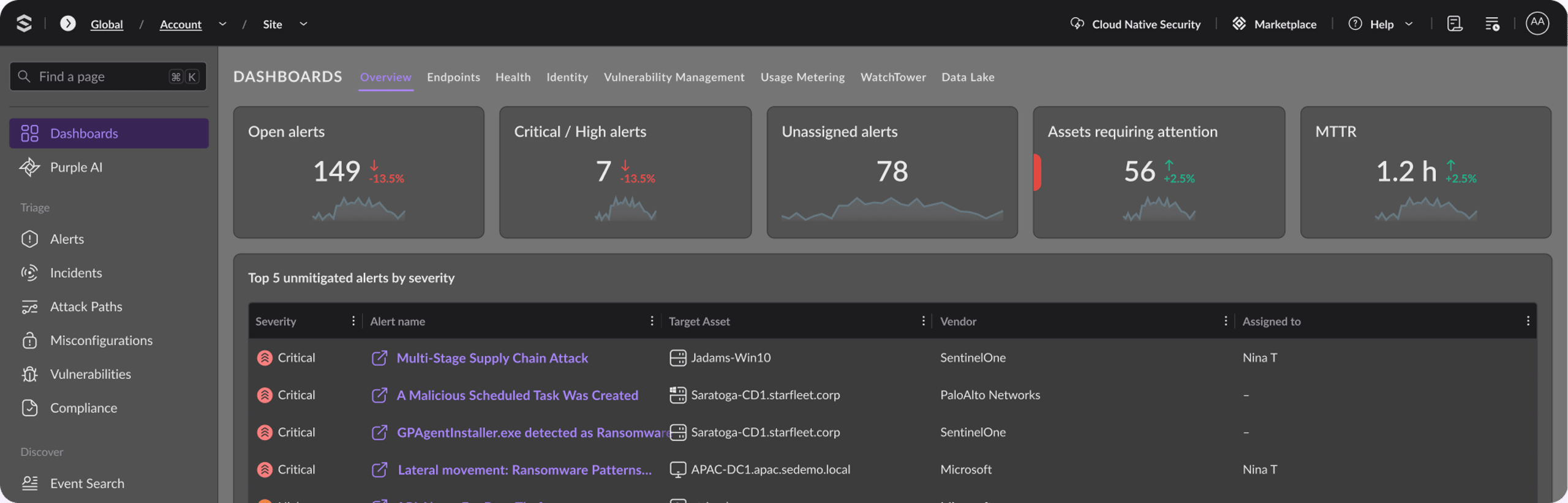
Copy-and-paste activity into AI platforms can outrun manual review capacity, so machine classification becomes the practical requirement. Tools built for AI visibility, such as SentinelOne Prompt Security, give security teams a record of where AI use is happening across browsers and apps. That record makes the measurement possible.
Common AI Acceptable Use Policy Mistakes
The ways an AI AUP fails are predictable, which is good news: you can design around them before launch. The four below show up again and again in policies that look finished on paper and fall apart in practice, from rules nobody can enforce to whole categories of tools nobody thought to cover. Here is where teams go wrong:
- Blanket bans: Prohibiting all AI without an approved alternative drives usage underground. CSA guidance notes that banning AI outright “is unlikely to be effective and may drive employees to use unvetted tools via shadow IT.”
- No enforcement mechanism: Policies that prohibit “unauthorized AI use” without specifying what authorization requires “tend to be widely ignored,” per the same CSA Labs paper.
- Ignoring embedded and third-party AI: NIST AI 600-1 calls for policies that address contractors and both proprietary and open-source generative AI. Browser extensions that see everything in the window need explicit handling.
- Set-and-forget: AI tools and risks change quickly. A stale policy is a predictable failure mode.
These failures share a root cause: a policy treated as a document to file instead of a control to operate. Fixing them is a matter of building the policy to run, with clear owners, checks that fire automatically, and a refresh schedule. The practices below pair each failure mode with the habit that prevents it.
AI Acceptable Use Policy Best Practices
A policy people follow looks different from one they ignore, and the difference is operational. The practices that hold up share a trait: each turns an intention into a repeatable action with an owner and a schedule. Five of them carry the load.
- Approve tools through a real workflow. Run each candidate through a defined path: business purpose, risk screen, security and privacy review, legal and procurement sign-off, business owner approval, then monitoring. Treat enterprise and consumer versions of the same tool as different products, since they handle inputs differently, and make every approval time-limited so it gets re-examined on a schedule.
- Tie data rules to tool categories. “Use AI responsibly” is an intention. A rule names the data and the tool. The tiered model that links data sensitivity to a permitted tool category is the operational heart of the document.
- Automate the monitoring. Manual review cannot keep pace with the volume of prompts and uploads. Prompt Security covers that layer for AI use specifically, with real-time monitoring and policy controls on prompts entering AI tools. People stay in the loop for decisions. Automation handles the volume.
- Train people on the work they actually do. Cover data privacy rules and prompt hygiene, and build verification of AI output into the workflow. Co-create the guardrails with employees so responsible AI use becomes a habit instead of a slogan.
- Set a review cadence. A scheduled reassessment, plus out-of-cycle triggers for new tools, incidents, or regulatory change, keeps the policy current.
The practices above describe how a strong AI AUP behaves once it is live: approvals that expire, classification rules tied to tools, monitoring that scales, training built around real tasks. Turning those behaviors into a written document is the step where teams stall, because a blank page gives no indication of what belongs where. The skeleton and sample clauses below give you that starting structure.
AI Acceptable Use Policy Examples and Template
Defensible AI AUPs share a common backbone: a set of sections an approver can check against and an auditor can follow. The skeleton below works as an AI policy template, listing those sections with the content each one needs, followed by sample clauses you can adapt for data restriction, disclosure, human review, and enforcement.
Section | Key Content |
Purpose and Scope | Who is covered, which AI systems, including generative or agentic tools and embedded SaaS AI, which devices |
Approved/Prohibited Tools | Approved, restricted, and prohibited lists plus a request process |
Data Classification | Tiered table linking sensitivity to permitted tool category |
Acceptable Use Cases | Permitted workflows and prohibited actions |
Disclosure Requirements | When and how AI use must be disclosed |
Human Review | Trigger conditions and consequential decision categories |
Roles and Responsibilities | Policy owner, approving authority, employee obligations |
Monitoring and Incident Reporting | Audit mechanisms, reporting channel, escalation path |
Enforcement and Review | Disciplinary consequences, scheduled review dates |
Data classification is where an AI AUP either works or collapses into vague advice. A tiered model answers the only question employees actually ask in the moment: can this data go into this tool? The four tiers below map sensitivity to a permitted tool category.
- Tier 1, Public. Published marketing material, public-facing website content, and general industry research. Permitted in any reputable AI tool.
- Tier 2, Internal. Internal communications, process documentation, and non-confidential project material. Permitted only in approved enterprise AI tools tied to company accounts.
- Tier 3, Sensitive. Customer data, employee PII, financial records, proprietary processes, and regulated information. Permitted only with explicit approval, in designated tools covered by data-handling agreements.
- Tier 4, Prohibited. Authentication credentials and encryption keys. Never entered into an AI tool under any circumstances.
Sample clauses give the policy teeth:
- On data restriction, the Department of Energy generative AI policy (DOE P 203.1) directs personnel to match each prompt to the tool’s approved data level: proprietary data, Controlled Unclassified Information, and PII “may not be used as an input” to a tool cleared only for open data.
- On disclosure, Stanford University Communications’ AI guidelines advise that when AI plays a material role in a work product, “disclose that use to the relevant editor, supervisor, or decision-maker.”
- On human review, the University of Iowa states that AI outputs should be closely reviewed and verified by a human.
- On enforcement, define consequences, reporting channels, and escalation procedures before the first violation.
Enforce Your AI Acceptable Use Policy with SentinelOne
Policy without enforcement is documentation. SentinelOne turns the rules in your AUP into technical controls that run on every prompt, tool, and agent in your environment. Real-time visibility and policy enforcement across thousands of AI tools make your approved and prohibited tool lists enforceable rather than aspirational. Edge-based redaction strips sensitive data before it reaches an external model, and in-line coaching corrects risky behavior in the moment.
That same enforcement extends to developer tools like code assistants and integrated development environments (IDEs), closing the embedded and third-party AI gap that most policies overlook. It also reaches agentic systems, where discovery of unsanctioned agents and Model Context Protocol (MCP) servers, policy-based controls on agent actions, and searchable audit logs give you the accountability trail your AUP requires.
Purple AI™ works as a natural language security analyst for investigations and AI threat hunting. Early adopters report running hunts up to 80% faster. Your SOC moves from scattered AI-use signals to prioritized investigation paths.
The Singularity™ Platform is the visibility and enforcement layer underneath, with a single agent, one console, and a single data lake across endpoint, cloud, and identity. It prevents, identifies, and responds to threats autonomously. In the 2024 MITRE ATT&CK Evaluations, the platform’s Behavioral AI generated 88% fewer alerts than the median across all vendors evaluated, so your analysts work a short list of real findings instead of noise.
CISOs get an AI governance story they can take to the board. SOC managers get enforcement they can run across the environment.
Request a SentinelOne demo to see how these controls map to your AI policy.
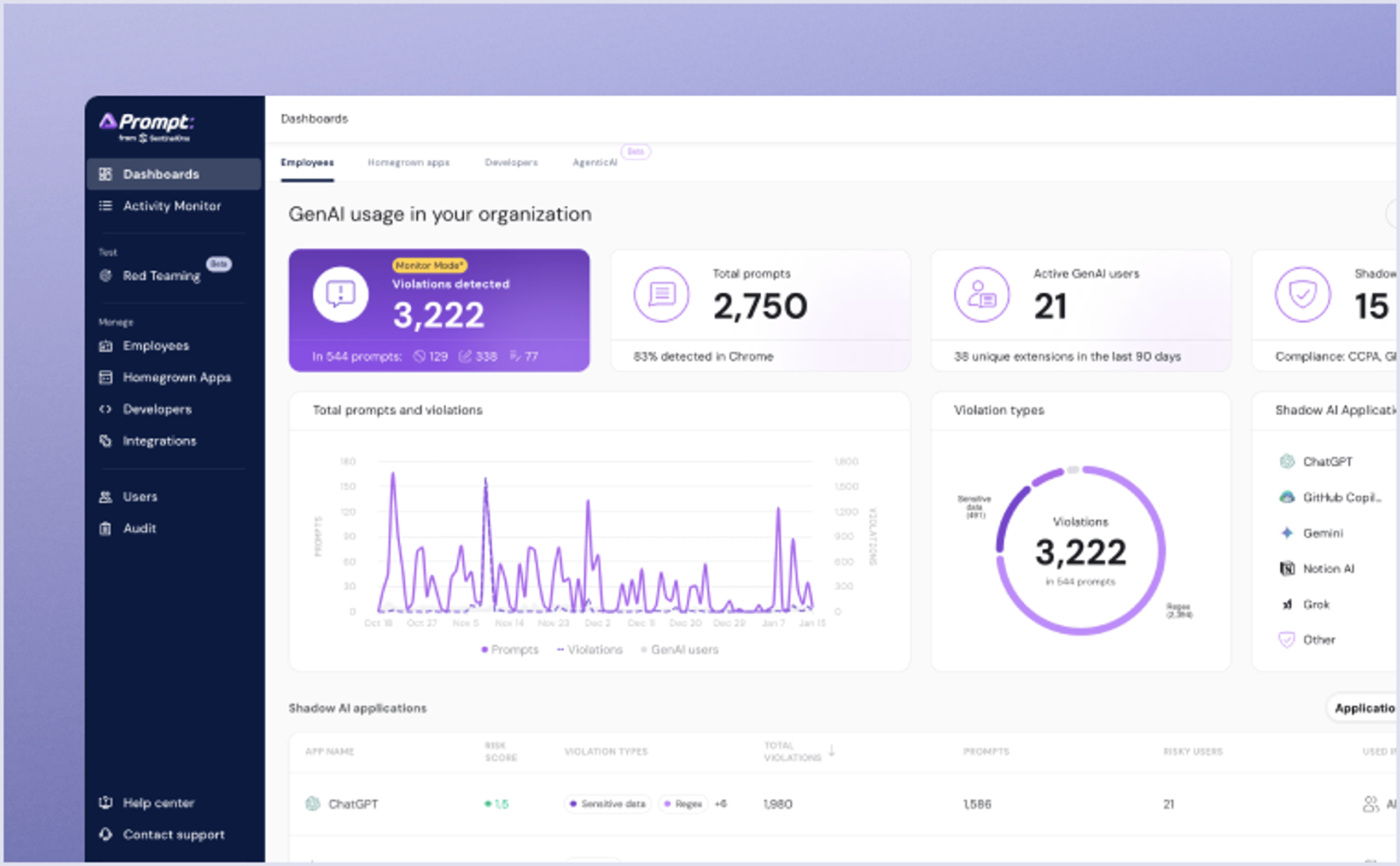
Get complete visibility, security and governance over AI usage in your organization. Uncover shadow AI, protect your sensitive data and safely enable AI in the organization.
Conclusion
Treat anything your employees put into an AI tool as data you may not get back. That is the practical reason to govern AI use in writing, before regulators or a court raise the question for you. A policy earns its place when it gets specific: tiered data rules, enforcement that does not lean on manual review, and a set review date.
Prompt Security enforces those rules where AI gets used, and the Singularity Platform and Purple AI give your SOC the visibility and speed to act on what it finds. Get those pieces in place and AI becomes something your people use in the open, inside lines you can defend.
FAQs
An AI acceptable use policy sets the ground rules for using AI at work: which tools are sanctioned, what data can go into them, when a person must check or overrule the output, and who is accountable for the result.
It covers ground a general acceptable use policy does not, including generative output, agentic actions, and the AI built into software you already approved.
Assign ownership to a cross-functional governance body, typically chaired by security or the CISO. Include legal, privacy, IT, HR, procurement, and business leadership so the policy reflects operational, regulatory, and employee realities.
Name one policy owner who remains accountable for review and updates. The broader group should approve tools, review exceptions, define escalation paths, and keep the AUP connected to data and IT governance.
Not universally, but legal obligations are converging across regulated environments. The EU AI Act requires documented governance over covered systems, and U.S. Office of Management and Budget (OMB) memo M-25-21 directs federal agencies to set acceptable use terms for generative AI.
For regulated enterprises, a documented AI AUP is becoming a practical requirement because it shows governance, oversight, data controls, and review when auditors or regulators ask how AI use is managed.
A standard AUP governs data access and system use. An AI AUP adds model-level concerns: generative outputs, hallucination, prompt injection, training data leakage, agentic autonomy, and AI-specific regulation. It also ties data classification rules to approved tool categories.
Employees need clear rules for data entering AI systems and for human review, including ownership of AI-assisted decisions.
Find shadow AI through network traffic monitoring, data loss prevention (DLP) inspection of outbound data flows, cloud access security brokers, and endpoint behavioral analytics that flag AI tool activity. Discovery should include browser extensions and OAuth grants to unapproved services, plus clipboard data destined for AI endpoints.
Management starts with inventory normalization and risk scoring, then teams decide whether to sanction, replace, restrict, or block each tool based on business need and data risk.
Use DLP controls to inspect prompts before they reach AI endpoints and classify content against your tiered data model. Inline controls can intercept calls to public models, then block or redact sensitive data based on context.
DNS and firewall controls can restrict unapproved AI domains. Endpoint agents should monitor clipboard activity and browser extensions, including screen scraping behavior, while behavior analytics can flag unusual paste volumes or off-hours AI access patterns.
Discover More About Data and AI



Ready to Revolutionize Your Security Operations?
Discover how SentinelOne AI SIEM can transform your SOC into an autonomous powerhouse. Contact us today for a personalized demo and see the future of security in action.