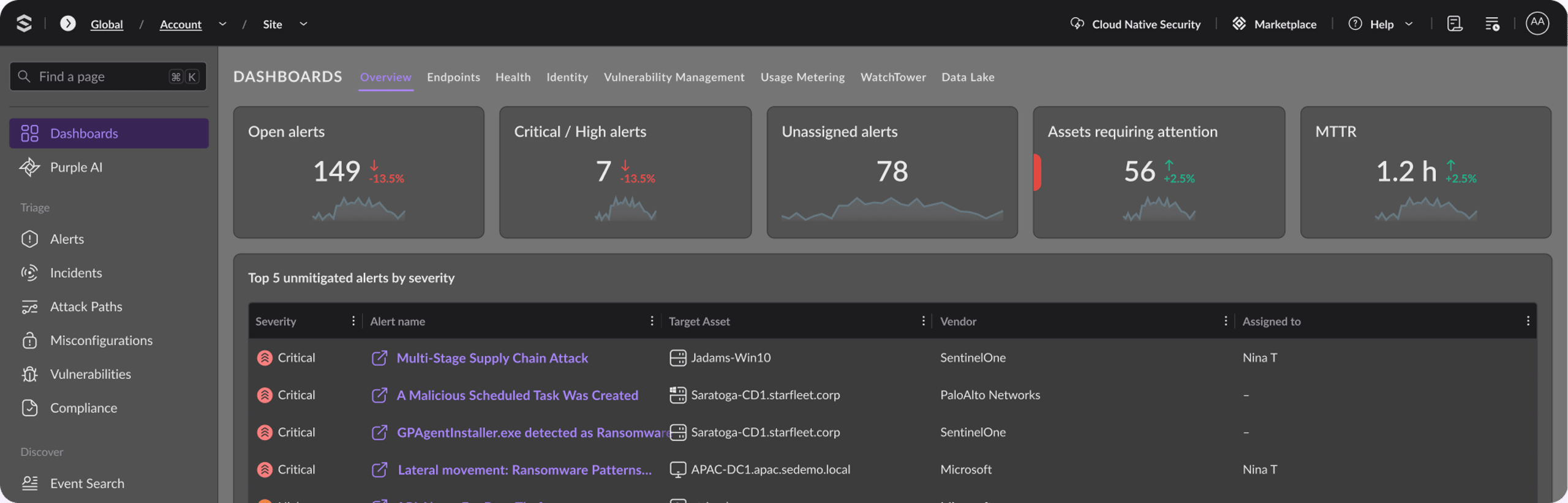
AI SOC Guide: Build Autonomous Security Operations with SentinelOne
An AI SOC makes AI the operational backbone for triage through response. Learn where SentinelOne fits, what to govern, and how your analysts stay in control.

Key Takeaways
An AI SOC (AI Security Operations Center) is a security operations model that embeds artificial intelligence and machine learning across detection, triage, investigation, and response — letting teams operate at machine speed and scale well beyond what human analysts alone can sustain.
- AI SOC extends the traditional SOC, not replaces it — it augments analysts across the full workflow (triage, correlation, investigation, response), so teams handle far higher alert volumes without proportional headcount growth.
- Automated correlation cuts through alert fatigue — by correlating signals across endpoint, identity, cloud, and network telemetry in real time, an AI SOC collapses thousands of raw alerts into a handful of high-fidelity incidents analysts can actually act on.
- Behavioral analytics and threat intel work together — combining UEBA with continuously updated threat intelligence catches novel and living-off-the-land attacks that static, signature-based tools miss.
- Autonomous response shortens dwell time — rather than waiting on manual playbooks, an AI SOC can auto-contain, isolate, or remediate confirmed threats immediately, cutting the window attackers have to move laterally or exfiltrate data.
What Is an AI SOC?
An attacker breaches your environment in the middle of the night. By the time a traditional security operations center (SOC) begins manual triage, they’ve moved laterally and started staging data for exfiltration. One investigation becomes six, with your team pulling telemetry from disconnected endpoint, identity, cloud, email, network, and third-party tools while the attack is still in progress. Manual coordination can’t move that fast.
An AI SOC uses agentic AI to detect threats, accelerate response, and manage the complete threat lifecycle from triage to remediation. NIST's Cybersecurity AI Profile identifies three ways AI improves defensive operations: augmenting human analysts, cutting detection and response time, and supporting recovery. Machine learning and generative AI absorb the alert volume and investigation work that human teams alone cannot sustain.
A true AI SOC makes AI the operational backbone, not a bolt-on addition to a traditional architecture. AI handles alert summaries and ticket drafts, and it works across triage, investigation, enrichment, response recommendation, and remediation workflows. Your analysts set boundaries and review high-impact decisions.
Why an AI SOC Matters for Security Operations
Operational pressure drives AI SOC adoption. ISC2’s 2024 Cybersecurity Workforce Study found that growing alert volumes and investigation complexity rank among the top operational burdens facing SOC teams. The workforce gap compounds it. You cannot hire your way out of a shortage that keeps growing. AI triage and SOC automation shrink the alert queue by automating repetitive enrichment, duplicate alert review, and routine evidence collection. That reserves analyst judgment for the threats that actually require it. An AI SOC absorbs routine work so your analysts spend their time on the decisions only they can make.
AI SOC vs. Traditional SOC
A traditional SOC depends on human analysts using rule-based tools and manual workflows. Security information and event management (SIEM) alerts are the primary data input, investigation quality varies with each analyst's experience, and response runs on rigid playbooks that break the moment something unexpected happens.
An AI SOC integrates directly with endpoint, identity, and cloud sources, then applies behavioral analytics and agentic reasoning across that data. Agentic systems direct their own tool usage, loop until they achieve a goal, and collect evidence, correlate activity, and recommend or execute actions within approved boundaries. No static playbook can replicate that.
Core Components of an AI SOC
An AI SOC is built in layers: data ingestion at the base, analytics and detection above it, an AI-augmented response and decision layer, and human oversight at the top. Six components do the work within that model.
- Data ingestion and the security data lake. Pulls telemetry from endpoint, identity, cloud, email, network, and third-party tools into a shared schema. The Open Cybersecurity Schema Framework (OCSF) normalizes events into a vendor-agnostic taxonomy so everything is queryable in one place.
- AI/ML analytics engine. Scores every event against known patterns, surfaces anomalies, and correlates alerts across user behavior, process activity, asset sensitivity, and related events before deciding to investigate, escalate, or act.
- User and entity behavior analytics (UEBA). Baselines normal activity across users and systems, then flags deviations that signal insider threats, compromised accounts, lateral movement, or exfiltration. Signature-based tools miss those.
- Threat intelligence integration. Enriches every alert with indicators of compromise (IOCs), geolocation, and adversary tactics, techniques, and procedures (TTPs) mapped to MITRE ATT&CK. Structured Threat Information Expression (STIX) and Trusted Automated Exchange of Intelligence Information (TAXII) keep that intelligence machine-readable and operational.
- Security orchestration, automation, and response (SOAR). Executes actions across firewalls, SIEMs, and endpoints: block an IP, isolate a host, revoke access. It also connects dots across alerts that rigid playbooks miss.
- Human-in-the-loop oversight. Routes high-impact escalations and strategic decisions to Tier 2 and Tier 3 analysts, who set and enforce the limits on autonomy.
These six components work together as a system.
How an AI SOC Works
When an alert arrives overnight, the data layer has already ingested telemetry from your endpoint, identity, and cloud sources into the data lake, normalized to OCSF. The analytics engine scores the event against behavioral baselines and known patterns. The AI SOC enriches the alert automatically with domain reputation, IP geolocation, user behavioral history, and IOC context.
The decision boundary determines what happens next. Low-risk, high-confidence actions like blocking a known malicious IP can run autonomously. Higher-impact actions like disabling a user account route to an analyst for approval. SANS instructor Christopher Crowley writes, "AI cannot decide when automation should run." That choice depends on your risk tolerance and the sensitivity of the action.
The maturity spectrum runs from human-in-the-loop, where AI assists and humans decide, to human-on-the-loop, where AI acts and humans oversee. The AI-driven SOC operates at the human-on-the-loop end. AI agents analyze and act on high-confidence threats autonomously, and analysts set the boundaries they operate inside. Most teams start somewhere specific.
Common AI SOC Use Cases
An AI SOC earns its place by handling the recurring work that consumes analyst time. Common applications include:
- Phishing detection and triage: parsing reported emails, scoring intent, and closing false positives autonomously.
- Identity threat detection: finding impossible travel, credential abuse, and account takeover through behavioral baselines.
- Endpoint detection and response (EDR) alert triage: enriching and prioritizing endpoint alerts with full process context.
- Insider threat detection: flagging data staging and unusual access through UEBA.
- Web application firewall (WAF) and data loss prevention (DLP) alert handling: correlating web and data-loss signals against broader activity.
- Network monitoring: detecting anomalous traffic patterns that suggest exfiltration.
AI triage turns these recurring queues into consistent decisions instead of judgment calls that vary by shift. Additional use cases include predicting new attack patterns, writing detection rules, and supporting compliance reporting. The payoff shows up in three places.
Key Benefits of an AI SOC
- Faster detection and response. AI gathers evidence, enriches alerts, correlates related activity, and recommends next steps faster than manual triage. Speed only counts when it arrives with enough context for an analyst to act on.
- Less noise. AI stops duplicate or low-confidence alerts from reaching your queue and groups related events so analysts can prioritize the incidents most likely to matter. Analysts stop working the queue one row at a time.
- Relief from burnout. A SANS post on banishing SOC analyst burnout names SOC automation in the analyst workflow as a relief mechanism. When routine triage becomes strategic work, analysts grow instead of leaving.
These benefits have limits, though, and understanding them is as important as knowing the upside.
Challenges and Limitations of an AI SOC
The same alert volume an AI SOC is built to absorb also exposes its weak points. Better outcomes demand stronger correlation, better context, and explicit control over when autonomous response is allowed.
Three structural limits apply to any AI SOC deployment. First, large language models introduce risks that traditional security tools do not, including prompt injection and hallucinations that can corrupt investigation outputs. Second, an AI's conclusions are only as good as the context it receives, which changes constantly as infrastructure and business conditions shift. Third, autonomous response creates accountability gaps if logging and governance frameworks are not in place before deployment.
Common AI SOC Mistakes
These structural limits become operational problems when teams make avoidable errors during deployment:
- Optimizing for speed over quality. An incomplete investigation that closes in two minutes is not better than a thorough one that takes thirty.
- Feeding agents stale context. Decisions degrade when business and infrastructure change faster than the data feeding the model.
- Skipping analyst training. AI agents surface findings that require human interpretation. Teams that deploy without training analysts to supervise and validate AI outputs end up with a system nobody trusts.
Governance prevents these mistakes. Tooling alone does not.
AI SOC Best Practices
Use a risk-based, phased approach. SANS recommends deploying AI incrementally, starting in non-critical systems and expanding as controls mature.
- Establish AI governance. Stand up a centralized governance board to oversee security and compliance, and develop an AI incident response plan that covers breaches to the AI systems themselves.
- Secure the AI. Filter and validate prompts to stop prompt injection, define response policies as guardrails, and avoid training models on confidential data unless necessary.
- Monitor models continuously. Track inference refusal, watch for model drift, and log prompts and outputs for audit trails on sensitive decisions.
- Run threat modeling regularly. ISACA advises reviewing threat models after significant changes, using STRIDE, PASTA, or MITRE ATT&CK rather than applying everything at once.
- Rethink your metrics. Expand beyond mean time to respond (MTTR) to include model accuracy, escalation quality, and containment effectiveness.
SOC automation works best when these controls define what can run autonomously, what needs analyst review, and what evidence must be preserved. Governance, prompt controls, model monitoring, and better metrics define safe autonomy. That posture also decides how far the AI SOC can go next.
The Future of the AI SOC
AI SOCs are no longer experimental. Most security teams have moved past whether to deploy autonomous AI. The open question is how to govern it.
Regulatory pressure makes that question urgent. The Network and Information Security Directive 2 (NIS2) and the Cyber Incident Reporting for Critical Infrastructure Act (CIRCIA) compress reporting timelines and require defensible records of how security decisions were made, including decisions made by AI. Teams that deploy autonomous response without logging, classification frameworks, and clear accountability structures will struggle to meet those requirements.
The organizations that get the most from an AI SOC build in governance from the first phase. Analysts shift from manual triage to supervising autonomous systems, validating ambiguous findings, and improving the detection logic that drives AI decisions. Automation handles the volume. Humans own the boundaries.
Build an Autonomous AI SOC with SentinelOne
SentinelOne brings these components together in a single platform. The Singularity™ Platform unifies endpoint, identity, and cloud telemetry into a central data lake built on OCSF. It ingests and normalizes native and third-party data, so investigations run on complete context instead of SIEM alerts alone.
Purple AI™ handles the investigation work that drains your team. It writes contextual alert summaries, suggests next investigative steps, and supports deep analysis in an agentic AI investigation notebook. Early adopters reported up to 80% faster threat hunting and investigations.
At the detection layer, Singularity AI SIEM, built on the Singularity Data Lake, gives your analysts a cloud-native SIEM with real-time ingestion from any source, normalized to OCSF. It pulls third-party log data up to 100x faster than legacy SIEM solutions. In the 2024 MITRE ATT&CK Evaluations, SentinelOne detected 100% of 80 attack substeps with zero delays and generated 88% fewer alerts than the median across all vendors evaluated, a signal-to-noise gap that changes what your queue looks like every single shift.
Behavioral AI runs in both the agent and the platform. The agent analyzes device-level behavior, while the platform finds identity anomalies like impossible travel. When ransomware executes, autonomous response isolates the threat, and 1-click rollback recovers affected systems to their pre-infection state.
See how the Singularity Platform performs against live threats. Request a demo with SentinelOne to map an AI SOC roadmap against your existing tool investments and regulatory deadlines.

Unleash AI-Powered Cybersecurity
Elevate your security posture with real-time detection, machine-speed response, and total visibility of your entire digital environment.
Conclusion
An AI SOC uses agentic AI to detect threats, accelerate response, and sustain continuous coverage your team cannot staff alone. It outpaces traditional SOCs on detection and response speed while cutting alert noise.
Success depends on integration, governance, human oversight at the right boundaries, and disciplined use of SOC automation. Done well, the volume stops being a staffing problem, and your analysts get back the judgment work only they can do.
AI SOC FAQs
An AI SOC (AI Security Operations Center) is a security operations model that uses agentic AI to detect threats, triage alerts, and manage the complete incident lifecycle from detection through remediation. A true AI SOC makes AI the operational backbone rather than a bolt-on tool.
It automates enrichment, correlation, and routine response actions so analysts can focus on the decisions that require human judgment.
Human-in-the-loop requires analyst approval before each action executes. Human-on-the-loop allows AI to act autonomously while analysts monitor outcomes and set boundaries. The right model depends on regulatory requirements, action sensitivity, reversibility, and risk appetite.
Start human-in-the-loop for high-impact actions like credential revocation or network segmentation changes. Then move to human-on-the-loop for routine tasks as confidence and governance mature.
There is no single timeline, because implementation should be phased rather than treated as a single cutover. Prerequisites include a unified data lake that ingests telemetry from security tools, OCSF or another normalization standard to reduce schema conflicts, governance frameworks that set autonomy boundaries and escalation thresholds, and analyst training focused on supervising AI outputs instead of performing manual triage.
Track model accuracy, including true positive and false positive ratios. Measure escalation quality by calculating what percentage of AI-escalated incidents actually require human intervention.
Monitor containment effectiveness, analyst capacity, investigation completeness, and training velocity for new detection logic against your pre-AI baselines. Compare noise reduction and investigation quality the same way.
An AI SOC uses unsupervised machine-learning models to identify statistical anomalies without needing prior examples. These models flag deviations from normal operational patterns, such as unusual process chains, abnormal memory access, or atypical data movement.
Cross-entity correlation links suspicious activity across multiple assets, while behavioral analytics engines continuously update baselines. Human oversight stays essential for validating anomaly-based findings and deciding on containment.
Autonomous AI decisions introduce accountability requirements. With NIS2 and CIRCIA compressing reporting timelines, your organization remains responsible for AI-driven security decisions, so logging infrastructure must show that AI categorization decisions were defensible.
Compliance programs should preserve evidence chains showing who approved autonomy boundaries, how model outputs were validated, and where human review occurred.
Discover More About Data and AI


Ready to Revolutionize Your Security Operations?
Discover how SentinelOne AI SIEM can transform your SOC into an autonomous powerhouse. Contact us today for a personalized demo and see the future of security in action.