12 Best AI Cybersecurity Vendors for Enterprises in 2026
Compare 12 AI cybersecurity vendors across endpoint, cloud, network, and data security. See what each does well, where each fits, and the criteria that should drive your enterprise shortlist.

Picking the wrong AI cybersecurity vendor costs you twice: once in what you spend, and again in the year you lose before anyone admits the fit was wrong. Plenty of organizations get this stage wrong and end up locked into features they will never switch on.
New vendors enter this market constantly, and the differences between them are real. Below are the ones doing the most credible work right now, what each is actually good at, and where each fits.
What Is an AI Cybersecurity Vendor?
AI cybersecurity vendors are companies that use AI-powered platforms and solutions to improve an enterprise's ability to detect, prevent, prioritize, and mitigate security risk. They cover multiple domains, including application security, software supply chain protection, security operations center (SOC) workflows, endpoint defense, and network security.
Top cybersecurity vendors that use AI will secure development by scanning APIs, containers, infrastructure-as-code, and open-source components throughout the software delivery lifecycle (SDLC).
Some vendors offer agentic AI capabilities that govern actions across workflows, with humans kept in the loop to approve guardrails, review audit trails, and take over investigations where judgment is needed. Others are AI-native startups founded specifically to secure large language models (LLMs) and the pipelines around them.
Top 12 AI Cybersecurity Vendors in 2026
AI cybersecurity vendors specialize differently. Some focus on endpoint protection, some on application and API security, and some on the full platform. Here are the vendors worth evaluating in 2026:
1. SentinelOne
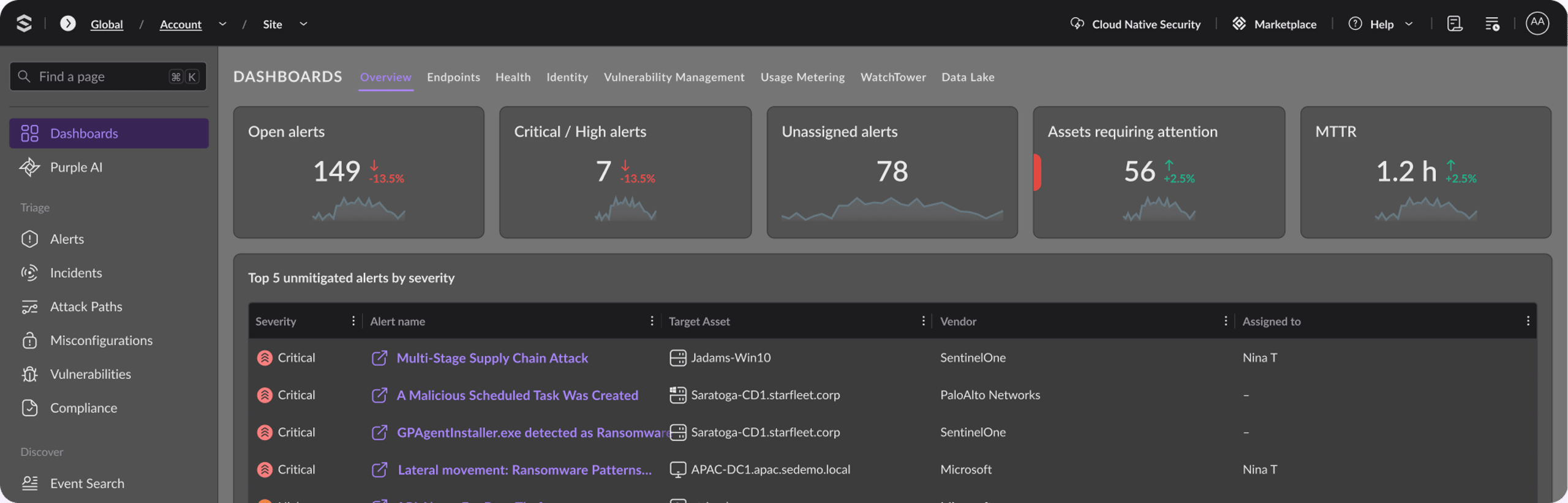
SentinelOne combines endpoint detection, response, and recovery in one platform, and it is built to catch threats no signature has seen yet. Its 1-click rollback reverses unauthorized changes and restores endpoints to their pre-attack state without reimaging. Security automation carries the load underneath all of it, cutting manual work and giving analysts their time back.
Platform at a Glance
- Singularity™ Platform: This combines everything SentinelOne has to offer. It builds the right foundation for enterprise-wide cybersecurity. You get one intelligent platform that brings you unfettered visibility, industry-leading detection, and autonomous response. Through this one holistic solution, you get access to Purple AI™, Singularity AI SIEM, Singularity Cloud Security, Singularity Endpoint, and even Singularity Identity. It also covers email and network security, and manages unstructured data and logs. Take the Singularity Complete tour to find out more.
- Singularity XDR: This extends detection and response beyond the endpoint, across every surface the Singularity Platform covers. It ingests and normalizes data from any source, correlates activity across attack surfaces, and gives you the full context of an attack instead of fragments. Automated workflows prioritize incidents the moment something breaks through.
- Singularity Network Discovery: This is a network discovery tool which is built into the existing endpoint agent. It maps and monitors unmanaged IoT devices across the enterprise network without needing users to install any extra software.
- Singularity Cloud Security: SentinelOne’s agentless cloud-native application protection platform (CNAPP) extends security to cloud-native environments. It combines real-time agent protection with agentless scanning for Kubernetes, containers, and cloud VMs. It also delivers AI security posture management (AI-SPM), infrastructure-as-code scanning, compliance support, and detection of 850+ secret types across both public and private repositories, including GitLab, Bitbucket, and GitHub. Read the CNAPP buyer’s guide for more details.
- Prompt Security: This gives your organization full control over how AI is actually being used. It eliminates shadow AI blind spots, prevents sensitive data and secrets from leaking into public LLMs, and blocks AI-specific threats including prompt injection, jailbreaks, and unsafe model outputs that legacy tools were never built to catch. It governs agentic AI systems and Model Context Protocol (MCP) servers, blocking unauthorized actions before they become incidents. It also enforces AI usage and compliance policies across your entire workforce, giving security teams the visibility they need into how tools are being used and how policies are being applied, without disrupting how people work.
Key Features
- With Prompt Security, you can prevent secrets and intellectual property (IP) from leaking into LLM prompts, and enforce AI usage policies across development environments.
- SentinelOne protects the AI applications you build. Custom apps are shielded from data leaks, unsafe LLM outputs, and prompt injection, with security policies enforced at runtime.
- Enforces least-privilege policies across agents and MCP server activity and stops unauthorized actions before they reach critical resources.
- Singularity Binary Vault automates malicious and benign file uploads and forensic analysis. It grants insights into newly introduced binaries with automations that sweep samples into the SentinelOne cloud.
- On-device Behavioral AI detects attacks using local machine learning (ML) models on the device. It identifies ransomware or malicious activity even if the device is completely offline.
- If ransomware does encrypt files, SentinelOne's 1-click rollback feature can instantly reverse the unauthorized changes. It restores files, registry keys, and system settings to their pre-attack state using shadow copies.
- SentinelOne also comes with static and behavioral engines. It replaces legacy antivirus by identifying known file signatures and unknown, suspicious process behaviors at the same time.
- Singularity Marketplace integrates third-party tools (like firewalls, identity providers, and email security) to automatically ingest data and trigger response actions outside the endpoint.
- SentinelOne’s data lake retains massive volumes of enterprise telemetry data at low cost, so security teams can hunt across long lookback windows instead of the last 30 days.
- SentinelOne's Offensive Security Engine™ with Verified Exploit Paths™ acts as an automated red teamer, safely attacking your own cloud infrastructure to prove which vulnerabilities are actually dangerous. You get evidence-based prioritization instead of a severity score.
Core Problems That SentinelOne Solves
- Analysts stop piecing logs together by hand to work out how an attack unfolded. SentinelOne's Storyline™ technology maps the events into a single visual timeline automatically.
- Blocks and quarantines threats in real-time, even if devices go completely offline. 1-click rollback restores files back to their pre-encrypted state instantly.
- AI-assisted operations via Purple AI can translate your natural language queries into security actions. You can execute system commands instantly and isolate threats.
- SentinelOne cuts false positives by validating which exposures are genuinely exploitable rather than theoretically vulnerable. That also puts advanced threat hunting within reach of junior analysts.
- SentinelOne defends against ransomware, zero-days, and data loss, and cuts investigation time from hours to minutes. Alert volume drops, and everything runs from one console.
Testimonial
“SentinelOne CSPM is part of the Singularity Cloud security platform that helps organizations identify and fix security misconfigurations in their cloud environments. It works without agents and provides instant visibility of all cloud assets across multiple cloud platforms like AWS, Azure and Google Cloud. CSPM continuously monitors cloud resources, detects security gaps, compliance issues, and risky configurations and prioritizes them using AI. It improves your overall cloud security posture.” -IT Associate
Reviews and Ratings
Look at Singularity Cloud Security’s ratings and reviews on Gartner Peer Insights and PeerSpot for additional insights.

Unleash AI-Powered Cybersecurity
Elevate your security posture with real-time detection, machine-speed response, and total visibility of your entire digital environment.
2. Darktrace
Darktrace's Adaptive AI learns how an organization actually behaves, then flags deviations from that profile. It covers connected devices, cloud services, and industrial systems, acts on attacks in progress, and provides visualization tools for investigation and incident response.
Features:
- Darktrace builds a behavioral profile for the organization it protects and updates it continuously, flagging deviations without predefined rules or threat signatures.
- Darktrace Autonomous Response can take targeted action to interrupt threats in progress, such as blocking specific connections or quarantining devices, without requiring human approval.
- E-mail security module monitors communication patterns to detect phishing, account takeover, and impersonation attacks that bypass standard gateway filters.
- The platform provides coverage across on-premises networks, cloud environments, operational technology (OT) systems, and endpoints through a single management interface.
- Cyber AI Analyst automatically investigates alerts and compiles incident reports, cutting down the time analysts spend manually piecing together attack timelines.
Look at Darktrace’s ratings and reviews on Gartner Peer Insights and G2 for additional insights.
3. Vectra AI
The Vectra AI Platform monitors traffic across data center, cloud, identity, and SaaS environments to surface threats that endpoint tools miss. Vectra positions it as AI-native security and observability, with network detection and response (NDR) at its core. It uses behavioral analysis to detect lateral movement, privilege abuse, and command-and-control activity, then prioritizes the findings that matter most so analysts spend less time chasing noise.
Features:
- Attack Signal Intelligence correlates detections across network, identity, and cloud layers, so analysts focus on the most urgent incidents rather than individual low-level alerts.
- The platform operates agentlessly, deploying coverage in hours by pulling metadata from network traffic and cloud APIs without requiring changes to endpoints or workloads.
- Automated host, account, and traffic containment lets teams isolate compromised identities or block malicious connections in real time, either natively or through integrations with existing endpoint detection and response (EDR) and security information and event management (SIEM) tools.
- Vectra covers hybrid environments, including on-premises data centers, AWS, Azure, GCP, Microsoft 365, and OT/IoT infrastructure.
- It maps detections and generates reports that show security posture changes over time.
Compare Vectra AI’s ratings and reviews with SentinelOne on G2 and PeerSpot for additional insights.
4. Salt Security
Salt Security is an API protection platform that discovers, monitors, and secures every API in an organization’s environment, including shadow and zombie APIs that standard gateways miss. It analyzes API traffic over time to detect attacker behavior, enforce posture policies, and map coverage against frameworks including the OWASP API Security Top 10.
Features:
- Salt's platform discovers all APIs across cloud, on-premises, and hybrid environments, including endpoints that teams missed or deployed accidentally.
- It uses behavioral analysis to detect low-and-slow attacks. A Posture Governance Engine maps APIs against frameworks like OWASP, PCI DSS, GDPR, and NIST, flagging misconfigurations and broken authentication issues before they get exploited.
- Salt MCP Finder discovers MCP servers in agentic AI deployments, and Salt Protect monitors interactions between AI agents and those servers, blocking unsafe or unauthorized actions.
- Attacker insights are generated using an LLM that translates attack patterns into plain-language summaries, so analysts can understand intent and act on findings without deep API expertise.
Read Salt Security’s ratings and reviews compared to SentinelOne on PeerSpot for additional context.
5. IBM QRadar
IBM QRadar collects and correlates log data, network flows, and threat intelligence across an organization’s infrastructure to identify security incidents. It helps security teams detect threats, investigate alerts, and manage compliance through a console that brings together data from different sources. Note that IBM sold the QRadar SaaS products to Palo Alto Networks in 2024 and now sells QRadar as a self-managed, on-premises platform, so evaluate it on that basis.
Features:
- QRadar ingests log and flow data from hundreds of data sources through a library of device support modules (DSMs).
- Its rule-based correlation engine applies hundreds of built-in offense detection rules, and teams can write custom rules to match their specific environment and threat models.
- QRadar Investigation Assistant, IBM's watsonx-powered assistant, automatically investigates offenses, surfaces relevant context, and suggests response steps. It replaces QRadar Advisor with Watson, which reached end of life in August 2026.
- IBM QRadar Network Insights adds deep packet inspection to give teams application-layer visibility into their traffic.
- The platform supports compliance reporting for frameworks including PCI DSS, HIPAA, and SOX, with pre-built report templates that map event data to regulatory requirements.
See more on what users have to say about IBM QRadar SIEM on Gartner Peer Insights.
6. Palo Alto Networks
Palo Alto Networks offers a portfolio of cybersecurity products spanning network security, cloud security, and security operations, built around its Cortex and Prisma platforms. Its tools cover threat prevention at the network edge, cloud workload protection, XDR for detection and response, and Secure Access Service Edge (SASE) for secure remote access.
Features:
- Cortex XDR collects telemetry from endpoints, network, cloud, and identity sources, stitching related events into incidents and applying behavioral analytics to catch threats that signature-based tools miss.
- Cortex Cloud, which replaced Prisma Cloud in 2025, is a CNAPP that secures cloud-native workloads across multiple cloud providers, covering misconfiguration management, workload protection, container security, and infrastructure-as-code scanning.
- Next-Generation Firewalls use App-ID, User-ID, and Content-ID to inspect traffic at the application layer, enforcing policies based on identity and content rather than just ports and protocols.
- Cortex XSOAR is a Security Orchestration, Automation, and Response (SOAR) platform that helps security teams build playbooks to automate repetitive response tasks, reducing mean time to respond across common incident types.
- Prisma AIRS, Palo Alto's AI security platform, covers threats to LLM-based applications, detecting prompt injection attacks, data leakage through AI interfaces, and unsafe model outputs in production environments.
See how good Palo Alto Networks is as an AI security vendor by evaluating its Gartner Peer Insights and PeerSpot ratings and reviews.
7. Wiz
Wiz, a Google Cloud company since March 2026, is a cloud security platform that connects to cloud environments through APIs and scans for risks across workloads, containers, data, identities, and infrastructure configurations. It correlates findings across layers to surface attack paths that individual point tools might miss, helping security teams focus remediation on what is most likely to be exploited.
Features:
- Wiz’s Security Graph connects vulnerabilities, misconfigurations, exposed secrets, and network exposures into a visual attack path, showing which combinations of risks create real exploitation risk.
- Cloud Infrastructure Entitlement Management (CIEM) identifies overly permissive IAM roles and service accounts, helping teams right-size access before attackers leverage excessive privileges.
- Container and Kubernetes security scans images in registries and running clusters for vulnerabilities, misconfigurations, and compliance violations. An optional eBPF runtime sensor adds deeper runtime coverage.
- Wiz Code extends scanning left into development pipelines, checking infrastructure-as-code templates and container images before they reach production environments.
- Data Security Posture Management (DSPM) finds sensitive data stored in cloud buckets and databases, maps who can access it, and flags exposure risks tied to misconfigurations or overly broad permissions.
Explore the feedback and ratings on G2 and PeerSpot to get further insights into Wiz’s capabilities.
8. Cyera
Cyera positions itself as an AI security platform built on data intelligence. It discovers, classifies, and monitors sensitive data across cloud, SaaS, on-premises, and database environments from a single interface, then shows who can access that data and what risk those access patterns create.
Features:
- Cyera automatically maps which web-based and internal AI tools your employees are using.
- Browser Shield inspects prompts in the browser in real time and can send alerts about policy violations.
- Agent Guardian monitors how autonomous AI agents and copilots interact with your data. It can prevent data losses and reduce alert fatigue.
See how Cyera compares to SentinelOne by reading its reviews and ratings on PeerSpot.
9. Cato Networks
Cato Networks converges SD-WAN, network security, and zero-trust access into a single cloud-native service delivered through a global private backbone. It gives organizations a way to connect all sites, users, and cloud environments through one platform with a unified policy engine, replacing a mix of separate networking and security point products.
Features:
- A single-pass engine inspects all network traffic, applying firewall, routing, and threat prevention policy in one place.
- You get Firewall as a Service and a secure web gateway to enforce web access policy and keep users away from malicious destinations.
- It provides a cloud access security broker (CASB) for shadow IT discovery, plus data loss prevention (DLP). Cato AI Security, generally available since March 2026, analyzes prompts for compliance and protects homegrown AI apps from jailbreaks and prompt injection.
Evaluate Cato Networks’ ratings and reviews compared to SentinelOne on PeerSpot for additional context.
10. Checkmarx
Checkmarx One is an application security platform that helps development teams find and fix code vulnerabilities before software ships. It scans source code, open-source dependencies, and infrastructure-as-code configurations across development pipelines, giving security teams and developers a single place to manage findings.
Features:
- Software composition analysis (SCA) identifies vulnerabilities, license compliance risks, and malicious open-source packages in third-party libraries.
- NG SAST performs static application security testing, and Developer Assist reviews AI-generated code in the IDE before it lands.
- Malicious Package Protection blocks known-bad open-source packages from entering the build. Its LLM Scanner inspects Python source bundled inside AI model packages, and is not a runtime or prompt-injection scanner.
- Secrets Detection prevents hardcoded secrets from reaching repositories, and API Security maps shadow APIs.
See how well Checkmarx performs in AI security by reviewing its PeerSpot ratings.
11. CrowdStrike Falcon
CrowdStrike Falcon is an AI cybersecurity vendor that provides endpoint detection, response, and threat visibility. Its cloud platform processes security events at scale, so teams can hunt threats automatically and cut the time an intruder stays resident.
Features:
- Falcon consolidates endpoint telemetry from across your environment. Security teams get one view of threats, which makes investigations quicker to run.
- Its Threat Graph database processes and correlates event data, connects indicators across endpoints, and helps analysts identify attack patterns.
- Falcon Fusion SOAR builds automated workflows that trigger response actions based on detections, which cuts manual alert triage and speeds up containment.
- Falcon Identity Protection monitors authentication activity to catch credential-based attacks like pass-the-hash, lateral movement, and account takeover attempts.
- Falcon Guardian, renamed from Falcon AI Detection and Response in September 2026, inventories known and shadow AI agents on Windows and macOS, links agent behavior to endpoint telemetry, and blocks prompt injection and jailbreak attempts at runtime.
See what CrowdStrike’s position is in the AI security segment by going through its latest Gartner Peer Insights and G2 reviews and ratings.
12. Microsoft
Microsoft offers a suite of security products covering endpoints, identity, cloud workloads, and email, all of which integrate natively with the Microsoft 365 ecosystem. Organizations already running Microsoft infrastructure can use it to get centralized threat detection and response across their environment without adding separate agents or connectors for covered surfaces.
Features:
- Defender for Endpoint provides endpoint protection, EDR, and threat and vulnerability management across Windows, macOS, Linux, Android, and iOS devices from a single console.
- Microsoft Defender XDR correlates signals from endpoint, identity, email, and cloud app sources automatically, linking related alerts into unified incidents so analysts see the full scope of an attack without manual pivot work.
- Defender for Cloud Apps acts as a CASB, giving visibility into SaaS application usage, enforcing access policies, and detecting risky behavior like excessive data downloads or access from anomalous locations.
- Defender for Identity monitors Active Directory and Entra ID for credential-based attacks such as pass-the-ticket, DCSync, and lateral movement using compromised accounts.
- Threat intelligence from Microsoft’s global sensor network feeds detections across the suite, surfacing indicators tied to known threat actor groups and campaigns.
- Microsoft Security Copilot is embedded in the Defender portal for incident investigation, threat hunting, and natural-language queries, and it runs prebuilt agents across Defender, Entra, Intune, and Purview. It is included in the Microsoft 365 E5 entitlement.
Check out Gartner Peer Insights and G2 reviews to see what users have to say about Microsoft Defender.
How to Choose the Best AI Cybersecurity Vendor?
When comparing AI cybersecurity vendors, you should look at factors such as their scalability, accuracy, and flexibility. Here are some helpful criteria you can use to evaluate them:
- Can they spot anomalies and flag unusual behaviors in real-time? You'll want their solutions to also run on both local and cloud setups. The protection should expand as your company grows and their tools should respond automatically.
- What’s their volume of false positives like? AI cybersecurity vendors should be able to detect false positives and keep them as low as possible. Vendors should give clear proof of accuracy which must be backed by real-world results.
- Can they integrate with your existing tech stack? Especially with SIEM, SOAR, and EDR tools. This can help minimize managing disparate tools, break down silos, and improve response times overall.
- How is their compliance support? The last thing you want is to violate a regulatory benchmark and be slapped with a hefty legal fine. Check if your AI cybersecurity vendor supports regulations including PCI DSS, HIPAA, and GDPR. Automated compliance is a big plus.
- Has the vendor's own environment or supply chain been compromised, and how did they disclose it? Security vendors are high-value targets, so being attacked is not by itself disqualifying. What matters is whether they detected it, what they told customers, and how quickly. Check the public record, and weigh a vendor that published its own incident ahead of the news cycle more favorably than one whose disclosure arrived only after outside pressure.
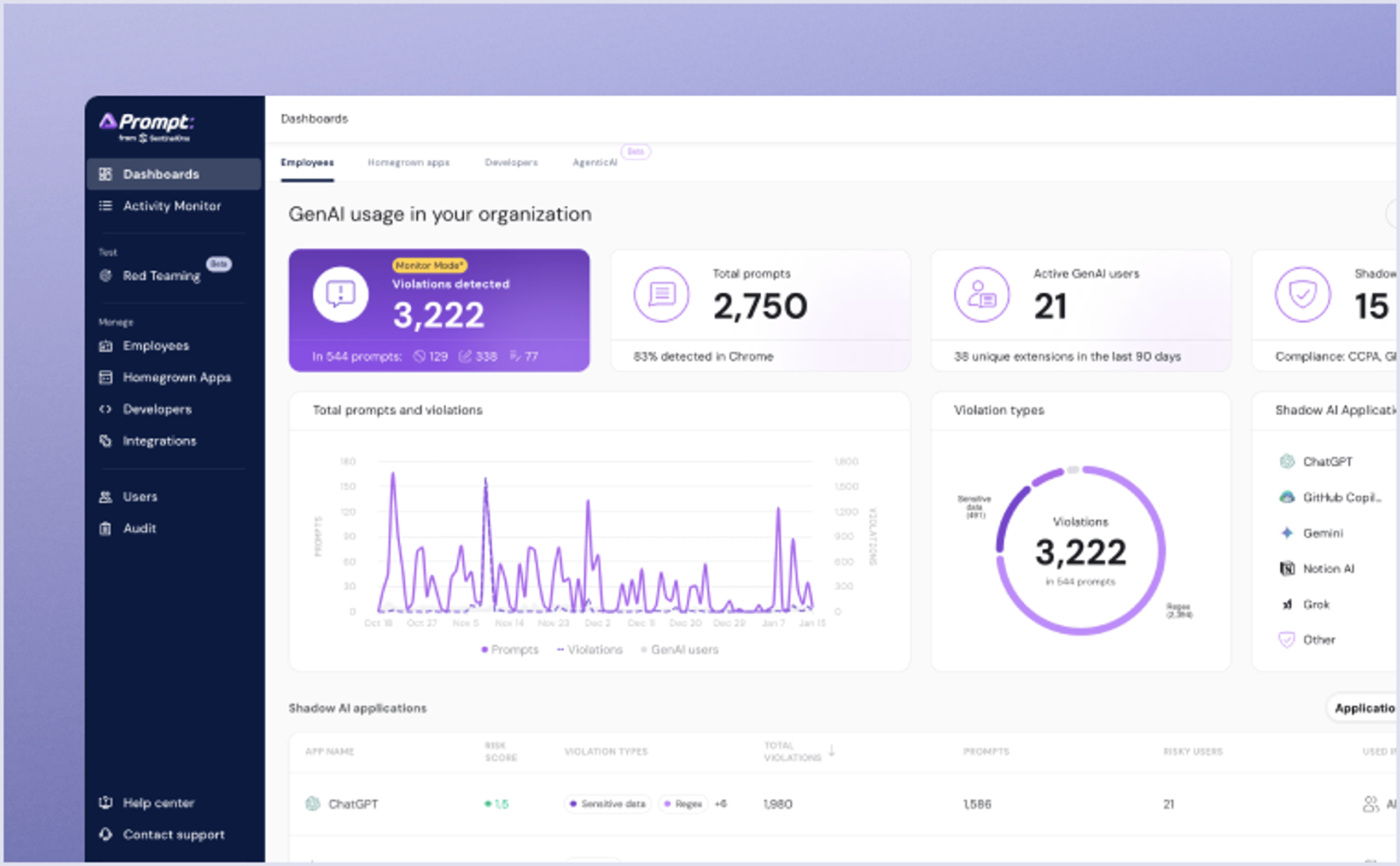
Get complete visibility, security and governance over AI usage in your organization. Uncover shadow AI, protect your sensitive data and safely enable AI in the organization.
Conclusion
Choosing the right AI cybersecurity vendor saves you a great deal of pain later. Every option above is a defensible starting point, and the work now is matching one to your environment. Check that the capabilities you are paying for are the ones your team will actually use, and be honest about whether you need a full platform or a specific set of use cases.
SentinelOne can give you tailored guidance if that helps. Do your research, see which vendor matches your business requirements and then pick accordingly.
AI Cybersecurity Vendors FAQs
Traditional antivirus relies on known signatures to catch malware. AI vendors look at how programs behave to stop new threats. That makes them a lot better at catching zero-day attacks. You can use them together.
The AI will handle unknown threats while the antivirus handles old ones. It's not about one being perfect, but AI gives you a bigger safety net.
Two different things get called AI security. The first is a traditional tool that uses machine learning to do its existing job better, such as an EDR that scores behavior instead of matching signatures.
The second is a platform built to secure AI itself: the models your teams build, the assistants your staff adopt, and the agents acting on your behalf. Your existing EDR and SIEM cover the first. Neither was designed for the second.
Ask what the number was measured against. A detection rate quoted without a test corpus, a false-positive figure, and a date is marketing, not evidence. Independent references worth requesting include MITRE ATT&CK Evaluations, which publish per-technique results, and any third-party test whose methodology is public.
Then run a proof of concept against traffic from your own environment, because a vendor tuned to someone else's baseline will generate noise in yours.
An AI agent is an identity that acts, often with permissions nobody deliberately granted it. The controls to ask about are discovery, so you know which agents and MCP servers exist, least-privilege enforcement on what each one can reach, and session-level logging that records what an agent was asked, what it did, and under whose credentials.
Without that last part, you cannot reconstruct an incident involving an agent after the fact.
It depends where the data comes from. Agentless cloud connectors read through provider APIs and return findings in hours. Endpoint agents take as long as your change management does, and staged rollouts across a large estate are usually measured in weeks.
The longer work is tuning: suppressing the alerts that do not matter in your environment, and integrating with the SIEM, ticketing, and identity systems you already run.
Discover More About Data and AI



Ready to Revolutionize Your Security Operations?
Discover how SentinelOne AI SIEM can transform your SOC into an autonomous powerhouse. Contact us today for a personalized demo and see the future of security in action.