How to Prevent Account Hijacking?
Prevent a data breach by learning how to prevent account hijacking and stop your credentials from being stolen or misused. Here’s what you should know about this attack technique.
Accounts are the backbone of every business. Users need them to operate across the organizations, do file exchanges, and interact with others. It’s a communication web; networks cannot be set up without accounts. Unfortunately, administrator accounts are not the only ones susceptible in organizations.
Hackers target ordinary users and attempt to escalate their privileges. You can call hijacking the act of taking over something. This guide will provide an overview of the concept and tell you how to prevent account hijacking.
What is Account Hijacking?
Account hijacking occurs when someone invades your user account by accessing your application. Once they can access the account, they can publish content in your name, commit fraud, or impersonate you. Account hijacking is one of the fastest ways to cause severe damage and exploit vulnerabilities across infrastructures.
The Consequences of Account Hijacking
Account hijacking has many consequences, including being hacked and accessed by an unauthorized individual. Hijacked accounts are a gateway to sensitive data and can leak trade secrets about organizations, customers, employees, and other proprietary information.
Businesses can permanently lose valuable information and expose it to unauthorized parties. Account hijacks have financial costs; some losses from paying ransoms can amount to millions. Your organization will also face many regulatory fines and penalties, and significant recovery costs, including system repairs, will be involved.
Account hijacking can damage an organization’s reputation and image. Customers and partners will lose faith and confidence in the firm’s ability to protect itself.
This will result in lost business opportunities, and new clients might move away from your brand. Hijacked accounts also cause operational disruptions and impact business continuity. They can delay projects, affect workplace productivity, and lower morale.
How Does Account Hijacking Work?
It’s essential to remember that account hijacking is not the same as account fraud. In hijacking, the hacker takes over your social media profiles, corporate handles, session logins, and any other credentials you possess. They use those details to log in to your respective platforms, wherever you are active. Account fraud is creating a fake profile that mimics your original identity.
In account hijacking, when an attacker compromises your account, they can move laterally through your network and launch further attacks.
Standard Methods Used in Account Hijacking Attacks
Account hijacking can use a mix of different techniques to compromise user accounts. Some of them are:
Phishing
Phishing occurs when users accidentally give out their credentials by interacting with malicious emails. These emails often appear to come from legitimate sources and include proof enough to convince the victim that they are interacting with the right person. In phishing, the attacker might manipulate the victim into making unauthorized financial transactions or even impersonate legitimate services via phone numbers or fake websites.
Social Engineering
Social engineering is when the attacker gets into the mindset of the victim and manipulates them by tapping into their emotion. They might get the victim to trust them, open up, and share sensitive information. Social engineering could also use scare tactics, fear, and other negative emotions, which might jolt the victim into taking immediate action.
Man-in-the-Middle Attacks
These are attacks where the attacker will compromise communications between two parties and eavesdrop on their sensitive data exchanges.
Credential Stuffing
Credential stuffing attacks occur when attackers use automated tools to generate many user password combinations. These combos are generated from previous data breaches and use a guessing technique. Credential stuffing works best for users who commonly reuse passwords across multiple websites and apps. So, if one account can be cracked, the others will be compromised since they use similar passwords.
There is no need to hack into the environment; once an attacker figures out the password, they can log into your account instead.
Malware and Trojans
These can involve keyloggers that record your keystrokes when you type sensitive information. If your device is impacted and you engage with a malicious web form you aren’t aware of, the k; their malware can steal your sensitive information without your knowledge.
How to Detect Account Hijacking Attempts?
Here are some warning signs you should look for to determine whether your account is being hijacked.
- Weird login activities—Pay close attention to suspicious logins in your network. These may include unexpected logins from unknown geolocations or devices or logging in at unusual hours of the day that don’t match your employees’ standard usage patterns.
- Unusual email movements – If the emails in your inbox suddenly get deleted or go missing, you know something is up. Look for cases where your read emails are moved to the spam folder or other folders. If you didn’t approve these changes, someone else is doing it.
- Account recovery requests—You may receive repeated account recovery requests. Someone may send you the OTP to your phone and lure you into divulging sensitive information. If you didn’t issue a recovery request, be wary.
- Unverified IP addresses—It’s a dead giveaway if unverified IP addresses attempt to communicate with your cloud services or connect to the organization’s networks.

Enhance Your Threat Intelligence
See how the SentinelOne threat-hunting service WatchTower can surface greater insights and help you outpace attacks.
Best Practices to Prevent Account Hijacking
Protecting your organizations with multi-layered phishing protection can prevent account hijacking attacks. Teaching your employees to recognize the signs of an incoming attack is also crucial.
They should know what to say to adversaries and what not to say. Being aware of the latest social engineering practices can boost their confidence. They will learn how to handle incoming threats and neutralize them whenever they attempt to engage with them.
Use continuous threat detection and monitoring technologies to detect signs of account misuse, inactivity, and suspicious behaviors. AI-based threat detection can monitor your endpoints around the clock and immediately alert you if it detects anything wrong. Endpoint protection tools can also prevent account hijacking by continuously monitoring your endpoints, assets, users, and IoT devices.
Consider hiring security experts outside of using automation tools who can give you human reviews occasionally. They will tell you whether your security strategy is working as intended or if it needs areas of improvement.
Tell your employees to rotate their passwords regularly and not use the same password everywhere. Implementing proper cyber hygiene practices and not sharing sensitive information with strangers online is also essential.
Organizations today are encouraged to adopt advanced practices that go beyond the traditional security solutions identified above. One key focus area is implementing a Zero-Trust framework. This step reduces the chance of unwanted access by viewing each access attempt as untrusted and constantly authenticating it. Even when malicious actors surpass initial protective measures, Zero-Trust helps curtail lateral movement and compartmentalize potential damage.
Another important innovation is the application of machine learning-based behavioral analysis. These systems monitor user behavior in real-time and look for irregular patterns that could suggest hijacking attacks. For example, abrupt alterations in login IP addresses, uncommon access times, or deviations from defined user profiles can generate instant alerts, allowing for immediate incident response. Combining such analytics with practical Security Information and Event Management (SIEM) solutions further enhances monitoring and response capabilities.
Regular security awareness training is also required. Periodically, simulated phishing campaigns and updated training modules enable employees to identify and counter social engineering methods easily. Coupled with strict password policies, multi-factor authentication, and biometric identification, these training modules strengthen security habits.
Real-World Examples of Account Hijacking
Account hijacking doesn’t stop at stealing login credentials. Thieves have no honor, and they will steal phone numbers, too. SIM-swapping crimes have increased since 2021, and the FBI says that port-out hijacking incidents are under review.
Storm-0501 is one of the best stories of account hijacking in the real world. Ransomware attackers hopped from on-premises systems to the cloud to compromise Microsoft 365 user accounts. They launched high-profile ransomware-as-a-service attacks and compromised targets, exploiting weak credentials and overprivileged access rights. They gained control over the whole network and created persistent backdoor access to cloud environments.
The threat actor was active for over three years and riddled target organizations with ransomware streams like Blackhat, Lockbit, Hive, etc. They even dropped the Embargo ransomware and performed network reconnaissance to identify high-value assets.
Mitigate Account Hijacking Attacks with SentinelOne
SentinelOne can help you defeat every attack at any stage of the threat lifecycle, no matter where it is. It can perform cloud-based security audits, internal and external audits, and inventory your assets. It can detect whether your resources are being overused or underutilized and pinpoint behaviors coming from user accounts. If any users act beyond their established baselines, SentinelOne can flag their accounts for investigation.
You can also identify and map out dormant and inactive accounts to avoid misusing them. SentinelOne’s unique Offensive Security Engine™ with Verified Exploit Paths™ can predict and detect account hijacking attacks before they happen. It can launch attack simulations on your infrastructure to probe for vulnerabilities and tell you more about your security strategy. You can enforce consistent security policies across multi-cloud and hybrid ecosystems by using SentinelOne’s platform.
SentinelOne can reduce the number of false alerts, minimize alert noise, and prevent zero days. It can also fight against social engineering, ransomware, phishing, and other cyber threats. SentinelOne can monitor your endpoints, assets, users, and IoT devices and extend endpoint protection. Its agentless CNAPP offers comprehensive security capabilities such as CSPM, CWPP, SSPM, EASM, KSPM, CDR, and other security features.
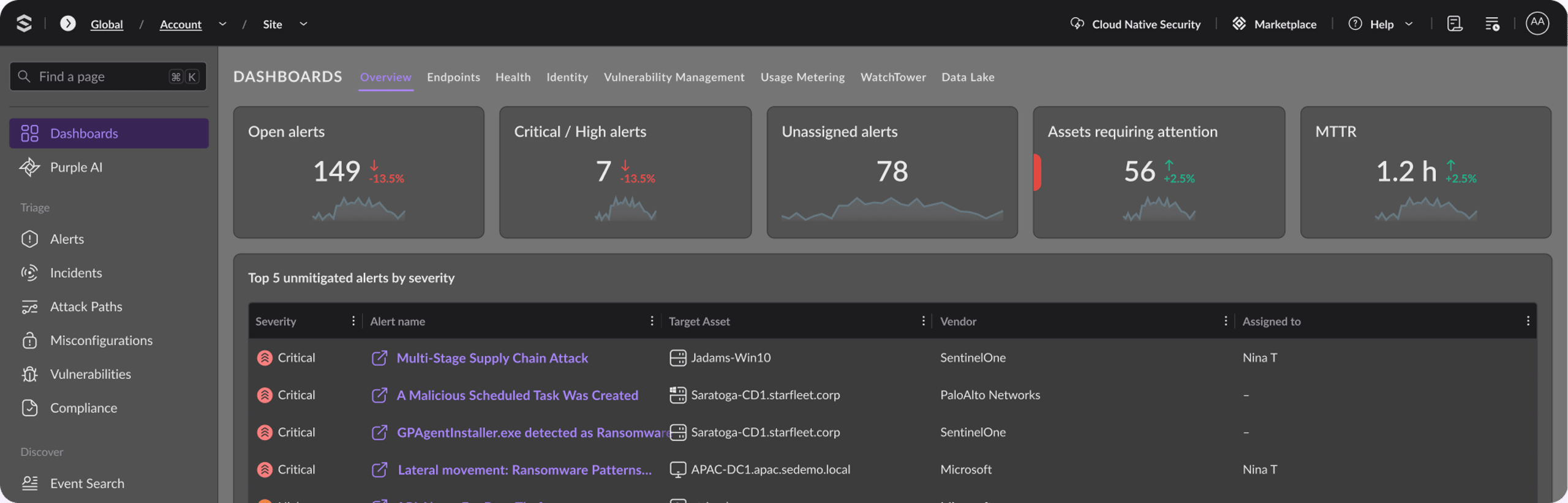
Purple AI is SentinelOne’s Generative AI Cybersecurity Analyst. It can provide unique insights into your accounts.
Book a free live demo to learn more.
Conclusion
Account hijacking is an ongoing threat that requires proactive countermeasures and ongoing vigilance. Knowledge of how cybercriminals operate allows organizations to install multi-layered security measures, train employees, and use the best account monitoring software.
These best practices reduce the potential for unauthorized access and protect valuable data and business continuity. Stay informed and ready to respond as the cyber threat evolves.
Take a strategic security stance and explore solutions such as SentinelOne to bolster your defenses further. Invest in good cybersecurity today and secure your organization’s future.
FAQs
Account hijacking in cybersecurity is the unauthorized takeover of a user’s account by cybercriminals via vulnerabilities like weak passwords or phishing attacks. Once the account is compromised, hackers can impersonate users, retrieve sensitive data, and further attack systems. This security breach not only sabotages operations but also compromises confidential information and undermines trust, making it imperative for firms to learn about and prevent it.
Organizations must react to account hijacking by isolating affected accounts as quickly as possible, performing an in-depth investigation, and taking a strong incident response. These include password resets, multi-factor authentication, and reviewing recent account activity. Teams must also inform stakeholders, reinforce security policies, and deploy enhanced monitoring tools to identify anomalies in a timely fashion. A rapid, forceful response reduces damage and allows trust and business stability to be rebuilt.
Typical hijacking signs are suspicious login patterns, such as unauthorized access at unknown locations or terminals, unintended account configuration updates, and strange transactions or emails. Users might also notice strange data transfers or recurrent password reset prompts, indicating unauthorized modification. These symptoms necessitate the immediate examination and active investigation of any violation to ensure and terminate further unauthorized utilization or account exposure.
If your account has been compromised, act fast by securing your login and alerting your service provider immediately. Update your passwords, activate multi-factor authentication, and check for unauthorized transactions in recent activity. Alert your IT staff or cybersecurity professionals to scan and contain the breach. Alert appropriate contacts promptly and involve professional services to evaluate and contain the damage, securing your digital assets and preventing future breaches.
Session hijacking involves seizing an existing user session, enabling attackers to bypass authentication without knowing the user’s login credentials. Credential theft, however, focuses on usernames and passwords that can be used for unauthorized access in the future. Both activities undermine account security, but session hijacking exploits live connections to steal existing sessions. In contrast, credential theft focuses on stored or transmitted authentication details that can be used in the future.
Discover More About Threat Intelligence



Ready to Revolutionize Your Security Operations?
Discover how SentinelOne AI SIEM can transform your SOC into an autonomous powerhouse. Contact us today for a personalized demo and see the future of security in action.