10 Zero Trust Vendors in 2026
This article explores 10 leading Zero Trust vendors in 2026. From cloud-based access controls to AI-driven threat detection, see how they harden defenses and reduce cyber risks for businesses.

Zero Trust models have taken center stage in the cybersecurity world, driven by the rise of cloud computing, remote work, and the constant inventiveness of threat actors. Traditional perimeter-based defenses cannot match modern exploits that bypass firewalls and pivot through compromised accounts. Due to this, organizations look toward Zero Trust vendors who emphasize continuous verification of every user, device, and application session. In fact, 63% of enterprises have started deploying the Zero Trust security model in some form, mostly starting with a selective use case. These solutions will, by default, implement the “never trust, always verify” principle.
This article provides insight into exactly how zero-trust companies take advantage of identity-centric policies, real-time monitoring, and policy-based segmentation to ensure that attackers get very few soft spots. We will also look at the advanced features cybersecurity companies using zero trust are incorporating into their services, such as AI-driven anomaly detection and zero-trust vulnerability management to harden multi-cloud and hybrid infrastructures.
Be it coping with remote work, intricate supply chains, or compliance demands, your organization will realize the importance of a zero trust architecture in 2026.
What is Zero Trust?
Zero Trust is a cybersecurity framework that eliminates the concept of an internal network perimeter that is trusted by default. Instead, every user request, every device, and every application session is verified through strong authentication and authorization—no matter the location, role, or device posture. The model runs in opposition to legacy cyber security strategies, where once you pass an initial gate, you typically face minimal scrutiny.
Fundamentally, Zero Trust is based on continuous authentication, least-privilege access, and micro-segmentation. Continuous authentication ensures that user sessions remain verified based on real-time risk assessments and not on one-time password checks. Least privilege means giving employees, contractors, and services only the minimum permissions necessary to perform their tasks manually, minimizing potential damage radiuses. Micro-segmentation further compartmentalizes resources so that in case a threat actor manages to compromise an endpoint or account, it will inhibit lateral movement.
Modern zero trust vulnerability management also plays a role in proactively finding weak spots in infrastructure components-servers, containers, SaaS platforms-before bad actors can exploit them. Solutions from Zero Trust vendors often integrate with Identity and Access Management, endpoint security, and cloud workload protection, forming a cohesive, policy-driven environment. Whether you have a hybrid cloud environment or a fully remote workforce, Zero Trust ensures that no user or workload is implicitly trusted without continuous verification.
Need for Zero Trust Vendors
Did you know? About 86% of organizations consider unsecured access to private applications by third-party contractors a top security concern to be addressed with Zero Trust solutions.
With corporate perimeters fast dissolving and attackers getting bolder, the question is no longer if you need Zero Trust but how quickly you can have it.
Following is a list of the key drivers for the adoption of Zero Trust vendors:
- Hybrid & Multi-Cloud: Companies working with AWS, Azure, Google Cloud, and on-premises systems create complex networks with multiple ingress points. A Zero Trust architecture imposes consistent security rules across all environments, ensuring users must re-authenticate for each resource and role.
- Remote Workforces: With more employees working from home, traditional VPNs scale badly. Zero Trust centralizes identity verification and then applies context-based rules such as device posture, geolocation, or threat intelligence to allow access. This approach enhances security and provides a more seamless user experience compared to traditional VPNs as the number of remote users increases.
- Advanced Threats: Credential stuffing, phishing, and zero-day exploits are used to evade traditional defenses by attackers. Zero trust companies inject AI-powered detection into each stage of an attack that can stop the threat at the authentication phase or block malicious lateral movement.
- Regulatory Compliance: Regulations such as HIPAA, PCI DSS, and GDPR demand the strict and auditable logging of and controls associated with data access. Zero-trust cybersecurity companies are monitoring in one go and then applying micro-segmentation. This enables the compliance audit to be easier which may prove the minimal data exposure.
- Supply Chain & B2B Collaboration: Companies are increasingly integrated with vendors, partners, and contractors. Overexposure of internal resources can be disastrous if a partner system gets compromised-a Zero Trust approach segregates the resources and allows granular role-based access to mitigate such supply chain risks.
- Smaller Attack Surfaces: Traditional networks have large segments of trust. When one segment is compromised, many others can be accessed as well. Zero Trust eliminates large zones of trust by confining users or devices to only those apps and data they need to fulfill their role. This limits the impact of a potential breach by containing the compromise to a smaller area.
With these challenges, paying attention to zero trust vulnerability management and continuous policy enforcement is no longer optional. The sections that follow will outline the best Zero Trust Vendors that bridge these requirements.
Zero Trust Vendors Landscape in 2026
Here are ten of the most noteworthy zero-trust companies that guarantee real identity-centric Zero Trust with micro-segmentation, comprehensive analytics, and threat detection across all hybrid, on-premises, and multi-cloud environments.
SentinelOne
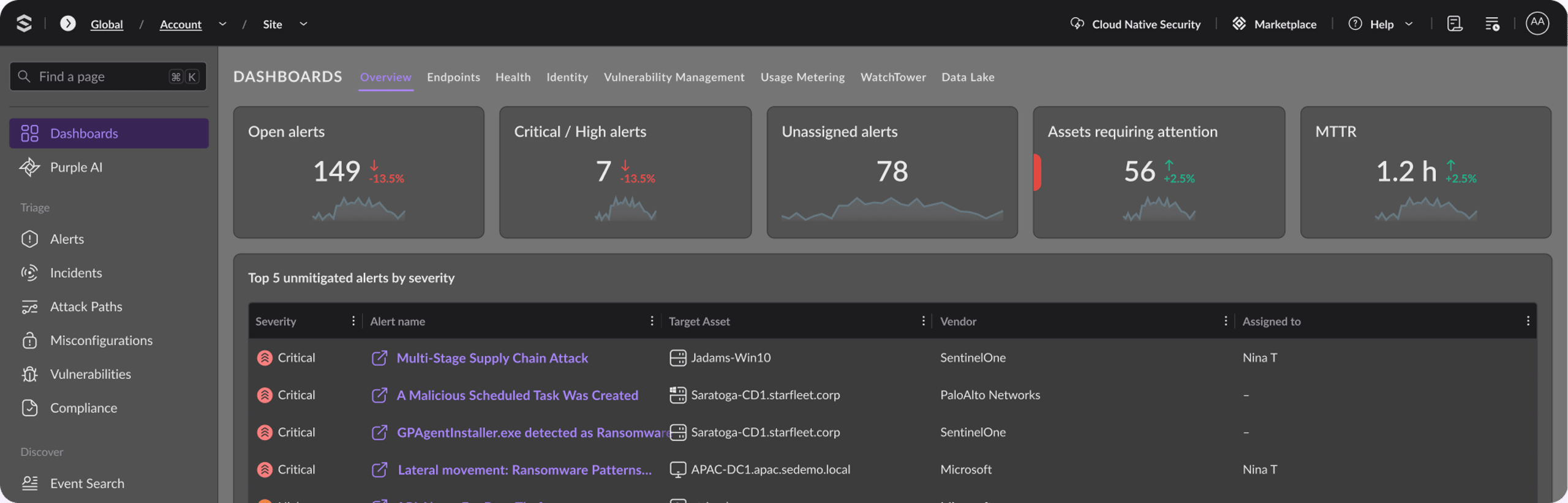
SentinelOne Singularity extends the AI-driven endpoint detection and response platform to Zero Trust workflows. Integrating threat intelligence, behavior analysis, and real-time policy enforcement, SentinelOne ensures continuous validation of every user and device session. The dynamic approach of correlating endpoint states with network access privileges cuts the connections at the moment some unusual activity appears.
Full synergy with microsegmentation frameworks completes a Zero Trust cycle, shutting down attack surfaces to a minimum.
Platform at a Glance
SentinelOne’s Zero Trust solution layers on top of existing EDR capabilities, linking device posture to identity management. The administrator defines a strict set of rules that change as the risk scoring changes. In case of anomalies, such as privileges being escalated or suspicious file downloads, immediate revocation of sessions or quarantining will be triggered.
Integration with major cloud providers allows coverage across ephemeral containers and remote VMs, reinforcing zero trust vulnerability management by scanning for misconfigurations.
Features:
- AI-based Risk Scoring: Calculates in real-time the risk of a device and user to grant or revoke privileges.
- Adaptive Policies: Utilizes context in the form of location, device posture, and user behavior to fine-tune access levels.
- Automated Containment: In case of a detected compromise, the solution stops suspicious processes and isolates the endpoint.
- Multi-Cloud Support: Extend Zero Trust logic to AWS, Azure, GCP, and container ecosystems.
Core Problems That SentinelOne Eliminates
- Excessive Trust: Enforces session reevaluations for all users and services.
- Long Dwell Times: It immediately quarantines a compromised endpoint, thereby limiting the possibility of lateral movement.
- Siloed Data: Centralizes the threat intel, connecting endpoint behaviors to network policies.
- Complex Resource Sprawl: Single-pane-of-glass platform for on-prem, multi-cloud, and container resources.
Testimonials
“Each operating system had a number of different interfaces. We have Microsoft servers, workstations and MacBooks. Each and every one of them had to be managed separately. It was hard to tell which versions of the anti-malware they were running. We also had to secure remote workers using different kinds of workarounds. All in all, it was taking too much time.” Marc Lindemann (SR. INFRASTRUCTURE CONSULTANT)
Explore detailed user reviews and feedback about SentinelOne on Gartner Peer Insights and PeerSpot.

Singularity™ Identity
Detect and respond to attacks in real-time with holistic solutions for Active Directory and Entra ID.
Palo Alto Networks Zero Trust
Palo Alto helps organizations build a Zero Trust security architecture. It fuses network micro-segmentation with identity verification and continuous threat inspection. Its firewalls help drive visibility into applications, and they ensure that only the right traffic is getting into each micro-segment. Its integrations with cloud providers mean Palo Alto can enable consistent zero-trust controls for both on-prem networks and multi-clouds.
Features:
- Prisma Access Integration: Delivers zero-trust enforcement at the remote gateways and branch offices.
- Layer 7 Application Policies: Traffic filtering based on application behaviors, not just IP addresses.
- Threat Intelligence Feeds: Correlates real-time threat data with user access attempts.
- Micro-segmentation: Segments critical assets into secure zones to minimize risk.
Discover what users have to say about Palo Alto Networks Zero Trust on Gartner Peer Insights.
Zscaler
Zscaler is a cloud native platform that acts as a secure gateway to the internet and private applications in companies. Instead of traditional VPNs, Zscaler brokers the users’ sessions to verify resources, including authentication and device posture checks on the go. This architecture is particularly well suited to the requirements of remote or hybrid workforces that need to gain direct access to SaaS or data center apps. Zscaler has SSL inspection and deeper analytics built in, so each session can be assured to follow Zero Trust principles.
Features:
- Application Segmentation: It directly connects only allowed users to allowed applications without any dependence on broad network trust.
- SSL Inspection: Decrypts encrypted traffic first before inspecting it for hidden threats.
- Granular Policy Enforcement: Suspicious domains are blocked and the usage limits on known risky services are set.
- User & Device Context: This solution supports dynamic privilege adjustment as needed for the various compliance checks made at the device and user role level, as well as for specific signals for risk.
Check out the ratings and reviews of Zscaler on TrustRadius.
Okta
Okta provides single sign on (SSO), adaptive multi factor authentication (MFA), and lifecycle management to ensure that every login is on principle of least privilege. It offers integrations within SaaS apps, on-prem resources, and custom APIs, allow organizations to bring together identity policies. With continuous risk assessment, users are re-evaluated mid session, having their privileges updated in real time.
Features:
- Adaptive MFA: Depending on the level of the risk signals, increases or decreases the level of authentication requirements.
- User Life Cycle Management: Provisioning and de-provisioning of accounts into a system to avoid orphaned accounts.
- Context-Aware Access: It also includes device health and IP location when allowing or disallowing access.
- Extensive Integrations: Consistent identity controls integrate with HR systems, SaaS apps, or legacy databases.
Gain valuable user perspectives on Okta through Gartner Peer Insights.
Cisco Zero Trust
Cisco applies identity based segmentation, software defined networking, and endpoint analytics to unify Zero Trust principles. It takes advantage of Cisco’s networking features and embeds Zero Trust security across switches, routers, and cloud edges. Cisco blocks sessions that are not verified at every gateway by correlating telemetry from endpoints, network flows, and identity records.
Additionally, it has an AI driven engine that flags anomalies in user or device behavior for admins to swiftly refine policies with minimal risk exposure.
Features:
- Cisco ISE Integration: With identity enforcement tied to the physical or virtual network layer, this platform brings identity enforcement down into the network layer.
- Endpoint Analytics: It detects the state of devices and automatically quarantines suspicious endpoints.
- Zero Trust Segmentation: It confines users or workloads to their assigned zone, reducing lateral movement.
- SecureX Platform: It brings threat intelligence and security operations together under a single dashboard.
Learn how Cisco Zero Trust is rated and reviewed by users on Gartner Peer Insights.
Microsoft Azure AD Conditional Access
Conditional Access extends the identity engine of Azure Active Directory into Zero Trust territory. Policies are defined by administrators, which weigh the compliance of the device, the location of the user, and the risk scores before allowing any resource access. It makes sure that every request is revalidated based on the conditions at that time, such as suspicious login times or multiple failed attempts.
Through integration with Microsoft 365, Azure services, and a broad ecosystem of third-party apps, this solution extends continuous verification across the board.
Features:
- Conditional Access Policies: Create granular rules for each SaaS or on prem app.
- Risk-Based Authentication: Unusual activity, such as sign-ins from unknown devices or unexpected locations, can be used to dispute multi-factor authentication (MFA).
- Azure Identity Protection: It automatically remediates leaked credentials and detects compromised accounts.
- Compliance Alignment: It offers templates that map policies to standards such as PCI or HIPAA.
Uncover firsthand user experiences with Microsoft Azure AD Conditional Access on Gartner Peer Insights.
Symantec Zero Trust
Symantec Zero Trust framework delivers endpoint and network security. It orchestrates a layered Zero Trust environment with data loss prevention, secure web gateways, and authentication. Its CASB integrates the coverage to SaaS applications with scanning and detection of misconfiguration and unusual usage patterns. By taking a ‘trust nothing’ posture, it reduces the risk of internal and external unauthorized access.
Features:
- DLP Integration: This prevents data leakage via file movements and monitoring and control.
- CASB: It gives visibility and policy control to SaaS applications.
- Network Forensics: The platform logs and analyzes the traffic for suspicious activity, which might indicate a breach.
- User & Endpoint Verification: It ties endpoint posture checks together with identity verification for every session.
Browse through genuine feedback about Symantec Zero Trust on Gartner Peer Insights.
BeyondCorp by Google
BeyondCorp grants direct, per-app access based on device trust and user context. It routes each request to a zero trust access proxy that authenticates it. BeyondCorp brings together SSO, device certificates, and granular policy enforcement. It is ideal for companies wanting location-independent security.
Features:
- Per-Session Enforcement: Credentials and device posture of the user is checked prior to every access for a resource.
- Device Certificates: Verifies the authenticity of the endpoint before allowing traffic.
- Application-level Segmentation: The employees are provided with only the services they need and not an entire network segment.
- Contextual Aware Access: Integrates user role, device posture, and real-time threat data in access decisions.
See detailed opinions and evaluations of Google BeyondCorp on Gartner Peer Insights.
IBM Zero Trust
IBM Zero Trust offers its solution on a single platform: identity governance and threat analytics to network segmentation. The platform injects AI through Watson for threat pattern recognition by correlating anomalies in user activity with probable security incidents.
It locks down PAM with microsegmentation into a minimum scope of resources relevant to every given identity. Its also allows large-scale deployments based on Zero Trust.
Features:
- Watson AI Integration: Identifies abnormal user journeys or device behaviors that could be indicative of threats.
- Privileged Access: Manages root or admin credentials with just-in-time escalation.
- Cross-Platform Protection: From mainframe applications to containerized workloads, it’s all covered.
- Flexible Deployment: Provides on-premise, hybrid, and cloud modules as per your need.
Find out what professionals think of IBM Zero Trust on Gartner Peer Insights.
Cloudflare Zero Trust
Cloudflare Zero Trust focuses on secure remote access and application connectivity. It inspects every session for malicious payloads or suspicious patterns. It follows the principles of DDoS protection, web application firewalls, and secure DNS resolution for Zero Trust. Cloudflare does network performance optimizations and implements endpoint security checks.
Features:
- Access & Gateway: Provides security at the periphery of the corporation’s apps by filtering all incoming requests.
- WAF & DDoS Shield: Stops volumetric attacks and app-layer exploits at the edge.
- DNS Firewall: Identifies malicious domains or phishing links before they reach endpoints.
- Device Posture Checks: Ensure only authorized, patched devices connect to internal systems.
Get trusted reviews and real-world insights on Cloudflare Zero Trust from Gartner Peer Insights.
Key Considerations for Choosing a Zero Trust Vendor
Choosing a zero trust vendor can be daunting, given all the features and deployment options that are available. When thinking about deployment models, whether cloud native, on premise, or hybrid, as well as the ease with which you can integrate with your existing infrastructure.
Below is an overview of the critical factors to guide your decision effectively:
- Integration and Ecosystem Compatibility: Does the solution fit your existing environment, whether through IDaaS platforms, cloud providers, endpoint solutions, or SIEM systems? Tools from zero-trust cybersecurity companies supporting open APIs or prebuilt connectors will definitely smooth adoption by unifying security policies.
- Micro-segmentation & Policy Granularity: See if the vendor can offer strong segmentation down to data center servers to ephemeral containers. Fine-grained policies are what allow you to specify who or what can access a resource, under which conditions, and for how long.
- Adaptive Authentication & MFA: With any Zero Trust product, the term dynamic authentication is attached. However, the reality may be different. So, look for solutions that have flexible multi-factor authentication triggers. For instance, reauthentication after some suspicious action or a change in device posture. A good Zero Trust approach will have privileges changed dynamically based on real-time risk scoring.
- Cloud-Native or On-Prem: Will you need a purely cloud-based solution for the speed of deployment, or will you require a hybrid approach because of compliance or data sovereignty reasons? Some Zero Trust companies have specialized in on-prem integration in order to serve heavily regulated verticals, whereas others have concentrated on SaaS simplicity.
- Zero Trust Vulnerability Management: Maintaining Zero Trust involves continuous identification and patching of vulnerabilities. Does the vendor continuously scan for weaknesses in containers, microservices, or legacy on-prem servers? Automated patching or guided remediation may significantly reduce your attack surface.
- Reporting & Compliance: Regulatory frameworks require logs as to who accessed what data and when. Top zero-trust cybersecurity companies use granular reporting dashboards, audit trails, and prebuilt templates for PCI, HIPAA, and more. That would make all the alignment of compliance easy, time-saving, and fine-reducing.
- Performance Overheads and Scalability: Zero Trust, if not carefully tuned, has a tendency to add friction or challenges to operations. So, evaluate how the vendor addresses scalability related to large user pools, sudden upticks in remote access, and/or dispersed worldwide teams. Solution flexibility is usually better with a cloud-based model, though it may require more upfront resource management to avoid lag with on-premise solutions.
Reduce Identity Risk Across Your Organization
Detect and respond to attacks in real-time with holistic solutions for Active Directory and Entra ID.
Conclusion
To conclude, Zero Trust has emerged as a fundamental element of present day protection, offering organizations a way to shield themselves from progressed threats by expelling the certifiable trust and consistently checking users, gadgets, and sessions. The approach drastically mitigates the possible breach impact and is therefore indispensable as remote work, SaaS adoption, and multi-cloud environments grow. Vendors in this space bring unique strengths to the table, from per application authentication to AI powered endpoint correlation.
Zero Trust solutions bring together policies and advanced analytics in a way that unifies them and delivers real time enforcement across enterprise data centers, cloud deployments, and hybrids.
SentinelOne’s Singularity Platform delivers a Zero Trust architecture that is easy to implement, seamlessly integrated, AI powered, and comes with automated threat response, which enables agility and security in one platform. Try SentinelOne today to prepare your organization for what’s to come and keep one step ahead of the curve.
FAQs
Zero Trust security is a model that does not rely on traditional perimeter defenses but requires continuous verification for every user, device, or application session. Instead of giving broad access after a single login, Zero Trust enforces granular policies tied to identity, device posture, and other real-time factors.
By segmenting resources and applying least-privilege principles, Zero Trust vendors ensure attackers face multiple hurdles, significantly reducing the likelihood of lateral movement.
Zero Trust solutions developed and supported by vendors maintain coordination between authentication, authorization, and micro-segmentation across organizational networks and cloud services. Quite often, these platforms incorporate AI-driven analytics, zero-trust vulnerability management, and policy enforcement. They integrate with identity providers, endpoint protection tools, and infrastructure systems to provide unified security.
This is important, as these vendors give organizations seamless ways to keep pace with the evolving nature of threats and work dynamics through automated adjustment of access privileges based on context.
Any organization that handles sensitive information or is bound by compliance requirements can take advantage of Zero Trust. These include technology startups hosting workloads in the public cloud or large enterprises with legacy on-prem systems and industries like healthcare and finance that have strict regulatory compliance. This also applies to remote and hybrid workforce models since Zero Trust extends consistent security irrespective of the location of the device or network.
In other words, zero trust companies aim at any organization that wants to reduce assumptions about trust and implement strict verification of access.
Multi factor authentication is a core part of most (if not all) Zero Trust solutions. When it comes to Zero Trust vendors, they often provide out of the box integration with existing MFA providers or have built in features allowing them to alert the user based on risk signals, such as unrecognized devices, foreign IP addresses, or other unusual login times. If suspicious behavior occurs mid session, the identity assurance can be further strengthened by having adaptive MFA escalate from a simple user password check to biometrics or tokens.
Most zero trust cybersecurity companies include compliance policy templates for PCI DSS, HIPAA, GDPR, or FedRAMP. These templates will reduce the time it takes to set up your infrastructure by helping you set up recommended access rules, logging requirements, and incident response guidelines.
Compliance packs provided by the vendor remove the manual guesswork and speed up audits, demonstrating that you’ve deployed proven best practices to protect regulated data.
Subscription based pricing is practically the norm for Zero Trust vendors, usually tied to the number of users, devices, or resource contexts being managed. Tiered plans capable of unlocking advanced capabilities like AI analytics, micro segmenting, or advanced EDR features are available in some of the solutions.
Some of them provide usage based pricing such that cost scales with requests processed or logs stored. Be sure to always consider hidden costs such as professional services, premium support, or custom integration fees.
Zero Trust solutions are beneficial to almost every sector. However, it is particularly useful for industries that handle sensitive data, like healthcare, finance, government, and high tech research. The cost of a breach in these domains is staggering, both in terms of fines to pay and damage to reputation.
This also benefits organizations with large, sprawling supply chains or frequent external collaborations because micro segmentation and continuous verification make lateral movement impossible. In the end, all groups with strict compliance rules or highly sophisticated threat actors will benefit from the adoption of a robust Zero Trust architecture.
Discover More About Identity Security




Ready to Revolutionize Your Security Operations?
Discover how SentinelOne AI SIEM can transform your SOC into an autonomous powerhouse. Contact us today for a personalized demo and see the future of security in action.