Top 10 Cyber Security Principles For Businesses
From securing data and managing risks to monitoring activity and responding to incidents, learn the fundamental principles of cybersecurity best practices.

The data security industry is growing at a CAGR of 12.3% and is forecasted to reach $55.3 billion by 2027. With attack surfaces expanding due to BYOD work arrangements and the increased adoption of remote work, companies are constantly striving to tighten their security. This stat is telling—more than 75% of companies use more than 50 distinct cybersecurity products, according to the third-annual Oracle and KPMG Cloud Threat Report.
Despite such an array of innovative solutions and painstaking efforts by organizations the number of cyber attacks is still surging. According to the 2024 Thales Data Threats Report, 93% of surveyed enterprises reported a rise in threats. The advent of Gen AI opens new possibilities for hackers to perform social engineering and phishing attacks — the explosion of Chatgpt and its bot-offshoots have enabled a 1265% increase in phishing emails.
As cybercriminals continuously develop advanced methods to breach security systems, businesses must ensure that their security protocols and efforts pass these time-tested cyber security principles. In this article, we will explore ten essential principles that every organization should prioritize to safeguard their digital assets effectively.
 What are Cyber Security Principles?
Cyber security principles serve as the north star, providing the foundational guidelines that organizations must follow to protect their information systems, data, and networks from cyber threats. These principles are crucial for establishing a robust security posture so that sensitive information remains secure, accurate, and accessible only to those with the proper authorization.
The Need For Cyber Security Principles
The first step toward enhancing an organization’s cybersecurity situation is acknowledging when there are gaps in your current security measures.
Here are some clear signs that indicate your cybersecurity practices need a boost:
- Frequent malware alerts: Constant warning messages stating that the computer has a malware problem indicating insufficient protection to stop the attack.
- Slow system performance: If your systems are becoming slow, then that may hint at deeper security issues, such as malware or unauthorized activities in the background.
- Unauthorized access attempts: Regular detection of unauthorized access attempts signals that access to your systems indicates weak security controls.
- Unexpected software installations: Discovering software installed on your systems without authorization clearly violates your security.
- Strange network traffic patterns: Unusual patterns in network traffic, such as spikes in data transfer or unexplained connections, may indicate a breach or an ongoing attack.
- Files changing without explanation: If files are being modified or deleted without any known cause, it strongly indicates that your systems are compromised.
- Ransomware messages: Receiving messages demanding payment to unlock your files is one of the most obvious signs that your cybersecurity defenses have failed.
- Unusual outgoing traffic: If you notice large amounts of outgoing traffic that you can’t account for, it could be a sign that your data is being exfiltrated by an attacker.
Top 10 Cyber Security Principles for Enterprises and Businesses
Below are the top ten cybersecurity principles and best practices that every enterprise should follow to protect their digital assets.
#1. Confidentiality, Integrity, and Availability (CIA triad)
The CIA triad is the pillar of cybersecurity that consists of three essential elements:
- Confidentiality: It ensures that sensitive information is accessible only to those who are authorized. This is achieved through encryption, access controls, and data classification. Confidentiality protects against unauthorized disclosure, helping to maintain privacy and data security.
- Integrity: It confirms that data remains accurate and unaltered by unauthorized users. Techniques like hashing, checksums, and digital signatures are employed to detect and prevent unauthorized modifications so that data can be trusted for decision-making processes.
- Availability: It ensures that systems, applications, and data are accessible to authorized users whenever needed. This involves implementing redundancy, disaster recovery plans, and regular maintenance to prevent downtime.
#2. Identify Risks and Vulnerabilities
Identifying risks and vulnerabilities within an organization’s IT infrastructure helps prevent potential threats. This process involves:
- Risk identification: Regularly conduct vulnerability scans, penetration testing, and detailed risk assessments to identify possible threats and weaknesses within your IT infrastructure.
- Understanding threats: Recognize the different types of cyber threats, such as malware, ransomware, and phishing attacks, and measure their potential impact on your business.
- Vulnerability assessment: Measure and prioritize risks based on their potential impact using tools like ISO 27001 and NIST frameworks.
#3. Have a Proper Risk Management Framework
When planning for risk management, we create a process to continuously assess, mitigate, and monitor risks to ensure that an organization remains at all times prepared for cyber threats. A risk management regime should include
- Risk assessment: Your security team should identify different assets and catalog them based on the likelihood of risks and the potential impact of a breach occurring via these devices.
- Risk mitigation: Risk mitigation involves setting up technical controls such as firewalls, encryption mechanisms, etc., and procedural controls (training and policies), and physical controls (secure facilities) to manage risks.
- Communication: Your security teams must report risk findings, and treatment plans to stakeholders. Communication also involves setting up proper training and awareness programs so that they maintain the company’s security posture.
- Monitoring and review: Consistency is key in risk management. Security teams must establish procedures to survey and report the risk environment, review risk management processes and access controls.
Also, monitoring on a continuous basis helps risk management strategies remain relevant and are updated.
#4. Protect Data and Systems
Data and system protection are among the major aspects of cybersecurity. This principle takes cryptographic measures to secure data by encryption while in transit and at rest. In addition, data would be regularly backed up with an effective disaster recovery program to ensure that systems run smoothly and that data is recoverable in case of a breach.
#5. Employee Training and Awareness
Training and awareness are the basic cyber security principles, as errors caused by humans are a major source of security breaches. According to ThoughtLabs Group, 38% of organizations that had no breach are advanced in awareness and training vs. 29%
with multiple breaches.
Regular training programs educate employees on best practices, such as recognizing phishing attempts and creating strong passwords. Meanwhile, ongoing awareness campaigns and simulated attacks, like phishing simulations, help reinforce secure behavior.
#6. Access Control and Authentication
Control in access and authentication is very crucial for an organization to prevent illegal access to data and systems. With role-based access control (RBAC), every user will have access only to information relevant to his work.
For example, Western Union implemented a role-based identity management solution to streamline offering access to needed applications. Since implementation, new employees receive access to applications in 2.5 minutes, as opposed to 14 minutes, pre-implementation.
Multi-factor authentication (MFA) further reinforces security by demanding users submit several forms of verification before accessing critical systems. 46% of the respondents to Thales’ survey report that only 40% of employees in their organization are using multi-factor authentication. Security managers must periodically audit access control measures, and update permissions to reduce the risk of insider threats.
#7. Monitor Activity in Networks, Systems, Applications, Services, and Data Sources
Continuous monitoring lets you detect and respond to cyber threats in real-time. It includes:
- Network security monitoring: Use tools like security information and event management (SIEM) systems and intrusion detection systems (IDS) to monitor network activity for suspicious behavior.
- System and application monitoring: Keep a close eye on system performance, resource utilization, and application security to find and fix vulnerabilities as early as possible.
- Service monitoring: Regularly monitor the health and performance of services via centralized monitoring tools to ensure they remain secure and available.
#8. Incident Response and Compliance
A well-crafted incident response plan mitigates security breaches. This plan should specify the steps to be taken during a cyber incident, including roles, responsibilities, and communication procedures.
Regulatory compliance is also a key aspect of cybersecurity, ensuring that an organization’s practices align with industry standards and legal requirements. Essentially, compliance with regulations such as the General Data Protection Regulation (GDPR) and ISO 27001 will strengthen credibility and trustworthiness.
#9. Regular Software Updates and Patch Management
Keeping software up-to-date is essential for protecting against known vulnerabilities. The steps are as follows:
- Patch management: Implement a structured patch management process to ensure that all systems and applications receive regular updates.
- Automated updates: Set up automated systems to apply software updates and patches promptly to ensure your defenses are always in sync.
- Vulnerability management: Regularly scan for vulnerabilities and address them through timely updates and patches.
#10. Network Security and Secure Configuration
Ensuring the security of the network and the proper configuration of systems is of utmost importance. This includes using firewalls, IDS, and other security tools to protect the network from unauthorized access and attacks.
Secure configuration by eliminating unnecessary services, closing unused ports, and regularly reviewing and updating system settings to address potential vulnerabilities. Moreover, manage remote access carefully and implement strong authentication measures to further secure the network.
As businesses move operations and data to cloud environments, the attack surface expands, and basic measures fall short. To protect your cloud infrastructure, you need a solution that adheres to cyber security principles and enhances them through advanced automation and intelligence.
Benefits of Implementing Key Principles of Cybersecurity
Investing in strong cyber security principles goes beyond protecting data. The associated benefits are as follows:
- Protection against cyber threats: The most immediate benefit received from implementing principles of cybersecurity has to do with any form of cyber threat, malware, ransomware, phishing, and advanced persistent threats (APTs).
- Compliance with regulatory requirements: Most industries have strict regulatory requirements on the protection of data and cybersecurity. The principles implemented in your business will ensure compliance with the regulations and protect your business from such costly fines and other legal implications.
- Enhanced data integrity and confidentiality: Confidentiality is the basis of privacy principles in cybersecurity, and concepts such as the confidentiality, integrity, and availability triad or the CIA triad help support the integrity and confidentiality of sensitive data. This is particularly important for businesses that are concerned with personal, financial, or proprietary information.
- Increased customer trust and confidence: Businesses can win clients and partners when they show and are committed to cybersecurity. This is very important for long-term relationships and is crucial when data security is a concern.
- Business continuity and resilience: A strong cybersecurity framework includes measures for incident response, data backup, and disaster recovery so your business can quickly recover from cyber attacks or other disruptions. This is key to the continuity of business since it reduces the time needed to restore its operations.
- Operational efficiency and cost savings: By preventing breaches and minimizing disruptions, businesses can avoid the high costs of data loss, legal fees, and regulatory fines. Furthermore, security automation opens up more efficient operations to free IT staff to focus on strategic endeavors.
- Competitive advantage: Strong cybersecurity practices can be a selling point for industries where clients are highly concerned about data security. The higher the standard of protection, the more likely a business is to attract and retain customers.
Simplify Cloud Security with SentinelOne
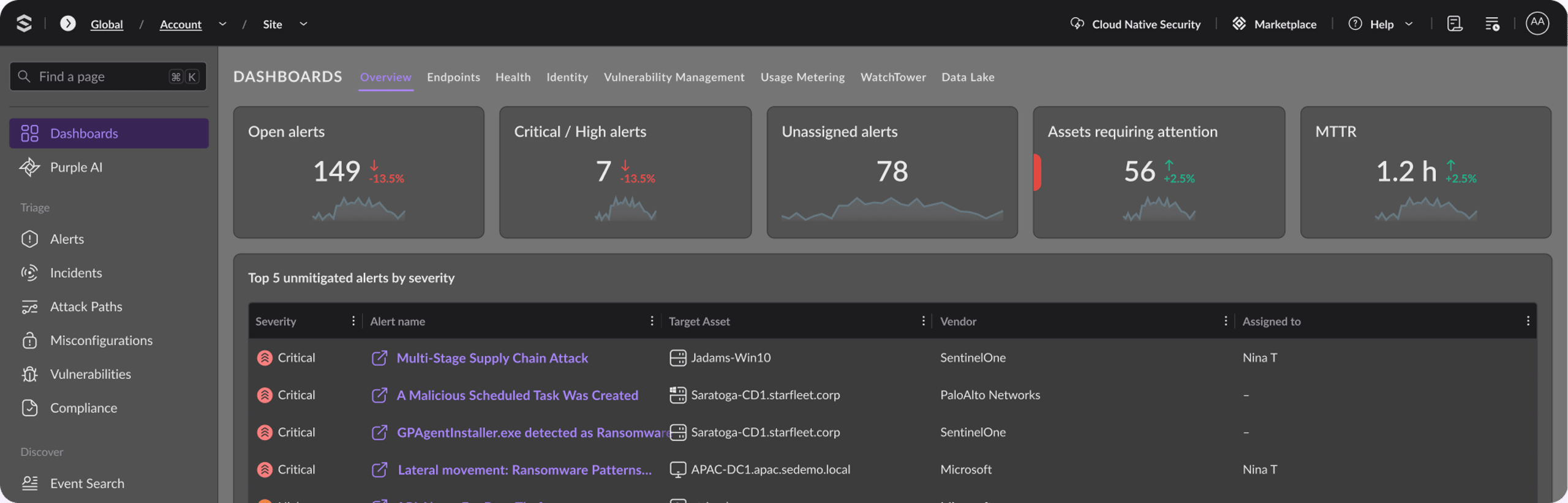
The SentinelOne Singularity cloud security platform maximizes visibility across cloud services and detects misconfigurations that could lead to security breaches. Its AI-driven capabilities enable real-time threat detection and response to help organizations maintain a strong security posture. Here’s how SentinelOne can help you simplify cloud security:
- Extensive misconfiguration detection: SentinelOne’s cloud threat intelligence engine conducts in-depth analyses to detect possible misconfigurations across leading cloud services like Amazon Web Services (AWS), Google Cloud Platform (GCP), and Microsoft Azure.
- Highlighting security gaps: The platform highlights security deficiencies in both new and existing services while offering actionable practices to remediate them.
- Secret scanning: Detect over 750 types of secrets and cloud credentials in real-time across public repositories.
- Ready-to-use policies: SentinelOne’s built-in checks detect misconfigurations
- across over 2,000 cloud services and also allow users to write custom security policies.
- Cloud-native application protection platform (CNAPP): SentinelOne’s CNAPP delivers end-to-end security for cloud environments, including AI-driven threat hunting.
- Auto-correction: This feature enhances cloud management efficiency by automatically resolving detected misconfigurations.
- Graph-based depiction: This unique visualization technique simplifies understanding and managing cloud security by visualizing issues to help address them quickly.
- Offensive security engine: SentinelOne includes an offensive security engine that analyzes threats from an attacker’s perspective, offering insights into potential exploit pathways.
- PurpleAI and compliance: The platform also integrates PurpleAI, a personal cybersecurity analyst who assists in managing cloud security operations efficiently and adhering to the latest compliance standards.

Singularity™ Platform
Elevate your security posture with real-time detection, machine-speed response, and total visibility of your entire digital environment.
Conclusion
Following the best cybersecurity principles can establish a strong security foundation for your organization. You will learn exactly how to deal with emerging threats, and apply the best security measures to prevent them. Good cybersecurity principles will help you make informed business decisions and select the right tools to make your security journey much easier. If you need assistance with the process, be sure to reach out to SentinelOne for help.
FAQs
The four key security principles in cybersecurity are protect, monitor, assess, and respond. Protecting involves securing systems and data from unauthorized access. Monitoring ensures continuous observation of networks to detect and address threats. Assessing involves regular risk evaluations to identify vulnerabilities, and responding focuses on having strategies in place to manage and mitigate security incidents.
Confidentiality is often considered the most crucial, especially in protecting sensitive information from unauthorized access. However, the balance of confidentiality, integrity, and availability (CIA Triad) is essential for a complete security approach.
Discover More About Cybersecurity



Experience the Most Advanced Cybersecurity Platform
See how the world’s most intelligent, autonomous cybersecurity platform can protect your organization today and into the future.