Attack Surface Reduction Guide: Steps & Benefits
Learn the basics of attack surface reduction, including minimizing exposure, securing cloud environments, continuous monitoring, and best practices to protect against cyber threats.
In modern-day complex applications, there are multiple entry points, which makes it very favorable for attackers to attack the systems. All these points make the attack surface. This surface comprises every device, link, or software that connects to a network.
The idea of attack surface reduction is to reduce the size and make it hard to attack these points. It works by identifying and eliminating any vulnerabilities or unnecessary portions of the system that a potential hacker can exploit, thus securing the system. This is needed because cybersecurity attacks are only becoming more prevalent and sophisticated day by day.
In this blog, we will discuss what attack surface reduction is. We will explore tools for attack surface reduction and how SentinelOne helps with this. Lastly, we’ll talk about the challenges of cloud security and prevention measures that can be taken.
Introduction to Attack Surface Reduction (ASR)
Attack surface reduction is a method to reduce attack surfaces from the system, cutting down entry points that a malicious attacker would be able to use. This means identifying all the vectors through which one can attack a system and remove or defend them. This covers shutting down unused network ports, uninstalling additional software, and disabling any unnecessary features.
ASR works by simplifying systems. Every piece of software, each open port, and every user account might represent a gateway for attackers. When organizations remove these extra pieces, they close the door to attackers who may be looking for backdoor access to the organization.
The process begins with examining everything in the system. From this, teams determine what they truly need to have and what they can discard. They take out unnecessary components and put the protection on the remaining parts.
Why attack surface reduction is essential
Every day, organizations are confronted with an increasing number of cyber-related risks. With a variety of sources and methods for attacking, these threats are no joke. A larger attack surface allows these threats to be more successful.
The more entry points there are to a system, the more work to defend it. It means more places to watch and more points to protect. It complicates security teams’ jobs and increases the risk of them missing something crucial.
Mitigating the attack surface goes a long way in different aspects. This allows teams to prioritize the protection of the most important assets. It also cuts costs by eliminating unnecessary components.
Key Components of Attack Surface Reduction
The three pillars of attack surface reduction are physical, digital, and human. Infrastructure includes hardware such as servers, devices, and network equipment. Digital includes software, services, and data. The human components are the user accounts and the permissions.
Organizations require a different strategy for each section. Physical reduction is getting rid of unnecessary hardware and securing what is left. The elimination of unused software, followed by securing necessary programs, is referred to as digital reduction. Human reduction, on the other hand, is concerned with access, as in, who gets to use what and when.
These elements are combined thematically, i.e., cutting in one category often reduces others as well. For example, decommissioning unused software may also lead to removing unnecessary user accounts. This builds an end-to-end strategy for making systems safer.
How to Implement an Effective Attack Surface Reduction Strategy
A structured approach is essential to an efficient attack surface reduction strategy. To properly reduce their attack surface, organizations must take the following steps.
Identify and map all assets and entry points
The first step involves an examination of everything in the system that is vulnerable to attack. Organizations need an inventory of every device, software program, and connection. These may include servers, workstations, network devices, and user accounts.
Exploration teams verify how these sections interrelate and connect with outside systems. Such as network ports, web applications, and remote access tools, they seek entry points. This gives teams a better idea of what they need to secure.
Eliminate unnecessary or unused services
Once the teams locate all of the parts in the system, they identify what they do not need and remove it. This is accomplished by disabling/uninstalling any unnecessary network services and extra software. They remove old user accounts and disable any unused network ports.
Organizations need to do a thorough examination of each of the services. Without this knowledge, they cannot figure out whether users will be maladjusted when something is taken away. Only the one that needs the service sticks around.
Enforce strong access controls and authentication
Strong access control prevents unauthorized users from accessing critical components of the system. They ensure that users are only given access to what they need to do their jobs.
This step involves creating complex passwords and including additional verification methods. Teams may use security tokens, fingerprint readers, and other hardware.
Secure Cloud, APIs, and External-Facing Services
Cloud services and APIs deserve special consideration. It is essential for teams to configure effective security settings on cloud services. They review API settings to ensure that only authorized users and applications can access them.
This involves verifying the data movement between the systems. Data is encrypted by the teams that configure it. They also rely on managed services or external security platforms to help enforce their security policies.
Patch and Update Software Regularly
Software is updated frequently to fix security issues. Teams build systems to track when updates are available. Their process is to test updates prior to installation in order to not break things.
Monitor and Continuously Assess Risks
The final step ensures ongoing protection of the systems. Teams monitor for new threats and test security measures against them. They deploy tools that monitor system operations and notify of challenges.
Technologies for Attack Surface Reduction
There is a wide usage of technology available today to mitigate attack surfaces. This tool set brings together to provide robust systems protection.
Discovery and mapping tools
Discovery tools automatically discover and track system components. This scans the networks to discover devices and connections. This helps security teams get visibility into what they have to secure. These tools help in tracking changes in the systems. It informs teams when new devices connect or when a setting(s) changes. It is helpful for teams to determine if something new needs security.
Vulnerability scanners
Vulnerability scanning tools are used to scan systems for vulnerabilities. They examine software versions and settings to identify issues. They identify problems and communicate to teams things that need to be fixed. Some of the scanners check the system from time to time. As soon as they identify issues, they notify teams. It helps teams to patch before attackers exploit them.
Access control systems
Access control systems manage and enforce who can use specific system tools. They verify user IDs and monitor individual activity. SentinelOne also monitors changes in user behavior that could indicate attacks, a feature known as behavioral detection. Such systems employ rigorous techniques to validate end-user identity. They may need different types of evidence, such as passwords and security tokens.
Configuration management tools
The configuration tools make sure settings are correct. They monitor for changes and ensure settings are maintained securely. If something is changed, they can revert it or notify the security team. The tools also assist teams with setting up new systems securely. They can automatically replicate secure settings to new devices. This ensures that all systems adhere to security rules.
Network security tools
Network monitoring tools monitor and control the data flows between individual systems. They hinder the traffic and monitor traffic to and from. There are some tools that can detect and execute attacks automatically. They also allow for the segregation of different parts of the system. These form safe zones that restrict the extent to which attacks may reach.
How SentinelOne helps reduce attack surface?
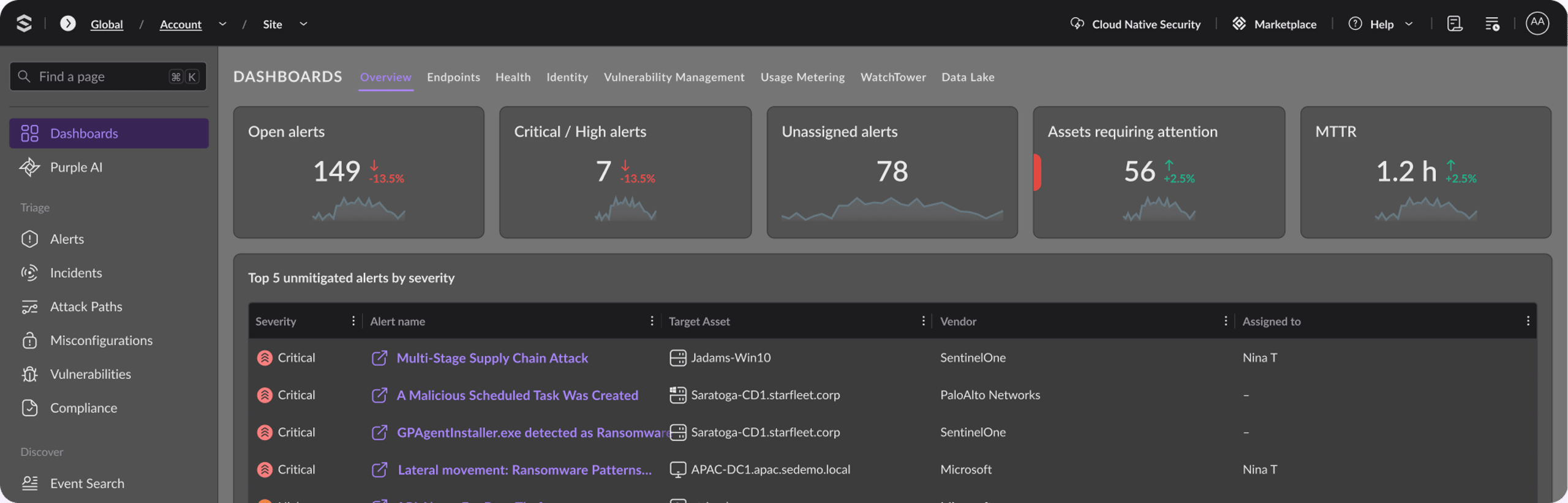
Different attack surface reduction areas use various tools, and SentinelOne provides these specific sets of related tools. It scans for devices and monitors live system activity.
AI is used by the system to detect issues. It detects attacks that normal security tools cannot identify, and when it detects any issue, it eliminates it without the delay of waiting for human help.
SentinelOne monitors program behavior on devices. It detects when applications are attempting to do malicious things and mitigates them in short order. It stops attacks before they cause organizations any damage.
SentinelOne tracks users’ actions for access control purposes. It can also know when any of the users do something suspicious that may indicate an attack. A system also helps detect or block malicious attempts to take over user accounts.
Attack Surface Reduction in Cloud Environments
Cloud systems open up new attack vectors against systems. This knowledge of how the cloud changes security allows teams to better secure their systems.
Cloud impact on attack surface
Cloud services introduce additional components that need to be secured in an environment. Every cloud service is a new entry point for an attacker. When an organization uses multiple cloud services, it creates more points to defend.
Cloud systems are often used as integrated platforms with many other services. While these links enable different components to cooperate, they also increase the potential pathways for attacks to propagate. All of these connections must be monitored and protected by teams.
Cloud systems are more at risk due to remote access. Users can access cloud systems from anywhere, which means attackers can access them from anywhere as well. This, in turn, necessitates verifying user identity.
Common cloud misconfigurations and risks
Different cloud storage-specific settings are often a security risk. Storage could be provisioned by teams that are accessible to anyone. This allows attackers to view or modify private data.
Cloud systems require multiple setups of access controls. A wrong setting can give more access to the users. There are old user accounts that should have been disabled after people left the company, which creates security holes.
Settings within its cloud services can be complicated. Options for security may be missed by teams creating software, or defaults may be used that are not sufficiently secure. A missed configuration means there is a space for attackers to use.
Strategies for cloud environment security
Organizations need to audit their cloud security settings on a regular basis. This includes examining access to services and their functionalities. Frequent monitoring ensures that issues are identified and rectified promptly.
Having a network separation prevents traditional attacks from propagating all over the system. Protecting data is a significant concern for cloud infrastructure. Make sure the team uses a strong encryption algorithm for stored data as well as data traveling between systems.
Challenges in Reducing Attack Surfaces
There are many big challenges that organizations encounter while they see how to reduce the attack surface. Let’s have a look at some of them.
Complex system dependencies
Today, a modern system contains a broader set of parts. If you delete one, possibly others that depend on it will break, too. These connections should be validated by teams before performing any changes. It takes time and requires a deep knowledge of the system.
Legacy system integration
The legacy systems pose specialized security threats. In many cases, old systems have no possibility to deploy new security methods. They may require old software or settings to operate. Teams will need to find ways to secure those systems while still keeping them functioning the same. This is a bit of additional work and could leave some cracks for security, though.
Fast technology changes
Innovative technology rapidly develops unique security requirements. Organizations need to familiarize themselves continuously with new types of threats and how to protect themselves against them. With new technology, old security plans may fail. This means that organizations need to update their strategy frequently.
Resource limitations
Resource constraints appear to be one of the main contributing factors to ineffective security controls. There are not enough individuals or tools to verify everything that a team must produce. Some organizations cannot buy each and every security tool for various infrastructure needs. This leaves teams with a decision on what to protect first.
Impact on business processes
There is a constant conflict between security and business efficiency needs. Work processes get slowed down due to changes in security. This means that simple tasks could take a bit longer due to strong security. One of the greatest challenges for teams is balancing the security needs against allowing people to do their jobs.
Best Practices for Attack Surface Reduction
Reducing the target surface requires the following practices. These practices enable organizations to provide comprehensive protection to their systems.
Asset management
Good asset management is the foundation of reducing the attack surface. Teams have to maintain up-to-date inventories of every component in the system. That consists of every hardware, software, and data that the organization uses.
Security staff should review their asset lists regularly. They have to get rid of the old components and introduce new ones. Assets should be labeled in a way that identifies their function and ownership. This activity set defines what to protect and how to protect it, which helps teams in case of a security breach.
Network security
Multiple security controls are required to protect a network. Security teams should refactor networks into isolated segments. It should only connect with other parts when absolutely necessary. This prevents attacks from traveling throughout the entire system.
Monitor what traffic goes in and out. Teams require tools that can rapidly detect and prevent malicious traffic. Frequent scans of the network assist in identifying new issues. Network rules should control what can connect.
System hardening
System hardening, in effect, strengthens individual components. Teams need to strip away all unnecessary software and functionalities. Only what is needed for each system to function should be kept. This includes disabling default accounts and modifying default passwords.
Regular attention is required for the updates. Security patches need to be deployed rapidly by teams. Wherever possible, systems should update themselves. Security settings must be periodically re-checked. Teams must adopt robust configurations that comply with security benchmarks.
Access control
Access control must follow the principle of least privilege: grant each user only the access needed for their role. Remove access promptly when roles change or users leave. Regularly review and update permissions.
Authentication systems need multiple checks. Teams should use strong passwords and extra security steps. They should watch for strange login attempts. Access systems should log all user actions.
Configuration management
Keeping systems configured correctly is configuration control. These settings should be checked on a regular basis. Teams must be able to track their configuration changes using appropriate tools. Such tools must raise an alarm in case of an unauthorized change. It should also aid in the automatic remediation of incorrect settings.

AI-Powered Cybersecurity
Elevate your security posture with real-time detection, machine-speed response, and total visibility of your entire digital environment.
Conclusion
In modern cyber security strategy, attack surface reduction is a critical piece. By understanding these reduction methods and using them, organizations can best protect their systems against the growing number of cyber threats.
Several key factors play an important role in the successful implementation of attack surface reduction. Security is complicated, and organizations should have a full grasp of their systems, use the right tools, and follow security best practices. They have to correlate security requirements with business processes. It provides a balance to help ensure the availability of protective measures that won’t halt essential functions.
With the right modern tools, established best practices, and consistent vigilance around emerging threats, organizations can maintain a narrow attack surface. It makes it more difficult to attack and simpler to defend systems. Constant reviews and updates of security measures help to ensure effective security stays in step with developing technology.
FAQs
Attack Surface Reduction works by removing paths from the system that attackers could use. This includes finding and removing unnecessary software, closing unused connections, and restricting system access.
ASR rules govern the ways in which programs are allowed to interact with systems. Most of these rules block dangerous behavior, such as executing malicious scripts or executing benign programs that could exfiltrate data. It stops programs from performing operations that could disrupt systems or reveal PII data.
Organizations must list all their systems, connections, and entry points. They can use scanning tools to find open ports and services that are up and running. Frequent security testing helps to identify vulnerabilities that need to be patched.
Organizations must regularly scan their systems for emerging vulnerabilities. To clean it up quickly, eliminate unused programs and services. Security settings should similarly be updated regularly, and unnecessary features should remain inactive.
A system is always changing as programs get installed, settings are modified, etc. Continuous monitoring then helps identify these changes, preventing them from turning into security issues. Ongoing management makes certain that security remains robust as systems evolve.
Discover More About Cybersecurity



Experience the Most Advanced Cybersecurity Platform
See how the world’s most intelligent, autonomous cybersecurity platform can protect your organization today and into the future.