What is an Attack Surface Mapping?
Discover attack surface mapping, a key cybersecurity strategy for identifying and securing vulnerabilities. Learn techniques, benefits, and steps for stronger defenses against attacks.

As we dwell in an interconnected digital ecosystem, cybersecurity has become a vital concern for businesses of all scales. As cyber threats become more advanced, the importance of understanding as well as securing an organization’s attack surface, the total of all the potential entry points an attacker could use to infiltrate it in a potential exploit, is greater than ever.
The attack surface is everything that can be a potential entry point for attacking the network, and attack surface mapping is just one of many cybersecurity strategies designed to proactively look for, audit, and map out these vulnerabilities so that you can shore up your defenses against them. Boasting a complete view of where risks are located empowers organizations to be one step ahead of cybercriminals who take advantage of vulnerabilities in networks, applications, and human behavior.
In this blog, we will cover what attack surface mapping is, why attack surface mapping is a pillar of modern security strategy, and how it can empower an organization’s ability to protect its critical assets. From what methods are utilized to find vulnerabilities to the real-world impact it gives, we’ll dissect the mechanism and show actionable things that can be done.
What is Attack Surface Mapping
Attack surface mapping is the act of identifying, cataloging, and analyzing the potential attack vectors or entry points that an attacker could use to gain access to a given environment within an organization’s digital environment. This ranges from exposed servers, unpatched software, misconfigured cloud services, and open ports to less obvious vectors, such as employees susceptible to phishing or integrations from third parties. In short, it’s a structured method of mapping out the extent of your security weaknesses while shining a light on both the obvious and less-obvious places they can be found.
Beyond visibility, attack surface mapping is the underlying enabler of proactive cybersecurity. With no idea of what is exposed, organizations are essentially flying blind, responding to incidents instead of preventing them. By assembling the attack surface, organizations are able to transition from a reactionary defense to a proactive offense, foreseeing risks, and patching vulnerabilities before attackers have a chance to exploit them. As a result, it is a crucial activity to remain ahead in an ever-evolving landscape where cyber threats are emerging daily, targeting legacy systems and affecting new cloud deployments.
Attack Surface Mapping Techniques
Let’s look at some of the techniques that organizations should follow for attack surface mapping.
Conduct passive reconnaissance
Starting off to do something with a low profile, passive reconnaissance techniques focus on no direct interaction with the target systems. It’s cybersecurity’s equivalent to eavesdropping, quietly drawing information from publicly available sources such as DNS records, WHOIS databases, and even social media to build a picture of an organization’s digital footprint. This technique identifies exposed assets, such as domains or IP addresses, without informing defenders or triggering alerts and, thus, acts as a stealthy starting point for attack surface mapping.
Active scanning approaches
Active scanning techniques take a more aggressive route, querying systems using tools such as networks or vulnerability scanners to find weaknesses. It’s like knocking on every door and rattling every window to see what’s unlocked, including port scanning, service enumeration, or running automated scripts to discover misconfigurations. Although this method gives deeper insight into live vulnerability, it is noisier and may occasionally trip off alarms, and thus needs to be executed carefully.
OSINT gathering
Use Open-Source Intelligence (OSINT) gathering to help bring in publicly available data, news articles, forums, or leaked credentials obtained by an attacker and posted on the dark web to add context to the attack surface. It’s the detective work of cybersecurity, exposing things like the email patterns of employees, relationships with third-party vendors, or even old subdomains that won’t make it into scans. Having this layer of insight helps provide a full picture of possible risks hiding in plain sight.
Automated discovery tools/pipelines
Automated discovery tools and platforms, such as attack surface management (ASM) solutions, accelerate the mapping process by continuously indexing and cataloging assets at scale. These tools are like a tireless assistant that alerts you to new cloud instances, rogue devices, or unpatched software in real-time. They also save time and minimize human error, making them a go-to for organizations managing sprawling, dynamic environments.
Manual verification processes
At times, there is simply no substitute for the human touch. That’s where manual verification processes come in to verify what the tools find in case any false positives can escape detection. It’s resource-heavy, but adding a human element in this way introduces a level of accuracy that automation alone can’t provide, particularly for critical assets where quality assurance isn’t an option.
Benefits of Attack Surface Mapping
An attack surface map ensures that organizations can uncover and patch vulnerabilities before attackers exploit them. Security teams, as opposed to waiting for a breach to happen and then scrambling to react, are able to fix flaws in advance, lowering the odds of a crucial cyber strike succeeding. This evolution from reactive to proactive is a game-changer in cybersecurity. This minimizes downtime, prevents data loss, and protects an organization’s reputation by stopping threats at an early stage. For example, flagging an exposed server or a patchless application in mapping can save millions of dollars in a potential breach.
However, not all vulnerabilities represent the same risk, and attack surface mapping makes that clear by highlighting the highest risk. For security teams, knowing which flaws, such as an unprotected database or a weak line of authentication, could lead to the most impending damage when exploited makes it easier to prioritize their fixes. This concentrated strategy spares time and irritation after staff are overwhelmed with less critical tasks. It’s particularly valuable in large organizations where there may be hundreds of vulnerabilities, ensuring that limited resources address the highest-impact concerns first.
Implementation Steps for Attack Surface Mapping
Attack surface mapping is the key to spotting vulnerabilities before attackers do. Here’s how it works, step by step.
Defining the what and its limits
Attack surface mapping starts with defining what you want to look at. That means drawing clear lines in the sand on which networks, systems, applications, or even third-party services will be covered. When there is no well-defined scope, efforts can lack focus, leaving important areas unaddressed or wasting time on unrelated ones. For instance, an organization could target its customer-facing websites and cloud infrastructure but temporarily leave out internal employee devices.
Construct baseline infrastructure maps
Once the scope is determined, the next step is to create a map of the organization’s infrastructure baseline. This means mapping out all assets, such as servers, endpoints, databases, and cloud instances, to get a sense of what is out there and how it’s wired together. Network scanners or asset management platforms can assist with this, but accuracy may require manual input. A baseline map, for instance, might show an old web server that no one knew was still up.
Identifying critical assets and crown jewels
Not every asset is created equal, so identifying the most valuable ones often referred to as “crown jewels,” is essential. They might include customer databases, intellectual property, or systems that power the business, like payment processors. Mapping looks for where these assets live and how they’re exposed, for instance, via weak access controls or unencrypted connections. focusing on attacking the targets that are high in value to the organization and if those who are in control of them are protected.
Storing attack vectors
Once assets are identified, the next step is to enumerate all possible attack vectors and specific methods that attackers could use to get in. This can include open ports, outdated software, misconfigured permissions, or even phishing threats linked to employee emails. Each of the above vectors should be accompanied by details such as the location, severity, and how it could be exploited. For example, an unpatched VPN server could be flagged as a high-risk vector if known exploits exist. Robust documentation transforms raw data into actionable insights, creating a far easier path to plan fixes and communicate risk with stakeholders.
Modeling the attack surface
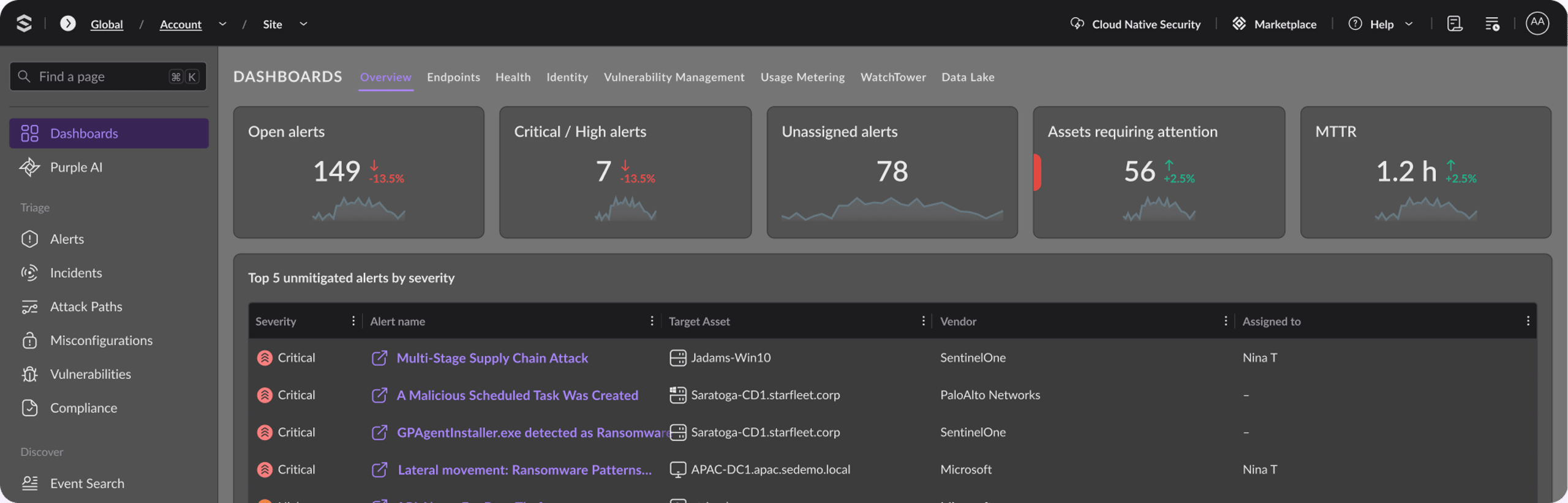
Lastly, visualizing the gathered data into maps should help clarify the process. Diagrams or dashboards can indicate how assets are related, where vulnerabilities are concentrated, and which areas require immediate attention, essentially a heatmap of risk across a network. Graphing software or attack surface management platforms can automatically produce these types of visuals. A simple visualization might show, for example, that the majority of the risks are a product of one cloud provider, which would drive strategic decisions.
Challenges in Attack Surface Mapping
Attack surface mapping sounds straightforward, but it’s a beast to tame. Here are the hurdles that make it tough.
Transitory and dynamic environments
Modern IT environments are dynamically shifting and changing, which means attack surface mapping is a moving target. Cloud instances come and go, employees log in from new devices, and applications self-update, sometimes every few hours or minutes. Snap this way, and you might just make it, but this ephemerality means that a map painted today could be a different shape tomorrow.
Complexity of cloud and containerized infrastructure
The move to cloud and containerized systems adds complexity to attack surface mapping. This is different from traditional setups, where the responsibility is typically divided: providers secure some parts (i.e., physical servers), and users secure the rest (i.e., app configurations). Containers, which tend to be ephemeral and numerous, can mask vulnerabilities in their images or networks. An incorrectly configured AWS S3 bucket, for example, could lead sensitive data to be made public with nobody noticing “until it’s too late.
Shadow IT discovery
Shadow IT refers to systems or software that people use without IT’s knowledge. Employees could start using unsanctioned tools such as Dropbox or personal VPNs, adding vulnerabilities outside the official attack surface footprint. These vectored-in assets are harder to see because they circumvent typical oversight, but they can still be inlets for attackers.
Maintain map integrity over time
An attack surface map is only as good as its last refresh, but keeping it accurate is an ongoing challenge. New vulnerabilities and updates arise (or get missed), and business processes change, each of these alters the risk landscape. Without routine refreshes, maps go stale, misleading teams on what’s actually at risk. You might as well be using a one-year-old map with a new API that is exposed and used as the attack path on the most recent attack. This challenge requires automated tools as well to track changes along with a rigor to revisit and course correct mappings on an ongoing basis.
Technical debt and resource limitations
Mapping an attack surface requires time, tools, and skilled people. Resources many organizations do not have. Smaller teams may be unable to cover sprawling systems, and budget restrictions make expensive scanning platforms out of reach. Temporary solutions or technical debt, like obsolete legacy systems, exacerbate the problem, creating easy-to-deflate risks that continue to go unaddressed. A company stuck using an old, unsupported server, for example, may not even know what steps to take to chart its weaknesses.
Best Practices for Attack Surface Mapping
Attack surface mapping requires focus and precision. These practices ensure it’s done effectively.
Set clear objectives and scope
Focus Starting with a plan will help you better define your goals and the borders for your attack surface mapping. Identify what you protect: customer data, intellectual property, or operational systems, and constrain what can be reasonably delivered, such as public-facing assets or a single cloud environment. This helps prevent being overwhelmed and ensures that efforts are aligned with business priorities. A financial firm may prioritize mapping payment systems versus internal HR tools, for example.
Use automation for efficiency
Automated tools to do the heavy lifting of discovery and monitoring. The ASM tools can scan networks, cloud services, and endpoints continuously, pinpointing new assets and vulnerabilities much more quickly than manual efforts. This is particularly important in large or ever-changing environments where manually updating is impractical. A retailer, for instance, might automate the process of tracking seasonal web servers that appear during sales.
Combine OSINT and threat intelligence
Strengthen your mapping with open-source intelligence (OSINT) and threat intelligence to identify risks that you may not see from your own perspective. OSINT can show if you have any exposed credentials on some dark web forums or perhaps some old subdomains that you had forgotten about, and threat intelligence reveals emerging attack patterns in your industry. An OSINT provider may tell a healthcare provider that the recently publicized breach of a third-party vendor also exposed systems. Merging these homespun insights with external data creates a fuller picture of the attack surface.
Keep your maps regularly updated and validated
Attack surface mapping is a living process, not a single project. Plan regular updates, monthly or quarterly to identify changes such as new deployments or patched vulnerabilities. Combine it with manual validation to verify that what was found automatically is indeed correct. As an example, a team may confirm that a port that was open is now closed after a software update. Maps need to be refreshed regularly so they are reliable and show a map of the state of your environment as it evolves.
Encourage cross-department collaboration
Engage with IT, security, and even business units in the matter so that you can break down silos. IT can give asset inventories, security can check for risks, and business teams can provide a heads-up on critical operations, such as a sales platform with a link to revenue. This collaborative effort helps ensure that nothing gets lost to the shadows of an IT tool only the marketing team is aware of.
Attack Surface Mapping for Enterprises
Enterprise scale means large networks, multiple locations, and large tech stacks; generic mapping approaches simply don’t cut it. Tailoring the process involves segmenting it into phases, for example, dedicating time to only one business unit or region at a time, such as mapping the North American data centers before moving on to the Asia-Pacific region. This helps keep efforts manageable and recognizes unique risks, such as regulatory differences or legacy systems pertaining to specific lines of business.
Big companies often employ multi-cloud and hybrid, think AWS, Azure, and on-prem server environments, each with its idiosyncrasies of attack surface. Clouds need mapping, with tools spanning providers and stitching data into a service view, highlighting misconfigurations such as exposed S3 buckets or orphaned VMs. An example of this is a financial enterprise tracing a leak of sensitive data back to an overlooked Azure instance in the course of this process. Baselining this complexity guarantees that all elements of the distributed infrastructure are validated, regardless of the additional layers.
Conclusion
Attack surface mapping is a vital practice for organizations aiming to stay secure in a world of relentless cyber threats. By identifying vulnerabilities, prioritizing risks, and enabling proactive defenses, it transforms how businesses protect their digital assets. It’s not just about finding weaknesses. It’s about understanding them well enough to stop attacks before they happen. As environments grow more complex with cloud adoption, remote work, and third-party integrations, the need for clear visibility into the attack surface has never been greater.
FAQs on Attack Surface Mapping
Attack surface mapping is the process of identifying and analyzing all the potential entry points in an organization’s digital environment where attackers could gain access. This includes networks, applications, devices, and even human factors like phishing risks. It helps security teams understand and secure their vulnerabilities.
It provides a clear view of where weaknesses exist, allowing teams to prioritize and fix the most critical ones first. Showing how vulnerabilities connect to key assets streamlines remediation efforts. This makes vulnerability management more focused and effective, reducing overall risk.
Cybercriminals target exposed points like unpatched software, open ports, misconfigured cloud services, or weak passwords. They might use phishing to trick employees or exploit third-party flaws to breach networks. Mapping reveals these entry points, showing exactly what attackers aim for.
Companies can use automated tools to track changes in real-time, like new devices or vulnerabilities, and update their maps regularly. Combining this with manual checks and threat intelligence keeps oversight consistent. Solutions like SentinelOne offer continuous monitoring to simplify the process.
Automated mapping is faster, scales better, and catches changes instantly, making it ideal for large or dynamic environments. Manual analysis is slower but offers deeper, human-driven accuracy for complex issues. Hybrid approach automation for breadth and manual for depth often works best.
Discover More About Cybersecurity




Experience the Most Advanced Cybersecurity Platform
See how the world’s most intelligent, autonomous cybersecurity platform can protect your organization today and into the future.