As organizations rush to adopt AI, they are discovering that traditional, siloed security tools cannot keep pace. The data is too vast, the infrastructure is too interconnected, and runtime environments are too dynamic. Security leaders are confronting a hard reality: AI cannot be secured with point solutions — it is just too broad.
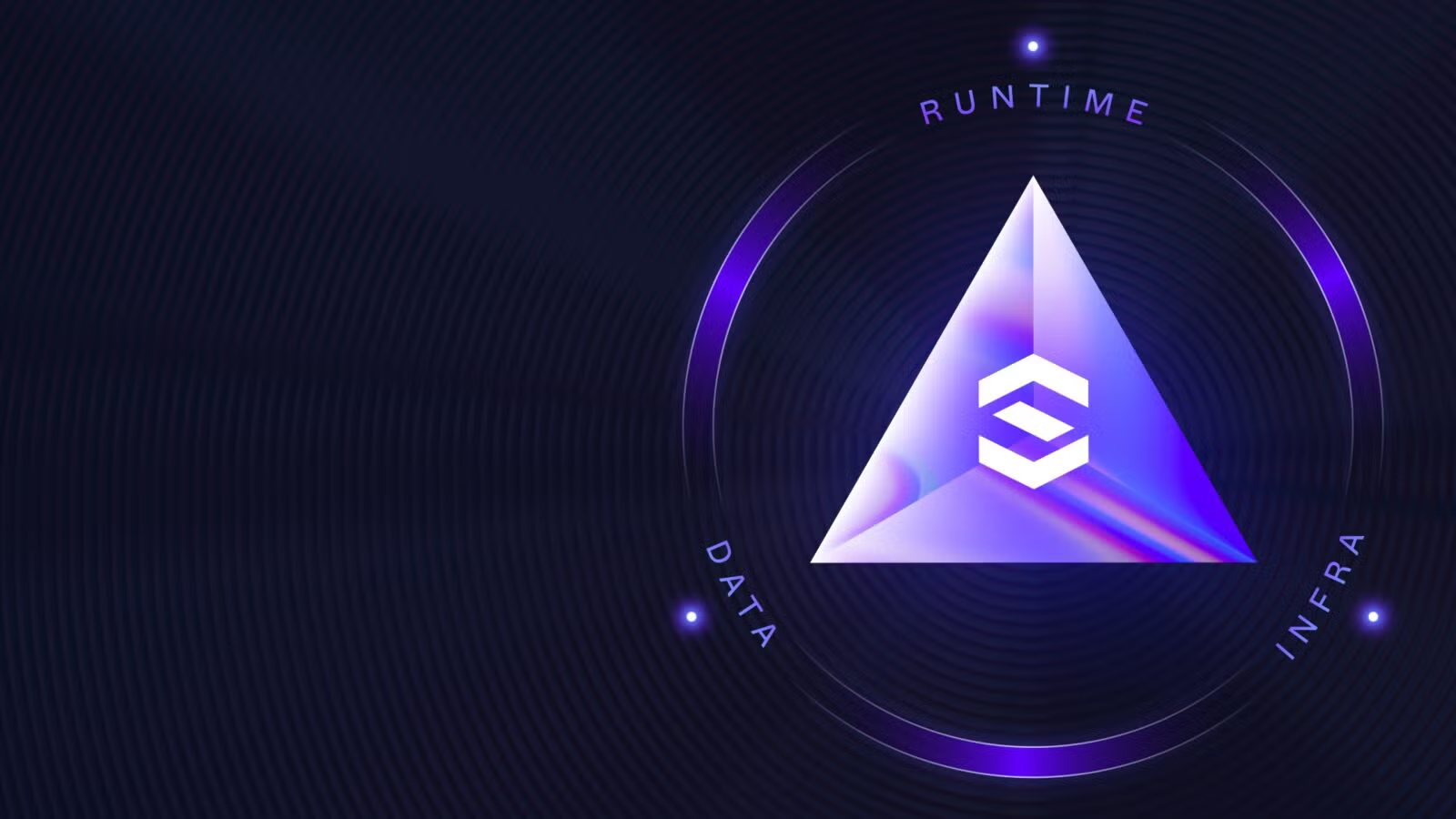
To scale AI with confidence, enterprises must move beyond check-the-box controls and adopt a holistic, machine-speed defense that secures the entire AI lifecycle. This means protecting the data that fuels and is accessed by models, the cloud infrastructure that runs them, and the workloads and AI systems operating at runtime as a single, unified, and immutable system.
As AI capabilities accelerate, a critical question is emerging in the market: Does AI reduce the need for cybersecurity, or fundamentally increase it?
The answer is clear. With current infrastructure architectures, AI is not a replacement for security. It is a multiplier for risk. Models ingest massive volumes of data and agents can sprawl uncontrollably. It depends on complex cloud infrastructure and operates continuously at machine speed. Each stage of the AI lifecycle introduces new attack paths and new failure modes.
Today, SentinelOne is announcing the expansion of its AI Security platform with new Data Security Posture Management (DSPM) capabilities, model red teaming, validation and guardrails (by Prompt Security), MCP Security (by Prompt Security), AI-SPM, AI Workload Protection, and AI end user protection. This milestone advances our broader vision, delivering a unified platform that secures AI end to end, from data accessed, all through runtime execution and model input and output. This is complete security, visibility, and governance over Al usage throughout its entire lifecycle.
The Foundation: Securing AI at the Data Layer
AI security starts with data, not because data is abundant, but because mistakes made at this stage are irreversible. AI models also don’t just process the data they ingest, they memorize it. If sensitive PII, credentials, or proprietary information enter a training pipeline, that data can become baked into a model’s weights, creating a permanent security liability that is nearly impossible to remediate later.
This risk is amplified by scale. Industry projections estimate that the global datasphere, the unstructured data stored in cloud object stores and increasingly fed into AI pipelines, will reach 10.5 zettabytes by 2028. This data is not just storage. It is the fuel that trains, fine-tunes, and powers AI systems. This is why data security is the first mile of AI security.
With the introduction of these new DSPM capabilities, SentinelOne enables organizations to establish a “safe-to-train” gate before data ever reaches an AI pipeline. These capabilities provide deep visibility into cloud-native databases and object stores, allowing teams to discover unmanaged or forgotten data sources, classify sensitive information with policy-driven precision, and prevent high-risk data from being used in training or inference workflows.
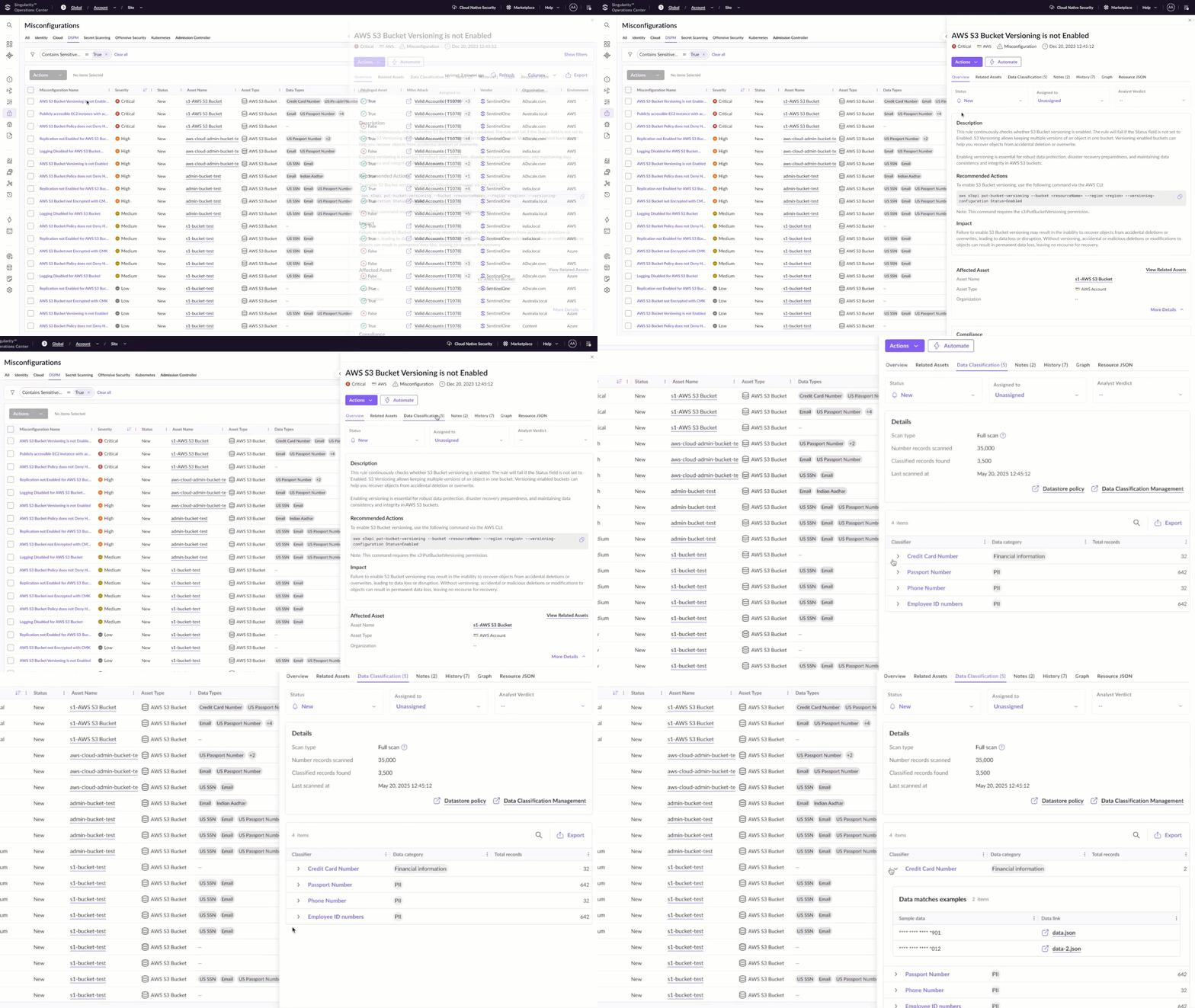
Singularity Cloud Security’s integrated DSPM discovers cloud object stores and databases and classifies sensitive data that could find its way into AI training pipelines.
However, visibility alone is not enough. AI pipelines ingest data at massive scale, making them an attractive vehicle for malware delivery and pipeline poisoning. In addition to identifying and redacting sensitive data, SentinelOne actively scans cloud storage at machine speed to prevent malicious content from ever reaching AI models or applications. By securing data at ingestion all before training begins, organizations eliminate entire classes of AI risk that cannot be fixed downstream. This is the foundation for trusted AI adoption.
The Infrastructure Layer: Securing the Systems That Run AI
Securing AI data is necessary, but it is not sufficient. Data does not exist in isolation. Rather, it lives on cloud infrastructure and in AI environments where infrastructure becomes a critical failure point.
AI workloads introduce a uniquely high-risk combination of high-value data, high-privilege access, and high-performance compute. AI factories, training clusters, managed AI services, and inference endpoints often require broad permissions and continuous access to cloud object stores. Without strong infrastructure controls, attackers can pivot from exposed data into model logic, model weights, or downstream applications. This is where cloud infrastructure security becomes inseparable from AI security.
Traditional Cloud Security Posture Management (CSPM) provides essential hygiene across the cloud estate by identifying misconfigurations, excessive permissions, and policy drift. In AI environments, however, security teams also need visibility and control that is specific to how models are built, deployed, and accessed.
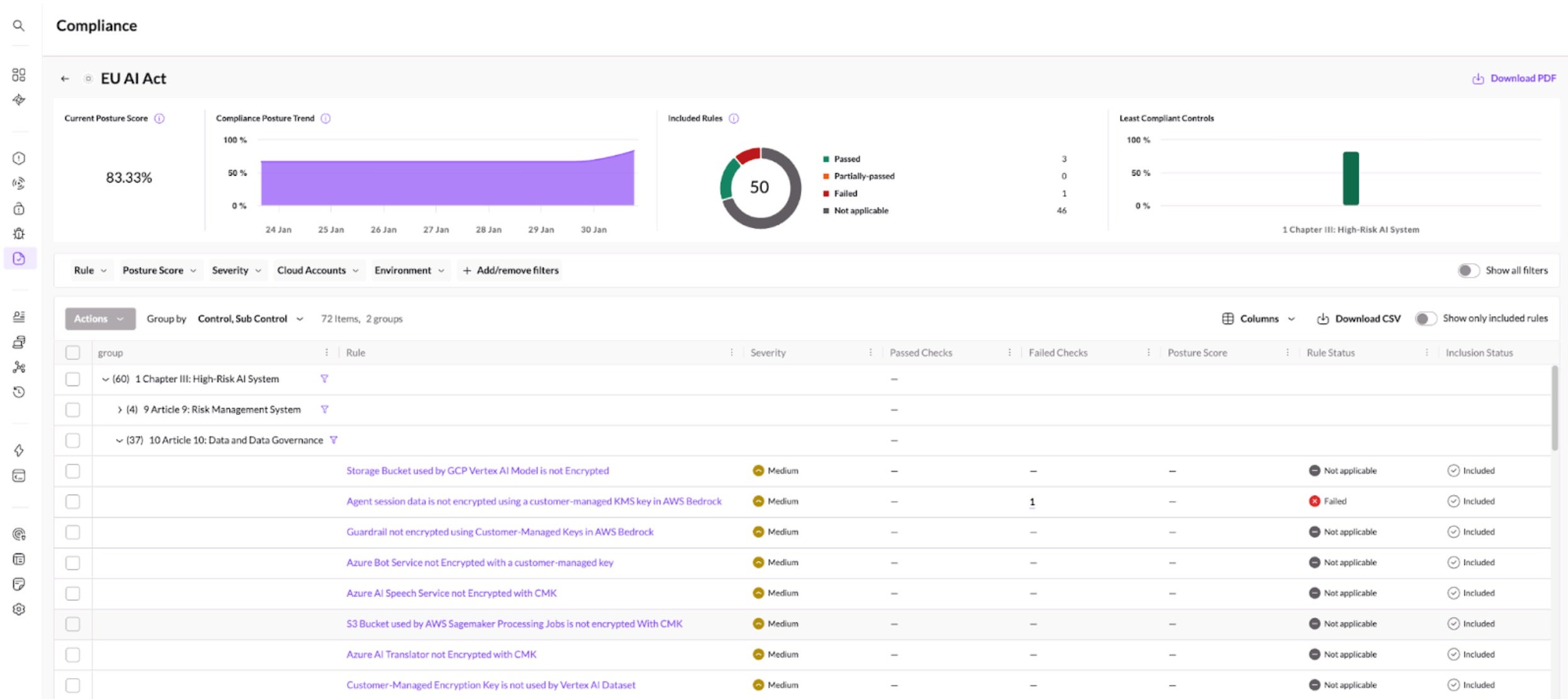
AI-Security Posture Management (AI-SPM) extends infrastructure security directly into the AI layer. By treating AI systems as first-class assets, AI-SPM provides a unified inventory of training jobs, development notebooks, managed AI services, and inference endpoints across the environment.
Together, CSPM and AI-SPM allow security teams to understand how data, infrastructure, and AI systems are connected. They can trace attack paths from misconfigured storage to over-privileged training containers, detect unmanaged AI assets, and prevent adversaries from moving laterally from the cloud foundation into model logic. This infrastructure layer is what connects secure data to secure runtime and it is essential for protecting AI at scale.
The Runtime Layer: Protecting AI In Production
AI security cannot stop when a model finishes training. The moment AI systems move into production, they begin interacting with real users, real data, and real business processes, making runtime protection a critical part of the AI security lifecycle.
At runtime, AI workloads operate continuously and at machine speed. Models and agents execute inside cloud workloads that must be protected against exploitation, unauthorized access, and lateral movement. Any compromise at this stage can immediately impact business operations, data integrity, and customer trust.
This is where runtime workload protection becomes essential. Cloud Workload Protection Platforms (CWPP) provide real-time visibility and enforcement across the compute environments running AI models, ensuring that workloads are monitored, hardened, and protected without degrading the performance required for high-velocity inference.
By extending protection into runtime, security teams ensure that AI systems remain secure not only during development and deployment, but throughout their operational life. This completes the AI security lifecycle from data ingestion, through infrastructure, to production execution.
Prompt Security and AI Red-Teaming: Continuously Validating Trust
Securing AI at runtime goes beyond protecting the workloads that execute models. It also requires validating how models behave when they are used (and misused) in the real world.
Prompts are the primary interface to AI systems and they represent a powerful new attack surface. Malicious or malformed prompts can be used to bypass controls, extract sensitive information, manipulate model behavior, or trigger unintended actions in downstream systems. These risks cannot be addressed solely through static controls or one-time reviews. This is where prompt security and AI red-teaming become essential.
By continuously testing AI systems with adversarial prompts and simulated attacks, organizations can identify behavioral weaknesses before they are exploited in production. AI red-teaming helps validate that models behave as intended under real-world conditions, exposing prompt-level vulnerabilities, unsafe outputs, and policy bypasses that would otherwise go undetected.
When combined with runtime protection, this approach ensures that AI systems are not only secure in how they are built and deployed, but also resilient in how they respond — even as models evolve, prompts change, and new attack techniques emerge.
This continuous validation loop is critical for maintaining trust in production AI systems and closing the final gap in the AI security lifecycle.
A Unified Fabric for AI Security
The transition to AI is ultimately a trust shift. Organizations will only move AI from experimentation to production if they can trust the data that trains models, the infrastructure that runs them, and the systems that govern how AI operates at runtime. Securing AI therefore cannot be fragmented. It requires a unified platform that treats data, infrastructure, and runtime as a single, connected system with shared context and continuous visibility across the entire AI lifecycle.
By integrating data security, cloud infrastructure posture management, AI-specific posture management, and runtime workload protection, SentinelOne delivers end-to-end AI security from data ingestion through runtime execution. This approach does more than reduce risk. It enables velocity. When security is built into the foundation, organizations can deploy AI faster, meet evolving regulatory requirements more easily, and innovate with confidence.
Secure the data.
Secure the infrastructure.
Secure the runtime.
This is how AI moves from risk to real-world impact. Contact us or book a demo to see how SentinelOne secures AI end to end — from data ingestion to runtime execution.