What is Identity Access Management (IAM)?
Identity access management (IAM) decides who reaches your systems, what they can do, and when access is revoked. See how IAM controls stop credential attacks.

Key Takeaways
- Identity access management (IAM) governs who reaches your systems, what they can do once inside, and when that access is revoked.
- IAM runs on five linked functions: authentication, authorization, policy enforcement, session monitoring, and deprovisioning.
- An attacker holding working credentials looks like an employee, so your IAM policies decide how far a stolen login travels.
- Orphaned accounts come from lifecycle failures and over-permissioned roles come from weak recertification, and both hand attackers a login that looks legitimate.
- IAM enforces access policy; identity threat monitoring catches valid credentials being abused inside an active session.
What Is Identity Access Management (IAM)?
Identity access management (IAM) is the security framework that verifies who or what is requesting access and decides which resources that identity can reach. It also removes the access when it is no longer needed. The IAM definition covers policies, processes, and the technology that enforces all three.
The pattern that breaks IAM is rarely technical. FBI and CISA documented attackers phoning corporate help desks, posing as employees, and talking staff into resetting passwords and moving multi-factor authentication to attacker-controlled devices. The result was working accounts in single sign-on environments.
If you own access for a hybrid estate, you need to know which controls still hold when the credential itself is valid.
How IAM Relates to Cybersecurity
Identity is the control plane attackers work hardest to reach, because one valid login moves past network filtering, endpoint policy, and perimeter rules in a single step. Every other control assumes it knows who is acting. IAM is what supplies that answer, and the quality of the answer sets the ceiling on everything downstream. IAM is therefore the record of who holds access, plus the enforcement that keeps the record true. When that record drifts from reality, your monitoring tools inherit the error and treat an intruder as staff.
What Does IAM Stand For, and Where Did It Come From?
IAM stands for identity and access management: establishing who someone is, and governing what they can do. Neither half works alone. Early administrators created accounts by hand, set passwords, and removed access on request. That worked for one server room and failed as soon as identities lived across data centers, SaaS tenants, and remote endpoints.
IAM reached its current shape in stages:
- Directory services. LDAP and Active Directory centralized accounts and applied group-based permissions across systems from one place.
- Federation and single sign-on. SAML and OAuth let one verified login authenticate a user across dozens of applications. Password sprawl dropped and audit coverage improved.
- Identity-centric security. Modern IAM adds behavioral analytics, cloud entitlement management, and alignment with zero trust architecture, so a session is judged on behavior as well as credentials. Enforcement points multiplied at every stage, but they all still run one decision sequence.
How IAM Access Control Works
The IAM access control process runs five checks on every request, and a failure at any one of them produces the access an attacker wants without a single exploit being fired.
- Authentication. The system establishes who is asking, using passwords, multi-factor authentication (MFA), biometrics, hardware tokens, or certificates. Risk-based authentication raises the requirement automatically when signals look wrong.
- Authorization. Once identity is settled, policy decides scope. A marketing analyst is cleared for campaign tools and refused entry to financial databases.
- Policy enforcement. Conditional access applies before entry, weighing device health, network location, time of day, and session risk. An unmanaged laptop triggers a step-up challenge or a refusal.
- Session monitoring. The system logs every authenticated session and resource request, so investigators get a timeline and auditors get evidence.
- Deprovisioning. When a role changes or a person leaves, lifecycle triggers revoke access automatically, closing the window on accounts that keep their permissions after their owner is gone.
Deprovisioning is the step organizations quietly skip. CISA and MS-ISAC traced a breach of a state government network to a former employee's account that was never disabled after their departure. The credentials had leaked in an unrelated incident. The attacker used them to authenticate through the VPN with administrator rights, then queried a domain controller. No malware was needed at any point. The controls that would have stopped it belong to specific components of the framework.
Key Components of an IAM Framework
An identity access management framework is a set of components that each close a different failure mode, and they only work as a set.
IAM Component | Function | Risk Addressed |
Authentication | Establishes identity at login | Stolen credentials used from anywhere |
Multi-factor authentication | Requires a second proof of identity | Account takeover after a password leak |
Authorization and RBAC | Grants permissions by job role | One account reaching far past its role |
Single sign-on | Runs one login session across systems | Password reuse and thin audit coverage |
User provisioning | Manages the account lifecycle | Orphaned and over-permissioned accounts |
Privileged access management | Controls administrative accounts | High-value targets with standing rights |
Identity governance | Recertifies access as roles change | Privilege accumulated quietly over years |
Audit logging | Records authentication and access events | Investigations with no reliable timeline |
Look at how the components connect, not only at whether you own them. Single sign-on without MFA concentrates risk into one credential. Role-based access control without recertification drifts into privilege creep. IAM administrator accounts left outside privileged access management become the most valuable target in the estate. Wiring the components to each other is what turns the framework into security outcomes you can measure.
IAM Benefits for Security Teams
IAM produces outcomes your team can measure inside a quarter, and they trace back to one thing: constraining what a working credential is allowed to do.
- Smaller blast radius. Least-privilege access confines a compromised account to what its owner needed, forcing attackers into privilege escalation that behavioral analytics can flag.
- Faster investigation. Audit logs answer which accounts touched which systems, from where, and at what time. Triage drops from hours to minutes.
- Simpler compliance. HIPAA, PCI DSS, SOC 2, and NIST 800-53 all require demonstrable access control and audit trails, and IAM generates both as a byproduct of operating.
- Lower insider risk. Automated deprovisioning ends access at the moment employment ends, and access reviews expose permissions that exceed current duties.
- Reduced ticket load. Automated provisioning and self-service password reset remove repetitive requests from the service desk queue, along with the social engineering opportunities those requests create.
Collecting them depends on knowing where IAM’s remit ends, since teams routinely assume it covers more than it does.
Where IAM Fits Among Identity Security Controls
IAM owns authentication, authorization, and account lifecycle for every identity in the organization, while adjacent disciplines take narrower slices of the same problem.
Concept | Scope | Primary Focus | Relationship to IAM |
IAM | All users and accounts | Authentication, authorization, lifecycle | The core framework |
PAM | Administrative and elevated accounts | Credential vaulting, session recording | A subset for high-risk accounts |
IGA | All enterprise identities | Certification, role management, policy | The governance layer |
ITDR | All identities during live sessions | Behavioral analytics, anomaly response | Extends IAM into active response |
Privileged access management (PAM) concentrates on accounts with elevated rights: domain administrators, database owners, and service accounts whose compromise hands over broad control in minutes. Identity threat detection and response (ITDR) adds behavioral monitoring and active response to the same identities IAM already governs.
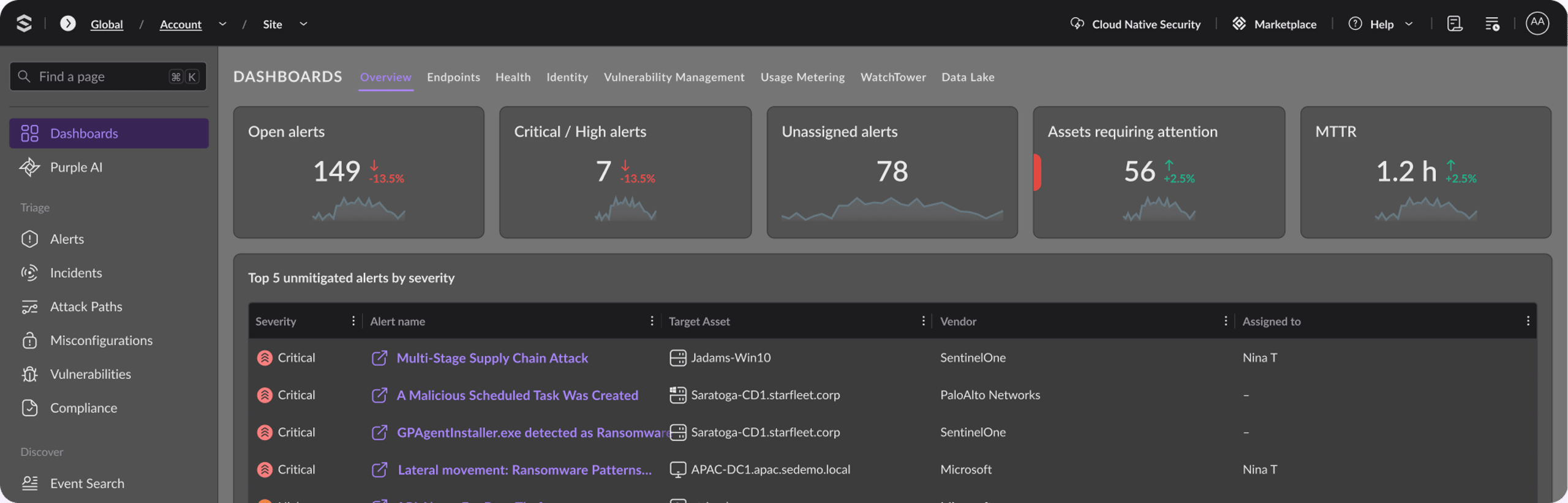
IAM and ITDR together answer the help desk attack described earlier. IAM would have validated the reset credential and allowed the session. ITDR watches what the session then does, and that is the job products such as Singularity Identity perform. Sequencing the rollout is what makes the pairing work.
IAM Implementation Best Practices
Effective IAM rollouts start where compromise is most expensive, then widen, because a program that tries to cover every account at once stalls before it protects anything.
- Start with privileged accounts. Deploy MFA and session recording on administrative accounts before extending coverage to standard users.
- Enforce least privilege. Audit current permissions against current duties, remove the excess, and use role-based access control so you are governing roles and not individuals.
- Automate the lifecycle. Connect IAM to your HR system so joiners, movers, and leavers trigger access changes on the day they happen.
- Recertify on a schedule. Quarterly reviews where managers confirm each report’s permissions prevent the slow accumulation that audits later expose.
- Layer authentication by risk. Adaptive policy should demand stronger proof for new devices, unusual locations, and sensitive data systems.
- Route identity logs into analysis. Audit data only earns its storage cost when an analyst reads it, so feed it into your SIEM alongside endpoint telemetry, where Purple AI can question it in plain language.
Together they shorten the window in which a stolen credential still works. Closing that window mid-session takes tooling built for it.
Stop Identity Attacks with SentinelOne
SentinelOne extends identity access management into the moment an attack is already using a legitimate account.
Singularity Identity defends identity infrastructure across Active Directory and Entra ID, and covers non-human identities including service accounts, APIs, AI agents, and automated workloads. It validates access continuously at runtime, so authorization granted at login is not treated as settled for the rest of the session.
When an account starts enumerating directory objects or reaching for locally stored credentials, Singularity Identity alerts during reconnaissance. It also misdirects the adversary and collects telemetry on their methods.
Purple AI compresses the investigation that follows. Your analysts question the Singularity Data Lake in plain language to reconstruct how the identity was used, which systems it reached, and whether lateral movement occurred. In the IDC Purple AI study, customers identified threats 63% faster and remediated 55% faster, with a 338% three-year return on investment.
Singularity Hyperautomation turns your identity playbooks into autonomous workflows: revoke the active session, require re-authentication, notify the account owner, and file the compliance record, without waiting on an analyst. SentinelOne is a Leader in the 2026 Gartner Magic Quadrant for Endpoint Protection Platforms, its sixth consecutive year in that position.
Request a SentinelOne demo to see identity attacks stopped mid-session.

Reduce Identity Risk Across Your Organization
Detect and respond to attacks in real-time with holistic solutions for Active Directory and Entra ID.
IAM FAQs
In cybersecurity, identity access management (IAM) is the layer your other controls depend on for the answer to who is acting. The working IAM definition reaches past employees to contractors, service accounts, and workloads, all under one policy set.
IAM also produces the evidence your auditors ask for: who authenticated, from where, to what, and when their access ended.
It should, and this is where coverage usually lags. Service accounts, API keys, CI/CD credentials, and AI agents authenticate constantly, rarely rotate, and often carry standing privileges nobody owns.
Bring them into the same inventory as human accounts, assign a named owner to each, cap their scope to one function, and rotate their secrets on a schedule your pipelines can tolerate.
Ownership is usually split, and the split is why programs stall. Security defines policy, IT operates the platform, and HR supplies the events that drive the lifecycle.
Name one accountable owner for the policy, then agree in writing which team executes joiner, mover, and leaver changes, and how fast. Without that agreement, deprovisioning becomes nobody’s task.
Issue third parties identities in your own directory, not shared logins, and attach an expiry date at creation so access lapses by default.
Scope entitlements to the systems named in the contract, require MFA with no exceptions for vendor convenience, and log their sessions separately so a supplier compromise is visible to you before it is reported by the supplier.
Track time from termination to full access revocation, the count of accounts with standing administrative rights, the percentage of privileged accounts covered by MFA, the number of accounts with no activity in 90 days, and completion rates on access recertification.
Drift shows up in these numbers long before an auditor finds it.
Discover More About Identity Security



Ready to Revolutionize Your Security Operations?
Discover how SentinelOne AI SIEM can transform your SOC into an autonomous powerhouse. Contact us today for a personalized demo and see the future of security in action.