Cloud Security Governance: Principles & Challenges
Cloud security governance lays the foundation for future security measures and implementations. Effective cloud security governance involves establishing policies, procedures, and standards to ensure secure cloud deployments, monitor compliance, and respond to security incidents across the entire cloud estate.

Cloud Security Governance has rapidly emerged as an essential framework in today’s interconnected digital environment, protecting data, applications, and infrastructure hosted in cloud environments.
Cloud Security Governance goes far beyond simply safeguarding information; it encompasses overseeing the cloud operations of any business. We will explore what Cloud Security Governance is, challenges faced, objectives, principles, best practices, and discover how solutions like SentinelOne offer additional protection. Whether you are a business owner, IT professional, or simply curious about this vital discipline – this comprehensive guide offers insight into key components.
What is Cloud Security Governance?
There’s always the risk that something unexpected could go wrong and force us all backward again, such as when they give out those pesky freebies! So I say: let the games commence! Cloud Security Governance is an approach intended to safeguard the confidentiality and availability of cloud environments by devising policies, compliance standards, and risk mitigation strategies tailored to individual organizations’ requirements and any legal or mandates regarding hosting data or services in these environments.
CSG must create and implement security policies tailored to its practice in order to maintain integrity, confidentiality, and availability; its aim should be to offer an open yet controlled platform where cloud operations comply with both legal requirements as well as individual organization-specific needs – taking an approach in CSG would ensure its practice becomes widely respected by industries across industries.
Cloud Security Governance involves setting and enforcing rules about how data and applications are utilized, accessed, managed, and controlled in the cloud. It covers numerous dimensions such as access controls, encryption, threat detection protocols, and continuous monitoring to help organizations ensure their cloud infrastructure meets business goals while remaining free from attack. Organizations can better ensure their cloud operates securely while fulfilling business needs and goals by developing and instituting these protocols.
Cloud Security Governance should not be reduced to an off-the-shelf model; rather, organizations must tailor it specifically to fit their organization size, industry, regulatory landscape, and usage patterns of their cloud environment. By understanding their cloud environment’s attributes and associated risks, organizations can design tailored Cloud Security Governance solutions that secure their assets while taking full advantage of cloud technologies without jeopardizing security but reap all their advantages without risk.
Understanding the Need for Cloud Security Governance
Cloud Security Governance has become more necessary due to our increasing reliance on cloud services and an increasingly complex and perilous cybersecurity landscape. Below are several factors which point to its importance:
Compliance Requirements: Many industries operate under stringent regulatory standards that mandate certain levels of data protection and privacy when it comes to cloud platforms, with various data privacy obligations mandated by various regulations for cloud platform operations. By employing Cloud Security Governance practices within cloud operations, organizations can ensure their legal obligations are adhered to, thereby helping avoid legal penalties or reputational damage due to compliance violations.
Data Security: With data breaches and cyberattacks increasing alarmingly, safeguarding sensitive information has never been more crucial. Cloud Security Governance provides an organized approach to doing this through encryption, access controls, and other safeguards.
Operational Control: With more resources shifting into the cloud, maintaining operational control can become challenging. Cloud Security Governance provides an effective framework to establish and enforce uniform security policies across various cloud services to ensure operations adhere to established protocols.
Risk Mitigation: Cloud Security Governance allows organizations to implement proactive security measures by recognizing potential vulnerabilities and threats and taking immediate steps against any security incidents that arise, effectively mitigating risks while responding efficiently if any incidents do arise.
Align With Business Aligning with business goals and objectives are at the core of Cloud Security Governance; by connecting IT strategy with operational agility, it allows companies to strike a balance between security and agility in operations.
Challenges Related to Cloud Security Governance
Navigating the complex terrain of Cloud Security Governance can be a difficult and time-consuming endeavor, with various technologies, compliance requirements, and organizational needs colliding to present an immense challenge to any governance framework. Furthermore, with cyber threats rapidly develop their attacks against organizations in real time, posing additional layers of complexity to this process of governance. Below we discuss some specific difficulties organizations might experience while trying to implement and sustain a practical Cloud Security Governance framework:
Understanding Regulatory Landscape: Staying apprised of rapidly evolving regulatory requirements can be challenging and requires constant vigilance and flexibility for compliance across various jurisdictions.
Complexities of Cloud Environments: With various cloud models such as public, private, and hybrid available today, security becomes complex to manage. A conceivability framework is required that fits across these different models – this poses significant difficulties to administrators trying to develop effective security practices within these environments.
Lack of Visibility and Control: Without full visibility over their cloud assets, organizations often experience unauthorized access or usage issues that complicate governance, making its administration an uphill struggle.
Integration With Existing Systems: Merging Cloud Security Governance with existing on-premise security controls and policies may result in inconsistencies and conflicts, potentially increasing complexity for administration.
Implementation Gap: Implementing Cloud Security Governance requires specific knowledge and skill; lacking qualified professionals in this area could impede its governance framework’s effective deployment and administration.
Cloud Security Governance presents many complexities for enterprises to contend with; its success necessitates an in-depth knowledge of technologies, regulations, organizational dynamics, and cybersecurity as a whole. To be effective at this endeavor requires adopting an organized, strategic approach with tools for continuous adaptation and learning as part of ongoing adaptation and learning cycles – yet its importance in our digital era makes its journey all the more imperative to ensure the secure use of cloud services responsibly and safely.
What are the Objectives of Cloud Security Governance?
Cloud Security Governance strives to foster an operating environment within a cloud that is secure, compliant, and efficient – one which aligns the technological capabilities of cloud services with business strategic goals while remaining compliant and providing robust protection. Here are its primary goals.
Compliance: One of the cornerstone goals is ensuring cloud operations adhere to relevant legal and regulatory obligations, such as GDPR, HIPAA, or other industry-specific standards. To do this effectively means taking measures such as GDPR certification or HIPAA implementation measures to meet compliance.
Protect Data and Privacy: Cloud Security Governance’s primary goal is to keep sensitive information safe from unauthorized access, modification, or deletion; this applies to customer data and intellectual property assets.
Cloud Security Governance assists organizations in assessing security threats, implementing appropriate controls to limit them, and minimizing associated risks – this also includes regularly monitoring for incidents that require responses when they arise.
Implement Transparency and Accountability: Establishing transparent policies and procedures allows all participants to clearly understand their roles and responsibilities, increasing accountability as well as trust among participants.
Enhance Operational Efficiency: Cloud Security Governance streamlines operations by standardizing security protocols across different cloud services, and facilitating faster, more agile utilization of available cloud resources.
Cloud Security Governance aligns security strategies and measures with business goals by balancing maintaining security measures and fulfilling goals for an optimal organizational experience. In doing so, Cloud Security Governance helps boost organizational efficiency overall.
Principles of Cloud Security Governance
Cloud Security Governance (CSG) is guided by fundamental principles that outline how organizations approach, implement, and oversee their cloud security strategy. These rules serve as a roadmap toward meeting desired objectives while keeping security a top priority within operations.
- Responsibility and Accountability: For successful Cloud Security Governance, clear roles and accountabilities must be defined among each stakeholder, from executives to technical staff in the cloud environment. Each person should understand his/her respective responsibilities within this environment as well as be held accountable for them.
- Risk-Based Approach: At the core of any governance framework lies risk evaluation and mitigation, making a risk-based approach essential in allocating resources where they’re most needed. Organizations should identify potential vulnerabilities, evaluate associated risks, and implement controls accordingly, ensuring resources go where needed most efficiently.
- Transparency: Transparency in policies, procedures, and operations fosters trust between stakeholders by making the rules governing cloud environments clear to everyone involved and encouraging collaboration to achieve security measures that are communicated and understood by everyone involved.
- Compliance Align: Aligning with relevant legal and regulatory requirements is of utmost importance when it comes to cloud Security Governance, so measures taken must encompass industry regulations and standards as a representation of adherence to lawful, ethical operations.
- Integrate Security into Every Aspect of Cloud Operations: Security should be integrated into each aspect of cloud operations from design, deployment, and ongoing management. By embedding security into its cloud strategy early in its lifecycle, organizations can ensure it does not become an afterthought but part of its foundational plan.
- Monitoring and Improvement: Cloud environments are dynamic environments where threats evolve quickly. To stay current with threats in this ever-evolving space, continuous monitoring and regular assessments are vital to maintaining effective governance frameworks that adapt to technological, regulatory, and business changes. Plus, they help facilitate ongoing improvement, which adapts to ever-evolving requirements – helping keep costs in line.

CNAPP Buyer’s Guide
Learn everything you need to know about finding the right Cloud-Native Application Protection Platform for your organization.
Best Practices for Cloud Security Governance
Implementing Cloud Security Governance successfully involves more than simply understanding its underlying principles; it also requires adhering to best practices proven to increase security and compliance. Below are a few best practices organizations should keep in mind when developing and overseeing their Cloud Security Governance framework:
Define Clear Policies and Procedures: Articulating policies and procedures ensures everyone in an organization understands their responsibilities – this may involve access controls, encryption standards, incident response protocols, or more.
Compliance Requirements Should Be Regularly Assessed and Updated: Compliance can be an evolving goal with regulations and standards constantly shifting; regular assessments are crucial in keeping governance frameworks aligned with legal obligations and legal compliance needs.
Implement Robust Access Controls: Controlling who has access to what in a cloud environment is essential to its security, so using role-based access controls and regularly reviewing access rights helps avoid unintended access.
Invest in Continuous Monitoring and Alerting: Continuous monitoring provides real-time insight into the security posture of cloud environments while alerting systems ensure any suspicious activities or potential breaches can quickly be identified and remedied.
Integrate Security into the Development Lifecycle: Security should never be treated as an afterthought in development; by including security considerations throughout all steps in the lifecycle design processes, applications will be created with security in mind from day one.
Collaborate With Cloud Service Providers: Building relationships and maintaining clear communications with cloud service providers is paramount for seamless integration and increased security. Gaining insight into their security measures aligning with an organization’s governance framework will allow seamless implementation with enhanced protection for its members.
Conduct Security Audits and Assessments Regularly: Audits and assessments provide a great opportunity for organizations to gauge the success of their governance framework by highlighting any vulnerabilities identified as well as making improvements that need to be made.
Educate and Train Staff: Security can only be as strong as its weakest link: the human element. By investing in education and training for employees, security protocols will become second nature, with less human error occurring over time.
How SentinelOne Helps in Cloud Security Governance?
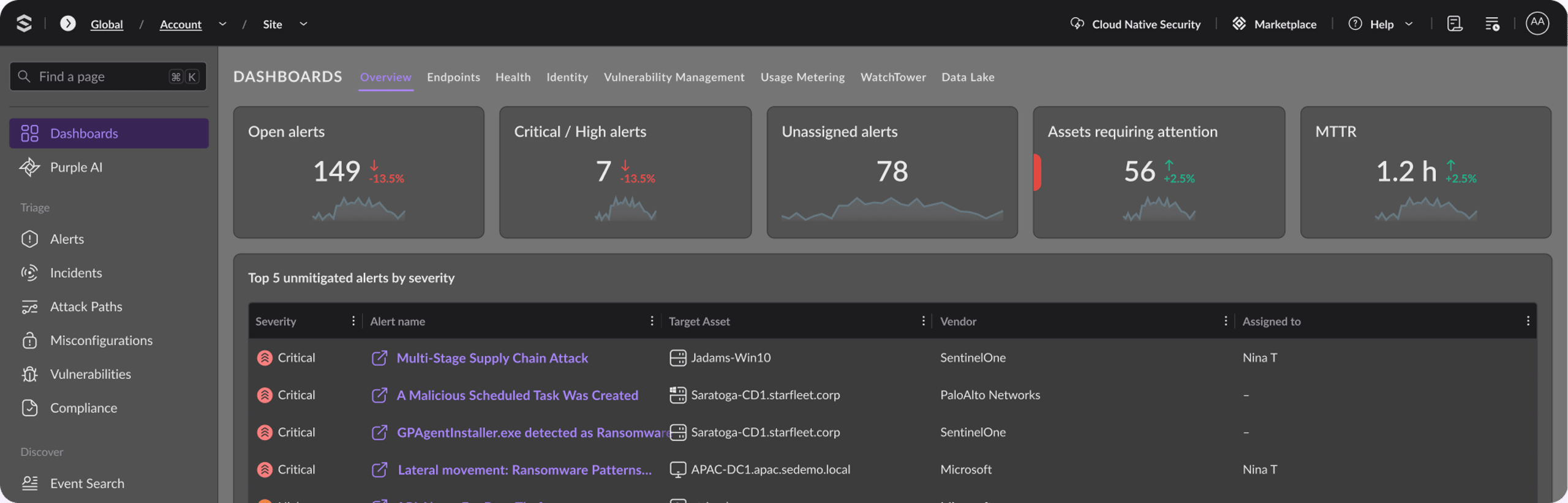
Cloud Security Governance requires robust solutions that continuously identify and address potential vulnerabilities and risks. SentinelOne offers an integrated suite of features that provides comprehensive protection in line with governance requirements for cloud environments.
- Comprehensive Vulnerability Management and Misconfiguration Detection: SentinelOne’s Cloud Misconfigurations and Vulnerability Management features allow organizations to easily detect. Its agentless scanning ensures all critical and hidden vulnerabilities are identified and addressed effectively. SentinelOne’s compliance dashboard ensures continuous multi-cloud compliance and supports the implementation of various regulatory standards like PCI-DSS, SOC 2, ISO 27001, CIS Benchmark, and others.
- Offensive Security and Real-Time Credential Leakage Detection: SentinelOne’s Offensive Security Engine emulates an attacker by simulating zero-day attacks harmlessly for greater coverage, helping security researchers understand potential attack paths while decreasing external research dependency. Furthermore, Cloud Credential Leakage detects real-time IAM Key/Cloud SQL Credential Leakages through native integrations such as Github/Gitlab/Bitbucket Cloud monitoring to validate sensitive information for real-time credentials leakages for real-time validation while simultaneously monitoring/validating sensitive data without false positives/enhancing security measures and increasing overall protection measures.
- Container Security – SentinelOne Singularity™ Cloud Security can do container and Kubernetes security posture management. You can run misconfiguration checks and also ensure compliance standard alignment.
- Cloud Detection and Response (CDR): Organizations get the benefits of full forensic telemetry and incident response services from experts. You can respond, contain, and remediate threats in real-time. SentinelOne’s Cloud Detection and Response also comes with a pre-built and customizable detection library.
- SentinelOne AI-SIEM: SentinelOne AI-SIEM lets you ingest first-party and third-party data from any source and easily integrates into your entire security stack. It never locks you into any vendor but gives you actionable insights with AI-driven detection. You can replace brittle SOAR workflows with Hyperautomation and it enhances security operations. It correlates insights, centralizes security data, and drives governance across all your platforms
AI-powered cloud workload protection (CWPP) for servers, VMs, and containers, that detects and stops runtime threats in real time.
Conclusion
Cloud Security Governance has quickly become essential to cloud technology and business success. SentinelOne is an integrated solution with features designed to address vulnerabilities, misconfigurations, credential leakages, and more, giving organizations full control of their cloud security.
Discover How SentinelOne Can Assist in Safeguarding Your Environment. Your security is our main priority; we’re here for support every step of the way.
Cloud Security Demo
Discover how AI-powered cloud security can protect your organization in a one-on-one demo with a SentinelOne product expert.
Cloud Security Governance FAQs
Cloud security governance sets rules, roles, and responsibilities for protecting data and services in the cloud. It defines policies on access, and streamlines incident response. Governance ensures everyone follows the same security standards, from developers to executives.
By laying out clear decision-making processes and accountability, it keeps cloud environments consistent, auditable, and aligned with an organization’s risk tolerance and strategic objectives.
As businesses move vital workloads to multiple cloud platforms, governance stops gaps from emerging. It makes sure security policies apply uniformly across AWS, Azure, or GCP, so you don’t end up with rogue servers or public buckets.
Good governance helps meet regulatory demands, reduces the chance of breaches caused by human error, and provides management with visibility into cloud risks and controls at scale.
Cloud management focuses on day-to-day tasks—provisioning servers, monitoring performance, and handling backups. Governance sits above management: it defines the guardrails for those tasks, like who may spin up resources, which regions are allowed, and how encryption must be applied. While management executes workloads, governance sets the policies that guide safe and compliant execution of those workloads.
Compliance monitoring checks that cloud settings match legal or industry requirements—GDPR, HIPAA, PCI DSS, and so on. Automated scans flag misconfigurations, missing encryption, or weak access controls. By reporting violations in real time, monitoring lets you fix issues before auditors arrive or regulators fine you.
It ties governance policies to measurable evidence, proving that your cloud environment meets both internal standards and external mandates.
Teams often juggle multiple cloud accounts, each with differing native controls and shared-responsibility models. Rapid deployments can outpace policy updates, creating drift. Lack of centralized visibility means misconfigurations go unnoticed. Cultural gaps between security and DevOps slow policy adoption.
Finally, evolving regulations and new cloud services demand constant policy reviews, or governance falls behind the pace of change.
SentinelOne CNAPP continuously scans your cloud accounts against best-practice benchmarks. It spots risky settings—public storage buckets, open security groups, or unencrypted databases—and flags them in a unified console. The platform also runs vulnerability checks on host images and container registries.
By surfacing actionable findings alongside remediation guidance, SentinelOne helps you enforce governance policies and close gaps before they become incidents.
Identity and privilege control enforces who can do what in the cloud. By defining least-privilege roles and using multi-factor authentication, you limit potential damage from compromised accounts. Governance policies tie into identity services to automate role assignment, rotation of credentials, and policy-based approvals for high-risk actions.
Strong identity controls ensure that only authorized users or services follow governance rules when accessing or changing cloud resources.
Discover More About Cloud Security




Your Cloud Security—Fully Assessed in 30 Minutes.
Meet with a SentinelOne expert to evaluate your cloud security posture across multi-cloud environments, uncover cloud assets, misconfigurations, secret scanning, and prioritize risks with Verified Exploit Paths™.