AWS Infrastructure as Code: Best Practices & Examples
This article explains AWS Infrastructure as Code, covering its concepts, implementation, benefits, and best practices. It discusses AWS IaC services and highlights how SentinelOne can help.
Handling infrastructure is essential for businesses, especially when coming onto the dynamic platform of cloud computing. AWS Infrastructure as Code (IaC) is a cloud management alternative and delivers the provisioning of resources on an automatic basis. Well, it increases operational efficiencies and brings down the risks of human errors. A new report titled “Moving Onto the AWS Cloud Reduces Carbon Emissions” calculates that AWS infrastructure is as much as 4.1 times more efficient when deployed on-premises.
With AWS Infrastructure as Code, adoption through AWS can become quite effective for organizations in regard to scalability, consistency, and speed of operations at cloud operations.
This blog will address all things businesses must know about AWS Infrastructure as Code, which is crucial. It will explore what it is and how it works for your organization. We will be discussing the AWS IAC services and their benefits, also with examples of how to put them into practice. By the end, the reader should be clear about what really is AWS Infrastructure as Code and how they can start implementing it in their organization.
 Understanding AWS Infrastructure as Code
AWS Infrastructure as Code is a revolutionary methodology that makes organizations cut through managing their cloud environments by writing code. The following section will introduce you to basic concepts, terminology, and mechanics of AWS IaC in operation and will provide the foundation for more advanced discussions on the subject.
What is AWS Infrastructure as Code?
AWS IaC is an approach that grants businesses the capability to manage and provide cloud infrastructure with code without manual processes. Organizations define their infrastructure as code, and this way, they automate the setup and configuration of AWS resources for consistency and repeatability.
With IaC, businesses can treat their infrastructure like application code, applying version control, testing, and continuous integration to infrastructure configurations.
Key Concepts and Terminology
Understanding basic concepts and terms is fundamental to successfully adopting AWS IaC. They represent the core of what IaC is all about, and you will need them throughout this article.
- Templates: These are JSON or YAML formatted files that describe what your desired state of infrastructure should look and feel like. In other words, templates are blueprints to deploy and manage AWS resources to make sure everything is created exactly as it should be.
- Stacks: These are a collection of AWS resources you can manage as a unit. To deploy a stack, a template is used. This way, resources are easily managed and deleted as a group rather than singularly.
- Drift: The difference between the current state of your resources and the desired state is defined in your templates. Drift detection finds discrepancies so that your infrastructure remains the same as specified configurations.
- Modules: Those are reusable components that can be shared and utilized for different sets of projects. A module provides standardization of configurations that allow for code reusability with ease of maintenance and updating infrastructure.
- State Files: These record the current state of your infrastructure, allowing for incremental updates and rollbacks when necessary. These state files help you maintain and apply changes to the infrastructure in a controlled manner.
AWS IaC: How It Works?
Understanding the mechanics of AWS Infrastructure as Code (IaC) is essential for effective implementation. Here’s a concise breakdown of the process:
Defining Infrastructure with Templates
AWS IaC begins with a description of your desired infrastructure state in the form of templates, written either in JSON or in YAML, that provide the blueprint to outline configurations, dependencies, and typed specifications so that the latter ensures consistency and replicability.
Deploying Templates as Stacks
Templates are deployed to create stacks, which are collections of AWS resources treated and managed as one. AWS CloudFormation takes care of the automation of such processes and assures that resources are correctly provisioned and consistent, with minimal configuration mistakes.
Tracking Resource States with State Files
State files record the current attribution of your resources. As such, they allow incremental updates and rollbacks. Such state files also guarantee that only the parts of your infrastructure that have been modified are updated and offer an easy way to revert to previous states if needed.
Drift Detection to Ensure Consistency
Continuous drift detection monitors your resources to keep them aligned with the desired stated templates. If any drifts are detected, AWS IaC tools will trigger alerts for you to take corrective actions to maintain your infrastructure’s reliability.
Realignment of Resources
When drift occurs, corrective actions such as updating configurations, redeploying resources, or rolling back to a previous state help realign your infrastructure. This will ensure that the cloud remains secure, efficient, and in conformance with your defined specifications.
In short, AWS IaC provides infrastructure definition through templates, deployment through stacks, state tracking through state files, and homogeneity through drift detection and realignment. It is a smooth way of getting more control and reliability on your cloud infrastructure.

CNAPP Market Guide
Get key insights on the state of the CNAPP market in this Gartner Market Guide for Cloud-Native Application Protection Platforms.
Implementing AWS Infrastructure as Code within Your Organization
Migration to AWS IaC requires a more systematic approach. This section will take you through the process of implementing AWS IaC within an organization, from initial assessment up to deployment and monitoring.
- Assess Your Current Infrastructure: First, understand your current infrastructure setup-describe what is and what should be improved. This assessment will help you in planning the scope of IaC implementation and hence allow you to prioritize resources according to needs.
- Choose the Right Tools: Choose appropriate AWS IaC services and tooling that will best meet your needs in your organization. Where third-party tools are chosen, ensure that they are compatible, user-friendly, and backed by an active community.
- Define Infrastructure in Code: Infrastructure should be described through templates – usually in JSON or YAML – that define what this infrastructure’s desired state is. These templates need to be particular and detailed, describing exactly how this configuration and all its dependencies are set up.
- Version Control: Keep templates under version control to track changes over time and allow for collaboration. Version control systems keep historical records of all changes; thus, if something happens, it is very easy to return to earlier versions.
- Deploy and Monitor: After you prepare your templates, you can deploy them by creating stacks. You run your resources in a continuous fashion in order to consistently check for drift in current states. Set up monitoring and dashboards to observe the performance and health of the resources.
Benefits of Implementing AWS Infrastructure as Code
Adopting AWS IaC provides various benefits that can really make tangible impacts on the cloud operation within your organization. In this section, we will look at the key benefits of implementing AWS IaC and why it is worth adding to your cloud strategy.
- Consistency and Repeatability: The idea behind infrastructure as code is that each deployment yields the same result. Organizations using Infrastructure as Code have also seen a 50% reduction in configuration errors, showing how consistency reduces human mistakes – A QnA forum for DevOps developers adds to the reliability of the infrastructure and adds operational stability to it.
- Scalability: IaC enables up and down scaling of infrastructures with just simple changes in the templates and redeployment. According to a survey, organizations implementing IaC report a 60% decrease in deployment failures. It will give an organization flexibility to respond without wastage of resources in a way that will never be overstretched nor under-provided.
- Version Control: Having your infrastructure code in version control allows you to track changes, collaborate among members of your team, and, when something has gone sideways, perform rollbacks to previous configurations. Version control is absolutely necessary for an auditable trial and any kind of root cause analysis or troubleshooting.
- Automation: This, in essence, automates the process of setting up and maintaining your infrastructure, reducing time and effort in doing respective manual processes. Speedier deployments, faster times to recover, and quicker management of resources are what automation leads to.
- Cost Efficiency: Infrastructure as Code ensures resource utilization optimally but, at the same time, entails minimal human intervention. In fact, organizations adopting Infrastructure as Code can annually save up to 30% of operational costs because of improved resource management and automation. Over-provisioning is drastically reduced with immense savings and operational overheads are reduced in a manner that resources are being used efficiently.
AWS Infrastructure as Code Services
The services offered under AWS provide a complete set of services for Infrastructure as Code, catering to specific needs that may be attached to the management of the cloud. It simplifies a cloud operation, makes it consistent, and is also manageable up to a great scale. This section continues to describe the most popularly used AWS IaC services with details of their feature sets and capabilities.
#1. AWS CloudFormation
AWS CloudFormation offers a core service for defining infrastructure in JSON or YAML templates. It allows the automating of provisioning and managing AWS resources. The user will be assured of consistency and repetition in deployments. Owning to the fact that this is a declarative service, the user can define the desired state and CloudFormation will manage the creation and configuration of those AWS resources to meet the desired state. In addition, the ability to create StackSets is also allowed by CloudFormation; these are used for managing multiple deployments across different AWS regions and accounts.
This capability is of great importance to organizations seeking a uniform infrastructure across various parts of their operations in different parts of the world.
#2. AWS Cloud Development Kit (CDKTF)
AWS Cloud Development Kit takes this a step further by enabling developers to define cloud infrastructure in common programming languages like Python, Java, and TypeScript. This now allows developers to leverage their existing skill sets and toolchains while programmatically defining AWS resources.
By using high-level constructs based on the configuration of complex instances, users can easily construct robust and scalable systems with CDK. It also integrates seamlessly with Terraform, creating CDKTF and further letting teams use both together for flexibility and powerful infrastructure management.
#3. AWS Config
AWS Config is a service that allows users to assess, audit, and evaluate the configurations of their AWS resources continuously. It gives a very clear look at resource configurations and the compliance status against desired settings. AWS Config enables you to create rules that automatically evaluate the resource configurations. In so doing, it can quickly identify organization-wide resource deviations from best practice guidelines or compliance requirements.
Such visibility helps proactive governance to ensure that the infrastructure is running in compliance with the company’s policies and regulatory standards.
#4. AWS CloudWatch
AWS CloudWatch is a service used for the monitoring and observability of AWS resources and applications. It lets users monitor data in real time, collecting and tracking metrics, logs, and events. With this, teams are able to configure alarms that notify them when operations fall outside of a normal system condition, thus enabling quicker responses to performance degradation and other operational issues. Besides that, CloudWatch plots time-series trends, enabling the organization to better optimize resource usage and troubleshooting.
#5. AWS CloudTrail
AWS CloudTrail is a service that enables governance, compliance, and auditing of activities related to AWS accounts by capturing all API calls within the AWS account and retaining this information for auditing purposes. An organization leverages CloudTrail to track infrastructure changes, troubleshoot user activity, or detect unauthorized access in cases like insider threats.
This provides CloudTrail with a complete record of events that assist in forensic analyses, helping with regulatory requirements for compliance.
#6. AWS Systems Manager (SSM)
Operational data from multiple AWS services comes with a single user interface that includes an integration for managing AWS resources through AWS Systems Manager (SSM). With this service, users manage operational tasks across resource configurations, patch management, and compliance checks in one place. Running scripts, applying configuration changes, and troubleshooting issues are some of the uses of SSM. Having all control in one place speeds up resource management and operational agility, enabling teams to focus more on strategic projects and less on getting bogged down with routine tasks.
AWS Infrastructure as Code services help organizations bring ease and efficiency to the management of their cloud estate, ensure compliance, and improve operational effectiveness through practical application. Each is a key component to building out a successful IaC strategy and making sure the cloud infrastructure is not only reliable but can be agile enough to move nimbly in response to constant business change.
AWS Best Practices on Infrastructure as Code
Integrating AWS IaC seamlessly is possible by following some AWS infrastructure as code best practices. This section shall discuss some best practices that are important to make your AWS IaC deployments effective, reliable, and secure.
- Modularization: Break infrastructure into reusable blocks in order to effect sharing of codebase and manage it more comfortably. With modularity, standardization is easy, and maintenance and updates for different projects become relatively easy.
- Source Control: The IaC templates are stored in source control to monitor the history of changes and enable collaboration with others. Version-control tools, including Git, keep a record of changes to files in order to revert to previous versions if needed.
- Automated Testing: Automate some tests for your templates so that when they are to be deployed, they have already been tested to work as expected. In automated testing, errors are caught way in advance in the development process, thereby reducing deployment failures drastically.
- Continuous Integration/Continuous Deployment: Align your IaC workflows with CI/CD pipelines to programmatically deploy and maintain your infrastructure. CI/CD pipelines make changes continuously, deploy at a fast pace, and test while ensuring that assurance happens much faster compared to manual processing.
- Drift Detection: Your infrastructure should be continuously monitored for configuration drift, and corrective action should be taken so that it configures to the desired state as defined by your templates. The whole point of drift detection is to ensure the consistency and reliability of your infrastructure.
Picking the Right AWS IaC Service for Business
For businesses, choosing the right AWS IaC service is always complex. The following section shall guide you on how to assess and choose an AWS IaC service apt for your needs and requirements.
- Assess Your Needs: Assess infrastructure size and complexity, your organizational team size and expertise, and tools in use/workflows implemented. Understanding your needs will help you in such a way that it could accord you with the capability of finding out more about the most suitable IaC service for your organization.
- Determine a comparison of available services: Compare features and capabilities of the selected AWS Services for IaC. Look at how easy it is to use, its flexibility, and for community support.
- Consider Integration: Make sure that the service fits nicely among your current set of tools and workflows, such as version control systems, CI/CD pipelines, and monitoring solutions. Seamless integration will save hours in using your IaC implementation and will contribute to higher efficiency.
- Scalability and Flexibility: A service that would be able to scale up with the growth of an organization and changing requirements should be opted for. Scalability and flexibility are factors that are required to keep infrastructure management both efficient and cost-effective.
- Cost and Support: Can you afford the service cost, and what support and resourcing are available to get you up to speed and help you troubleshoot? In that regard, consider pricing models, documents, and community forums.
CNAPP Buyer’s Guide
Learn everything you need to know about finding the right Cloud-Native Application Protection Platform for your organization.
SentinelOne for AWS Infrastructure as Code
Having a robust security solution for your AWS Infrastructure as Code strategy is critical to ensure the complete protection of your cloud infrastructure. SentinelOne offers cutting-edge security solutions designed from the ground up to solve challenges that most AWS IaC environments have typically faced. Singularity™ Cloud Security represents the ultimate AI-driven CNAPP that’s bringing together agility with agentless insights and the full capabilities of a real-time runtime agent.
By bringing SentinelOne into your AWS IaC workflows, you will protect your cloud infrastructure to be secure, compliant, and resilient in the face of various types of threats.
Threat Detection and Response Automation in Real-Time
One of the key aspects that SentinelOne offers is real-time threat detection. It runs autonomously in the background across your AWS Infrastructure. As you deploy your resources using Infrastructure as Code, SentinelOne keeps an eye on any suspicious behavior—for example, unauthorized configuration changes, security policy violations, or the introduction of vulnerable components.
SentinelOne provides AI-driven visibility and automated identification of active threats, including zero-day vulnerabilities and fileless attacks that escape traditional security controls. SentinelOne triggers an automatic response once detection is done, reducing dwell time. In turn, this keeps your deployments in AWS secure proactively without demanding your constant, hands-on attention.
Full Visibility into AWS Cloud Environments
SentinelOne extends deep visibility into your AWS IaC environment, whether you’re managing resources across multiple regions or a variety of AWS services like EC2, Lambda, and S3. With SentinelOne, you are able to gain full visibility into every component of your infrastructure. This visibility is absolutely critical if you want all bases covered and ensure that every single asset is not only identified but also properly protected.
Cloud administrators using SentinalOne’s flagship solution, Singularity™ Cloud Security, know how their resources are being used, identify weak configurations, and reduce possible weaknesses. In addition, this visibility can be further supercharged by automatically checking compliance against all resources set up through AWS IaC according to the required security standards and best practices in the industry.
Seamless Integration with AWS Services
The strong integration of SentinelOne with all the key AWS services allows for easy insertion into your automation of IaC workflows. AWS CloudFormation, Terraform, or whatever the automation tool is, SentinelOne can find its way into your deployment pipelines without hiccups and at every other stage of the infrastructure lifecycle to ensure proactive security.
This integration supports AWS-specific security features, including AWS IAM and Amazon GuardDuty. When working in harmony with the tools that AWS provides, SentinelOne will elevate your capabilities to lock down infrastructure without increasing complexity in the environment or causing slowdowns in development cycles.
Address Serverless Security and Container Security
In modern organizations, serverless architectures and containerized applications are used to enhance security postures. That is where SentinelOne provides a specific solution for serverless security: monitor AWS Lambda functions and associated resources for vulnerabilities and compliance issues without requiring agents.
Container security also involves the scanning of Docker images for vulnerabilities and secret scanning to make sure these images are free from any known vulnerabilities or that sensitive information is not embedded within code repositories. All this can be ensured through agentless vulnerability management measures that enable organizations to identify and fix security issues without adding any extra layer of complexity to their environments.
Remediation of Cloud Misconfigurations
Among the most critical parts of cloud security involves dealing with misconfigurations, which are among the leading causes of security breaches. SentinelOne automates the scanning of your AWS infrastructure for misconfigurations, recommending remediation steps in the process. Integrating these automated remediation processes into your IaC frameworks enables an organization to ensure strong security practices without slowing down deployment cycles.
SentinelOne’s commitment to security can be further expressed through its CNAPP platform: an integrated security framework that provides critical functionalities featuring vulnerability management en masse, compliance enforcement, and runtime protection in cloud-native environments.
Securing AWS IaC at Scale
As the deployments of AWS IaC scale in an organization, so does the attack surface. Being able to scale with ease, SentinelOne easily navigates large dynamic environments where security is always consistent with infrastructure size. This can be important for companies relying on Continuous Integration/Continuous Deployment pipelines, where updates and changes to infrastructure are pushed with regularity.
The intelligence of SentinelOne extends to the protection of cloud-native applications through integrating with AWS container services such as Amazon Elastic Container Service for Kubernetes. That means the Kubernetes workloads are managed with Infrastructure as Code and are secured from container-based attacks and vulnerabilities.
Ensuring Compliance in AWS IaC Deployments
Organizations that need to comply with stringent security laws like PCI-DSS, HIPAA, and SOC 2, by using the SentinelOne platform, can automate their compliance checks and generate overall detailed reports with enhanced regulatory compliance.
With SentinelOne integration in an AWS IaC strategy, validations are always updated at regular intervals. This ensures that every resource and configuration stays compliant. The risk of security audits finding any vulnerability or misconfiguration that may incur penalties or reputational damage will be immense.
In summary, SentinelOne’s Singularity™ Cloud Security significantly increases the value of your overall AWS Infrastructure as Code strategy in raising security posture, simplifying compliance, and scaling easily with the growth of your infrastructure. Real-time threat detection and full visibility, integrated seamlessly and automated in compliance, provide an important element for all organizations to assist in the protection of their AWS IaC deployments.
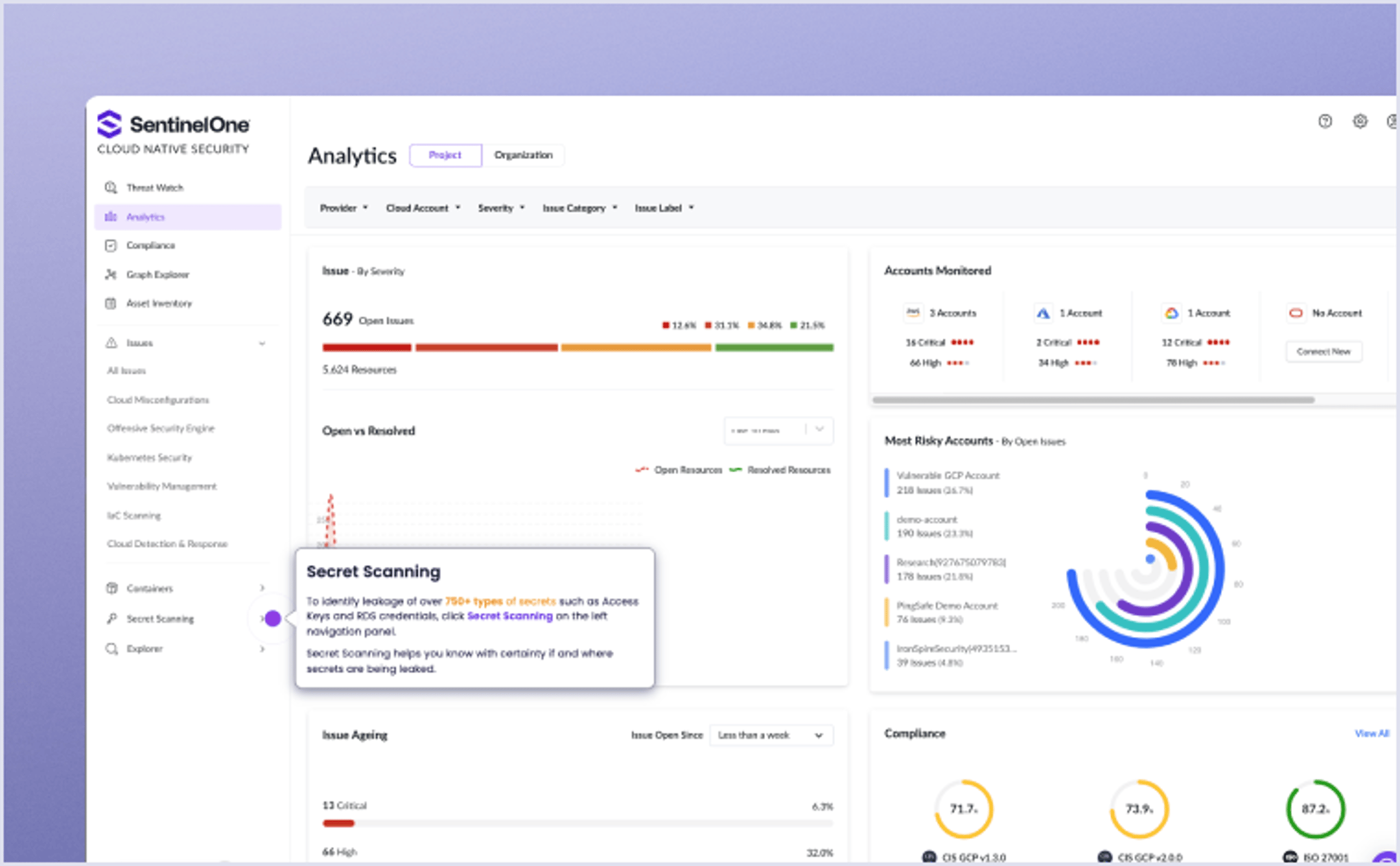
AI-powered cloud workload protection (CWPP) for servers, VMs, and containers, that detects and stops runtime threats in real time.
Conclusion
To sum up, AWS IaC is a great approach to employ cloud infrastructure resources as code that can help to accelerate and optimize the task of provisioning and administering infrastructure. When the structure reduces the involvement of people, it eliminates the possibility of making mistakes while at the same time increasing on efficiency of business operations. Using IaC, organizations can prevent building sometimes mediocre, slow, and hard-to-manage environments within the cloud.
As highlighted in this article, AWS IaC can be the backbone of a sound cloud strategy, especially when used together with the right tools and approaches. The AWS IaC integration process will ensure your company is ready for the digital environment and can grow in the future.
Wondering how SentinelOne can assist in AWS Infrastructure as Code? Please feel free to contact us to find out more about the various security services that we offer in detail for your needs.
FAQs
AWS Infrastructure as Code (IaC) allows you to configure and manage your cloud infrastructure using code rather than manual processes. This approach simplifies the management of AWS resources, ensuring consistency, reliability and enabling automation across your environment.
Examples include AWS CloudFormation templates, AWS CDK-Cloud Development Kit scripts, and Terraform configuration. All these tools let you define your infrastructure as a code that drives greater automation, consistency, and control of your cloud resources.
Infrastructure as Code is supported in AWS through AWS CloudFormation, AWS CDK, and AWS Elastic Beanstalk. Each offers various features and functionalities to interact with infrastructure management and automation through code-based solutions.
Some of the AWS Infrastructure as Code best practices involve modularization, version control, automated testing, CI/CD, and drift detection. These go a long way in keeping cloud infrastructure much more consistent. It also scales operations, reduces costs, avoids human errors, and increases efficiency by automating the provisioning and management of AWS resources.
Discover More About Cloud Security




Your Cloud Security—Fully Assessed in 30 Minutes.
Meet with a SentinelOne expert to evaluate your cloud security posture across multi-cloud environments, uncover cloud assets, misconfigurations, secret scanning, and prioritize risks with Verified Exploit Paths™.