Leading ASPM Vendors in 2026
Delve into the world of ASPM to close security gaps before they derail your releases. This guide helps you weave safety into every dev phase, from planning to deployment. Your code depends on it.

What if you pushed your latest software release live to discover a hidden vulnerability attackers exploit in minutes? It doesn’t just hurt your bottom line—it can erode user trust beyond repair. Many enterprises have felt this sting, yet the pressure to move faster in development never eases. That’s where Application Security Posture Management (ASPM) steps in. ASPM vendors empower you to anticipate risks, secure your code, and maintain confidence in a rapidly shifting threat landscape.
With the right ASPM strategies, you can root out hidden cracks before they become headline news. It’s not just about reacting to incidents; it’s about setting a foundation of proactive, resilient defenses—so your organization can innovate without fear.
With that in mind, let’s explore how ASPM vendors fit into your security journey.
 What are ASPM Vendors?
ASPM vendors are organizations that specialize in safeguarding your software at every phase of development and beyond. Their core goal? To help you monitor potential weak links in your applications—whether it’s insecure coding practices, overlooked configurations, or new vulnerabilities that surface post-deployment. They don’t just run surface-level scans; these vendors often integrate deeply with your continuous integration and continuous deployment (CI/CD) pipelines. They can catch flaws earlier, offer remediation advice, and ensure minimal disruptions.
A company qualifies as an ASPM vendor when it focuses on the entire lifecycle of application security posture—design, coding, testing, deployment, and runtime. While some solutions concentrate on shift-left scanning alone, ASPM extends its reach into runtime monitoring, threat intelligence, and automated policy enforcement. Essentially, ASPM vendors deliver an end-to-end perspective of how your code behaves in staging and production. This differs from Cloud Security Posture Management (CSPM) providers, whose focus may be broader at the cloud infrastructure level. ASPM’s niche specialization lies in drilling down to your applications’ intricacies and dependencies.
You’ll often find capabilities like vulnerability detection, code analysis, secret scanning, and integration with bug-tracking systems. The ASPM vendors provide actionable alerts instead of flooding you with superficial data. They help you understand not just “what” is wrong but “why” it matters and “how” to fix it. Their success hinges on visibility into your development ecosystem—from third-party libraries to microservices that spin up and down on demand. If a vendor dedicates itself to comprehensively monitoring your application’s posture, that’s a clear sign you’re looking at an ASPM solution rather than a more generic cloud security tool.
The Need for ASPM Vendors
In a world where software deployments happen in rapid cycles, security often risks being an afterthought. This leaves organizations exposed to an array of threats that quickly evolve. For instance, a single unpatched library could open the door to sophisticated malware like Doki, specifically targeting container and cloud-based systems. Attackers thrive on exploiting overlooked details—a neglected API token, hardcoded credentials, or an unprotected serverless function.
Without a robust ASPM strategy, your teams might tackle vulnerabilities late, leading to rushed fixes or incomplete patches. Meanwhile, continuous integration pipelines can amplify minor oversights. Once the code reaches production, one mislabeled environment variable or an ignored build warning can morph into large-scale security incidents. Phishing and credential stuffing also remain significant concerns—exploited credentials are often the most straightforward way for attackers to slip past your perimeter.
ASPM vendors exist to preempt these pitfalls. By weaving security checks directly into development stages and runtime environments, they help you avert issues long before your software goes live. Their platforms highlight misconfigurations, detect unusual traffic patterns, and spot suspicious code behavior in real-time. Some solutions unify data from multiple sources—like scanning reports, bug trackers, and security information event management (SIEM) systems—so you have a consolidated view of your risk. That can be especially critical when entire microservices might be compromised if a single container is breached.
ASPM vendors address the precise challenges of modern enterprises: short development cycles, complex microservice architectures, and a rapidly evolving threat landscape. By adopting ASPM practices, you can take a proactive stance and consistently guard your applications against known and unknown dangers.
7 ASPM Vendors in 2026
You can supercharge your app security by learning about the seven ASPM vendors in 2026. Let’s explore their key capabilities offerings, and see what they can do for enterprises.
SentinelOne
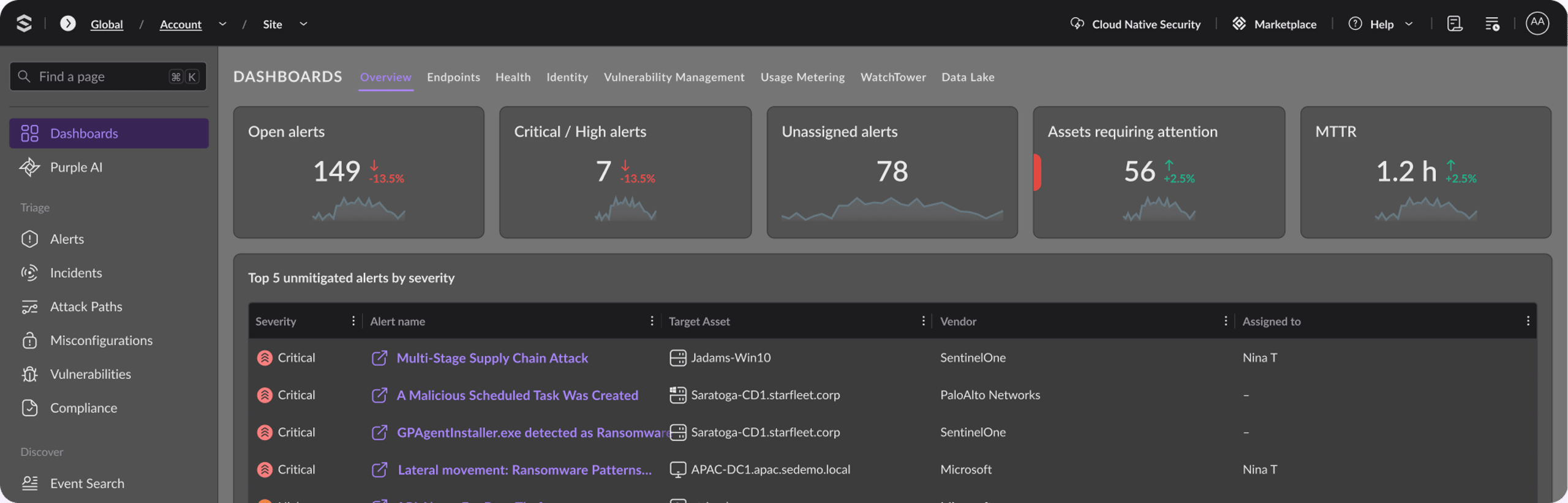
You might already associate SentinelOne with endpoint security, but it extends deep into application security posture management. As an ASPM vendor, SentinelOne focuses on more than just one layer of your tech stack. It weaves security measures throughout your entire application lifecycle—covering code repositories, CI/CD pipelines, runtime environments, and even SaaS platforms you rely on for day-to-day operations.
SentinelOne’s philosophy is centered on centralized visibility. Instead of juggling multiple consoles, you get a single interface to track vulnerabilities, scan infrastructure-as-code (IaC) templates, and verify that your cloud apps meet compliance standards like PCI-DSS, NIST, or CIS Benchmark. This approach simplifies your workflow and reduces friction between DevOps and SecOps teams.
Platform at a Glance
- You can monitor CI/CD pipeline scans, track newly discovered secrets (including 750+ distinct types, from API tokens to SSH keys), and push automated policy updates whenever a high-risk vulnerability surfaces. SentinelOne’s single console even helps prevent double work. If a developer team has already resolved a critical issue, SentinelOne updates the system to avoid repeated fixes.
- Workflow automation is another crucial piece of the puzzle. You can set policies to prioritize the riskiest vulnerabilities first, ensuring that your team tackles the problems that pose the most significant threats. The platform also supports continuous compliance checks, applying over 2,100 rules across your cloud workloads to spot early misconfigurations. For instance, if there’s a gap in your Kubernetes deployment or a missing encryption setting, SentinelOne flags it before it ends up in production.
- You’ll also see specialized scanning for Helm charts, Terraform files, and other IaC components—functional when coordinating large-scale cloud rollouts. Add to that agentless vulnerability detection and SaaS security posture management, and you have a system designed to keep your entire environment in check, from the first line of code to the final runtime instance.
- SentinelOne proactively analyzes user activities, looks for anomalies in application behavior, and flags suspicious changes in real-time. Plus, SentinelOne’s integration with Snyk means you can plug in specialized open-source scanning where it counts. Suppose you want your development cycles to move quickly without sacrificing security. In that case, you’ll be glad to know that it unifies your processes—from code commit to production deployment—under one consistent umbrella.
Features:
- Offensive Security Engine: Proactively simulates attacker tactics, enabling you to identify potential break-in points before they’re exploited.
- Verified Exploit Paths maps out how a vulnerability could be exploited, giving insight into priority fixes and possible lateral movement.
- Zero-Day and Ransomware Defense: This program observes behavioral patterns to catch evolving threats, from zero-day malware to orchestrated ransomware campaigns.
- Monitored User Activities: SentinelOne watches for unusual activity, such as when someone inside your organization misuses privileges or an app behaves erratically.
- AI-Driven Anomaly Detection: Purple AI correlates data from logs, processes, and network flows to identify out-of-place behaviors that might suggest hidden intrusions.
- Holistic Threat Coverage: Targets everything from social engineering attempts to malicious file downloads, minimizing the blind spots that attackers love to exploit.
- Singularity Data Lake Integration: Leverages aggregated cloud app data to produce threat intelligence, highlighting correlations you might miss with a fragmented toolset.
Core Problems that SentinelOne Solves
- Misconfigurations in Cloud Apps: This fix fixes overlooked settings. Doing so can ensure your workloads adhere to recommended security guidelines and prevent significant compliance gaps.
- Excessive Manual Oversight: Automates policy enforcement and vulnerability prioritization so your teams don’t waste time on repetitive tasks.
- Credible Compliance Assurance: SentinelOne aligns your environment with frameworks like PCI-DSS, NIST, and CIS Benchmark. It can prevent risks such as potential future lawsuits and regulatory fines.
- Untracked Secrets: Monitors for over 750 secret types; it can prevent data leaks caused by exposed API tokens or embedded credentials.
- Resource Sprawl: Applies over 2,100 checks across your cloud deployments. It helps you avoid inefficiencies and maintains a consistent security posture. You can also use SentinelOne to apply the best app security practices and optimize resource utilization.
- Fragmented Feedback Loops: Integrates seamlessly with CI/CD systems and Snyk. You can start consolidating developer input and ensuring issues get resolved once, never to revisit them.
Testimonials
“I’ve never seen our security teams and developers collaborate so smoothly,” says a senior DevSecOps engineer at a global retail brand. “Before SentinelOne, we struggled with repeated fixes. One sprint would patch a bug, and then three weeks later, someone would report it again. Now, it’s a single fix and done. Their single console pulls everything together—IaC checks, compliance scans, user activity logs—into one place. We even found old tokens hidden in a rarely used microservice. SentinelOne flagged them before any damage occurred. Our sprints are tighter, and our management finally feels confident about our application security posture.” -G2 reviewer.
See SentinelOne’s ratings and reviews on Gartner Peer Insights and PeerSpot for additional insights.

See SentinelOne in Action
Discover how AI-powered cloud security can protect your organization in a one-on-one demo with a SentinelOne product expert.
Veracode
Veracode helps you detect and fix application flaws before they become big problems. It supports multiple languages and frameworks, so you won’t have to juggle different scanning tools. Veracode also offers educational guidance to help developers improve their secure coding habits.
Features:
- Binary Static Analysis: Examines compiled code for hidden weaknesses.
- Contextual Remediation Advice: Shows the “why” behind each flaw.
- Low False Positives: Curates results so you only see relevant alerts.
- Scalable Cloud Setup: Adapts whether you have a single app or hundreds.
Know what users are saying about Veracode as an ASPM vendor by reading its PeerSpot reviews.
Checkmarx
Checkmarx offers unified scanning for both proprietary and open-source code. It digs into your files to catch logic errors, injection points, or insecure libraries. You can configure incremental checks to spot new vulnerabilities quickly. Its multi-language coverage simplifies life if you work across diverse tech stacks.
Features:
- Incremental Scanning: Focuses on recent changes for rapid feedback.
- Risk-Based Scores: Points you toward high-priority issues first.
- Policy Guardrails: Blocks merge if severe vulnerabilities go unresolved.
- Dev-Centric Integrations: Works with Git repos and popular IDEs.
See how well Checkmarx performs in ASPM by reviewing its PeerSpot ratings.
Rapid7 InsightAppSec
Rapid7 extends its security expertise to application-level scanning through InsightAppSec. This tool uses dynamic analysis, simulating attacks, and watching how your app responds. It also supports API scanning, which is handy for connecting multiple services. For regulated fields, built-in compliance checks map to standards like PCI or HIPAA.
Features:
- Interactive DAST: Tracks real-time app responses to uncover hidden flaws.
- API Support: Examines endpoints for overlooked threats.
- Compliance Mapping: Aligns scans with mandates you must follow.
- Guided Fixes: Walks your teams through precise remediation steps.
You can learn Rapid7 InsightAppSec’s value as an ASPM vendor by browsing its ratings and reviews on Gartner and TrustRadius.
Contrast Security
Contrast can help you catch vulnerabilities in your apps before they occur. Rather than analyzing static code, it monitors how data flows during normal operations or test cycles. This reduces guesswork, as you can see which exploits can happen in real-time.
Features:
- Instrumentation: Insert “eyes” into your code for live monitoring.
- IAST: Uncovers flaws by observing fundamental interactions.
- Runtime Alerts: Flags exploitation attempts as they unfold.
- Lightweight Footprint: Produces minimal extra overhead for dev teams.
You can learn more about Contrast Security as an ASPM vendor by checking out its G2 reviews.
Palo Alto Networks Prisma Cloud
Prisma Cloud combines container, serverless, and Kubernetes security under one roof. It helps you enforce consistent rules if you’re running on multiple cloud providers. The platform also does runtime checks, hunting for anomalies in container processes that might signal a hidden attack.
Features:
- Multi-Cloud Policies: Applies uniform security across AWS, Azure, and GCP.
- Runtime Defense: Spots malware in active workloads.
- Micro-Segmentation: Limits blast radius if one piece gets compromised.
- Policy-as-Code: Embeds compliance checks into your deployment scripts.
Find out what Palo Alto Networks Prisma can do for your app security posture management by reading its Gartner Peer Insights and PeerSpot ratings and reviews.
WhiteSource
WhiteSource, now often called Mend, monitors your open-source libraries and dependencies. It identifies which vulnerabilities threaten your code base, so you’re not panicking over irrelevant CVEs. Renovate, its update tool, eases the workload by automating dependency upgrades in your Git repositories.
Features:
- Reachability Analysis: Tells if an exploit affects your app’s code path.
- Renovate Bot: Automates library and framework updates.
- Open-Source License Checks: Prevents compliance troubles down the road.
- Priority Tagging: Flags urgent issues for immediate attention.
See what WhiteSource (Mend.io) can do as an ASPM vendor by reading its PeerSpot reviews.
How to Choose the Best ASPM Vendors
Selecting an ASPM provider goes beyond comparing feature lists. Check how each solution fits your existing workflows—do they connect with your IDEs or ticketing system without forcing you to switch tools? Budget is another factor: pricing might be based on developer seats, scans, or resources scanned. Make sure you understand long-term costs, including premium support or extra modules.
Scalability is key to spin up new services or expand your dev teams. Some solutions are built for large, distributed environments, while others shine in smaller setups. Don’t forget threat intelligence and compliance alignment, primarily if you work in regulated industries. You’ll want a vendor that swiftly responds to emerging vulnerabilities, ships regular updates, and automates policy checks for frameworks like PCI or ISO standards.
Ultimately, an ASPM vendor should feel like a partner. They should enhance collaboration between security and development rather than creating more silos. If a tool provides timely alerts, crystal-clear remediation steps, and unintrusive scanning, it can become a natural part of your delivery pipeline.
CNAPP Buyer’s Guide
Learn everything you need to know about finding the right Cloud-Native Application Protection Platform for your organization.
Conclusion
The ASPM market includes a variety of solutions, each with its twist—static analysis, real-time instrumentation, open-source dependency management, or dynamic scans. By weaving security into every development step, you reduce the chance of last-minute fire drills and costly breaches. Whether your focus is container orchestration or classic web apps, an ASPM vendor can give you the peace of mind to innovate entirely.
Do you want to improve your app security and level it up more? Try SentinelOne today!
FAQs
Yes. Good ASPM platforms integrate with CI/CD pipelines, IDEs, and version-control systems.
Many vendors do map to common standards, but be sure to check your region’s specific regulations.
Ideally no. Most modern tools aim to catch vulnerabilities early, minimizing last-minute delays.
It’s crucial if you rely heavily on external libraries, which most modern applications do.
Reputable ASPM providers update rules or signatures quickly; some employ real-time threat intel to stay current.
Discover More About Cloud Security




Your Cloud Security—Fully Assessed in 30 Minutes.
Meet with a SentinelOne expert to evaluate your cloud security posture across multi-cloud environments, uncover cloud assets, misconfigurations, secret scanning, and prioritize risks with Verified Exploit Paths™.