Cloud Compliance: Importance & Challenges
Modern cloud compliance requires more than just benchmarks. Ensure seamless regulatory adherence with our solutions, which provide real-time visibility, automated compliance monitoring, and continuous risk assessment for cloud, on-premises, and hybrid environments

Reduce your digital footprint, minimize attack surfaces, and comply with GDPR/CCPA and other industry regulations. Good cloud compliance streamlines audits and is a great way to protect your customers and assets. Dispose of duplicate data and improve data integrity, confidentiality, and availability. Reduce cyber risks for your business, avoid unlawful fines, lawsuits, and boost business reputation.
Cloud Security compliance is crucial as it creates a solid security architecture, ensures security best practices, and gives firms a framework to build a thorough security program. Let’s explore its landscape in this guide.
We will discuss Cloud Compliance, its components, why it is essential, and more below.
What is Cloud Compliance?
Cloud Compliance refers to following the regulatory standards and guidelines governing the utilization of cloud services. These set industry protocols and applicable national, international, and local laws.
Cloud Compliance frameworks are designed to bolster security, mitigate risks, and uphold industry standards. These frameworks encompass various regulatory standards and requirements, including industry-specific compliance norms and those set forth by cloud service providers. Noteworthy cloud compliance frameworks encompass SOX, ISO, HIPAA, PCI DSS, GDPR, and others.
Every compliance rule set is created for a certain kind of business. But there are some standard requirements that these laws frequently state. These include utilizing codes to ensure that sensitive information is kept secure, implementing “good enough security” for your responsibilities, and routinely monitoring everything to identify and address potential security issues in your business.
Why is Cloud Compliance Important?
When you move services to the cloud, you should be able to access an army of professionals that can defend and protect your data. But regrettably, security problems are frequent.
Security issues with cloud computing typically result from two things.
- Providers: Breaches may result from software, platform, or infrastructure problems.
- Customers: Businesses don’t have reliable policies to support cloud security.
The greatest danger that businesses face is data breaches. Companies don’t always use simple methods (like encryption) to secure data from attackers who want it.
Companies frequently have trouble comprehending the safety services that their cloud providers supply. Additionally, many businesses don’t create internal processes that prioritize security.
Components of Cloud Compliance
Here are the main components of cloud compliance:
- Governance
- Change Control
- Identity and Access Management (IAM)
- Continuous Monitoring
- Vulnerability Management
- Reporting
#1 Governance
All major company security topics are under the authority of cloud governance. It establishes the firm’s security and compliance needs and ensures they are upheld in the cloud environment.
A cloud governance policy’s three key parts are continuous compliance, automation and orchestration, and financial management. Financial management supports several cloud governance concepts and aids in cost control for your company.
- Asset management: Businesses must evaluate their cloud services and data and set up configurations to reduce vulnerabilities.
- Cloud strategy and architecture: This entails defining the cloud’s ownership, roles, and responsibilities and incorporating cloud security.
- Financial Controls: It is crucial to set up a procedure for authorizing the purchase of cloud services and guaranteeing the cost-effective use of cloud resources.
#2 Change Control
A methodical technique for managing any changes made to a system or product is called “change control.” The goal is to ensure that no modifications are performed that are not essential, that all modifications are documented, that services are not unnecessarily interrupted, and that resources are used effectively.
#3 Identity and Access Management (IAM)
Each organization’s security and compliance policy must include IAM policies and processes. The three crucial procedures of identification, authentication, and authorization ensure that only authorized entities have access to IT resources.
IAM controls undergo various changes when transitioning to the cloud. Several best practices include:
- Constantly monitor root accounts and, if feasible, disable them. Implement filters, alarms, and multi-factor authentication (MFA) for added security.
- Employ role-based access and group-level privileges tailored to business requirements, adhering to the principle of least privilege.
- Deactivate dormant accounts and enforce robust credential and key management policies to enhance security.
#4 Continuous Monitoring
Due to the intricate and decentralized nature of the cloud, it is of utmost importance to monitor and log all activities. Capturing essential details such as the identity, action, timestamp, location, and method of events is vital for organizations to maintain audit readiness and compliance. Key factors to consider for effective monitoring and logging in the cloud include:
- Ensure that logging is enabled for all cloud resources.
- Take measures to encrypt the logs and refrain from using public-facing storage to enhance their security and protection.
- Define metrics, alarms, and record all activities.
#5 Vulnerability Management
Vulnerability management helps identify and address security weaknesses. Regular assessments and remediation are essential for maintaining a secure cloud environment. It remediates unknown and hidden vulnerabilities within systems as well via regular assessments.
#6 Reporting
Reports offer current and historical evidence of compliance, serving as a valuable compliance footprint, particularly during audit processes. A comprehensive timeline of events before and after incidents can offer critical evidence if compliance is questioned. Reports are forwarded to stakeholders and used for making key business-decisions.
Popular Cloud Compliance Regulations
The most popular Cloud Compliances (Regulations and Standards) are:
- International Organization for Standardization (ISO)
- Health Insurance Portability and Accountability Act (HIPAA)
- General Data Protection Regulation (GDPR)
- Federal Risk and Authorization Management Program (FedRAMP)
- Sarbanes-Oxley Act of 2002 (SOX)
- PCI DSS or Payment Card Industry Data Security Standard
- Federal Information Security Management Act (FISMA)
Challenges of Compliance in the Cloud
New compliance challenges come with different types of computing environment challenges. Below are some of the numerous Cloud compliance challenges:
- Certifications and Attestations: You and your chosen public cloud vendor must demonstrate compliance to meet the requirements set forth by relevant standards and regulations.
- Data Residency: Careful choices about cloud regions are necessary, as data protection laws often restrict hosting personal data within specific territories.
- Cloud Complexity: The cloud’s intricate environment with multiple moving parts poses challenges for visibility and control over data.
- Different Approach to Security: Conventional security tools, tailored for static environments, face challenges when adapting to the dynamic nature of cloud infrastructure. To address this, specially designed security solutions are necessary, considering the frequent changes in IP addresses and the routine launching and closing down of resources.
Tips for Cloud Compliance
To achieve cloud compliance, the following practices are particularly beneficial in meeting regulatory requirements:
- Encryption: Initiate protecting your vulnerable data by implementing encryption measures, both when it is stored (at rest) and while it is being transmitted (in transit). However, ensure the security of your data keys, as they also play a crucial role in the overall encryption process.
- Privacy by Default: Integrate privacy considerations into the design of your systems and processing activities right from the beginning. This approach simplifies cloud compliance with data protection regulations and standards.
- Understand your compliance requirements: Understanding the relevant requirements is the first step toward compliance, which is not a simple task. It may be necessary to seek outside assistance from consultants and specialists in order to comprehend the regulations and optimize the compliance infrastructure. This is expensive—but not as expensive as noncompliance.
- Recognize your responsibilities: Cloud companies often only provide a shared responsibility approach for security and compliance. It’s crucial to thoroughly comprehend your obligations and take the required steps to ensure compliance.

CNAPP Buyer’s Guide
Learn everything you need to know about finding the right Cloud-Native Application Protection Platform for your organization.
How will SentinelOne help you to monitor and maintain Cloud Compliance?
Although the cloud offers businesses a number of benefits, it also presents a distinctive set of security risks and challenges. Due to the considerable differences between cloud-based infrastructure and traditional on-premises data centers, it is necessary to implement specific security technologies and tactics to ensure adequate protection.
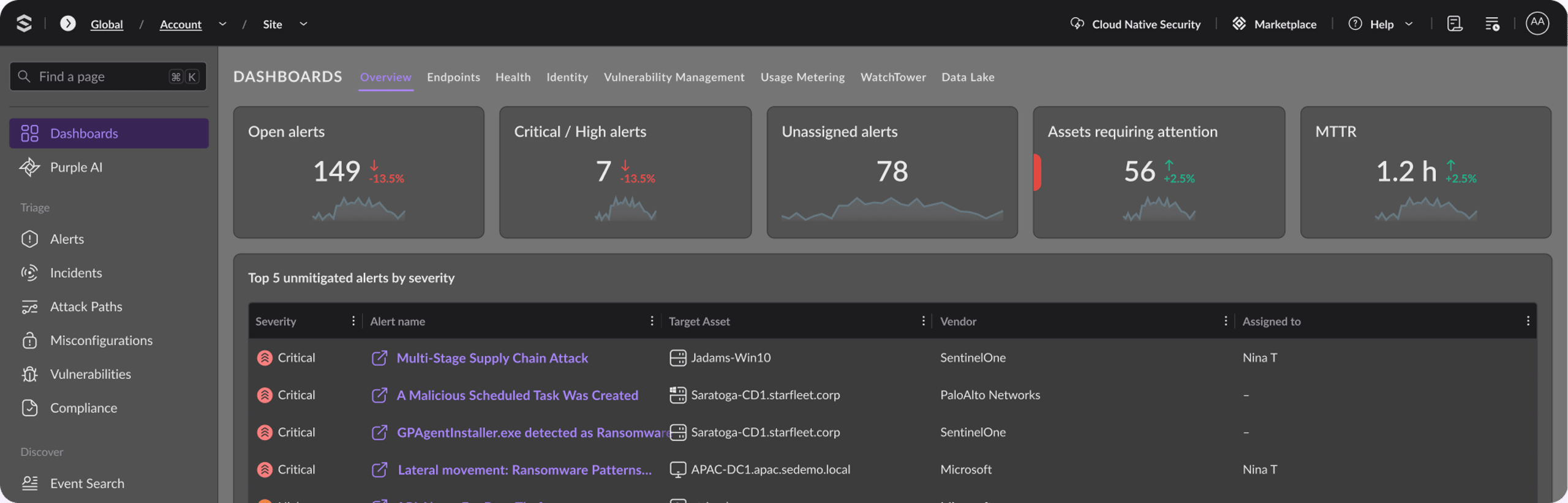
SentinelOne offers an advanced AI-driven autonomous cyber security platform for monitoring and mitigating cloud security threats. Its comprehensive Cloud-Native Application Protection Platform (CNAPP) offers a range of features such as Behavior AI and Static AI engines, Singularity Data Lake Integration, Compliance Dashboard, Software Bill of Materials (SBOM), IaC Scanning, and Offensive Security Engine, to boost cloud-native security. It delivers AI-powered agent-based Cloud Workload Protection Platform (CWPP), Cloud Security Posture Management (CSPM), Kubernetes Security Posture Management (KSPM), Cloud Detection & Response (CDR), and Cloud Data Security (CDS). PurpleAI and Binary Vault take your cloud security to the next level by enabling you with advanced threat intelligence, forensic analysis, and automated security tool integrations.
Other several features offered by it that enhance cloud security are:
- Real-time monitoring: It continuously looks for unusual cloud infrastructure and service activity to spot potential threats and security lapses.
- Threat Detection and Prevention: It protects cloud resources from damage by detecting and thwarting cyber threats, including malware, DDoS assaults, and unauthorized access attempts using cutting-edge techniques.
- Strong access restrictions and authentication procedures ensure that only authorized users and gadgets can access cloud services and data.
- SentinelOne uses encryption to protect data while in transit and at rest, adding an extra layer of protection against unwanted access even during a breach. It builds a Zero Trust Architecture (ZTA) and helps implement the principle of least privilege access across hybrid and multi-cloud environments.
- Management of Vulnerabilities: Routine vulnerability scans and assessments assist in proactively identifying and addressing problems in cloud infrastructure.
- Compliance and Governance: Offering reporting and auditing capabilities helps firms comply with legal obligations and industry norms.
- In a security crisis, notifications, threat intelligence, and automated response measures facilitate rapid reaction.
- By enforcing recommended practices for resource setup, cloud resource configuration management reduces the likelihood of incorrect settings and the resulting security flaws.
Organizations may dramatically improve cloud security, reduce risks, safeguard critical data, and guarantee smooth cloud operations using SentinelOne.
See SentinelOne in Action
Discover how AI-powered cloud security can protect your organization in a one-on-one demo with a SentinelOne product expert.
Conclusion
A change to the cloud also calls for a change in how security and compliance are approached. But it’s crucial to keep in mind that the two disciplines are distinct from one another.
Compliance frequently has a much broader scope, addressing issues like individual rights and how you handle their data. This has consequences when you process and store their data in the cloud.
Compliance is merely a checkbox exercise to ensure you satisfy the minimum criteria of legislation and standards, though. Additionally, this does not imply that you are adequately shielded from the security dangers that your company confronts.
Because of this, security should go beyond compliance by concentrating on what your firm genuinely needs rather than what assessment programs call for. Because if you don’t, you could still be at risk of being attacked. The repercussions of this could be severe, ranging from operational disruption and significant financial losses to long-term harm to your company’s brand.
Cloud Compliance FAQs
Cloud compliance means following laws, regulations, and security standards that apply to cloud services and data. It involves meeting rules about data privacy, protection, and handling, so your organization avoids legal trouble. Compliance ensures that cloud environments are configured securely and policies are in place to control who can access sensitive information.
Compliance helps prevent fines, lawsuits, and reputational damage from data breaches or mishandling. It builds trust with customers and partners who expect their data to be protected. Plus, it pushes organizations to follow safe cloud practices, reducing risks and making audits and reporting easier.
It’s a shared job. Cloud providers secure the infrastructure, but you own security of your data, apps, and configs. Your compliance team, IT, and security staff must work together to set policies, run audits, and fix issues to meet requirements. Ignoring your side can leave gaps criminals exploit.
Common ones include GDPR for data privacy in Europe, HIPAA for health info, PCI-DSS for payment data, SOC 2 for service security, and FedRAMP for US government clouds. Which apply depends on your industry, location, and what data you store or process in the cloud.
You can run automated compliance scans with CSPM tools that check cloud config against standards. Manual audits help verify policies and documentation. Also, continuous monitoring detects drift and alerts you if controls break. Review logs, permissions, and encryption regularly to stay on track.
At least quarterly audits are a good baseline. Increase frequency if you handle highly regulated data or after major changes like migrations or new services. Continuous monitoring between audits helps catch issues early so you don’t fall out of compliance without noticing.
Automate policy enforcement and scanning to spot misconfigurations fast. Use role-based access and encryption by default. Train teams on compliance rules and report issues immediately. Keep documentation current and involve auditors early when deploying new cloud services. Aim to catch problems before they cause breaches or violations.
Limited staff and expertise can make setting up controls and audits tough. Complex cloud setups lead to missed rules or inconsistent policies. Budget constraints might mean skipping automation or thorough training. To manage this, prioritize high-risk areas, use managed security services, and keep processes simple but effective.
Discover More About Cloud Security



Your Cloud Security—Fully Assessed in 30 Minutes.
Meet with a SentinelOne expert to evaluate your cloud security posture across multi-cloud environments, uncover cloud assets, misconfigurations, secret scanning, and prioritize risks with Verified Exploit Paths™.