What Is an Agentic SOC? AI Agents in Security Ops
Learn how an agentic SOC works: AI agents plan and run multi-step alert investigations within guardrails while human analysts supervise high-stakes decisions.

Key Takeaways
- Agents do the investigating, humans supervise. An agentic SOC is a security operations center where AI agents plan and run multi-step alert and incident work within guardrails. Analysts validate verdicts and own high-stakes decisions.
- Agents go beyond copilots and SOAR. Copilots wait for a prompt and SOAR runs scripted playbooks. Agents reason through alerts no playbook anticipated, adapt to context, and escalate when they’re uncertain.
- Measurable gains. Every alert gets investigated, work stays consistent around the clock, and senior analysts are freed for hunting. IBM found organizations using security AI and automation extensively saved an average of USD 1.93M per breach. IDC found Purple AI customers achieved 63% faster threat identification and 55% faster remediation.
- Autonomy brings new risks. Errors compound across multi-step investigations, black-box verdicts create compliance exposure, and the agents themselves become targets (OWASP lists goal hijack, tool misuse, and privilege abuse). Skills erosion for junior analysts is a further workforce risk.
What Is an Agentic SOC?
In November 2025, AI developer Anthropic disclosed what it called the first reported AI-orchestrated cyber espionage campaign. Anthropic assessed with high confidence that a Chinese state-sponsored group had manipulated its Claude Code tool into running 80 to 90% of the operation against roughly 30 targets. At its peak, the AI made thousands of requests, often several per second, a pace Anthropic says human hackers could not match. Anthropic’s advice to security teams was to experiment with AI for defense in areas like security operations center (SOC) automation, threat detection, and incident response.
That advice points straight at the agentic SOC. An agentic SOC is a security operations center in which AI agents plan and execute multi-step alert and incident work within defined guardrails, while human analysts supervise decisions and handle judgment calls. The agents do the connective work you currently do by hand: pulling host history, correlating identity logs with endpoint telemetry, testing hypotheses, and assembling evidence into a verdict before a human ever opens the case.
The word “agentic” carries specific weight here. Writing on ISACA's blog, Richard Beck of QA uses the open-source OpenClaw platform as his example. Its agents call AI models, split complex tasks, hand pieces to sub-agents, connect to internal and external tools, and can run unattended overnight. Two technologies you already run mark the boundaries of what agents add to the SOC operating model:
- Generative AI copilots wait for your prompt and hand decision authority back to you: An agent initiates and completes work on its own within guardrails.
- Security orchestration, automation, and response (SOAR) playbooks execute scripted steps you defined in advance: Agents reason through alerts no playbook anticipated, adapt to context, and escalate when they hit uncertainty.
Copilots accelerate the analyst and playbooks accelerate the response. Agents occupy the investigative middle, where they plan their own steps, adapt to context, and produce verdicts a human can audit.
Gartner projects that 40% of enterprise applications will include task-specific AI agents by the end of 2026, up from less than 5% in 2025. Security tools ride the same curve, so agents will reach your SOC whether or not you plan for them. This guide shows how an agentic SOC works, where it pays off, where it breaks, and the governance that keeps agents accountable.
How the Agentic SOC Relates to Cybersecurity
At the SANS Cloud Security Exchange Summit 2026, Microsoft’s Wesley Kuzma and SANS’s Chris Cochran framed the shift bluntly. For decades, security frameworks assumed that “humans make decisions, machines execute them,” and agentic systems invert that model. In an agentic SOC, your analysts stop grinding through Tier-1 queues and move into supervisor and orchestrator roles: validating agent verdicts, applying business context, hunting, and governing the agents themselves.
The agentic SOC is an operating model. SentinelOne’s Autonomous SOC page describes where that model leads: detection, agentic investigation, and response on one platform, while analysts own the consequential calls. This agentic SOC strategy post makes the case that investigation capacity has become the SOC’s binding constraint.
Core Components of an Agentic SOC
The AgentSOC framework, proposed in a 2026 research paper, maps an agentic SOC to three layers joined in a closed loop: perception, agentic reasoning, and action and playbook. High-impact responses route to analysts for approval. The sections below build on that model to show what agents perceive, how they reason, and who stays in control.
Data and Reasoning Layers
The foundational layers define what agents can see and how they turn that visibility into action, with each layer feeding structured output to the one above it:
- Perception layer: Normalizes alerts and logs from security tools, cloud controls, and operating systems, then enriches them with asset and identity context to form structured incident objects.
- Agentic reasoning layer: Uses a large language model (LLM) to propose attack hypotheses, then checks them against your environment’s topology and privilege paths and ranks possible responses by risk.
- Action and playbook layer: Builds response playbooks, routes high-impact actions to an analyst for approval, and moves lower-risk ones to automated execution.
Together, these layers create the operational loop that turns raw telemetry into explainable security work: structured inputs, validated hypotheses, and response steps that carry their evidence with them.
Orchestration and Control Layers
You keep operational control of a multi-agent system by defining how agents coordinate, what context they retain, and when a decision escalates to a person:
- Specialized agents own narrow roles: Individual agents handle endpoint telemetry, identity analysis, and cloud log correlation, while a supervisory orchestrator coordinates the work.
- Shared context and memory: Agents exchange structured findings through memory layers or knowledge graphs so investigation state survives handoffs.
- Human-in-the-loop controls: Approval checkpoints keep analysts in charge of consequential decisions, as in LanG, a 2026 research platform whose SOC pipeline pauses at two mandatory analyst approval gates.
- Interoperability patterns: These govern how agents connect to tools and share context when delegating work.
That shared state makes multi-agent security workflows auditable. Treat AI agents in the SOC as governed operators, because they earn or lose trust in how these components run together.
How an Agentic SOC Works
Agentic AI in security operations follows a decision loop from alert intake through response. Triage agents ingest every alert, filter false positives, enrich context, and assign priority dynamically. Nothing sits in a queue waiting for a night-shift analyst.
Investigation agents with tool access then run multi-step investigations in parallel: alert-context retrieval, host and user history queries, artifact detonation, and threat intelligence correlation. Forrester analyst Allie Mellen sketches how such a chain could work. A phishing triage agent confirms a true positive, endpoint triage and investigation agents check whether the attack landed and escalated privileges, and an endpoint response agent hands the analyst the context to decide.
Response agents then move from recommending actions to executing approved ones within policy, under monitoring, and they escalate to a human when they hit uncertainty or a policy exception. Human-in-the-loop security operations are SOC workflows in which analysts review and approve an agent’s consequential decisions, so autonomy stays bound to policy.
Human oversight belongs in the architecture. A draft implementation guide from the Cloud Security Alliance (CSA) recommends immediate human review for privileged-account and critical-infrastructure alerts, correlation patterns new to the environment, high-confidence malicious verdicts, and confidence scores below a defined threshold. In that model, the agent investigates and recommends, while analysts review the evidence and authorize any action with external effect.
Agentic AI in security operations earns its keep when each stage creates evidence the next stage can reuse across the loop.
Key Benefits of an Agentic SOC
The benefits of an agentic SOC fall into two groups: coverage and consistency gains inside the alert queue, and analyst and business outcomes that show up in reporting.
Coverage and Consistency Gains
Agentic coverage starts with the alerts your current workflows leave behind, because in an agentic SOC every alert gets investigated. Traditional SOAR covers only the alert classes you scripted playbooks for. Agents reason through alerts no playbook covers, which is the territory where missed intrusions hide.
Consistency holds at machine speed, too: agents run the same evidence-gathering discipline at 2 p.m. and 2 a.m., without fatigue-driven shortcuts on the overnight shift.
Analyst and Business Outcomes
Coverage and consistency convert directly into outcomes your leadership tracks: analyst time reclaimed, junior staff performing above their tenure, and measurable movement on breach costs.
- Analyst time reclaimed: When agents handle enrichment and correlation, your senior people spend their hours on high-stakes decisions and threat hunting.
- Junior staff performing above their tenure: AI-generated context and reasoning-backed recommendations let Tier-1 staff make calls that previously required years of pattern recognition, a real advantage in a market where ISC2’s 2025 Cybersecurity Workforce Study documents growing cybersecurity skill needs.
- Breach costs: IBM’s Cost of a Data Breach Report 2026 found that organizations using security AI and automation extensively saved an average of USD 1.93 million per breach compared with organizations using none.
The common thread is time: agents compress the hours between alert and verdict, and the organization reallocates those hours to judgment, hunting, and higher-stakes decisions.
Risks in an Agentic SOC
Agentic autonomy introduces its own risk classes: reliability and explainability risks live inside the investigation loop, while agent security and workforce risks live around it.
Reliability and Explainability Risks
Reliability risk increases when one agent’s error becomes another agent’s input. At the SANS Cloud Security Exchange Summit 2026, Graphistry CEO Leo Meyerovich showed how fast per-task errors compound. An AI that is 70% accurate on each step of a 10-task investigation leaves 97% of cases incomplete. That math is why per-task accuracy must be high before end-to-end trust is rational.
Agents that cannot show their reasoning create compliance exposure and make bad behavior hard to correct. The NIST AI Risk Management Framework (AI RMF) emphasizes governance, accountability, and transparency across the AI system lifecycle, and an unexplained verdict undercuts all three.
Data infrastructure and quality issues stall agentic AI programs: agents reasoning over incomplete or unnormalized telemetry produce confident, wrong answers.
Agent Security and Workforce Risks
You get useful autonomy from agents, but autonomy also creates new ways for attackers and operating mistakes to cause harm, starting with the agents themselves:
- Agent-targeted attacks: The OWASP Top 10 for Agentic Applications 2026, a peer-reviewed list from the Open Worldwide Application Security Project (OWASP), ranks the most critical security risks in autonomous and agentic AI systems. Its entries include threats that only emerge once AI can take actions, such as Agent Goal Hijack (ASI01), Tool Misuse (ASI02), and Identity & Privilege Abuse (ASI03). Agentic AI security means securing the agents themselves against adversarial manipulation.
- Operational and governance risks: CISA, the NSA, and their Five Eyes partner agencies warn in 2026 joint guidance that agentic systems can introduce “an expanded attack surface, privilege creep, behavioral misalignment, and obscure event records.” Gartner separately warns that applying uniform governance across AI agents will lead to failure, and it recommends matching controls to each agent’s autonomy level.
- Skills erosion: If agents absorb all Tier-1 and Tier-2 work, junior analysts never build the instincts that produce senior analysts.
Agentic AI security also requires you to watch the behavior of the agents with the same rigor you apply to users, workloads, and endpoints, because a subverted agent inherits every permission you granted it. Each of these risks maps to a control you can put in place before an agent ever touches production.
Common Mistakes When Adopting an Agentic SOC
Adoption failures follow recognizable patterns: the governance mistakes below stem from unbounded autonomy, and the data and threat modeling mistakes stem from weak foundations under the agents.
Governance Mistakes
The costliest governance mistake is deploying without escalation boundaries, which lets agents act across ambiguous domains or make irreversible decisions with no audit trail to reconstruct afterward. Define trust zones and escalation thresholds before day one. A second pattern is maximizing autonomy indiscriminately: use agents for high-volume, repeatable work and keep humans on decisions requiring judgment.
Data and Threat Modeling Mistakes
Building on weak telemetry is the mistake that amplifies every other one: agents deployed on poor-quality data compound hallucination and error, so fix normalization first. Skipping threat modeling leaves production agents unmapped. CSA’s MAESTRO (Multi-Agent Environment, Security, Threat, Risk, and Outcome) framework closes that gap by mapping agentic AI threats across seven layers, from foundation models up to the wider agent ecosystem. Treating human-in-the-loop as optional ignores where the major frameworks converge. The NIST AI RMF calls for human oversight processes to be defined, assessed, and documented. Careful Adoption of Agentic AI Services guidance leaves decisions about when human approval is required with system designers and operators. OWASP’s Agentic AI Threats and Mitigations guide recommends human oversight for high-impact agent actions. Irreversible actions such as taking a production server offline still need a human gate. Finally, neglecting analyst change management stalls adoption: agents need onboarding, and analysts need new supervisory skills.
Agentic SOC Best Practices
Sound practice pairs a phased, gated rollout with evidence-based governance: the first group controls what agents may do, and the second proves their decisions deserve trust.
Rollout and Approval Controls
Rollout discipline determines whether agents earn analyst trust: start narrow, gate anything consequential, and match each alert class to an autonomy level it has earned.
- Phase your rollout: Follow the Five Eyes agencies’ incremental approach. Start with clearly defined, low-risk, non-sensitive use cases and validate controls at each stage before expanding.
- Gate high-impact actions: Put human approval at defined decision points for anything irreversible, regulated, or material to customers.
- Dial autonomy per alert class: A commodity phishing alert and a privileged-account anomaly deserve different levels of human involvement, under a consistent audit format.
Phased scope, human gates, and per-class autonomy keep early deployments recoverable: when an agent misjudges, the blast radius stays small and the correction path stays clear.
Evidence-Based Governance and Measurement
Measurement and threat modeling keep governance honest over time, and they produce the evidence trail that auditors, boards, and your own analysts will ask for.
- Require cited reasoning: Every agent verdict should include evidence and citations. Unexplainable conclusions are unacceptable in a SOC.
- Threat model the agents: Map your agent architecture against MAESTRO and red-team it before production, using CSA’s research note on NIST’s AI agent red-teaming guidance and the red-teaming actions in NIST’s Generative AI Profile (NIST AI 600-1).
- Establish governance first: Before deployment, set policies for agent access, autonomy conditions, and ongoing monitoring under the NIST AI RMF GOVERN function.
- Measure outcomes, not activity: Shift success metrics from alert counts to mean time to detect (MTTD) and mean time to respond (MTTR), and review agent decisions continuously the way you would coach a new hire.
As you add AI agents in the SOC, these practices make human-in-the-loop security operations a design principle from day one. They also assume a platform built for governed agentic operation, and SentinelOne designed its architecture around exactly that requirement.
Build an Agentic SOC with SentinelOne
The Singularity™ Platform unifies telemetry from endpoint, identity, cloud, and AI security tools in one console with a shared data layer and a Behavioral AI engine. Agents reason over telemetry normalized to the Open Cybersecurity Schema Framework (OCSF), which addresses the data-quality prerequisite where agentic projects typically stall.
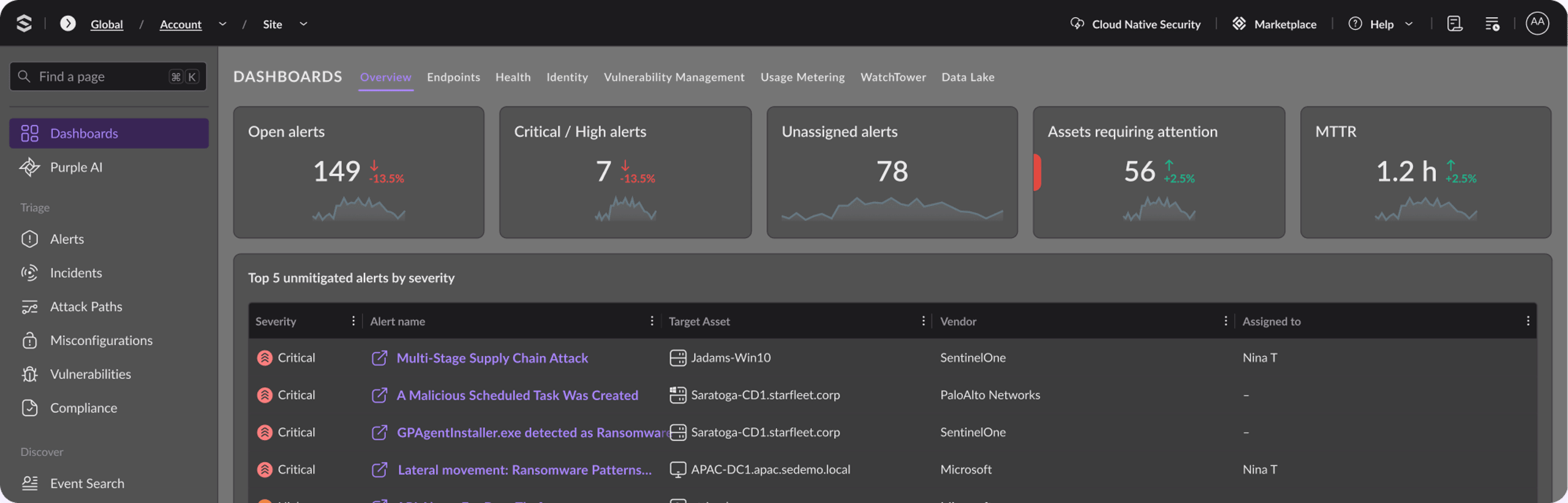
Purple AI™ is SentinelOne’s agentic AI security analyst. Its Agentic Investigation capability takes an alert from intake to verdict without manual investigation: it gathers cross-stack evidence, synthesizes threat data, constructs attack timelines in real time, and delivers explainable verdicts under analyst-in-the-loop governance. Along the way, it documents alert context, summaries, and next steps in Investigation Notebooks, so every verdict arrives with its evidence trail. IDC’s April 2025 Business Value of SentinelOne’s Purple AI report found Purple AI customers achieved 63% faster threat identification and 55% faster remediation.
Singularity Hyperautomation is SentinelOne’s no-code response workflow tool for Singularity environments, with human-in-the-loop steps for high-impact decisions built in. Hyperautomation comes with Singularity AI SIEM and is available as an add-on for other SentinelOne products. Purple AI delivers the investigation verdict, and Hyperautomation executes the response within pre-approved policies. Both work from the alerts and context your team already uses.
Latio, an independent research and advisory firm focused on security operations, named SentinelOne a SOC Platform Leader in its 2026 Security Operations Market Report.
If you manage a SOC drowning in alerts, or you own the board conversation about AI in security operations, request a SentinelOne demo to see governed agentic investigation against your own alert volume.

The Industry’s Leading AI SIEM
Target threats in real time and streamline day-to-day operations with the world’s most advanced AI SIEM from SentinelOne.
Conclusion
An agentic SOC puts AI agents to work on alert handling from triage through response while humans supervise from the top of the loop. Agents reason beyond playbooks, but compounding errors and black-box verdicts demand escalation boundaries, audit trails, and phased rollout.
Teams that pair governed autonomy with strong data foundations cut investigation and remediation time measurably. Their analysts get back to the work only humans can do: judgment, hunting, and the calls that matter most.
Agentic SOC FAQs
An agentic SOC is a security operations center where AI agents independently plan and execute multi-step alert and incident work within guardrails your team defines. Analysts still supervise the system and validate verdicts before approving high-stakes decisions.
In a copilot-assisted SOC, tools wait for your prompt. In an agentic SOC, agents initiate work on their own and carry investigations through to an evidence-backed verdict.
In an agentic SOC, AI agents and SOAR split the work: agents handle the investigative judgment, and SOAR executes the response steps your team scripted in advance.
SOAR playbooks require upfront configuration and manual updates for new threats, while agents reason through alerts no playbook anticipated and back their verdicts with evidence. Once an agent reaches a verdict, orchestrated workflows execute the approved response.
AI agents should escalate an alert to a human analyst when it involves privileged accounts or critical infrastructure. They should also escalate when they see a correlation pattern new to the environment, reach a “high confidence malicious” verdict, or fall below their confidence threshold.
Those four triggers come from the Cloud Security Alliance’s draft Agentic Cybersecurity Implementation Guide. Build escalation rules into agent configuration from day one, before the first production incident forces the issue.
AI agents are unlikely to replace SOC analysts, but they do change the job. The analyst role shifts from queue-grinding to supervision: validating agent verdicts, applying business context, hunting, and governing agent behavior.
Agents also raise junior analyst performance by supplying context that once took years of experience to build. The staffing risk is skills erosion, so deliberately preserve training paths that let juniors develop investigative instincts.
Before deploying agentic AI in a SOC, evaluate four things in order: telemetry quality, explainability, governance, and agent security. First, verify telemetry quality across endpoint, identity, and cloud, since agents amplify data problems.
Second, require explainability: every verdict needs evidence and a full audit trail. Third, define governance with trust zones, escalation thresholds, kill switches, and per-agent autonomy levels. Fourth, threat model agent security, including goal hijack, tool misuse, and privilege abuse against the agents themselves.
Discover More About Services



Ready to Revolutionize Your Security Operations?
Discover how SentinelOne AI SIEM can transform your SOC into an autonomous powerhouse. Contact us today for a personalized demo and see the future of security in action.