SOC Platform: Key Features and Benefits
A SOC platform unifies investigation and response workflows across your stack and adds threat intelligence so SentinelOne can help your SOC reduce noise and move faster.

Key Takeaways
- A SOC Platform unifies threat detection, investigation, and response into a single system — consolidating alert aggregation, behavioral/correlation analytics, investigation workflows, and threat intelligence feeds that would otherwise live in separate disconnected tools.
- The core value of a SOC platform is speed and signal quality: faster detection and response, reduced alert fatigue, and improved visibility across the environment by correlating data instead of forcing analysts to triage alerts tool-by-tool.
- Adoption isn’t frictionless — integration complexity, skill gaps, tuning overhead, and the risk of vendor lock-in are real limitations teams should plan for before rolling out a SOC platform.
- Evaluating a SOC platform comes down to a few concrete criteria: detection accuracy, integration breadth, scalability, and total cost of ownership — not just feature count.
- Platforms like SentinelOne Singularity extend these core SOC platform capabilities with AI-driven analytics and automated response, helping teams close the gap between detection and action.
What Is a SOC Platform?
A security operations center (SOC) platform is a unified software layer that consolidates threat identification, investigation, and response in a single operating environment. It pulls telemetry from endpoints, identity systems, cloud workloads, and network sensors into one place, then applies correlation, triage, and response logic across that data. The SOC functions as an integrating layer across otherwise disconnected tools.
Most security teams still operate fragmented toolsets. Analysts jump between consoles to stitch signals together, and gaps between those tools give attackers room to move. A SOC platform closes those gaps by bringing security information and event management (SIEM), endpoint and extended detection and response (EDR/XDR), security orchestration, automation, and response (SOAR), and threat intelligence into one workflow where correlation and response happen against shared data. The real test of a SOC platform is how deeply those capabilities work together.
Key Features of a SOC Platform
A SOC platform combines ingestion, correlation, triage, response, and case management in one environment. Each of those functions exists in standalone tools, but running them against the same data layer with shared context changes how they perform. Output from one capability feeds directly into the next, so correlation improves when ingestion normalizes cleanly, and autonomous response gets safer when triage delivers high-confidence verdicts. That tight coupling is what separates a platform from a stack of point products.
Feature | What It Does |
Centralized data ingestion | Collects and normalizes logs from endpoints, servers, identity providers, cloud services, and network devices into a single data layer |
Behavioral AI correlation | Uses adaptive machine-learning models to find behavioral anomalies that deviate from baseline activity, reducing false positives that rule-only approaches miss |
Autonomous triage | Classifies, prioritizes, and enriches alerts so your analysts work from verdicts with less raw-event review |
Investigation workflows | Translates natural language into SIEM queries, generates investigation reports, and supports conversational alert triage |
Autonomous response | Acts within defined guardrails to quarantine endpoints, suspend accounts, and block malicious connections at machine speed |
Case management | Tracks, enriches, and summarizes incidents across teams so your investigations stay coordinated |
Threat intelligence integration | Adds external context to findings so your analysts assess relevance faster |
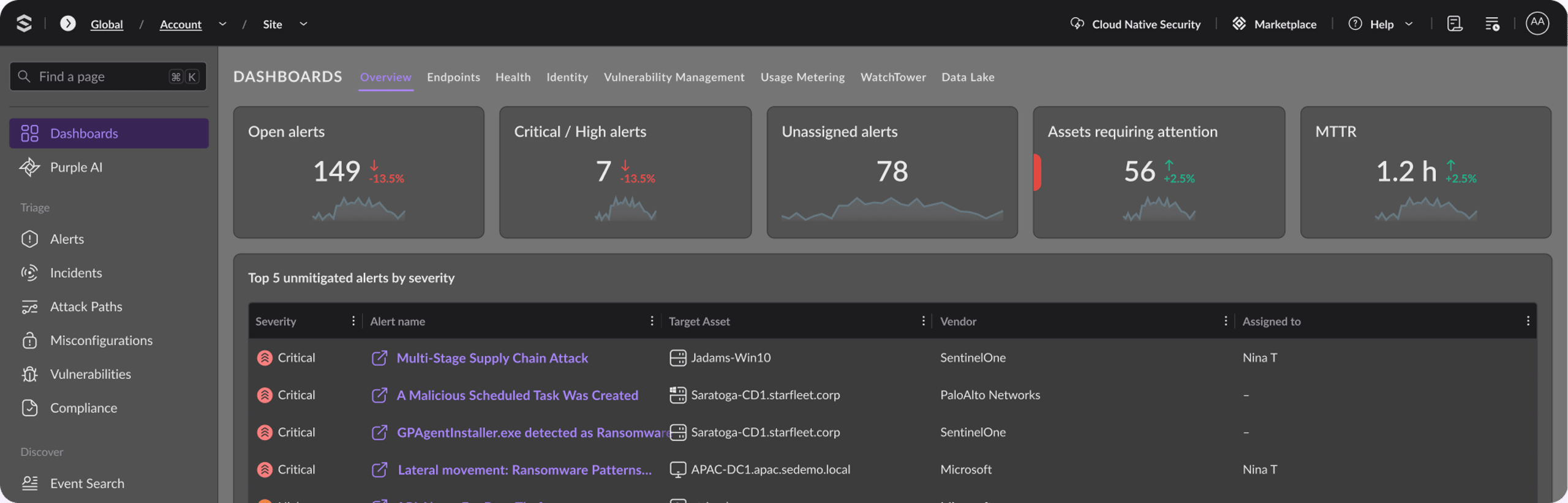
Dashboards and reporting | Delivers personalized dashboards plus scheduled and on-demand compliance reports |
The specifics vary by vendor and deployment model, but the underlying architecture follows a consistent operational sequence. How well a platform executes each stage decides whether unified operations show up in your response times or only on the datasheet.
How a SOC Platform Works
A SOC platform runs a continuous pipeline from raw signal to resolved incident. Each stage feeds the next, so a weakness at any point degrades everything downstream. In most deployments, this pipeline follows seven stages.
- Data collection. The platform ingests endpoint logs, firewall events, DNS queries, SaaS application logs, and cloud workload telemetry into a central data lake.
- Normalization and enrichment. Data gets converted into consistent formats and time-synchronized, then enriched with threat intelligence, asset ownership, and vulnerability context. The Open Cybersecurity Schema Framework (OCSF) gives analysts a common language across vendors.
- AI analysis and correlation. Machine learning and behavioral analytics connect related events. The more complete your data, the more accurately the platform finds multi-stage attacks and lateral movement.
- Alert prioritization. The system categorizes alerts, ranks high-risk threats, and filters noise so your analysts focus on what matters.
- Investigation or autonomous response. AI agents gather evidence and produce structured verdicts, or act directly when the pattern is well understood.
- Containment and remediation. Response playbooks suspend accounts, quarantine hosts, and block connections to cut mean time to detect (MTTD) and mean time to respond (MTTR).
- Reporting. Post-incident activity maps to NIST CSF 2.0 functions and captures lessons learned.
When this pipeline runs well, the operational payoff is measurable across response times, analyst capacity, and alert quality. SOC teams still running fragmented toolsets feel the difference almost immediately.
Benefits of Using a SOC Platform
A SOC platform directly addresses the operational friction that slows security operations teams: context switching, alert overload, and scaling constraints. When those problems shrink, analysts reclaim time they used to spend wrestling with tooling and start spending it on actual security work.
- Faster response times. The most immediate gain is shorter MTTR. Autonomous workflows handle enrichment and triage so your analysts spend less time collecting context and more time making decisions.
- Less alert fatigue. That same autonomy reduces noise by offloading Tier-1 work, which means analysts focus on incidents that actually need human judgment instead of chasing false positives.
- Consolidated tooling and broader visibility. Bringing SIEM, EDR/XDR, SOAR, and threat intelligence into one platform eliminates duplicated integrations and console switching. A single data layer spans identity, cloud, and endpoint telemetry, giving your team broader visibility without maintaining separate pipelines.
- Scalable operations. Because autonomous workflows absorb repetitive volume, your SOC scales capacity without proportional headcount growth. Staffing pressure does not disappear, but the platform changes the ratio between analyst hours and incidents handled.
Those benefits compound over time, but they come with real constraints. No platform eliminates friction entirely, and ignoring the tradeoffs just relocates the old problems.
Challenges and Limitations of SOC Platforms
A SOC platform solves real problems, but adoption introduces its own friction. Knowing these constraints before deployment prevents the most common failures and sets realistic timelines for payoff.
- Integration complexity. Established environments layer legacy infrastructure with modern systems, and cloud logging stays fragmented across providers in different formats.
- Data ingestion costs. Log volume can strain your budget when platforms charge by ingestion, storage, or retention tier.
- Tuning and false positives. Poor SIEM tuning and misconfigured rules drive noise. SANS guidance warns that migrating platforms without fixing identification logic resets the same problem in a new wrapper.
- Skilled analysts still required. Autonomous systems need experts to configure, validate, and troubleshoot them. The platform changes the job. It does not eliminate it.
Accounting for these constraints early shapes how you deploy and what you prioritize. Getting the deployment sequence wrong costs more in rework and analyst frustration than most teams budget for.
SOC Platform Best Practices
A SOC platform delivers value when defined goals, not vendor defaults, drive deployment and data-source selection.
- Design ingestion around threats, not availability. Before onboarding every data source you can reach, use threat modeling to determine which ones actually feed your identification logic. Identity and cloud sources deserve early priority because modern attacks center on credential abuse. Omitting authentication and directory logs blinds the platform to the attacks that do the most damage. Once you know what you need to ingest, adopt the Open Cybersecurity Schema Framework to normalize it cleanly, improve cross-source correlation, and reduce vendor dependency.
- Scale automation gradually. Once ingestion is running, resist the urge to automate everything at once. Begin with high-fidelity rules you trust and widen coverage as confidence grows, starting with repetitive triage work like data enrichment and Tier-1 alert classification. Offloading that volume frees your analysts for strategic investigation. The platform shifts analysts from operators to overseers, and those overseers still configure, validate, and troubleshoot the autonomous systems running underneath them.
- Measure and tune from day one. Track cases per analyst, noise-to-signal ratio, and false positive rates by source. NIST SP 800-61r3 endorses regular tabletop exercises and simulations to pressure-test response playbooks. And tune continuously: identification logic decays without feedback loops, and noise creeps back in when rules go stale.
The most common failure pattern is treating deployment as a finish line when the real work begins after go-live. These practices should also shape how you evaluate platforms in the first place, because a platform that fights your deployment approach will cost you more in rework than it saves in licensing.
How to Evaluate a SOC Platform
SOC platforms are not interchangeable. The difference between vendors often comes down to whether AI is built into identification and triage natively or bolted onto a legacy rule engine, and whether the platform normalizes on open standards or locks you into proprietary schemas that raise switching costs later. These distinctions are hard to spot in a feature comparison but easy to feel once you are mid-deployment, so pressure-test these criteria before you sign.
Criteria | What to Ask |
Ingestion flexibility | Does the platform support OCSF or another open schema, or does it require proprietary formatting that raises switching costs? |
AI architecture | Is AI built into identification and triage natively, or layered on top of a rule-based engine as an add-on? |
Autonomous response guardrails | Can you define exactly which actions the platform takes without human approval, and does it escalate edge cases? |
Data retention and cost model | How does pricing scale with log volume, and does the platform support hot storage for investigation without per-query charges? |
Integration depth | Does the platform ingest identity, cloud, endpoint, and network telemetry natively, or require custom connectors for each source? |
Analyst experience | Can analysts investigate in natural language, or do they need to write raw queries across multiple consoles? |
Evaluation is easier when you can test these criteria against a live environment instead of a slide deck. The answers you get during a hands-on assessment will tell you more about long-term fit than any feature comparison matrix.
Strengthen Your SOC with SentinelOne
SentinelOne's Singularity™ Platform is a unified SOC platform built for modern security operations on a single agent, single console, and single data lake. It uses OCSF for open ingestion and normalization across native and third-party sources.
AI SIEM ingests and stores data in hot storage at scale, delivering performance 100x faster than legacy SIEM solutions. Singularity AI Data Pipelines filter low-value telemetry, normalize data to OCSF at ingest, and enrich it before it reaches the SIEM. Analysts start from cleaner data on the first query. Purple AI™ handles natural-language investigation by gathering evidence and reconstructing attack timelines, moving your analysts from data gatherers to decision-makers. Purple AI customers saw 63% faster threat identification and a 55% MTTR reduction, according to IDC.
Behavioral AI analyzes device, identity, and activity patterns across the environment to catch threats that rule-based systems miss. When a threat is confirmed, autonomous response contains it at machine speed within defined guardrails, while your analysts retain oversight for judgment-heavy decisions. In the 2024 MITRE ATT&CK Evaluations, SentinelOne generated 88% fewer alerts than the median across all vendors evaluated, with 100% detection and zero delays.
Schedule a SentinelOne demo to benchmark MTTR and analyst throughput against your environment.

The Industry’s Leading AI SIEM
Target threats in real time and streamline day-to-day operations with the world’s most advanced AI SIEM from SentinelOne.
Conclusion
A SOC platform unifies SIEM, EDR/XDR, SOAR, and threat intelligence into one operating environment that ingests, correlates, triages, and responds across your stack. It cuts MTTR, reduces alert fatigue, and scales operations without linear hiring. Success depends on open ingestion, continuous tuning, identity and cloud coverage, and outcome-based metrics such as MTTD and MTTR. Get those right, and your analysts stop operating tools and start overseeing outcomes.
FAQs
A SOC platform is a unified software layer that consolidates threat identification, investigation, and response in one operating environment. It ingests telemetry from endpoints, identity systems, cloud workloads, and networks, then applies correlation, autonomous triage, and response across all of it.
By integrating SIEM, EDR/XDR, SOAR, and threat intelligence into one workflow, it gives analysts fewer console jumps and richer context to move from signal to action.
Pricing varies by vendor, deployment model, data volume, retention needs, and integration scope. A unified platform can reduce license-management overhead, professional services for integrations, and staffing effort across disconnected consoles.
You still need to model ingestion, storage, retention, training, migration, and operations. Evaluate total cost of ownership across all of those factors, because a low subscription price can mask high integration and tuning costs.
Run parallel ingestion during cutover so both the legacy SIEM and the new platform receive the same log streams during validation. Map existing identification rules to the new schema before go-live, prioritize high-confidence rules first, and keep dual-console monitoring until alert parity is validated.
Validate normalization and enrichment before shifting critical response playbooks. Shift workloads incrementally by use case, especially when your environment spans identity, cloud, endpoint, and network telemetry.
Use pattern consistency, risk tolerance, and judgment complexity to decide. Make high-volume, repeatable work autonomous, including credential validation, hash lookups, and enrichment queries, when outcomes follow predictable logic.
Keep human oversight for ambiguous scenarios that require business context, destructive containment, or executive risk decisions. Set confidence thresholds so AI handles high-certainty verdicts and escalates edge cases. Review those thresholds continuously with analyst feedback so autonomy stays aligned with your risk tolerance.
Start with identity authentication logs, including MFA events, privileged access, and service principal activity from systems such as Microsoft Entra ID (formerly Azure AD), Okta, or AWS IAM. Next, ingest cloud control plane logs such as AWS CloudTrail, Azure Activity Log, and GCP Audit Logs.
Then add endpoint telemetry, cloud workload logs from Kubernetes, serverless functions, and virtual machines, plus VPC Flow Logs and DNS queries for lateral movement visibility. This order gives your SOC identity context first, then cloud activity, workload behavior, and network movement.
Measure analyst throughput with cases closed per analyst, then track noise-to-signal improvements and false positive rates by data source. Quantify tool consolidation by counting decommissioned licenses and maintenance contracts.
Also track hours shifted from manual triage to proactive threat hunting, mean time to competency for new analysts, compliance evidence-gathering time, autonomous reporting cycles, and escalation rates. Those measures show whether the platform reduces operational drag and improves analyst focus while moving your SOC toward outcome-based security metrics.
Discover More About Services



Ready to Revolutionize Your Security Operations?
Discover how SentinelOne AI SIEM can transform your SOC into an autonomous powerhouse. Contact us today for a personalized demo and see the future of security in action.