Modern SOC Architecture, AI & Best Practices
Learn how a modern SOC unifies telemetry, applies AI-assisted investigation, governs automation, and uses SentinelOne to reduce alert noise and response time.

Key Takeaways
- A modern SOC is built on four architectural commitments: a unified telemetry layer, cloud-native infrastructure, AI-assisted detection and investigation, and governed automation. Machines handle triage at machine speed, and analysts keep authority over containment and response.
- AI changes who does each stage of SOC operations. AI takes on Tier 1 triage and investigation at volume. That frees analysts for detection engineering, threat hunting, and incident response, and it cuts alert noise and burnout.
- The most common modernization mistakes are architectural. They include bolting AI onto a legacy SIEM, collecting every log without a data strategy, and automating response before enrichment and evidence collection can be trusted.
- Successful SOC modernization starts with maturity and coverage. Teams assess maturity first, map detection coverage to MITRE ATT&CK, and run detection engineering continuously. They gate disruptive automated actions behind human approval, and they track MTTD, MTTR, false positive rates, and coverage to measure progress.
What Is a Modern SOC?
In August 2025, CISA and international partners documented state-sponsored intruders who had held persistent, long-term access inside telecommunications and critical infrastructure networks since at least 2021, operating through edge devices defenders could not see. Years of dwell time inside monitored networks is a visibility failure, and closing that gap is the problem the modern security operations center (SOC) exists to solve.
A modern SOC is a security operations center rebuilt around four architectural commitments: a unified telemetry layer, cloud-native infrastructure, AI-assisted detection and investigation, and governed automation. Machines handle triage at machine speed. Analysts keep decision authority over containment and response.
This article covers the core components of a modern SOC, how the operating model runs day-to-day, and the SOC best practices that keep the build durable.
How the Modern SOC Relates to Cybersecurity
Every security investment depends on the SOC to turn telemetry and controls into detection and response outcomes. NIST SP 800-53 states the architectural requirement plainly: a SOC risks being overwhelmed by the output of its own proliferating security tools unless it applies “advanced automation and analytics” to the data.
Your SOC’s scope has also widened. ISACA’s analysis notes that SOCs are evolving beyond alert-handling to correlate identity behavior, machine activity, and AI agent actions: “The SOC becomes a place of interpretation.” That expanded scope requires the SOC architecture choices below.
Core Components of a Modern SOC
You build modern SOC architecture in layers, and each layer adds SOC capabilities the one beneath it cannot, so analysts can investigate connected incidents on a single plane:
- A unified data layer: MITRE’s SOC strategies report requires that all SOC data feeds and sensors be integrated into one unified architecture: a data lake that ingests and normalizes endpoint, identity, cloud, and network telemetry on one plane so correlation can span domains.
- Cloud-native detection: Cloud platforms now generate much of your telemetry, identity events, and configuration drift. A cloud-native SOC treats cloud workloads as the primary detection surface. To see how extended detection and response (XDR) and cloud detection and response (CDR) divide that surface, read our article on the subject.
- AI-assisted triage and investigation: Behavioral analytics replace static signature rules, AI reasoning evaluates telemetry in context, and natural-language querying replaces manual log-pulling.
- Automation with governance: Static playbooks break when threats deviate from expected patterns, and standalone security orchestration, automation, and response (SOAR) is receding as platforms absorb its role. The modern approach automates enrichment and evidence collection before routing, with human approval gates on containment actions.
Detection engineering runs as a continuous discipline alongside threat intelligence and hunting: intelligence informs detections at the tactics, techniques, and procedures (TTP) level via MITRE ATT&CK mapping, while hunting operates as your SOC’s research function, testing hypotheses that are not yet strong enough to operationalize.
Each layer feeds the next: unified data makes cross-domain analytics possible, analytics make automation trustworthy, and automation frees the analyst time that detection engineering and hunting require.
How a Modern SOC Works
End to end, your operational flow starts with continuous monitoring across networks, endpoints, identities, cloud workloads, and SaaS. Behavioral analytics and correlation turn that monitoring into threat detection. Investigation and triage follow, then incident response to contain and recover. The loop closes with threat intelligence integration and continuous improvement through post-incident review. NIST SP 800-61 maps this lifecycle to the Cybersecurity Framework (CSF) 2.0 functions.
A modern SOC changes who executes each stage. AI handles initial triage and investigation at volume. Analysts retain authority over higher-risk decisions.
Your staffing model changes with it. MITRE holds in its SOC strategies report that both tiered and tierless models can work. When AI absorbs Tier 1 triage, you can flatten into specialist roles assigned by problem type: detection engineering, threat hunting, incident response, and threat intelligence. Tierless SOCs still need clear incident ownership, escalation paths, and mentorship for junior analysts. That reallocation of human attention is where the measurable benefits begin.
Key Benefits of a Modern SOC
A modern SOC pays back the build in sequence: speed improves first as correlation and AI triage compress investigation time, then cost control follows as automation absorbs manual work:
- Noise reduction. Cross-domain correlation collapses raw alerts into a smaller set of investigable incidents, and behavioral detection cuts the false positive load that consumes analyst shifts.
- Coverage where attacks otherwise slip through. Forrester added identity and cloud as separate detection-surface evaluation criteria in its XDR Wave because attacks in those domains are otherwise missed or downgraded. A unified data plane closes exactly those seams.
- Analyst retention. Automation absorbs the repetitive triage that drives burnout and returns analyst time to hunting and detection engineering.
- Measurable operations. You track detection, acknowledgment, response, coverage, and throughput metrics from the platform itself, replacing manual report assembly.
Whether you capture these benefits depends on the build itself, and four recurring constraints (staffing, tool sprawl, AI governance, and leadership readiness) shape how far a SOC modernization program gets.
Challenges in Building a Modern SOC
Staffing is the constraint that architecture has to solve first. ISACA’s State of Cybersecurity 2025 research shows cybersecurity hiring remains constrained, and teams cannot add analysts at the pace alert volumes and tooling demands increase, so a modern SOC architecture has to multiply the analysts you have. Some teams supplement with SOC as a Service while building internal capacity. Tool sprawl compounds the shortage: overlapping detection and response tools, each with its own console, data model, and alert queue, fragment context and slow investigation.
AI itself introduces a governance workload. Gartner’s 2026 cybersecurity trends analysis warns that AI-enabled SOCs add complexity through staffing pressures and upskilling demands, and it advises chief information security officers (CISOs) to build human-in-the-loop frameworks into AI-supported processes.
Deploying AI is the easy part. Owning it through tuning and governance is the harder work, and leadership preparedness lags behind both. ISACA’s 2025 research finds organizations are still building governance maturity for generative AI risk, which means modernization programs often move forward while leadership practices are still catching up. These constraints explain why programs fail in predictable ways. Predictable means preventable.
Common SOC Modernization Mistakes
The first mistakes in a modern SOC build come from forcing new SOC capabilities into old operating models or automating before you trust the inputs.
The costliest errors are architectural, made once and inherited everywhere, when teams carry legacy data assumptions into a new build or treat raw data volume as a proxy for coverage:
- Bolting AI onto a legacy security information and event management (SIEM) platform: AI layered on top of a legacy log-search architecture inherits the same rigid schemas and incomplete telemetry, so the improvement remains incremental.
- Deploying AI without operationalizing it: SANS Institute guidance notes that SOCs often deploy AI or machine learning (ML) tools without customization or integration into daily workflows, and without defined ownership.
- Collecting everything: Dumping all incoming data into a SIEM without a plan inflates costs, degrades detection quality, and makes tuning nearly impossible. MITRE’s data selection strategy is explicit: choose data by relative value.
The second cluster lives in the automation program, where teams switch on response actions or chase agentic tooling before the groundwork that makes either one trustworthy is in place:
- Automating response before enrichment: Automate the enrichment, evidence collection, routing, and documentation steps analysts repeat daily before touching response actions. Skipping that sequence creates operational risk without earning analyst trust.
- Chasing agentic hype without requirements: Gartner predicted that over 40% of agentic AI projects will be canceled by the end of 2027, citing escalating costs, unclear business value, and inadequate risk controls.
Each of these failures traces to missing operating discipline, and discipline is something you can build. The SOC best practices that follow give you a repeatable way to do it.
Modern SOC Best Practices
Strong SOC best practices start with scope, coverage, data quality, and a repeatable operating model. Work through this modern SOC checklist before you invest in another platform or playbook.
Plan Scope and Coverage
Before you engineer anything, map where the SOC stands today and where its coverage needs are, because the scope and data decisions here constrain every coverage and automation choice that follows:
- Assess maturity before you build. Use the SOC Capability Maturity Model (SOC-CMM) across Business, People, Process, Technology, and Services. Get a third-party assessment to reduce self-assessment bias. For SentinelOne’s perspective on the path toward an autonomous SOC, read The Autonomous SOC Revisited.
- Map detection coverage to MITRE ATT&CK, then close uncovered techniques. Start with a single technique before building a full heatmap. Missing logs cause a large share of coverage shortfalls, so turning on the right logging often delivers immediate visibility gains. Prioritize uncovered techniques by business risk and telemetry availability, using threat relevance to break ties.
- Build a threat-informed data strategy. Use CISA’s event-logging and detection guidance to decide which sources carry detection value, apply ROI analysis to each feed, and validate data quality. “We have the logs” does not mean you can find anything with them.
Together these three steps produce a coverage baseline you can defend to leadership, and they keep the next phase honest, since an operating model is only as sound as the data beneath it.
Run and Govern the Operating Model
With scope and data settled, the operating model turns those foundations into daily practice. It governs how detection engineering evolves, how automation earns authority, and how analysts grow as routine work moves off their plate:
- Run detection engineering as a continuous practice: Version detection logic, deploy through pipelines with rollback, track alert accuracy, and feed analyst feedback and post-mortems back into rules.
- Apply tiered automation governance: Automate high-confidence verdicts and gate disruptive actions behind human approval, with fallback pauses built in.
- Treat analyst growth as an architecture requirement: MITRE’s staffing strategy is “Hire AND Grow Quality Staff.” Allocate schedule time for skill development in automation and analytics. As routine work gets automated, that invested capacity compounds.
Run these three continuously, and the operating model holds as threats change. With the model in place, the remaining decision is the platform that runs all of it.
Build a Modern SOC with SentinelOne
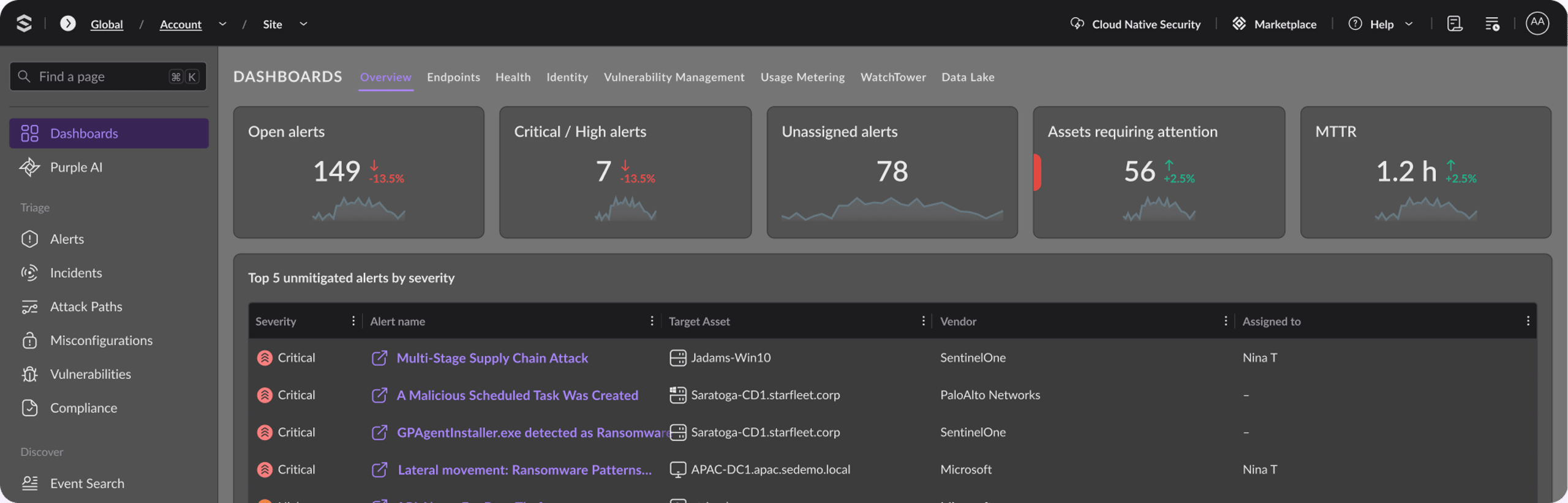
SentinelOne’s Singularity™ Platform delivers the unified architecture this article describes as one system. Built in. Not bolted on. When an endpoint agent identifies suspicious behavior, that signal flows to AI SIEM for correlation, Purple AI for investigation, and Hyperautomation for response inside one operating model. AI SIEM is your SOC’s system of record. It ingests and normalizes telemetry across native and third-party sources via the Open Cybersecurity Schema Framework (OCSF). Singularity AI Data Pipelines filter and enrich that data upstream of ingestion.
Purple AI™ is the platform’s agentic AI security analyst. It reasons over OCSF-normalized endpoint and cloud telemetry and summarizes identity alerts, with human-in-the-loop authority and privacy-first safeguards. Purple AI Agentic Investigation investigates threats, renders verdicts, and keeps analysts working from one visible investigation record. According to IDC, Purple AI customers identified threats 63% faster and remediated 55% faster.
Singularity Hyperautomation is SentinelOne’s response workflow tool, the AI SIEM add-on that delivers autonomous response. You replace standalone SOAR with native, no-code playbook automation, prebuilt workflows, and a drag-and-drop canvas for custom builds. Connect AI SIEM and Purple AI investigations to Hyperautomation workflows so response steps follow the evidence analysts already reviewed.
Two more pieces complete the coverage needs identified above. Singularity Endpoint stops ransomware and advanced attacks at the device, with patented 1-Click rollback that returns a Windows endpoint to its pre-attack state. Singularity Identity protects Active Directory and Entra ID with real-time defenses that end credential misuse, covering the identity detection surface this article treats as primary. Behavioral AI in the endpoint agent and platform analyzes device and identity behavior, including anomalous activity and impossible travel patterns.
SentinelOne was named SOC Platform Leader in the Latio Security Operations Market Report on the strength of this unified architecture.
If you manage a SOC or own the security program, request a SentinelOne demo to see your triage workload on one platform.

Singularity™ AI SIEM
Target threats in real time and streamline day-to-day operations with the world’s most advanced AI SIEM from SentinelOne.
Conclusion
A modern SOC unifies telemetry on one data plane, treats cloud and identity as primary detection surfaces, applies AI to triage and investigation, and governs automation with tiered human-in-the-loop controls. A cloud-native SOC treats workload, identity, and configuration telemetry as first-class investigation evidence. The common failures are predictable: AI bolted onto legacy SIEMs, collect-everything data strategies, and ungoverned out-of-box deployments.
Assess maturity first, map ATT&CK coverage, engineer detections continuously, and measure everything. Do that, and your analysts stop chasing alerts and start making the decisions only people can make.
FAQs
A modern SOC is built on four architectural commitments: a normalized data plane that unifies all telemetry, cloud-native collection that treats workloads and identity as primary detection surfaces, behavioral and AI-assisted detection and investigation, and governed automation with human approval on containment.
One architectural test confirms it: analysts can run cross-domain correlation, investigation, and response on a single platform, with every automated decision logged and reviewable.
Run parallel operations during the transition and phase migration by data source. Begin with cloud security and identity telemetry where legacy tools have weakest coverage, then use MITRE ATT&CK mapping to validate detection parity before migrating endpoint and network feeds.
Maintain dual-write until the new system shows equal or better alert fidelity for a defined validation period.
Track four categories at the same cadence as your sprint or incident retrospectives. For speed, trend mean time to detect (MTTD), mean time to acknowledge (MTTA), and mean time to respond (MTTR) together. For quality, watch the false positive rate over time alongside the true-to-false positive ratio.
For coverage, measure the share of prioritized MITRE ATT&CK techniques backed by a working detection. For throughput, count new detections moved to production each week. Automate the reporting itself so the trend lines stay comparable and leadership decisions move faster.
Build the case around financial and risk levers: cost per alert investigated, annual analyst turnover costs, breach probability reduction expressed as expected annual loss avoided, and savings from decommissioning redundant point products.
Pair those with board-level benchmarks such as time to contain a ransomware attack and percentage of critical infrastructure covered by behavioral detection, which connect SOC performance to fiduciary duty.
Build governance around risk and reversibility. Low-risk, reversible tasks such as enrichment, evidence collection, and ticket creation can run without approval gates. High-risk or disruptive actions such as endpoint isolation, account disablement, or firewall rule changes require human approval.
Define approval thresholds with AI confidence scores, and document the approver, timestamp, and rationale for post-incident review.
Discover More About Services



Ready to Revolutionize Your Security Operations?
Discover how SentinelOne AI SIEM can transform your SOC into an autonomous powerhouse. Contact us today for a personalized demo and see the future of security in action.