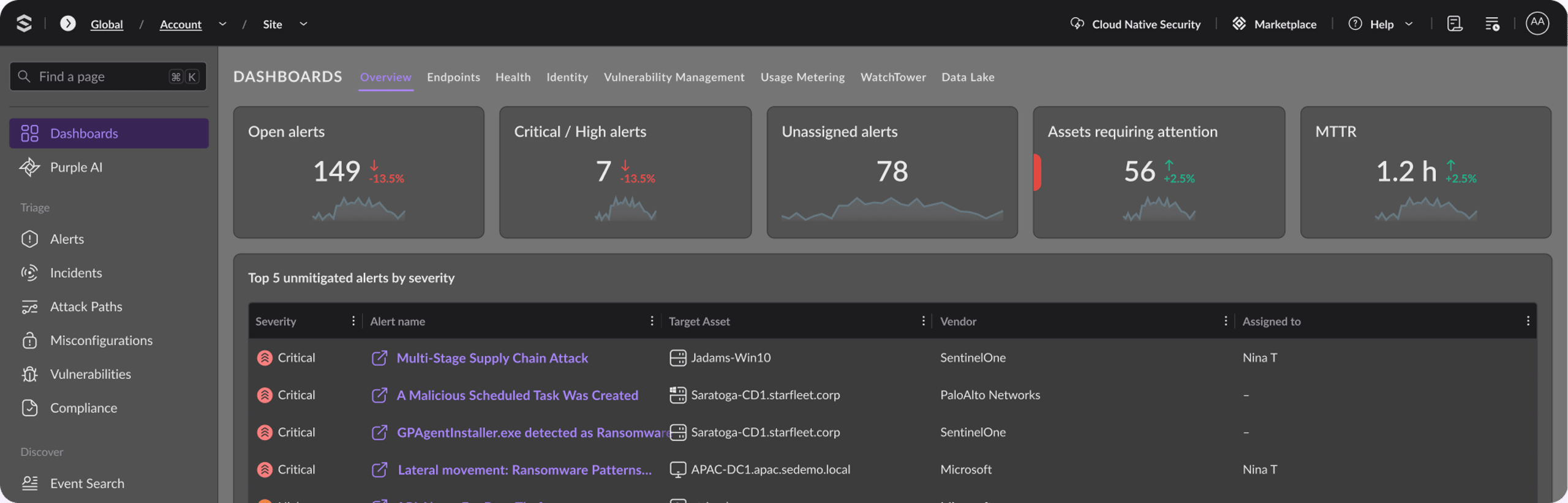
Data Access Governance: Control Who Sees What Data and Prove It
Data access governance controls which identities can reach which data, enforces those decisions, and proves access stays correct. Learn how the lifecycle works.

What Is Data Access Governance?
In late 2025, attackers used a trusted app's stolen OAuth tokens to read Salesforce customer data for nearly a month. Nobody had to break in. The access was already there, far broader than the app needed, and nobody revoked it. FINRA now tells firms to give connected apps only the access they need.
Data access governance is how you keep access like that from existing in the first place. It’s the set of policies and operational controls that decide which identities can reach which data, enforce those decisions, and prove they stay correct over time.
Your data lives across on-premises systems, cloud object stores, and SaaS platforms, and both people and machines accumulate privileges that are rarely revoked. Access drifts toward over-exposure by default. Containing that drift is the job, and it’s why data access governance sits at the center of your security program.
How Data Access Governance Relates to Cybersecurity
Data access governance brings together two areas that usually operate separately: identity and access management (IAM) and data security. IAM verifies who someone is and controls the credentials they hold. Data access governance answers the question IAM leaves open: should this identity reach this particular data, and can you prove the access is still justified? It does that by adding data classification, policy, continuous validation, recertification, and audit.
That per-request justification is what makes data access governance a foundation for zero trust, where every access request is verified regardless of network location or prior trust, as defined in NIST SP 800-207. The building blocks below are what turn that principle into daily practice.
How Data Access Governance Works
Data access governance runs as a continuous loop built from a few core building blocks. Each stage below puts one of them to work, and the cycle repeats as your data, identities, and business requirements change.
1.Discover and Classify your data
You cannot govern what you cannot see or label. Inventory data across on-premises and cloud environments, including SaaS platforms and cloud object stores, then apply persistent, machine-readable sensitivity labels aligned to your regulatory and business taxonomy. Data classification comes first because no control can enforce policy on data it cannot identify.
2. Map Identities and Current Entitlements
Inventory every identity that can reach each classified data set, human and non-human alike: user accounts, service accounts, API keys, OAuth tokens, and AI agents. Record what each one can currently access. Singularity™ Identity builds this inventory and keeps live visibility across human and non-human accounts. This baseline becomes your reference point for policy enforcement and recertification.
3. Define Access Policy
Write machine-enforceable rules that specify which roles, attributes, or conditions qualify an identity for access. Use role-based access control (RBAC) for baseline entitlements; attribute-based access control (ABAC) to refine them with context such as device posture, location, or time of day; and separation of duties to keep one identity from holding conflicting privileges.
4. Provision and Enforce Least Privilege
Default to deny, and grant only the minimum permissions each identity needs through formal approval workflows. For privileged data and administrative operations, use time-bound or just-in-time elevation that expires on its own, and log every privileged session. Certifying that existing entitlements are still justified belongs here too.
5. Validate Access Continuously
Verify authorization at every stage of the access lifecycle, including long after access is first granted. NIST SP 800-207 describes this as a constant cycle of access, threat assessment, adaptation, and reevaluation of trust.
Watch for anomalous patterns such as unusual data volumes or access from unexpected locations, especially when paired with privilege escalation, and apply stronger controls to privileged and service accounts. The CISA maturity model calls for continual verification of each user, device, application, and transaction throughout a session.
6. Review, Recertify, and Audit
Run access reviews on a defined cadence, examining entitlements at the individual level to catch permissions that roles accumulate over time. Deprovision access within hours of a departure, role change, or workload decommission; and keep a complete, centralized audit trail of every grant, modification, and recertification decision. Those audit findings feed back into discovery and classification. The loop closes, then starts again.
What Strong Data Access Governance Delivers
Run this lifecycle consistently and the outcomes are measurable, in security posture, audit results, and the daily work of your team.
- Enforced least privilege and a smaller blast radius. Every identity holds only the access it needs, so a compromised account can reach only a limited data set. Enforcing the principle of least privilege is what keeps that exposure contained.
- Faster, cleaner audits. A complete trail of access decisions, entitlement changes, and recertification records gives auditors the evidence they need without manual reconstruction.
- Lower insider risk and accidental exposure. Structured provisioning and regular recertification clear stale and excessive access before it turns into an incident.
- Smoother role transitions. Formal joiner, mover, and leaver processes stop privilege from piling up during transfers and clear access promptly after departures.
- A foundation for zero trust. Per-request authorization, continuous validation, and deny-by-default enforcement put zero trust principles into daily practice.
These outcomes assume the program runs the way it is designed to. In practice, a handful of recurring conditions keep that from happening.
Where Data Access Governance Programs Break Down
Even capable, well-resourced teams can struggle to sustain data access governance. When failures do occur, they usually trace back to a handful of structural conditions and avoidable choices.
Access Sprawl and Over-Provisioning
Entitlements accumulate through role changes, project grants, and emergency access that is never revoked, and orphaned accounts can persist for months or years. Granting broad access "to avoid blocking work" makes it worse, since those standing privileges linger indefinitely. Administrative and service accounts with broad rights become the highest-risk entitlements of all.
Limited visibility across tools and data
Shadow data spreads across cloud accounts and collaboration tools without ever entering a classification program. Machine identities such as service accounts, API keys, and AI agents now form a large, under-governed population that identity programs built for human users were never designed to track.
Privileged access management, identity governance, cloud posture, and SIEM tools each hold only a partial view of entitlements, so no single system shows the whole picture.
Process and Ownership Failures
Teams treat authorization as a one-time grant and never revisit it as roles and data sensitivity change, even though NIST SP 800-53 calls for reviewing accounts at an organization-defined frequency (control AC-2).
Reviews get rubber-stamped at the role level without examining the actual entitlements each role confers, access lingers for weeks after a person departs, and some organizations buy governance tooling before they have classified the data it is meant to protect. When no single function owns the program across security, IT, and the business, policy intent and day-to-day execution pull apart.
None of this is unsolvable. Every item on that list is a design choice you can reverse: name an owner, classify before you buy tooling, and review entitlements instead of roles.
How Data Access Governance Supports Regulatory Compliance
Six widely adopted frameworks require specific data access governance controls. Different industries, different jurisdictions, the same three demands: need-to-know provisioning, periodic or continuous access review, and auditable evidence.
| Framework | Access Governance Requirement |
| GDPR (Articles 5, 25) | Personal data must be limited to what is necessary; by default, data must not be made accessible to an indefinite number of persons without intervention. |
| HIPAA (Minimum Necessary Standard) | Covered entities must identify classes of persons needing access, the categories of PHI they need, and conditions appropriate to that access. |
| PCI DSS (Requirement 7) | Access to cardholder data is limited to individuals whose job requires it; the access control system must deny all unless specifically allowed. |
| SOX (Section 404) | IT general controls require role-based access for financial systems, segregation of duties, periodic access reviews, and annual management assessment. |
| ISO 27001 (Annex A 5.15-5.18) | Formal provisioning procedures, periodic review of access rights, and removal or adjustment of access upon role change or departure. |
| NIST 800-53 (AC Family) | Documented policies (AC-1), managed account lifecycles (AC-2), enforced authorizations including RBAC and ABAC (AC-3), and continuous monitoring (CA-7). |
As AI agents and non-human identities proliferate, regulatory attention to access governance is expanding beyond human users. SentinelOne reinforces these controls across identity, data, and investigation workflows.

Reduce Identity Risk Across Your Organization
Detect and respond to attacks in real-time with holistic solutions for Active Directory and Entra ID.
Improve Data Access Governance with SentinelOne
Governance decides who should reach your data. Enforcement decides who actually does. SentinelOne supports your access policies, control models, and classification programs with identity threat defense, continuous access validation, data visibility, and investigation built into the Singularity Platform.
- Who can access (identity). Singularity Identity shows you every endpoint and identity from a single lightweight agent. It enforces policy-based conditional access with session blocking and MFA reauthentication across Active Directory, Microsoft Entra ID, Okta, Ping, SecureAuth, and Duo. When credential theft or privilege escalation occurs, it finds the activity and blocks lateral movement before it spreads.
- What they reach (data). Singularity Cloud Security finds sensitive data across cloud object storage, including Amazon S3, Azure Blob Storage, and Google Cloud Storage. Your governance program gets visibility into the stores that hold regulated data.
- How you investigate. Purple AI queries normalized data across native and third-party sources in plain language, with no new query schema to learn. IDC found that Purple AI customers saw 63% faster threat identification and a 55% reduction in mean time to respond. For broader retention and analysis, Singularity Data Lake runs a cloud-native SIEM on a petabyte-scale data lake, with real-time ingestion from any source using Open Cybersecurity Schema Framework (OCSF) normalization.
Request a SentinelOne demo and see how these capabilities map to your access governance program.
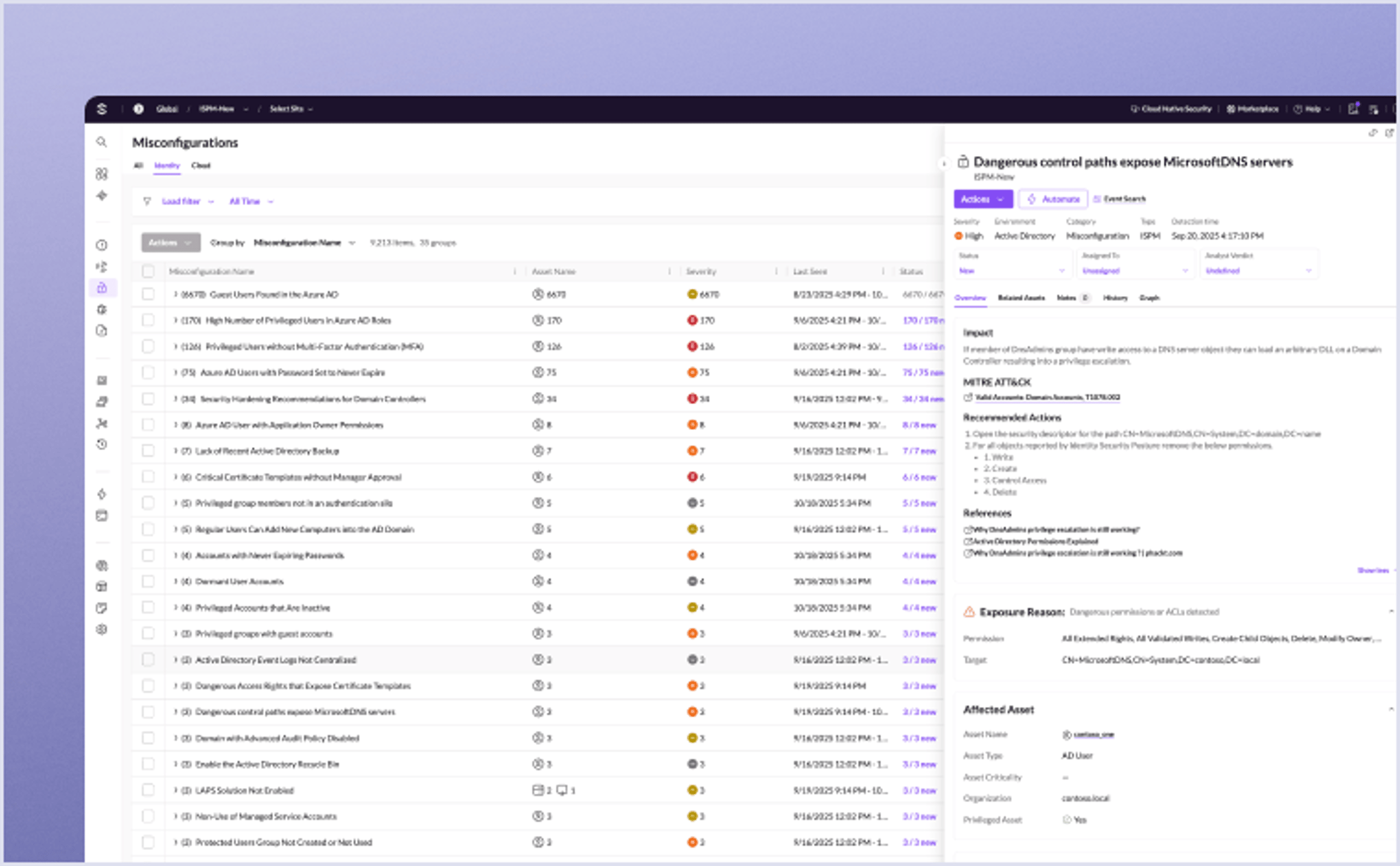
Get real-time identity protection and end-to-end visibility across hybrid environments to detect exposures, stop credential abuse, and reduce identity risk.
Key Takeaways
Data access governance controls which identities reach which data, enforces those decisions, and produces the evidence auditors and leadership need. Because access accretes over time, least privilege only holds if you enforce it continuously across the full lifecycle, from discovery and classification through validation, recertification, and audit.
Machine identities now demand the same rigor as human ones. Start by classifying your highest-risk data, default to deny, validate access continuously, and keep an auditable trail of every decision. Do that, and “who can reach this data?” stops being a full-scale investigation. It becomes a simple lookup.
Data Access Governance FAQs
Data access governance is the set of policies and operational controls that determine which identities can reach which data, enforce those decisions, and prove they stay correct over time. It combines data classification, access policy, continuous validation, recertification, and audit into a single lifecycle.
The goal is enforced least privilege: every human and non-human identity holds only the access its role requires, with auditable evidence behind every decision.
Identity and access management (IAM) handles authentication and the mechanics of granting, managing, and revoking access credentials. Data access governance adds data classification, policy definition, continuous validation, recertification, and audit on top.
IAM answers "can this identity authenticate and what permissions does it hold?" while data access governance answers "should this identity have those permissions, is the access still justified, and can you prove it?"
Ownership of data access governance typically spans three functions. The CISO or security team defines policy, sets risk thresholds, and runs continuous monitoring. IT or IAM operations manages provisioning, deprovisioning, and tooling.
Business data owners validate that entitlements match current job requirements during recertification. Organizations often designate a governance lead or steering committee to coordinate these three functions.
The frequency of access reviews and recertification should reflect data sensitivity and privilege level. Regulated data and high-privilege accounts usually require more frequent review than standard user access.
Combine calendar-based reviews on a defined cadence with event-driven recertification triggered by role changes, transfers, and departures. Highly sensitive systems may warrant continuous validation, since periodic point-in-time checks miss access that drifts between cycles.
When starting a program, begin by classifying data that carries the highest regulatory or business impact: personally identifiable information, protected health information, cardholder data, financial records subject to SOX, and intellectual property.
NIST IR 8496 recommends defining what constitutes a data asset before classifying it, then applying persistent labels. Once you govern high-sensitivity data, extend classification outward.
Data access governance must cover non-human identities, Service accounts, API keys, OAuth tokens, and AI agents create, move, and access data at machine speed and frequently receive broad standing privileges during provisioning.
Your governance program should inventory non-human identities alongside human ones, apply the same least-privilege and recertification standards, and use time-bound credentials wherever possible.
Discover More About Identity Security


Ready to Revolutionize Your Security Operations?
Discover how SentinelOne AI SIEM can transform your SOC into an autonomous powerhouse. Contact us today for a personalized demo and see the future of security in action.