AI Endpoint Security: A SentinelOne Guide for Modern SOC Teams
AI Endpoint Security uses behavioral AI to find ransomware, fileless, and living-off-the-land activity. SentinelOne stops these attacks and rolls back damage.

Key Takeaways
- AI endpoint security protects devices with machine learning and behavioral AI. It analyzes how files and processes actually behave, so it catches ransomware, fileless malware, and living-off-the-land (LOTL) techniques that signature-based tools miss.
- Effective endpoint threat prevention relies on four components working in a single agent: static AI for pre-execution file analysis, behavioral AI for runtime monitoring, telemetry collection for visibility, and automated response for containment and remediation.
- Behavioral AI stops threats by spotting deviations from normal baselines. Process-lineage tracing exposes abnormal parent-child process chains, which surface attacks even when every binary involved is legitimate.
- AI endpoint security still needs operational discipline. Teams have to manage false positives, adversarial evasion, agent resource use, and skills gaps. CISA advisories show most failures come from incomplete deployment, unreviewed alerts, weak tuning, and untested response plans, not from the tooling.
- Best practices start with coverage. Deploy agents on every asset, review alerts continuously (with agentic AI triage where possible), tune against evasion techniques, and integrate endpoint telemetry with identity, cloud, and SOC workflows.
What Is AI Endpoint Security?
In 2024, CISA, the NSA, and the FBI warned that Volt Typhoon, a group sponsored by the People’s Republic of China (PRC), had compromised U.S. critical infrastructure networks, in some cases holding that access for at least five years. Its main tools were the victims’ own. According to CISA Advisory AA24-038A, the group relies on living-off-the-land (LOTL) techniques that blend its activity into normal system and network behavior, which CISA says can get past simplistic endpoint security. With no malware to match, signatures have nothing to catch.
AI Endpoint Security is the practice of protecting endpoint devices across user and server systems with machine learning and behavioral AI models that analyze how files and processes actually behave. It combines pre-execution file analysis, runtime process monitoring, endpoint telemetry, and automated response to find and stop threats that signature tools miss.
The term also gets used for a different problem: securing the AI agents and assistants that now run on employee devices. This guide covers AI that protects endpoints. To protect the AI running on those endpoints, see SentinelOne’s guide to AI agent security.
You cannot block what you cannot see behaving, and that reality shapes every capability below.
How AI Endpoint Security Relates to Cybersecurity
AI Endpoint Security sits close to a common attacker foothold: the device itself. Endpoints generate process, file, and network activity that reveals an intrusion in progress. Correlating that telemetry with other data sources widens the risk context available to defenders. Endpoint data feeds identity monitoring, threat hunting, and incident response, which makes it foundational to AI in cybersecurity. Every model downstream is only as trustworthy as the endpoint evidence beneath it.
Core Components of AI Endpoint Security
Modern endpoint protection relies on four core components: static AI, behavioral AI, telemetry collection, and automated response. For machine learning endpoint security, each component addresses a different stage of an intrusion.
Component | Intrusion Stage | What It Does |
Static AI | Pre-execution | Classifiers trained on malware file collections of known malware and benign files study code structure, strings, and binary characteristics, then judge a file before it runs. Falls short against polymorphic malware, which rewrites itself to defeat signature matching. |
Behavioral AI | Runtime | Watches what a program does after it starts. MITRE ATT&CK M1040 guidance defines this layer as analyzing process behavior, files, API calls, and endpoint events through heuristics, machine learning, and real-time monitoring, without relying on signatures alone. Signals include unauthorized file access and abnormal API calls such as OpenProcess and WriteProcessMemory. |
Telemetry collection | Visibility across every stage | Agents on each device collect process and program details, device parameters, logged-in users, and traffic, then send that record to an analysis engine for evaluation against security policies and baselines (NIST endpoint telemetry). SANS EDR visibility guidance puts the dependency plainly: an endpoint detection and response (EDR) tool is only as effective as the events it can find. |
Automated response | Containment and remediation | NIST SP 800-61r3 specifies containment actions including quarantining malware, moving a compromised endpoint to an isolated remediation network, or halting execution of an infected container. |
These components deliver the strongest protection when they operate together, in a single agent that unifies prevention with EDR. For machine learning endpoint security, runtime behavior is where the hardest threats get caught.
How Behavioral AI Stops Threats
Behavioral AI stops threats by judging runtime process activity. That is why it catches the LOTL and fileless techniques that defeat signature scanners.
Behavioral analysis on the agent sits close to the activity it evaluates. NIST endpoint telemetry describes this agent-based approach as software agents that collect process and program details, device parameters, and traffic, then flag deviations from preconfigured security policies and established baselines.
The core advantage: because the model judges deviation from an established baseline, activity such as unusual resource consumption or a burst of new network connections stands out even when the malware itself is new.
Process-lineage tracing does much of the work. MITRE ATT&CK’s Process Creation data component states that monitoring process creation helps find malicious behaviors such as unauthorized binary execution, scripting abuse, and privilege escalation attempts, and explicitly covers “parent-child process relationships, process arguments, and environmental variables.”
- Living-off-the-land techniques. Rhysida ransomware, documented in CISA Advisory AA23-319A, operated almost entirely through trusted OS binaries: cmd.exe for registry modification, wevtutil.exe for log wiping, PowerShell for execution. No novel malware existed to sign, so behavioral models flag the abnormal sequence and lineage.
- Fileless attacks. Process injection runs code inside a legitimate process to mask execution. MITRE notes that execution masked under a legitimate process may slip past security products. Runtime monitoring of token calls and memory writes catches the injection behavior itself.
- Ransomware. MITRE’s Data Encrypted for Impact technique describes mass file encryption. Behavioral models identify the rapid, high-volume encryption pattern before a known encryptor hash exists.
Runtime models catch all three patterns because the behavior itself gives the attack away, and that coverage produces the operational benefits below.
Key Benefits of AI Endpoint Security
AI Endpoint Security protects against intrusions that avoid known malware and never trigger a signature. For endpoint threat prevention, the benefits follow directly from behavioral analysis and automated response.
- Coverage against unknown threats: Behavioral models find zero-day and fileless activity by comparing runtime behavior against baselines, so novel malware and living-off-the-land binary (LOLBin) abuse register as anomalies.
- Faster containment: Automated response isolates a host or halts a process the moment a threat is found, compressing an attacker’s window to move laterally.
- Full attack context: Process-lineage tracing gives you the parent-child relationships and command lines behind an alert. It also connects relevant network activity. That context turns hours of manual correlation into an investigable timeline.
- Adaptive, lower-noise operations: Continuous learning lets behavioral models adjust to new attack patterns, while telemetry correlation groups related events into fewer, higher-fidelity incidents.
These benefits hold only with ongoing tuning, adequate resources, and skilled staff, the operational costs covered next.
Challenges and Limitations of AI Endpoint Security
AI Endpoint Security introduces tuning, adversarial, resource, and skills costs that persist well past initial rollout, so plan for each before relying on the model in production.
- False positives and model tuning require ongoing attention. NIST AI 100-2 documents a persistent trade-off between adversarial robustness and model accuracy. The European Union Agency for Cybersecurity (ENISA), in its AI Cybersecurity Challenges report, adds that concept drift forces frequent retraining that is computationally expensive.
- Adversarial evasion attempts remain a concern. NIST states plainly that “designing ML models that resist evasion while maintaining accuracy remains an open problem.” Attackers face their own constraint: preserving malware functionality under perturbation is a hard problem, which keeps runtime behavioral analysis viable even against modified samples.
- Agent resource footprint varies widely by design. A USENIX Security study measured a lightweight production EDR footprint, while a separate research agent consumed far more memory and CPU. The variance reflects differences in telemetry scope and whether inference runs on-sensor or in the cloud, so validate against your own hardware baseline.
- Skills required to operationalize remain a real constraint. The 2025 SANS SOC Survey found that 42% of security operations centers (SOCs) rely on AI or ML tools out of the box with no customization, and those tools rank among the lowest rated for satisfaction. You still need to interpret model output and know when to question it.
Common AI Endpoint Security Mistakes
Endpoint failures usually trace to deployment and monitoring choices. CISA advisories document the same errors repeatedly. Endpoint threat prevention fails when your coverage, alert review, or response process leaves the model blind. Each one is a choice, which means each one is fixable.
- Incomplete deployment coverage: In the 2024 GeoServer incident, CISA Advisory AA25-266A found that “some public-facing systems lacked endpoint protection,” leaving the intrusion unnoticed.
- Unreviewed alerts: In the same GeoServer incident, the EDR tool identified the Stowaway tool, but SOC action came only after an alert-review lapse. The tool identified the threat. The human process did not.
- Insufficient tuning and configuration: CISA’s Red Team advisory AA24-193A lists “Insufficient EDR configuration” as a documented finding and directs teams to deploy EDR capable of catching commonly known obfuscation and execution techniques.
- Untested incident response plans: AA25-266A notes the affected agency had not tested or exercised its incident response plan, which delayed engaging third parties during the response.
Across these incidents, the tooling worked but the operating discipline around it fell short. That discipline is the part your team controls, and the practices below build it.
AI Endpoint Security Best Practices
Effective endpoint threat prevention depends on coverage completeness first, then continuous review, tuning, and integration. CISA and NIST guidance converges on a short list.
- Deploy on every asset. Put an EDR agent on all hosts, including public-facing and cloud systems, and pair it with application allowlisting, per the #StopRansomware Guide.
- Review alerts continuously. The GeoServer alert-review lapse shows that identification without continuous review produces the same outcome as none. Staff or automate around-the-clock triage. Agentic AI investigation makes automation practical: an AI analyst investigates critical alerts as they fire and hands your team a verdict backed by evidence, so coverage no longer thins on nights and weekends.
- Tune against evasion techniques. Configure agents to catch obfuscation and LOLBin abuse, and refine baselines as behavior patterns shift.
- Integrate, patch, and rehearse. CISA’s Trusted Internet Connections (TIC) 3.0 Cloud Use Case guidance directs agencies to fold cloud endpoint data into enterprise-wide situational awareness. Remediate known exploited vulnerabilities on a defined schedule, and run tabletop exercises so third-party access and escalation paths work before an incident.
SentinelOne’s platform is built to apply all four practices at scale.

Protect Your Endpoint
See how AI-powered endpoint security from SentinelOne can help you prevent, detect, and respond to cyber threats in real time.
Stop Endpoint Threats with SentinelOne
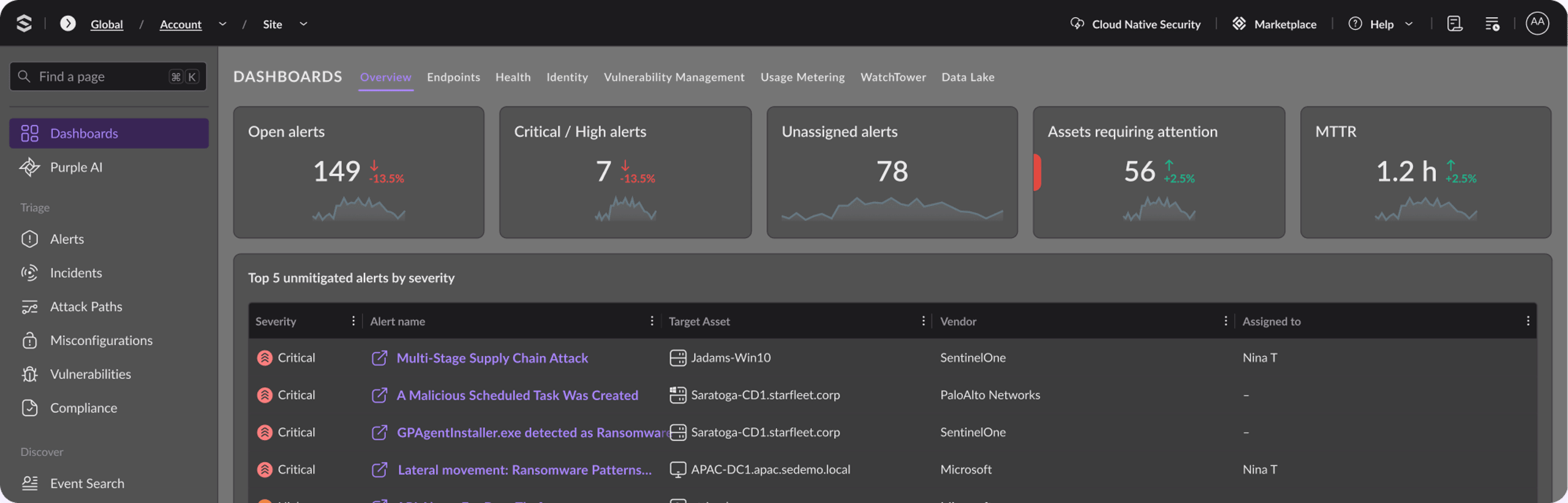
Singularity™ Endpoint combines AI-powered prevention and EDR in a single agent, applying Behavioral AI directly on the device to find and stop LOTL and fileless techniques. It also finds ransomware behaviors documented across CISA advisories. The agent evaluates process behavior and lineage at runtime, so ransomware behaviors and abnormal process lineage register as anomalies the moment they happen, before a signature exists.
Singularity Platform brings endpoint and cloud telemetry together with identity telemetry. A single agent and console feed a single data lake. Storyline® reconstructs process creation and file activity into a complete attack narrative. It also maps network connections, so you can move from alert to root cause without manually rebuilding the timeline. For the sixth year in a row, Gartner® named SentinelOne a Leader in the 2026 Magic Quadrant™ for Endpoint Protection. Latio named SentinelOne the SOC Platform Leader in its 2026 market report, recognition that spans the full SOC platform, from telemetry through investigation and response.
When ransomware does execute, Singularity Endpoint rolls back malicious changes and returns an affected Windows endpoint to its pre-infection state. A destructive encryption event becomes a recoverable one.
Purple AI™ extends this to investigation. It translates natural-language questions into structured hunts across endpoint telemetry so analysts reconstruct an attack timeline without manually correlating data across tools. Per IDC’s business value research, Purple AI customers achieved 63% faster threat identification and 55% faster remediation.
Purple AI Agentic Investigation takes the next step for SOC teams. When a critical threat crosses a defined threshold, it starts the investigation on its own, collects and correlates the evidence, renders a verdict, and can stop the threat at machine speed. Your analysts start at the verdict instead of the alert. Every verdict carries an auditable evidence chain, and your team sets how much autonomy Purple AI gets.
Singularity Data Lake ingests and normalizes telemetry with the Open Cybersecurity Schema Framework (OCSF). That gives you a common foundation for machine learning endpoint security, cloud investigation, and cross-domain correlation. Stored data stays hot, so analysts can query endpoint and cross-domain telemetry in near real time.
Request a SentinelOne demo to see Behavioral AI stop a live attack chain and 1-click rollback undo the damage.
Discover Unparalleled Endpoint Protection
See how AI-powered endpoint security from SentinelOne can help you prevent, detect, and respond to cyber threats in real time.
Conclusion
AI Endpoint Security protects devices by analyzing how files and processes behave, which is how it catches ransomware behaviors that defeated defenders in documented CISA incidents, along with living-off-the-land and fileless techniques. Static AI, runtime behavioral models, telemetry, and automated response work together. Coverage completeness and continuous alert review determine outcomes. Behavioral AI on the agent gives defenders their earliest warning.
Close the coverage and review gaps, and living off the land stops being a place to hide.
FAQs
AI Endpoint Security protects endpoint devices across user and server systems using machine learning and behavioral AI that analyze how files and processes behave at runtime. It combines pre-execution file analysis, behavioral monitoring, telemetry collection, and automated response.
Because it judges activity by deviation from normal baselines, this approach finds ransomware behaviors that signature tools miss, along with fileless malware and living-off-the-land techniques.
Behavioral AI finds threats that signature tools miss by watching what a process does at runtime. Signature tools match files against a database of known malware hashes and patterns, so they only stop what they have already seen. Behavioral AI compares runtime activity against baselines of normal behavior.
When attackers use fileless techniques, polymorphic malware, or trusted system binaries like PowerShell, the model evaluates process sequence and lineage as the process acts and flags the abnormal behavior itself.
Process-lineage tracing records the parent-child relationships between processes, along with command lines and arguments. MITRE ATT&CK identifies these relationships as key signals for finding attacks.
For example, control.exe spawning cmd.exe, or a signed binary launching an unsigned payload, indicates likely abuse. Lineage tracing catches this activity even when every individual binary involved is legitimate and trusted, because the chain exposes attacker behavior.
The primary challenges of deploying AI Endpoint Security are false positives, adversarial evasion, agent resource footprint, and skills shortages. False positives require ongoing model tuning and retraining as behavior drifts.
NIST calls adversarial evasion an open problem. Resource footprint varies by design and needs hardware validation. Your team also needs the skill to customize policies, interpret model output, and question results when the context looks wrong.
AI Endpoint Security sits at the core of a modern EDR strategy, and the two work best as one. The strongest approach runs both in a single agent: AI-powered prevention blocks malicious files before they run, behavioral AI models identify indicators of attack at runtime, and automated endpoint detection and response (EDR) contains what gets through.
Built in, not bolted on. This endpoint data also feeds identity monitoring, threat hunting, and correlation across the wider security program. That makes the endpoint the primary sensor for finding intrusions across cloud and on-premises environments.
Discover More About Endpoint Security




Endpoint Security that Stops Threats at Faster Speed and Greater Scale Than Humanly Possible.
One intelligent platform for superior visibility and enterprise-wide prevention, detection, and response across your attack surface, from endpoints and servers to mobile devices.