Enterprise EDR: Key Features, Benefits & Use Cases
Unlike signature-based tools, enterprise EDR identifies attacks through behavioral analysis. It provides continuous endpoint visibility, automated threat containment, and proactive threat hunting across your environment.

Business laptops and mobile devices are usually the first and last line of defense for company data. Workplaces are becoming more distributed which means we are handling more volumes for sensitive data across public networks and shared spaces. Although software-based security controls are still used, they're not enough to cover most attack surfaces.
Traditional endpoint security tools are lagging behind while firmware-level attacks are spiking as we speak. Cloud-delivered firmware updates may help you maintain device lifecycle integrity, but you need to build a more sound and resilient endpoint security posture that doesn't require any manual intervention.
This is where enterprise EDR can help. And here is everything you need to know about it, including how to get it set up, running, and scaling.
What is Enterprise EDR?
Enterprise EDR is a cybersecurity solution that continuously monitors and records activities across end-user devices. Your end-user devices are laptops, servers, and mobile devices, and these are what we call your endpoints. Enterprise EDR solutions will use antivirus to block known threats. It also uses behavioral analysis and machine learning to discover advanced cyber attacks such as fileless malware, ransomware, supply chain attacks, and even insider threats, all in real-time.
.jpg?width=2560&quality=90&format=auto)
How Does Modern EDR Differ from Traditional EDR?
Traditional EDR is strictly tied down to signature-based detection but enterprise EDR is not. Enterprise EDR can identify unknown and living-off-the-land attacks using behavioral analysis, AI, and machine learning, all of which are beyond the scope of traditional EDR solutions.
Unlike traditional EDR, enterprise EDR can give you real-time snapshots and recordings of all your endpoint activities. It gives your security teams full narratives of your security incidents.
Modern EDR tools are designed to be used by human analysts for proactive threat hunting. You can search for hidden threats that haven't triggered any alerts yet, and even map them to the MITRE ATT&CK framework.
Enterprise EDR solutions are also more scalable across larger and widely dispersed networks. You can also integrate them with cloud platforms.
Key Requirements Modern Enterprise EDR Platforms
Here are the key requirements for good modern enterprise EDR platforms:
Scalability Across Thousands of Endpoints
If you have 500 endpoints or 50,000, your management console should be quick to load, quickly conduct searches, and keep your agents online.
It needs to isolate environments by business unit or region, enforce data residency in local jurisdictions, and limit access based on roles to avoid accidental cross-tenant visibility.
AI and Security Automation
Modern enterprise EDR must include built-in AI for autonomously containing threats, eliminating false-positives, and automating response playbooks. Without it, your SOC drowns in alerts. Look for self-learning baselines, natural language querying, and the ability to kill processes or isolate hosts without human intervention, even when your endpoints are offline.
Centralized Visibility and Telemetry
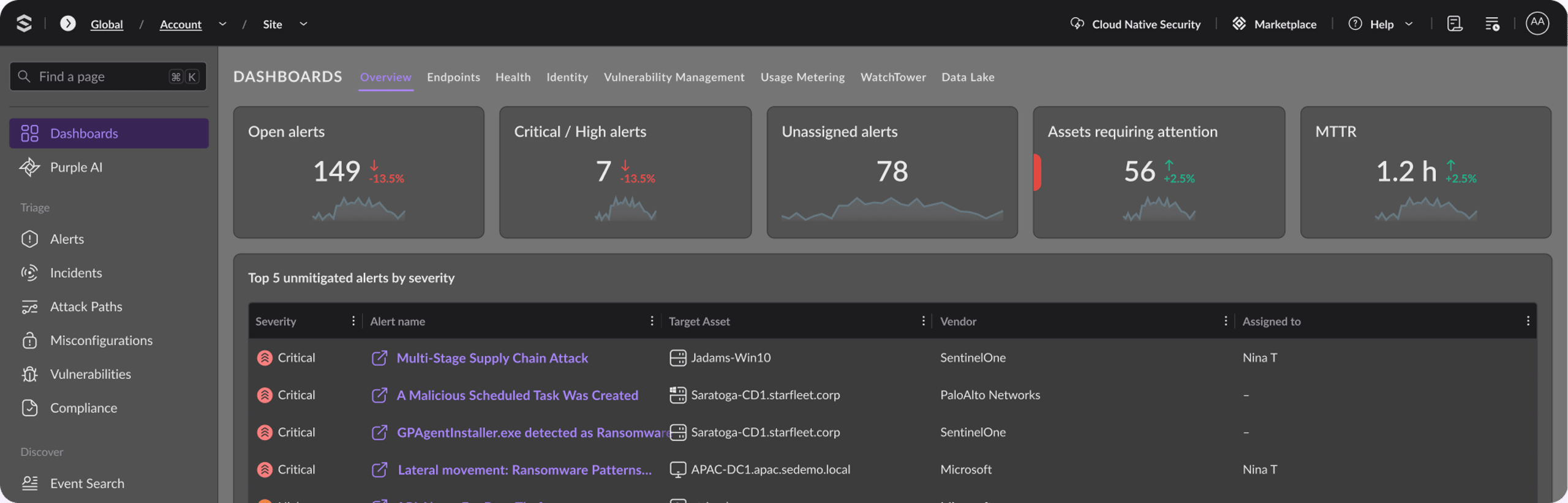
A single pane of glass that shows you every process, network connection, and registry change across all endpoints, regardless of OS or network segment. Alerts must flow to your central logging and automation pipelines enriched with endpoint telemetry.
No separate consoles for Windows vs. Linux vs. remote workers.
Integration with SIEM, SOAR, and Identity Systems
It is essential to pull information about user context from Active Directory or any cloud-based identity provider. The tool should work in combination with SIEM, SOAR, and identity management tools. It needs to identify which user performed what action across different periods or points in time.
Multi-tenant and Global Deployment Support
If you run security for multiple subsidiaries or need to isolate data by region, the platform must provide airtight tenant separation and delegated administration while keeping policy management unified.
Modern EDR Architecture and Deployment Models
Where your EDR lives and how it reaches your endpoints shapes everything from speed to compliance. Here’s what matters most when you’re mapping out the architecture.
Cloud-Native vs. On-Prem EDR
- Cloud-Native (SaaS): The management console and detection engines run in the provider’s cloud. You get instant scaling, no local servers to maintain, and automatic updates. Most teams pick this route unless a regulation forces them offline.
- On-Prem /Air-Gapped: You host everything yourself. Defense contractors and some financial regulators need this for full data residency. Legacy on-prem deployments often require trade-offs like manual updates, slower access to global threat intel, and a heavier ops burden.
Distributed Endpoint Environments
When you have thousands of devices spread across regions, your EDR architecture has to keep network traffic sane. Here’s what you need to know regarding their components:
- Data aggregators (proxies): You drop collector nodes in branch offices to bundle telemetry before it hits the central console. This stops security data from saturating the WAN.
- Unified agent strategy: A single agent installer that covers Windows, macOS, Linux, and your VDI environments. No per-platform forks, no missing coverage.
Hybrid Workforce & Remote Endpoints
Your users aren’t all sitting behind a corporate firewall anymore. The EDR design has to assume every device might connect from a coffee shop or public zone. These are some things to keep in mind:
- Internet-first management: Cloud-native agents talk to the management plane over HTTPS. A remote laptop appears in the console the same way an HQ desktop does, no VPN required.
- Offline protection: The agent carries its own behavioral rules. If ransomware fires while the device is offline, the agent kills the process locally—no round-trip to the server needed.
- Policy enforcement: Security rules and forensic recording travel with the endpoint. Corporate VPN or not, you’re still collecting telemetry and blocking threats.
Modern EDR for SOC Operations
Modern EDR for SOC can integrate with SIEM and SOAR platforms to streamline workflows and reduce alert fatigue. EDR tools are deployed via cloud SaaS, on-premises, and even hybrid models using agents. They can secure endpoints spread across diverse and distributed ecosystems.
You can address visibility gaps with deep kernel-level visibility and use pre-configured policy responses.
Modern EDR in Zero Trust and Identity Security
Zero Trust assumes no device or user gets a free pass inside the network. Modern EDR supplies the continuous device trust signal that makes those access decisions stand up over time.
- Provide a continuous device posture score. If an endpoint gets infected, EDR flags it immediately and tells your access control systems to revoke or limit that device's access.
- Monitor for privilege abuse after authentication. Even when a user has legitimate credentials, EDR watches for behavior like credential dumping or lateral movement that signals a compromised identity.
- Automatically isolate compromised endpoints. When EDR detects a threat, it can isolate that host from the network without waiting for human approval, stopping the breach from spreading.
- Feed device telemetry into adaptive authentication. Your identity provider can use EDR data (threat level, patch status, recent alerts) to decide whether a user's login attempt should proceed, require MFA, or get blocked.
- Catch insider threats that sail past initial auth checks. Behavioral analysis picks up on malicious insiders or stolen credentials by spotting abnormal activity after login, not just known malware signatures.
- Enforce least privilege dynamically. EDR tells the access policy engine when a device posture changes, so a user who had access minutes ago can lose it instantly if the endpoint becomes risky.
- Create a closed feedback loop with identity systems. When EDR detects suspicious behavior tied to a user account, it can trigger identity workflows like forcing a password reset or stepping up authentication requirements.
- Audit and prove device trust during every session. EDR logs serve as evidence that a device met security standards at the time of access, supporting compliance and forensic investigations.
- Reduce reliance on network location for trust. With EDR, trust follows the endpoint wherever it goes. A remote laptop that's fully patched and threat-free gets appropriate access even from a coffee shop.
- Align with Zero Trust principles at the endpoint layer. While identity tools verify who you are, EDR continuously verifies what your device is doing, closing the gap between initial authentication and ongoing session activity.
Use Cases for Modern Enterprise EDR
You can think about use cases in three layers: what you detect, how you respond, and how you run operations. Here’s how modern EDR maps to the real problems on your plate.
Detection Use Cases
- Fileless malware and living-off-the-land: Attackers use your own tools—PowerShell, WMI, PsExec—to move and steal data. EDR analyzes the behavior chain: unusual parent-child process relationships, suspicious command-line arguments, memory scraping activity. No file signature needed.
- Zero-day exploits: When an attacker uses a vulnerability nobody knows about yet, signature-based tools are irrelevant. Behavioral analysis catches the post-exploit activity—spawning a shell, dumping credentials, establishing persistence.
- Polymorphic malware: Malware that reshapes itself to dodge hashes gets caught because its actions (encrypting files, connecting to a C2 server) are consistent, even if its binary changes.
Response & Recovery Use Cases
- Rapid containment: With one click you isolate a compromised machine from the network, kill processes, and shut down lateral movement paths. You stop a single workstation incident from becoming a domain-wide crisis.
- Automated rollback: If ransomware turns documents into gibberish, the EDR can restore them to their pre-encrypted state. Malicious system changes? Reversed. Your recovery time shrinks dramatically.
- Threat hunting across timelines: An analyst suspects an actor has been in the network for weeks. They search historical telemetry for that actor’s known TTPs—even if no alert was fired at the time. You find dormant persistence mechanisms before they’re weaponized again.
Operational Use Cases
- Forensic investigation: You need to answer “What happened?” for an incident report or a board update. The EDR’s recorded timeline shows initial access, execution, persistence, and lateral movement in a single view. You trace the attack path without rebuilding it from scattered log sources.
- Compliance and audit support: Detailed, tamper-proof logs satisfy requirements for GDPR, HIPAA, PCI DSS. Auditors get clear evidence of detection, containment, and remediation—no last-minute panic to assemble documentation.
- Shadow IT and IoT discovery: Unmanaged devices pop up on your network all the time—smart TVs, rogue access points, forgotten Raspberry Pis. Modern EDR detects them the moment they connect and lets you quarantine or block them by policy.
- Remote workforce protection: Your support staff, sales team, and execs work from everywhere. The EDR agent keeps them safe regardless of network. Policy enforcement, forensic recording, and threat blocking all function over HTTPS, no corporate VPN required.
Industrial Use Cases
| Industry | What EDR Does |
| Manufacturing (OT) | Protects legacy factory-floor systems without taking them offline. Stops threats while production runs. |
| Retail | Locks down POS systems against memory scrapers, maintains PCI audit trails, and contains compromises fast. |
| Healthcare | Contains attacks within hours to protect patient data and keep clinical systems available during an incident. |
| Technology | Monitors developer workstations for code theft, unusual process behavior, and unauthorized access to IP repositories. |
Challenges in Modern Enterprise EDR Implementation
Here are some challenges you may face when implementing modern EDR in your company:
Alert Fatigue
When every behavioral deviation fires an alert, your SOC gets buried. Analysts waste hours triaging false positives while a genuine intrusion notice sits unread. If your team treats alerts as background noise, the platform has already failed its core job.
Data Volume and Storage
Continuous telemetry from tens of thousands of endpoints piles up fast. Process trees, network logs, registry snapshots—this is high-resolution forensic data. If you’re not on a cloud-native architecture, storing months of that history gets very expensive, and query performance starts to degrade.
Integration Complexity
Getting EDR to talk to your existing stack rarely works out of the box. SIEM solutions may need fine tuning. SOAR playbooks need the right data fields. Identity tools like Active Directory or Okta need to enrich investigations with user context. Each new integration will open up a new maintenance surface.
Skill Gaps
An EDR console is not a dashboard your help desk picks up in an afternoon. Threat hunting, behavioral analysis, and forensic timeline reconstruction require analysts who understand operating system internals and attacker tradecraft. Hiring or training those people remains one of the hardest parts of running the program.
Endpoint Performance Impact
Modern agents try hard to stay lightweight, but continuous monitoring, scanning, and data uploads add up. On older hardware, point-of-sale terminals, or legacy manufacturing PCs, you’ll sometimes see “agent bloat” that drags down system responsiveness and creates user complaints that erode trust in security.
Privacy and Legal Constraints
Recording every process start and network connection can clash with privacy laws like GDPR or CCPA, especially for global companies. Some regions mandate works-council approval before you collect telemetry from employee-issued laptops. You may need to dial back data collection in certain jurisdictions, which directly reduces your visibility.
Network Bandwidth Saturation
Shipping rich telemetry from remote sites over thin WAN links or congested VPN tunnels can choke the network. You’ll need aggregation proxies or careful telemetry filtering so that security data doesn’t cannibalize bandwidth needed for the business.
Support for Unmanaged and Legacy Assets
Every enterprise has oddball infrastructure. Specialized Linux kernels, end-of-life Windows machines on factory floors, IoT devices that won’t accept an agent. These create permanent blind spots. An otherwise tight EDR deployment leaves gaps because those assets can’t run the sensor.
False Positive Management
Behavioral detection that catches the clever stuff also flags legitimate admin scripts, software updaters, and developer tools. Tuning out the noise without accidentally silencing true signals is an ongoing fight. It takes rule refinement, exception lists, and constant feedback loops from your ops teams.
Best Practices for Modern Enterprise EDR Deployment
Here is a list of the best practices you can adopt for a smooth enterprise EDR deployment experience this year:
- Start in detect-only mode. Deploy agents with policies set to observe and log, not block. You’ll avoid breaking critical applications while the platform learns your environment.
- Pilot with power users first. Roll out to developers and admins who run complex tools—they’ll surface the edge-case false positives that need tuning before a wider deployment.
- Scale gradually across the fleet. Move from the pilot group to critical servers, then to the rest of your endpoints over about 60 days. Slow expansion protects trust and uptime.
- Lock in a behavioral baseline early. Give the platform a few weeks of normal activity to understand your environment. Accurate anomaly detection depends on that baseline.
- Limit exceptions to the smallest scope possible. Avoid allowlisting entire directories; attackers hide there. Keep exclusions as narrow and specific as you can.
- Apply aggressive monitoring to high-value assets. Domain controllers, sensitive data servers, and executive devices should carry the strictest policies and zero blind spots.
- Integrate with your SIEM and SOAR from day one. Feed EDR telemetry into your analytics and automation stack so alerts get cross-correlated, triaged, and escalated without manual swivel-chair work.
- Align detection rules with MITRE ATT&CK. Mapping coverage to the framework shows you exactly which adversary tactics you’re catching—and which ones you aren’t.
- Build containment playbooks for high-severity alerts. Automate host isolation and process termination for unambiguous threats like ransomware, while routing lower-fidelity alerts to manual review.
- Schedule quarterly tuning and testing. Review false positive trends, refine rules, update the agent alongside OS patches, and run red team drills to confirm your team responds effectively under pressure.
How SentinelOne Enables Modern EDR?
Singularity™ Endpoint is a modern enterprise EDR solution and it offers AI-powered autonomous protection, detection, and response capabilities across endpoints, identities, and more. It can provide seamless visibility across devices and users that interact with them.
It protects your organization against malware, ransomware, and can analyze malicious patterns and anomalous behaviors. You get critical endpoint and identity alerts with real-time visibility from system-level to identity-based attacks. Protect mobile devices from zero-day malware, phishing, and man-in-the-middle (MITM) attacks.
Singularity™ Binary Vault automates malicious and benign file upload, forensic analysis, and security tool integration. You can vet collected executables to ensure they are free from unwanted and unauthorized functions that may introduce undue risk. You can customize your security experience with user-definable exclusions of file types and paths. Streamline data retention, workflows, analytics, and much more.
If you want to extend endpoint protection and get broader security coverage, you can also try out SentinelOne's Singularity™ Platform.
Key Takeaways
Here are some key takeaways when it comes to modern enterprise EDR solutions and services in 2026. These are what people are currently talking about:
- Modern EDR can catch what basic AV misses. It catches fileless malware, zero-day exploits, and abuse of trusted tools like PowerShell by analyzing behavior, not file hashes.
- EDR can stop alert fatigue from killing the SOC. It can tune severity thresholds during a detect-only pilot, limit exceptions to narrow paths, and automate triage through SIEM and SOAR integrations.
- EDR can protect a remote workforce without a VPN. Yes. Cloud-native agents enforce policy, record forensics, and block threats locally over HTTPS regardless of network location.
- Modern EDR deployments solve challenges that traditional EDR deployment would trip on the most. Endpoint performance on legacy hardware, false positives from admin scripts, privacy law constraints on telemetry, and a shortage of skilled threat hunters.
- How much data does EDR generate, and how do you manage storage costs? Expect continuous streams of process trees, command lines, and network connections. Cloud-native architectures handle this natively; on-prem setups require strict retention caps and aggregation proxies.
- This is what a first-phase EDR rollout looks like: Start in monitoring-only mode on a small group of power users, establish a behavioral baseline, and scale to critical servers before going fleet-wide over 60 days.
- EDR solutions are being built for natural language queries. Modern EDR solutions are being built for non-tech users who don’t know coding. They can get broad visibility, insights, and solve security issues and silos through natural language queries and searches, no coding needed.
FAQs
Enterprise EDR is a cybersecurity solution that monitors and records activity across your endpoints, like laptops, servers, and mobile devices. It uses antivirus to block known threats and behavioral analysis with machine learning to catch advanced attacks in real time. That includes fileless malware, ransomware, and insider threats. It gives your security team full narratives of every incident and lets you proactively hunt for hidden threats.
Yes. Modern EDR is built to scale across tens of thousands of devices without slowdowns. The management console stays responsive, searches finish in seconds, and agents keep their connections stable. You get centralized visibility across Windows, macOS, and Linux, plus multi-tenant separation when you manage multiple business units or regions.
Your EDR needs to plug into your SIEM to send enriched alerts, into your SOAR platform to automate response playbooks, and into identity systems like Active Directory or Okta to pull user context. Without those integrations, your analysts end up manually piecing together attack timelines. Good integrations mean the EDR fits into your existing stack and reduces swivel-chair work for the SOC.
Yes. Zero Trust needs a continuous device trust signal, and enterprise EDR supplies it. If an endpoint gets compromised, EDR tells your access control systems to immediately revoke or limit that device’s access. It also monitors for privilege abuse after authentication, catching compromised identities, and it enforces least privilege dynamically so a device that was safe moments ago loses access the moment it becomes risky.
Enterprise EDR generates a continuous stream of process trees, command-line arguments, network connections, and registry modifications. That high-resolution forensic data lets you rewind and investigate attacks, but storing months of it can strain on-prem setups. Cloud-native architectures handle the volume natively. On-prem deployments need aggregation proxies and strict retention caps to keep storage costs and network bandwidth under control.
You need analysts who understand operating system internals and attacker tradecraft. Threat hunting, behavioral analysis, and forensic timeline reconstruction are daily tasks. Interpreting raw process logs and spotting subtle anomalies takes training and experience. This is not a tool your help desk can pick up in an afternoon. Hiring or developing people with these skills remains one of the hardest parts of running the program.
You should tune your EDR policies at least quarterly. Review false positive trends, refine detection rules, and update exclusions so you are not drowning the SOC in noise. Agent updates should align with your OS patch schedule to avoid compatibility problems. After any major incident or significant change in your environment, reassess your policies to close new detection blind spots and keep coverage tight.
Look for scalability across thousands of endpoints, real-time behavioral analysis that catches fileless and living-off-the-land attacks, and a lightweight agent that works offline. You need native MITRE ATT&CK mapping, deep forensic recording, and smooth integration with your SIEM, SOAR, and identity tools. Also check deployment flexibility, whether cloud-native or on-prem, and the quality of automated response actions like host isolation and file rollback.
Discover More About Endpoint Security



Endpoint Security that Stops Threats at Faster Speed and Greater Scale Than Humanly Possible.
One intelligent platform for superior visibility and enterprise-wide prevention, detection, and response across your attack surface, from endpoints and servers to mobile devices.