10 Best AI Cybersecurity Solutions for Enterprises in 2026
Find out which are the top AI cybersecurity solutions in the mark. Learn which is the best AI cybersecurity solution for your business and see how all the others work. Prep for tomorrow’s threats.

Introduction
Enterprise firms are adopting AI cybersecurity solutions because threats are getting smarter and bypassing traditional defenses. Which category or suite of AI cybersecurity solutions you use will depend on what your current priorities are with regards to SOC efficiency, endpoint defense, application security, supply chain risks, and so on.
AI cybersecurity solutions can also have double the effect when it comes to dealing with threats online. Because these tools learn from new data and improve their ability to detect emerging threats like zero days and phishing attacks. You will benefit from the faster incident response, stop attacks before actual damage occurs, and get better and broader visibility into your internal security.
We've done our best to shortlist some of the best AI cybersecurity solutions in the market currently. You can use them to boost your resilience, improve response, and prevent threats across complex IT environments. Keep reading to learn about the list.
.jpg?width=2560&quality=90&format=auto)
The Need for AI Cybersecurity Solutions
AI cyber security solutions are needed to foster business innovation, because think about it, how can you deliver your best services to your customers if you're worried about basic security in your enterprise and on the cloud? Customers are constantly worried about sophisticated cyber threats, getting hands on their data, and next generation managed detection and response services, along with the best AI cyber security solutions can ward off their worries. Business AI solutions are being built with integrated AI security.
There are many organizations who are using a suite of agentic AI cyber security solutions to operate autonomously and secure clients. You need AI cyber security solutions for industrial 5G. Pharmaceutical plants also have different security requirements than companies in the automotive assembly sectors. So AI security doesn't only apply to the online landscapes, but also to other industries, niches, and domains.
We are using AI not just as software, but AI is being integrated with physical tools as well. All these can be hijacked without the right industrial grade security measures. Also, cyber attacks can cause costly downtimes and compromise worker safety. AI cyber security solutions can make sure you follow the best compliance measures and don't violate NIS2 and other defense in-depth security architecture mandates.
The Best AI Cybersecurity Solutions for 2026
Now let’s get to the list of the top AI cybersecurity solutions. If you can’t find the best AI cybersecurity solution for your business, then we’ve got you covered. Here is the full roundup of who are leading currently this year:
1. SentinelOne
SentinelOne has a diverse portfolio of AI cybersecurity solutions, which means you get different solutions for different use cases. That's just one of the best parts about their AI security portfolio. You ship AI, not risks, and get to deploy AI apps and agents with built-in protection. All your testing gets automated, and you get real-time policy enforcement.
If you want to stop threats before they start and empower your teams, being amplified with humans also, then SentinelOne is your go-to cybersecurity solution and resource when it comes to finding the best AI cybersecurity solutions. You can bring visibility, context, and time action together into seamless workflows for a unified experience.
Here are the AI cybersecurity solutions SentinelOne offers for your security architectural advantage. Book a live demo to learn more.
Platform at a Glance
- Singularity™ Endpoint - Singularity™ Endpoint covers every managed device in your environment. On-device behavioral AI detects and stops threats without needing a cloud connection, and 1-click rollback can immediately undo unauthorized file changes caused by ransomware or other malicious activity.
- Singularity™ XDR - Singularity™ XDR extends coverage across endpoints, cloud workloads, identity, and network data sources. It pulls telemetry from all these into one unified incident view, so your team sees the full picture of any attack without jumping across multiple dashboards. SentinelOne integrates Security Orchestration, Automation, and Response (SOAR) into its Singularity™ XDR platform
- Singularity™ AI SIEM - Singularity™ AI SIEM runs on SentinelOne's data lake and ingests log data from any source, including third-party security products. You get long-term data retention, hyperautomation for faster triage, and the ability to run threat hunts across years of stored telemetry.
- Singularity™ Cloud Security - SentinelOne offers the most awarded CNAPP solution, which is agentless. It is the only CNAPP product in the industry to earn a 4.9 out of 5 rating, and has received over 240 awards and counting. Singularity™ Cloud Security can block your attacks with its AI-powered CNAPP. You can verify exploitable risks and stop runtime threats on their tracks. It offers various features like Cloud Security Posture Management, Cloud Workflow Protection, Data Security Posture Management, AI Security Posture Management, Cloud Infrastructure Entitlement Management, and even External Attack Service Management.

CNAPP Buyer’s Guide
Learn everything you need to know about finding the right Cloud-Native Application Protection Platform for your organization.
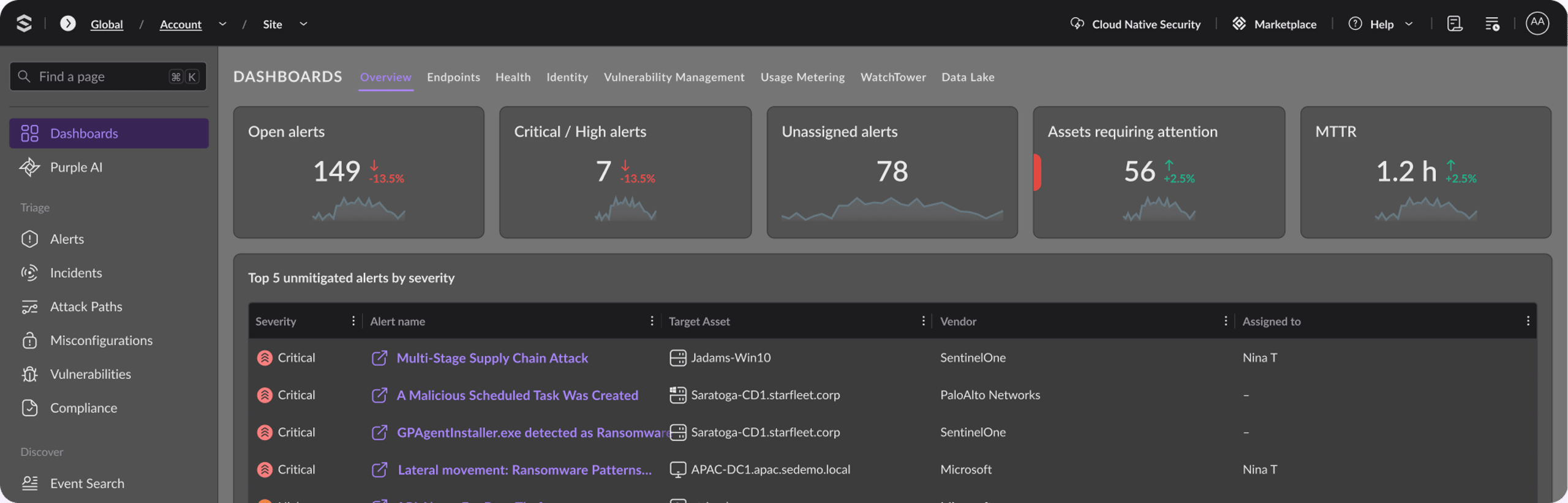
- Purple AI - Purple AI is SentinelOne's gen AI security analyst. Your analysts can type questions in plain English and get threat hunt results, investigation summaries, and response recommendations, no query writing required. It works across all your security data.
- Prompt Security - Prompt Security controls how AI is actually being used inside your org. Whether it's your employees, your agents, or the applications your teams are building, it stops data leaks and credential exposure, blocks prompt injection, governs shadow MCP servers, and gives your security team full visibility into every AI interaction.
- Other services - SentinelOne also offers MDR, human threat hunting, expert-led incident response and breach readiness services. You can check them out as well because they offer informed intelligence with humans in the loop for feed, especially if you want proactive defenses.
Key Features
- SentinelOne's CNAPP comes with a graph-based asset inventory, which can visually map cloud, endpoint, and identity assets. You can track and correlate alerts from different sources, and determine their blast radius and even the impact of threats.
- SentinelOne can easily apply shift-left security testing to your DevSecOps workflows. It integrates with your CI/CD pipelines; it can scan code repos, container registries, images, and IaC templates.
- You get the best of agentless vulnerability scanning, and it comes with 1,000+ out-of-the-box and custom rules. You can also do container and Kubernetes security posture checks and ensure compliant standard alignment.
- SentinelOne can hunt for threats across your entire cloud environment. It has world-class threat intelligence built into the solution and secures all your workloads, apps, and data.
- You can deploy active protection that goes beyond your configuration. You can fully respond, contain, and control all aspects of your cloud remotely.
- SentinelOne uses no-code or low-code hyperautomation workflows for even faster automation capabilities. You get full security coverage for any and all assets. This includes support for public, private, hybrid, and on-prem clouds. You also get support for all workloads, containers, Kubernetes, servers, virtual machines, databases, physical servers, serverless, and storage.
- SentinelOne can help you find and discover unknown cloud deployments and offers greater operating system coverage than any other vendor. No kernel access is needed.
- Purple AI lets analysts query the full Singularity data lake using plain language. It generates investigation summaries, suggests remediation steps, and runs automated threat hunts without requiring any scripting or query writing skills from your security team.
- SentinelOne's Identity Threat Detection and Response (ITDR) watches Active Directory and cloud identity environments around the clock. It catches credential abuse, unauthorized privilege escalation, and lateral movement attempts before attackers reach critical systems.
Core Problems SentinelOne Solves
- Can fight against ransomware, zero-days, unknown and hidden threats, and more. SentinelOne can apply baseline behaviors in your workplace, see if anyone deviates from them, and flag security anomalies. It’s great at spotting insider threats and signs of suspicious malicious activities in the background which often go undetected or lie dormant.
- Security training and awareness is a big problem in enterprises these days. Prompt Security can train employees how to safely use AI, ensure ethical usage, and prevent shadow IT AI attacks. It has guardrails in place to block unsafe LLM outputs and even blocks against unauthorized agentic AI actions.
- High alert volumes that overwhelm your analysts. SentinelOne's Storyline technology groups all related events into a single visual incident timeline per attack, so analysts immediately see what happened without manually connecting alerts from dozens of different sources.
- Investigations slowed down by complex query workflows. Purple AI answers security questions in plain English and surfaces findings in seconds, letting junior analysts run threat hunts without needing help from senior staff or advanced query skills.
- Untracked AI usage spreading across your workforce. Prompt Security monitors what employees are sending to external LLMs and blocks requests that include source code, API keys, or regulated data before they leave your environment.
- Cloud misconfigurations sitting undetected for weeks. SentinelOne continuously checks AWS, Azure, and GCP for exposed credentials, open storage buckets, and policy violations, and flags them with remediation guidance so your team can act before attackers do.
- Container and Kubernetes workloads falling through coverage gaps. SentinelOne scans container images, checks Kubernetes cluster posture, and monitors running workloads for active threats, all from the same console used for endpoint and cloud management.
- Compliance evidence taking too long to pull together before audits. SentinelOne auto-generates structured reports mapped to SOC 2, HIPAA, and CIS frameworks, cutting the manual effort your team puts into audit prep each cycle.
Testimonial
"The Singularity™ Platform delivers on what it promises. Autonomous protection, fast detection, and very little reliance on manual SOC effort. Purple AI has also been a standout addition. Our team can investigate threats using plain language queries and surface findings faster than before. Overall a very positive experience, with strong endpoint security and minimal operational overhead."
- Security Engineer, Gartner Peer Insights
Reviews and Ratings
Look at Singularity™ Platform's ratings and reviews on Gartner Peer Insights and PeerSpot for additional insights.
2. Crowstrike Falcon
CrowdStrike’s Falcon Security Suite is a security service for the endpoints, cloud workload, identities, and AI services, provided by a single lightweight agent and console. It gathers telemetry data from these attack surfaces, uses machine learning to identify any threat, and maps out behaviors to automate actions against the threat. In addition, it has started protecting another attack surface, namely the AI prompt-agent interface.
Features:
- Charlotte AI is a conversational AI tool which allows analysts to probe incidents, generate summaries of activities by threats, and receive recommended courses of action without the need to be familiar with Falcon's proprietary query language.
- Falcon AIDR (AI Detection and Response) analyzes prompt interactions and agent activities to detect prompt injection, shadow AI use, and misuse of models.
- Falcon Cloud Security protects your cloud assets, which include AWS, Azure, GCP, and on-premises resources for issues such as configuration errors, vulnerabilities, threats at runtime, container security, and Kubernetes scanning.
- Falcon Identity Protection detects authentication traffic across your AD and Entra ID to identify attacks based on credentials, lateral movement, and attempts at takeover of accounts.
See what CrowdStrike Falcon's position is in the AI cybersecurity segment by going through its Gartner Peer Insights and G2 reviews and ratings.
3. Cortex XSOAR
Cortex XSOAR is the solution by Palo Alto Networks for Security Orchestration, Automation, and Response. This solution consolidates four capabilities such as case management, automation of playbooks, collaboration, and threat intelligence management into a single workflow layer within SOC. Palo Alto has also introduced another solution known as Cortex AgentiX that it claims is an advanced version of XSOAR, powered with agentic AI, trained with more than a billion security playbooks.
Features:
- Its playbook integrations enable SOC teams to automate common tasks such as alert prioritization, phishing investigation, and vulnerability enrichment without having to build anything from scratch.
- Cortex AgentiX includes autonomous agents which can perform threat intelligence research, email investigations, and perform complex response tasks to minimize the work of human analysts.
- The war room allows your incident response team to collaborate while responding to the threat, with an auditing trail available for reviewing all actions performed.
- Built-in threat intelligence management will allow you to correlate data from various threat feeds and apply them to incidents automatically using playbooks.
Check how Cortex holds up in AI security operations by reading its Gartner Peer Insights and PeerSpot ratings and reviews.
4. Checkmarx One Assist
Checkmarx is designed for enterprise-level users who require security for their coding activities. It offers SAST, SCA, DAST, IaC, container, and API security with an ASPM layer. The new family of Checkmarx One Assist products includes intelligent agents that provide threat detection and protection throughout the software development cycle.
Features:
- Triage Assist is a self-governing AI assistant that focuses on vulnerabilities in terms of exploitability and contextual relevance beyond merely CVSS scores so that the developers address only the vulnerabilities that are relevant.
- Developer Assist checks code in popular IDEs such as VS Code, JetBrains, Cursor, and Windsurf including code completion by AI and delivers real-time advice during development without directing developers to go through another dashboard.
- The SCA scan detects vulnerabilities, licensing problems, and potentially malicious components in open-source libraries within the software supply chain.
- ASPM provides correlated insights across all kinds of scans in one cohesive risk management view, eliminating clutter created by using several different scanning tools.
See how well Checkmarx One performs in application security by reviewing its PeerSpot ratings.
5. Snyk AI Workflows
Snyk AI cybersecurity solution was made for developers using AI assistants during their coding and deployment operations. It offers protection throughout the entire development cycle, from scanning for vulnerabilities within AI-assisted code, to safeguarding the AI technology itself. It provides AI protection for your development environment.
Features:
- DeepCode AI detects vulnerabilities in the code as developers write the code, even when it is auto-completed using an assistant such as GitHub Copilot, in the very IDE where the coding occurs.
- Snyk "Shadow AI" detects hidden models, untrusted third-party components, and unscanned datasets that are included in your environment by your teams.
- SCA scanning evaluates the open-source libraries in your software dependencies through reachability and transitivity analyses; therefore, it will detect vulnerable functions only when they are reachable from your code.
- Snyk Guard enforces the security policies of organizations as software is developed and deployed, thereby checking the compliance of code with all required governance rules automatically.
To assess Snyk's capabilities in AI and application security, review its ratings and PeerSpot reviews.
6. Mend AI Native AppSec
Mend.io covers both the code layer and the AI layer of modern software development. Its AI Native AppSec approach scans continuously across code, open-source dependencies, containers, and AI components, and also runs automated behavioral red teaming against AI applications to test for risks before they get exploited.
Features:
- With Mend AppSec, static application security testing (SAST) and software composition analysis (SCA) are combined using reachability-based priority using EPSS and CVSS 4.0 scoring so that the team can be assured of fixing the vulnerabilities which are actually exploit-worthy and not theoretical at all.
- Mend AI finds the AI code in your organization, runs behavioral testing using automated red team testing of them, and then enforces runtime guardrails that prevent any malicious outputs or agent activity.
- Mend Renovate automatically performs package updates and organizes them by confidence levels to help your teams remove old packages without causing build breaks or delays caused by manual reviews.
- It works with various AI coding assistants which modern companies use.
Read PeerSpot reviews to learn more about Mend.io's features and what users think of its AppSec capabilities.
7. Wiz
Wiz automatically connects to the cloud and performs a scan of the workloads, containers, data stores, identities, and infrastructure configurations for any potential security risk. The AI cybersecurity solution can analyze the cloud environment to determine which combinations of risks can result in actual security exploits. Teams can use this information to prioritize their fixes.
Features:
- Wiz's Security Graph visualizes the vulnerabilities of a system to show which are exploitable
- DSPM helps find sensitive data in the cloud and maps out the data access privileges for each entity
- Container and Kubernetes security solution allows organizations to scan container images for vulnerabilities without installing any sidecar containers
- Wiz Code allows organizations to scan for vulnerabilities in infrastructure as code (IaC) templates and container images before they are deployed in production environments
Explore the feedback and ratings on G2 and PeerSpot to get further insights into Wiz's capabilities.
8. Darktrace
Darktrace uses AI to establish a baseline of normality for each user, device, and system within your network. Any anomalies from these established baselines will be flagged. It offers protection for on-premises and cloud networks, email, endpoints, and OT systems. Additionally, it can autonomously respond to threats without requiring human approval.
Features:
- Darktrace builds behavioral baselines for each entity on the network to detect threats invisible to signature-based antivirus software.
- Autonomous Response can perform actions like blocking specific connections or devices to contain threats without waiting for human approval.
- AI Analyst can investigate alerts and write incident reports to free up staff members from reporting requirements.
- Email security software can protect organizations from phishing, account takeover, and other types of email impersonation by examining email communication patterns.
Look at Darktrace's ratings and reviews on Gartner Peer Insights and G2 for additional insights.
9. Microsoft Security Copilot
Microsoft Security Copilot is a generative AI security analyst built on top of Microsoft's threat intelligence and Defender ecosystem. It processes security signals from Defender, Microsoft Sentinel, Intune, and third-party sources, and lets analysts investigate faster using plain language queries and AI-generated incident summaries. Teams already running Microsoft infrastructure get the most out of it since it pulls from signals already flowing through their existing Microsoft stack.
Features:
- Security Copilot converts natural language queries into security investigations across Defender signals, generating step-by-step guided response recommendations without requiring analysts to write queries manually.
- Microsoft Sentinel integration lets teams summarize incidents, run queries through plain language, and produce reports without needing full KQL fluency.
- Threat intelligence from Microsoft's global sensor network feeds directly into Copilot, providing context from known adversary groups and active campaigns when analysts are working live incidents.
- Defender's signal correlation across endpoints, identity, email, and SaaS apps creates unified incidents, which Copilot can then summarize and help triage automatically.
Check out G2 and PeerSpot reviews to see what users have to say about Microsoft Defender for Cloud.
10. Vectra AI
Vectra AI monitors network traffic across on-premises data centers, cloud environments, identity, and SaaS to catch threats that endpoint-focused security products typically miss. It uses behavioral analysis to detect lateral movement, privilege abuse, and command-and-control activity, then prioritizes findings so analysts aren't wasting time on noise.
Features:
- Attack Signal Intelligence correlates detections across network, identity, and cloud layers, helping analysts focus on the most urgent incidents rather than chasing individual low-level alerts.
- Coverage is agentless, pulling metadata from network traffic and cloud APIs without requiring any changes to endpoints or workloads.
- Hybrid environment support covers AWS, Azure, GCP, Microsoft 365, and OT/IoT infrastructure, all from a single management interface.
- Automated containment lets teams isolate compromised identities or block malicious connections directly, or via integrations with existing security products already in their stack.
Compare Vectra AI's ratings and reviews on G2 and PeerSpot for additional insights.
How to Pick the Best AI Cybersecurity Solutions for 2026?
When you’re looking for the best AI cybersecurity solutions in the market, here are key factors you should evaluate every product (and their features) on:
- Detection Speed vs. Response Time - Detection speeds and response times can vary depending on the AI cybersecurity solution you choose. And there is a wide range. You should expect your threat response solutions to be able to respond within 30 seconds or less. Because your SOC teams will not have time to wait for a solution to run its playbook.
- Pricing models - Many of today’s products offer pricing based on users or workloads as well as pricing based on data volumes. First determine the true environment size. If you have 5000 employees but 20,000 cloud workloads, a pricing model based upon users will destroy your budget very quickly.
- Visibility into Shadow AI - This has become a major area. Developers are already using chatbots for various use cases in their industry. Does your product provide visibility into what prompts developers are sending? Where is code being sent? Are API keys able to leak out from your product? Get answers to these questions. Or else, if not, then you have a massive blind spot.
- Ease of Integration with other products - Is your analyst currently working off 3, 5, or 8 different consoles? A good product should integrate into at least those tools your analysts are currently using. They use Slack, ticketing systems, and even your Security Information Event Management (SIEM).
- False Positive Rates - All security vendors claim to have low noise. Ask for the vendors’ actual data regarding false positive rates for deployments in 2026. Any vendor who has false positive rates greater than 5%, will eventually have their analysts ignore alerts. And that’s where breaches occur.
- Audit and Compliance Checks - Do you have a SOC 2, ISO 27001 or NIS2 type audit requirement? Will your new security product automatically generate documentation required for audits or do you need to continue spending multiple days each month gathering logs manually?
Conclusion
Now you know which AI cybersecurity solutions your organization should start using or at least you have a good starting point by exploring the products on our list. There is no clear answer on which cybersecurity solution is the perfect fit for your enterprise. You will have to try test out their features and find out for yourself.
But if you do need help with building your AI cybersecurity strategy, we can provide you with tailored guidance. SentinelOne's team is very happy to help and we can answer all your questions.
FAQs
Small businesses can use AI cybersecurity just fine. Many vendors now offer plans built for smaller teams with smaller budgets. If you run a small shop, you can get AI-powered endpoint protection, email filtering, and network monitoring without hiring a full security team. Some tools even come with free tiers or pay-as-you-go pricing, so you only pay for what you actually use.
Normal antivirus works off a list of known bad signatures, so if a threat is new, it slips right past. AI cybersecurity solutions look at behavior instead. They learn how your systems normally act, and when something weird happens, they flag it. This works on zero-days, fileless malware, and insider threats, because the AI doesn't need a signature to know something is wrong.
No. AI automates the boring, repetitive work like sorting through alerts and gathering data. Your analysts then focus on real investigations and strategic decisions. The cybersecurity talent gap is massive anyway, there are more open jobs than people to fill them. AI makes your existing team faster and helps junior analysts hunt threats like seniors, but it doesn't replace human judgment.
Assuming it works right out of the box without any setup. You need to train the AI on your specific environment, tune its thresholds, and define what normal looks like for your org. If you skip this, you will drown in false positives or miss real attacks. Also, do not turn off your existing security controls until you have validated the AI tool actually works in your setup.
Companies using AI and automation in their security stack saved about $2.22 million on average compared to those without it. The savings come from fewer breach costs, faster investigations, less time wasted on false alarms, and smaller security teams being able to do more work. You also consolidate multiple legacy tools into one platform, which cuts licensing and storage costs.
Yes. Some AI cybersecurity solutions send your security logs to external clouds for analysis, which can include sensitive data. Before you buy a product, ask where your data goes, who can access it, and if it ever leaves your environment. Also, employees might feed confidential company data into public AI chatbots without realizing it. You need guardrails to block that from happening.
The cloud changes constantly, new services spin up, containers launch, permissions get added. AI tracks all that automatically. It spots misconfigured storage buckets, finds forgotten cloud assets, and detects unusual API calls that indicate a breach. Instead of manually checking thousands of cloud settings every week, the AI does it continuously and flags only the risky stuff.
Ask them for hard numbers on false positive rates from real customer deployments. Any vendor with rates above 5% will exhaust your team. Also, check if their AI requires complex query languages or if analysts can ask plain English questions. Get references from companies your size, and ask about integration speed. If they cannot answer basic questions about data isolation and model training, walk away.
Discover More About Cybersecurity


Experience the Most Advanced Cybersecurity Platform
See how the world’s most intelligent, autonomous cybersecurity platform can protect your organization today and into the future.