7 Data Lake Solutions For 2026
Explore the 7 data lake solutions defining data management in 2026. Uncover benefits, security essentials, cloud-based approaches, and practical tips for effective data lake implementation.

Today, data has become a game changer in the business environment, changing everything from advanced analytics to real-time decision-making. In the quest to deal with massive and disparate data sources, data lake solutions have become a cornerstone of today’s information architectures. In fact, 35 billion records were exposed to data breaches in the first four months of 2024 alone, making the case for stronger data security measures such as cybersecurity data lakes to be implemented. Data lakes are very different from the rigid structures of traditional data warehouses because they allow the ingestion and processing of data in multiple formats.
This flexibility opens up innovative opportunities but also brings challenges in the areas of governance, performance, and security of the data lake. However, many enterprises are struggling to manage the complexity of migrating to a cloud based data lake, staying cost effective, and maintaining strong controls to achieve compliance. There have also been strategies that bridge the divide between approaches of data lake and data warehouse. With the data landscape continuing to evolve, it is important for businesses to determine the right data lake platform that fits their performance, scalability, and security needs.
In this article, we will explore the concept of a data lake, what are its main benefits, and why organizations today are turning to data lake solutions. In this article, we’ll highlight the top 7 technologies that will dominate data lake environments in 2026, the standout features, and how they solve modern data challenges. We’ll explore how each solution tackles ingestion, transformation, governance, and advanced analytics, including integration with existing data warehouses and streaming architectures. Finally, we’ll go through the key selection criteria and best practices for selecting the right platform.
What Is a Data Lake?
A data lake is a centralized repository in a centralized location that is used to store large amounts of raw data in its original format from a wide variety of sources (such as operational databases, IoT sensors, click streams, and unstructured documents). Data lakes don’t need an upfront schema, which is different from traditional relational databases or data lake and data warehouse solutions. On the contrary, data remains intact, and structure is applied only on demand (the “schema on read” approach). This provides the flexibility for data scientists, analysts, and developers to extract insights such that they are not bound by tight constraints.
Research projects data growth to be 28% annually, prompting the use of new technologies to handle this growth. In this landscape, data lakes have become an essential solution, a vendor-neutral environment to store large amounts of data. Data lakes provide a way to unify data across different channels, but their ‘store everything’ approach can create data swamps or poorly governed assets. Without a solid framework for classifying, lineage, and security of data, lakes quickly become chaotic, making compliance and advanced analytics difficult.
That’s why modern data lake solutions focus on governance, discoverability, and automation to keep data actionable and trustworthy.
Need For Data Lake Solutions
Data lake solutions are adopted by organizations for many reasons, all of which relate to the need to provide flexible, high volume analytics. Below are key drivers compelling modern enterprises to build or modernize their data lake architectures:
- Growing Data Volume and Variety: Enterprises are now generating an unprecedented amount of structured and unstructured data streaming from social media, mobile apps, IoT sensors, and partner APIs. These loads are not scalable and flexible enough for traditional database systems. A high capacity cloud-based data lake is a cost-effective method of storing data for future analysis.
- On-Demand Analytics and Machine Learning: Data analysts and scientists want raw data available quickly without waiting for those ETL processes. The flexible lake environment encourages experimentation and advanced analytics, such as predictive modeling, by allowing teams to query and transform data as they’re needed. Data lakes, coupled with advanced ML frameworks, can power real time insights as well as improved decision-making.
- Data Lake Security and Governance: Data lakes store massive and varied data, and, as a result, there is an urgent need for data lake security measures such as identity access management (IAM), encryption, and auditing. New solutions include fine grained controls to comply with GDPR and CCPA regulations, something that early data lake initiatives lacked.
- Operational Efficiency: Consolidating data into a single repository eliminates silos and as more business units demand data-driven insights. The duplication across multiple specialized systems can be reduced by teams to minimize overhead. Additionally, advanced transformations such as cleaning, normalizing, or enriching data with external sources can be performed in a single place of control.
7 Data Lake Solutions in 2026
Modern data lake platforms are built to ingest, store, transform, and secure vast quantities of data and provide capabilities such as automation, governance, and real-time analytics.
In this section we will review seven leading data lake solutions with distinct strengths to meet the different needs of an enterprise.
SentinelOne
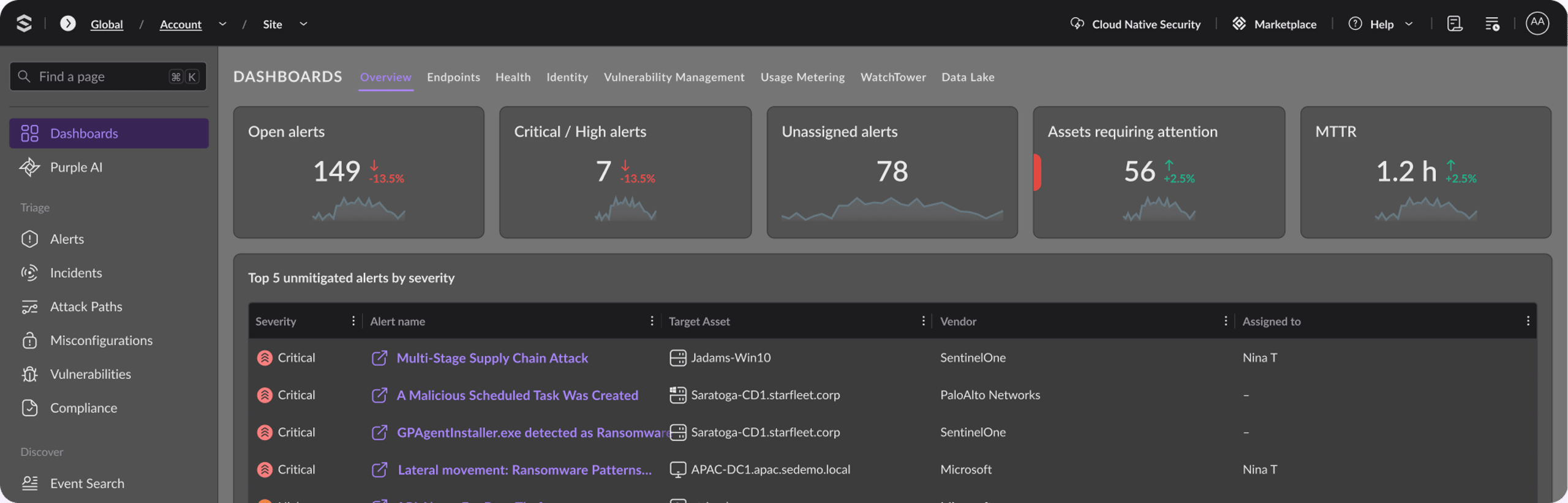
SentinelOne Singularity Data Lake is a unified AI-driven platform for transforming raw data into actionable intelligence. This centralizes data ingestion from disparate data sources, allowing for real-time investigation, threat detection, and automated response. SentinelOne Data Lake eliminates data silos and simplifies analytics, empowering enterprises to improve security performance while retaining full visibility and control of their data.
Platform at a Glance
- AI-Powered Analytics: Advanced AI algorithms are used by Singularity™ Data Lake to find patterns, detect anomalies, and predict future threats before they become actual threats. It allows the organization to analyze huge datasets in real-time to respond proactively to emerging risks. The platform correlates events, provides actionable insights, and simplifies complex investigations. Automated analytics lets teams spend less time on manual analysis and more time on strategic initiatives.
- Unified Data Ingestion: It effortlessly works with first-party and third-party sources, leaving no critical data unaccounted for. Data onboarding is streamlined with pre-built connectors, and time to value is decreased. It consolidates data from multiple environments, including cloud, on-premise, and hybrid systems, into a single, accessible location. This breaks down data silos and gives organizations the ability to see the whole picture of their operational landscape.
- OCSF Compliance: Ingested data is normalized and structured within Singularity™ Data Lake using the Open Cybersecurity Schema Framework (OCSF). Standardizing on this ensures that it’s compatible and makes it easy to integrate into other cybersecurity tools and systems. Consistency in how data is processed and analyzed gives the security teams a less complex environment to work in. The platform allows faster decision-making and improved interoperability across the security ecosystem by aligning with OCSF.
Features:
- Comprehensive Ingestion: Combines data from any source and never misses a critical piece of info.
- AI-Assisted Analytics: Offers deep insights into threats, behaviors, and performance by means of machine learning.
- Real-Time Response: Enables swift elimination of threats with context-driven insights.
- Enterprise-Wide Visibility: Breaks data silos for holistic cloud, endpoint, and other domain monitoring.
- Performance Optimization: It monitors analytics and scales effortlessly with enterprise needs.
Core Problems That SentinelOne Eliminates
- Data Duplication: It removes redundant data copies to ensure efficient storage and retrieval.
- Fragmented Security Views: Centralizes datasets to provide a unified view of the enterprise threat landscape.
- Extended Investigation Times: Automated workflows and AI-powered analytics accelerate the mean time to response.
- Limited Log Retention: Offers long-term secure storage of mission critical data.
- Manual Processes: Customizable automated rules and alert correlations reduce operational overhead.
Testimonials
“I’ve been using SentinelOne Singularity for a few months now and it’s been very impressive specially with ai driven security that automatically detects and responds to threats in real time. The platform is easy to manage and efficiently handles threats and malware.” – IT SECURITY & RISK MANAGEMENT ASSOCIATE
Find user ratings and reviews for SentinelOne Singularity™ Data Lake on Gartner Peer Insights and PeerSpot.

The Industry’s Leading AI SIEM
Target threats in real time and streamline day-to-day operations with the world’s most advanced AI SIEM from SentinelOne.
The Informatica Intelligent Data Management Cloud (IDMC)
Informatica IDMC is a platform that covers ingestion, transformation, governance, and analytics. The architecture enables organizations to build pipelines, impose data quality, and trace lineage throughout the pipeline. IDMC has built-in connectors that help create synergy between a data lake and a data warehouse environment.
Features:
- AI-Driven Data Catalog: New data sets are automatically discovered, with metadata and lineage records assigned.
- Data Quality Services: It ensures formatting, deduplication, and validation consistency.
- High-Speed Ingestion: On-prem systems, SaaS apps, or IoT sources that can load bulk or streaming loads.
- Secure Governance: The solution comes with role-based access controls, encryption, and compliance modules.
Discover what users have to say about Informatica Intelligent Data Management Cloud (IDMC) on Peerspot.
Palantir Foundry
Palantir Foundry can deploy analytics on government and enterprise clients. Foundry supports collaborative analysis across departments by treating data as objects within an ontology. It provides data practitioners with a semantic layer to help make sense of relationships.
Its access control also enforces data lake security, only allowing authorized personnel to access sensitive data.
Features:
- Ontology-Driven Data Model: It maps real-world entities and relationships onto raw data.
- Collaboration Tools: Data sets can be manipulated by multiple teams with full version control.
- High-Performance Pipelines: It scales horizontally to handle large, multi-format ingestion.
- Granular Governance: Data classification for compliance is interlocked with identity management.
Read authentic ratings and insights for Palantir Foundry on Peerspot.
SAP HANA
SAP HANA offers in-memory processing and real-time analytics between operational and analytical workloads. For data lakes, HANA uses its columnar store to process unstructured data and traditional SAP ERP transactions. It does analytics on live data, and is able to store raw, untransformed records.
It supports enterprise resource planning, supply chain management, and other mission-critical systems through its ecosystem.
Features:
- In-Memory Columnar Engine: Supports sub-second queries on large data volumes.
- Native ML and Predictive Functions: Includes advanced algorithms for real-time data science.
- Hybrid OLTP/OLAP: It streams transactional workloads and analytics in one environment.
- Integration with SAP Apps: Integration with apps such as Concur, SuccessFactors and more embed natively with S/4HANA.
Gain valuable user perspectives on SAP HANA through Peerspot.
Azure Data Factory
Azure Data Factory is a fully managed data integration service from Microsoft that orchestrates the movement of data from a variety of sources into a cloud based data lake. Mapping data flows provides a code-free environment, but custom transformations can be performed through notebooks or scripts. Data Factory can feed analytics pipelines with real time or scheduled data paired with Azure Data Lake Storage or Synapse Analytics.
Features:
- Customizable Pipelines: A drag-and-drop interface to design ETL/ELT flows.
- Rich Connector Ecosystem: Supports SQL databases, SaaS apps, big data sources and more.
- Scalable Spark Environment: It powers jobs with dynamic compute scaling.
- Event-Driven Triggers: Ingests upon file arrival or specific business events.
Learn how Azure Data Factory is rated and reviewed by users on Peerspot.
Matillion ETL
Matillion ETL is designed to make large scale data transformations approachable. Matillion makes building ETL pipelines for cloud warehouses or data lakes less complex by focusing on an intuitive UI. Users can visually define workflows from initial ingestion to advanced transformations. It speeds up project timelines for mid-sized companies that do not have a dedicated data engineering team but still require robust and large volume handling.
Features:
- Graphical Transformation Jobs: It makes building complex data workflows from ingestion to merges simpler.
- Deployment on Major Clouds: Native integrations with AWS, Azure, and GCP data services.
- Extensive Connectors: Includes CRMs, ERPs, and marketing tools for better connectivity.
- Lightweight Footprint: Matillion is a cloud-native tool that scales with usage peaks.
Uncover first-hand user experiences with Matillion ETL on Peerspot.
StreamSets
StreamSets provides a DataOps-driven platform for continuous data ingestion and transformation with schema evolution and real-time streaming capabilities. Its pipelines adapt to different sources’ data, keeping the ingestion process from breaking when new fields or formats appear. StreamSets can also unify batch and streaming jobs and feed a data lake and data warehouse at the same time.
Features:
- Schema Drift Handling: Manages unexpected fields or data structures on the fly.
- Real-Time Monitoring: Pipeline performance and error rate dashboards.
- Multi-Environment Deployment: Supports hybrid and multi-cloud, spanning on-prem systems and SaaS apps.
- Data Integrity Checks: It ensures data consistency via checksums, versioning and alerts on anomalies.
Browse through genuine feedback about StreamSets on Peerspot.
How to Choose an Ideal Data Lake Solution?
When choosing the right data lake platform, you have to carefully balance performance, security, integration, and cost. The following section covers seven things you need to consider, from examining your current ecosystem to thinking about governance, so you can design an architecture that takes advantage of the power of data lake solutions without getting sucked into data sprawl.
- Evaluate Existing Ecosystem Compatibility: See how the data lake solution works with your existing cloud provider(s) as well as on-premises databases, BI tools, and data warehouses. This mismatch can lead to expensive re-engineering or hamper analytics workflows. Ideally, your chosen platform has plug and play connectors and open APIs. Smooth data flows, and minimal disruptions are confirmed by thorough proofs-of-concept.
- Prioritize Data Lake Security: Data lake security measures are non-negotiable given data lakes usually store sensitive PII, financial records or IP. Instead, look for solutions which encrypt data at rest and in transit, use identity based access, and log user activity for auditing. Some of the vendors have added advanced anomaly detection to the mix, flagging suspicious reads or writes. If compliance is mission critical (e.g., GDPR or HIPAA), make sure the platform is certified for the compliance requirements.
- Scalability and Performance Assessment: Lesser tools can bog down with massive volumes and high concurrency. Make sure the solution supports distributed compute clusters, caching layers, or in-memory engines to quickly handle large queries. Evaluate auto scaling capabilities if you have bursty workloads (i.e., ingestion surges daily). With tested performance benchmarks for your data sizes, you can keep your SLAs stable.
- Find Automation in Data Onboarding and Transformation: Agility is stymied by manual processes. Automated metadata discovery, schema inference, or transformation pipelines are available on platforms that allow data teams to focus on value-added tasks instead of grunt work. Frameworks for ETL/ELT that deal with format variation reduce friction in adding new sources. Less technical stakeholders find GUI-based design or templated pipelines especially useful.
- Check Metadata Management and Data Lineage: Comprehensive lineage is required for effective governance, from its origin and transformations to each record. The dreaded data swamp is prevented by tools that automatically catalog new data sets. It also makes the information more discoverable, so analysts can find what they need, where they need it, faster. To comply, lineage tracking is usually required to show how data was collected, processed, and used.
- Evaluate Cost Structures: Data lake solutions can charge based on storage, compute usage, or ingestion events. Some just bundle everything into a per node or per instance rate. If your data volumes grow quickly, you don’t want to be caught in runaway expenses. For variable workloads, some organizations prefer pay-as-you-go pricing, and others choose committed use discounts to stabilize budgeting.
- Look at Hybrid and Multi-Cloud Flexibility: Most enterprise applications run in multiple clouds and/or on-premises. Geographic distribution, failover, and cost optimization are achieved with hybrid solutions that span multiple providers. Also, check if the tool can replicate or federate data across AWS, Azure, GCP, or your data center. That guarantees resilience and mitigates vendor lock-in, yet provides central governance.
Conclusion
In the end, we learned how data lakes occupy the center of modern data management, combining raw ingest, high volume storage, flexible analytics, and advanced transformations into a single domain. Data lake solutions enable you to bring streaming IoT data into your data lakes or unify departmental siloed data, opening new opportunities for insights and innovation. But it all comes together only if architecture is aligned with business goals and you solve for areas like data lake security, metadata governance, and cost optimization.
We’ve seen that each of the seven featured platforms has its own set of features, from security focus to ontology-based modeling. To make an informed choice, a business needs to test real-world use cases, look at integration with the existing ecosystem, and make sure operational support is robust. When done right, a data lake can become a strategic asset, enabling machine learning breakthroughs, data-driven decisions, and long-term competitive advantage in a data-rich world.
With SentinelOne Singularity Data Lake, you can empower your enterprise to stay ahead of threats while maintaining complete visibility and control. Contact us today to learn more or schedule a personalized demo.
FAQs
A data lake is a repository that holds raw data in its native format, whereas a data warehouse defines a schema beforehand and is optimized for analytics. Data lakes operate on a “schema-on-read” model, which provides flexibility for unstructured or semi structured data.
On the other hand, data warehouses normally deal with structured and cleaned data for fast reporting purposes. Data lakes are the best choice for exploratory analytics and machine learning use cases because they contain broader, less processed information.
Cloud-based data lake solutions with high scalability and pay-as-you-go pricing mean no large upfront hardware investments. These solutions also make global access easier for distributed teams and support advanced analytics tools within the same cloud ecosystem. Storage costs are reduced by moving infrequently accessed data to cheaper layers through built-in features like auto-tiering. In addition, most cloud providers offer native AI and analytics services that are natively integrated with your data lake.
By deploying a cloud based data lake, you remove operational burdens such as on-prem hardware maintenance. Rapid elasticity enables companies to meet sudden spikes in data, like seasonal traffic surges or overnight expansions, without re-architecting. Data scientists can also spin up analytics clusters on demand, so cloud based lakes also speed up time to insight.
On top of that, cloud vendors frequently offer native data governance, security, and auditing features that make compliance more straightforward.
Data lake security should be robust and can include encryption at-rest, encryption in transit, and strict identity and access controls. Traceability of who accessed or modified data is ensured in data lake security with audit logging, and anomaly detection tools detect suspicious usage patterns. Privacy regulations are met with role-based permissions, or even attribute-based controls to restrict sensitive fields. In addition, many also include advanced threat detection or zero trust policies to stop lateral movement in shared environments.
SentinelOne Data Lake, Informatica IDMC, Palantir Foundry, SAP HANA, Azure Data Factory, Matillion ETL, and StreamSets are some of the leading data lake platforms. Each caters to different organizational needs, some focusing on code-free transformations, real-time streaming, or advanced governance. The best choice for you depends on what technology stack you have already, what your compliance obligations are, or what your performance requirements are.
Many times, doing a proof of concept clarifies what platform works best for your requirements.
Data governance is crucial for businesses in the beginning as it will ensure that data is cataloged, documented, and not duplicated. Large scale queries and predictive modeling can be handled by teams through distributed engines such as Spark or specialized ML frameworks. Data efforts are focused on identifying high-impact business problems, such as customer churn or supply chain optimization.
Finally, a data lake combined with a solid data warehouse or real-time streaming pipeline completes an analytics ecosystem that delivers real outcomes.
Discover More About Data and AI



Ready to Revolutionize Your Security Operations?
Discover how SentinelOne AI SIEM can transform your SOC into an autonomous powerhouse. Contact us today for a personalized demo and see the future of security in action.