Cyber Security vs Network Security: Key Differences
Cyber security and network security get used interchangeably, but they cover different ground: one protects your entire digital estate, the other secures traffic and infrastructure. See how cyber security vs network security compare and where each fits your strategy.

TL;DR
- Cybersecurity includes all layers of the organization's digital footprint; i.e., endpoints, cloud workloads, applications, identity and data across an organization's total digital footprint.
- Network Security is just one part of the overall cybersecurity program which is to protect the underlying network structure that transmits the data; e.g. routers, switches, firewalls, VPN etc. as well as how traffic moves through it.
- Both are using some of the same tools and personnel, however both are targeting different "attack surfaces", will require different skills, and may be reporting up through different parts of the organizational chart.
- An organization that chooses to only fund Network Security will have left their applications, endpoints, and Identities open. An organization that funds cybersecurity but does not ensure their network is hardened will provide the attacker with a fast lane to move laterally through their environment when he gets inside.
Introduction
A new wave of state sponsored groups has come back again to target financial and defense companies in multiple regions across Europe and North America. Their attack process is very simple (and very effective!). They start by using spear phishing to collect user login information. Once they have access to an account, they immediately begin to move laterally throughout internal networks as quickly as possible. They are able to do so because they are bypassing organizational defenses at the edge of the network; these defensive systems did not have endpoint intelligence capabilities to enable correlation.
Although the organization's technical defenses were adequate for initial detection, it would appear that the user devices did not include appropriate protective mechanisms. What does that mean for you? You need both network security and cybersecurity. If you can’t decide between cyber security vs network security, then this guide is for you. Below, we will break down their differences and explain the importance of both.
.jpg?width=2560&quality=90&format=auto)
What is Cyber Security?
Cybersecurity is the full set of practices, technologies, policies, and processes an organization uses to protect its digital assets from attacks, unauthorized access, and damage. It covers everything from endpoints and servers to SaaS applications, cloud workloads, identities, and the data flowing between them.
The 3 goals of any cybersecurity program are confidentiality (keeping data from unauthorized eyes), integrity (ensuring data is not tampered with), and availability (keeping systems accessible when your teams need them). These three goals, collectively called the CIA triad, apply across every layer of your environment, from a developer’s laptop to a Kubernetes cluster running production workloads.
Cybersecurity also includes the human side of security. Phishing awareness, insider risk programs, access controls, and incident response plans all fall under the cybersecurity umbrella. It is as much about policy and process as it is about tools. When people ask whether cybersecurity vs network security is broader, the answer is always cybersecurity: network security is one of the many domains that sits inside it.
What is Network Security?
Network security is the branch of cybersecurity that involves protecting communications across your organizational environment. It controls which individuals and devices can be a part of your network, your company’s flow of traffic, and all network behaviors. It will monitor interactions between endpoints and users too in some cases to trace abnormal behaviors.
A good network security solution will include components like firewalls, intrusion detection and prevention systems (IDS/IPS), virtual private networks (VPN), NAC, and DDoS protection solutions. Network security professionals are concerned about network segmentation, as such measures can help prevent your entire system from being exposed to any risks just because one segment has been compromised by an intruder.
Network security revolves around the movement of data and the infrastructure used for carrying it. Therefore, it covers devices such as routers, switches, access points, and cloud networks. It does not focus on anything that happens above the network. So, such other issues should be addressed by other cybersecurity products.
5 Critical Differences Between Cyber Security vs. Network Security
Here are the areas where cybersecurity vs network security diverge and how they compare:
1. Scope and coverage
Cybersecurity is concerned with all parts of the attack surface: endpoints, cloud workloads, applications, identities, data repositories, and supply chain dependencies. Network security is concerned with an explicitly defined perimeter, including the routes used by the data, the devices routing the data, and the rules governing connectivity.
Consider the example of a phishing email delivering malware to a company’s endpoint. This would be considered a cybersecurity event. A Denial of Service attack aimed at overwhelming the firewall, meanwhile, would be considered a network security event. In between the two, however, lies the propagation of that malware throughout the company’s subnets via “pass-the-hash.”
2. Threats addressed
In network security, teams deal with threats like DoS/DDoS attacks, traffic spoofing, man-in-the-middle attacks, unauthorized device access, and traffic anomalies that indicate any signs of scanning bypass or laterally movement attempts.
On the other hand, the list of cyber threats for the cybersecurity team is far wider. Cybersecurity teams deal with malware, ransomware, phishing, social engineering, insider threats, supply chain attacks, application vulnerabilities, credential theft, and cloud misconfiguration among others. All those types of attacks come to a network too and harm endpoints, applications, or identities.
3. Tools and skills required
Network security can be found in firewalls, IDS/IPS technologies, network traffic analysis systems, SASE and SD-WAN solutions, and protocol analyzers. Network security pros will need a good understanding of TCP/IP, routing, packet processing, and network architecture.
Cybersecurity professionals use more extensive technologies like EDR, XDR, identity threat detection, CSPM, SIEM solutions, and vulnerability management solutions. They need to possess skills in threat intelligence, digital forensics, application security, and cloud security.
4. How roles and teams are structured
Most companies have their network security teams within the IT infrastructure and report upwards. On the other hand, cybersecurity is usually handled by security teams which report to either a Chief Information Security Officer (CISO) or Vice President (VP) of security functions.
The separation does lead to blind spots in many ways. When a threat crosses the boundary between the network layer and the endpoint layer, neither team may have full visibility into what happened. Organizations that handle this well are the ones that have built shared telemetry and escalation paths between both teams, not the ones that treat them as completely separate silos with no handoff.
Cyber Security vs Network Security: Key Differences
If you came here looking for a network security vs cybersecurity comparison table, here you go. It gives you an overview of both:
| Aspect | Cyber Security | Network Security | Example |
| Scope | Endpoints, apps, cloud, identities, data, and supply chain | Routers, switches, firewalls, traffic flows, and network infrastructure | A phishing attack on an employee vs a DDoS attack on a firewall |
| Primary threats | Malware, ransomware, phishing, insider risk, credential theft, cloud misconfigs | DoS/DDoS, spoofing, man-in-the-middle, unauthorized access, lateral movement | Ransomware dropped via email vs a SYN flood on a VPN gateway |
| Core tools | EDR, XDR, SIEM, CSPM, identity security, vulnerability management | Firewalls, IDS/IPS, NAC, VPN, traffic analyzers, DDoS protection | For endpoint and cloud vs a next-gen firewall for perimeter control |
| Team ownership | CISO-led security function | Network and IT infrastructure teams | Security operations center vs network operations center |
| Skills required | Threat intelligence, forensics, application security, cloud architecture | TCP/IP, routing protocols, packet analysis, network architecture | A security analyst vs a network engineer |
| Failure impact | Breached endpoints, leaked data, compromised identities, downed applications | Network downtime, traffic disruption, unauthorized access to internal segments | Ransomware encrypting files vs a DDoS taking a site offline |
How Cybersecurity and Network Security Work Together?
Defense in depth means security should always have multiple layers since none of them are good enough on their own. Both network security and cybersecurity are layers within a comprehensive security strategy.
In real life, you would use hardened networks that would implement security policies for controlling access only to the healthy endpoints – and network security would play its part. But what happens next is when you use an endpoint agent that detects behavior deviations, detects unauthorized access to credentials, and identifies the potential lateral movement of attacks. This is what is done within cybersecurity as it covers the network connections that were allowed. In the situation when an endpoint passed the initial stage of authentication through a VPN but started showing behavior abnormalities after only three minutes of the connection, this kind of threat could be detected.
This is what zero trust architecture brings to the table. It considers all requests for connection as untrusted, regardless of their source point, verifying the user’s identity, the health of the endpoint used, and its context before allowing access. Zero trust architecture requires both network-based control systems that enforce policy and endpoint and identity security that ensures the accuracy of that policy’s signals.
A move to the cloud makes this combination even more important. The shift from the company LAN to AWS or Azure or GCP removes the network perimeter almost entirely. The cloud provides native capabilities to control the routing and segregation of traffic, but there remains a need for endpoint and workload security to ensure protection against run-time and API abuse attacks.
Career Paths in Cybersecurity vs Network Security
When you are choosing between network security and a cybersecurity career, both have distinct differences, yet they tend to merge together eventually.
Network security positions begin with titles such as network engineer, network administrator, and network security analyst. Examples of certificates required for this profession are CompTIA Network+, Cisco Certified Network Associate (CCNA) and Cisco Certified Network Professional Security (CCNP Security), and Juniper Networks Certified Internet Associate (JNCIA). You will mostly be working on configuring and maintaining network infrastructures and firewalls while dealing with network alerts.
Cybersecurity jobs usually begin as security analysts, SOC analysts, or with security engineering positions. Some certifications that might be pursued include CompTIA Security+ or Certified Ethical Hacker (CEH). There are also certifications that can be earned related to CISSP, or even cloud certifications such as AWS and Azure. Threats will cover a larger scope and you will be expected to understand the ways in which threats progress from the network layer to endpoint and application layers.
It should be noted that roles in cybersecurity and network security don’t always stay separate indefinitely. Some of the most successful network engineers eventually pursue security roles once they gain experience with threats and incident response on top of their network engineering backgrounds. One area that is sought out by SOC teams is network forensics and traffic analysis.
While there is some flexibility in choosing which direction you’d like your career to take, there are still factors to consider. Cybersecurity roles tend to have more versatility, allow more specialization, and offer higher salaries than network security roles. But network security knowledge certainly isn’t wasted.
How to Plan Your Cybersecurity and Network Security Strategy and Budget?
CISOs and security leaders who structure their programs by technology category tend to overspend in some areas and leave gaps in others. A more practical framing is to plan by risk. Here is how you can go about that:
- Start by mapping your highest-risk attack paths. Where does a successful phishing attempt lead? How far can an attacker move if they compromise a VPN credential? What happens when a cloud workload is misconfigured and exposed to the internet?
- For each of these paths, identify where you currently have controls and where you have gaps. You will often find that network controls cover the entry points but leave post-compromise movement undetected, or that endpoint tools catch malware on devices but do not flag unauthorized network activity originating from those same devices.
- Reporting lines matter here too. If network security and cybersecurity report through separate chains with no shared escalation path, incidents that cross both layers will be slower to detect and contain. Whether you centralize everything under a CISO or maintain separate teams, build a shared incident response workflow that explicitly covers threats touching both the network layer and the endpoint and identity layers above it.
- Budget allocations should reflect where your actual risk sits. For most organizations today, that is endpoint and identity protection, because that is where attackers focus once they clear the network perimeter. Network security spending is still necessary, but starving the endpoint and identity layers to fund network tools is the wrong trade-off. Both have to work together.
Best Practices for Aligning Cybersecurity and Network Security Programs
These practices are what organizations that handle both domains well actually do. They address gaps that appear and help you sync both cybersecurity and network security:
- Map your attack pathways first, before allocating the budget. Determine how attackers could realistically traverse from initial intrusion, to laterally moving, and finally exploiting their most valuable resources in the organization. This helps highlight how network-based defenses transition to endpoint, and then identity-based controls, and at which points there are gaps in this coverage.
- Telemetry between network and security ops needs to be shared. Log information generated from firewalls, traffic, and DNS events should be forwarded into the same SIEM or XDR system that ingests data from endpoints and identities. Otherwise, low-confidence alerts from one and high-confidence alerts from another team would get overlooked.
- Use endpoint health status for zero trust segmentation. Access decisions made using the network must incorporate the health status of the endpoint that connects to the network, not just IP addresses and past certificates. Once the endpoint is deemed compromised even when already connected to the network, an automatic evaluation and segmentation must follow suit.
- Secure your protocols. Turn off SMBv1, require DNS encryption, only allow NTLM authentication if Kerberos is unavailable, and review admin shares that are not needed anymore. With these configurations in place, you can easily mitigate all the most straightforward ways of lateral movement before the attacker even gets there.
- Think about shadow IT. Your network team isn’t responsible for unmanaged devices; your security team isn’t responsible for unmanaged devices either. You should explicitly assign someone to discover and manage shadow IT, IoT sensors, and contractor computers. You can then develop work procedures for either installing agents on those devices or segmenting them off.
- Work through joint tabletops. If you haven’t had your network team and security team respond to an event jointly before, that first joint response will happen when something goes wrong. Make sure to run some tabletops where you start with a network-level event but end up at the endpoints and identities.
- Ensure regular examination of firewall rules and access control list configurations. Firewall rules build up over time and most of them are unnecessary for any business function at all. These unnecessary rules open avenues for attack that the attacker finds during the recon process. Consider it part of your security processes, rather than as something to do once in a while.
- Cloud networking should be considered in security posture reviews. Rules related to security groups, peering rules, and API gateway configuration in the cloud can be considered network security policies that are typically out of the network team’s purview. Include them in your security posture management just like you would the firewall rules on-premise.
How SentinelOne Covers Both Cybersecurity and Network Security?
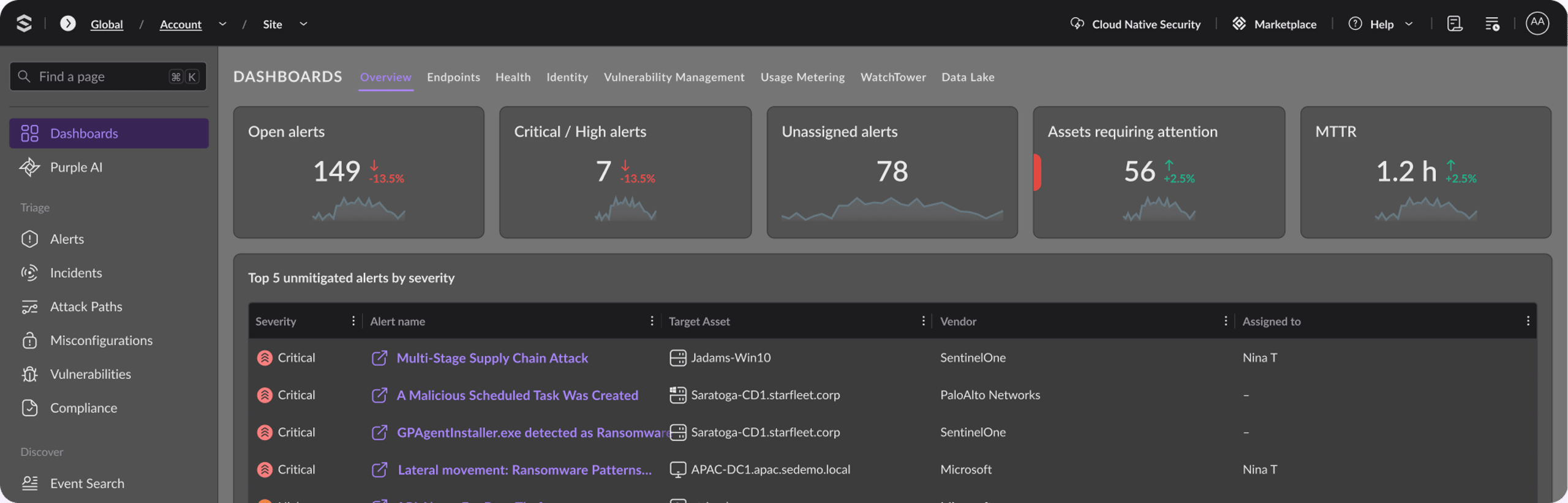
SentinelOne's Singularity™ Platform is powered by Autonomous Security Intelligence (ASI) — the intelligence fabric built into the foundation of the platform that identifies malicious behavior, automates critical work, and responds to threats at machine speed. It is built for threats that do not respect the boundary between network security and cybersecurity, giving security teams unified protection across endpoints, cloud workloads, identities, and the network layer from a single platform.
Singularity™ Network Discovery continuously maps your network by making use of deployed agents across your managed devices. It actively and passively discovers all IP-enabled devices, whether they are unmanaged endpoints, IoT devices, and even shadow IT that connects to your network but has no security agent on it. Once an unknown device tries to gain entry on your sensitive network segment, you can stop it from communicating with your managed assets with just one click. With Network Discovery, you get network visibility capabilities that a regular network management system offers, without deploying additional hardware or appliances.
Singularity XDR monitors machine-level operations at machine speed to detect lateral movement at the intersection of network and endpoint security. It builds execution context using behavioral AI and flags anomalous use of remote desktop protocols, credential-harvesting tools, SMB exploits, and other techniques attackers use to move across subnets once they are inside a perimeter. These are largely fileless attacks that network-layer controls will not catch because they look like normal traffic from a packet inspection standpoint.
On the broader cybersecurity side, Singularity™ Endpoint helps you secure endpoints on Windows, macOS, and Linux, cloud workloads on VMs, containers, and Kubernetes clusters. SentinelOne also has identity threat detection through Singularity™ Identity.
In early 2026, SentinelOne expanded Singularity Identity to cover non-human identities — including AI agents, service accounts, and APIs — which attackers increasingly exploit for lateral movement and data exfiltration that traditional identity management tools do not detect.
Using Purple AI, you can easily conduct natural language searches on all events across the entire Singularity Data Lake and collect telemetry from endpoints, cloud, and identity into a single query. Two anomalies occurring across the network and endpoint that seem unrelated at first glance can be correlated and linked to a single threat actor by running one natural language query through the Purple AI interface.
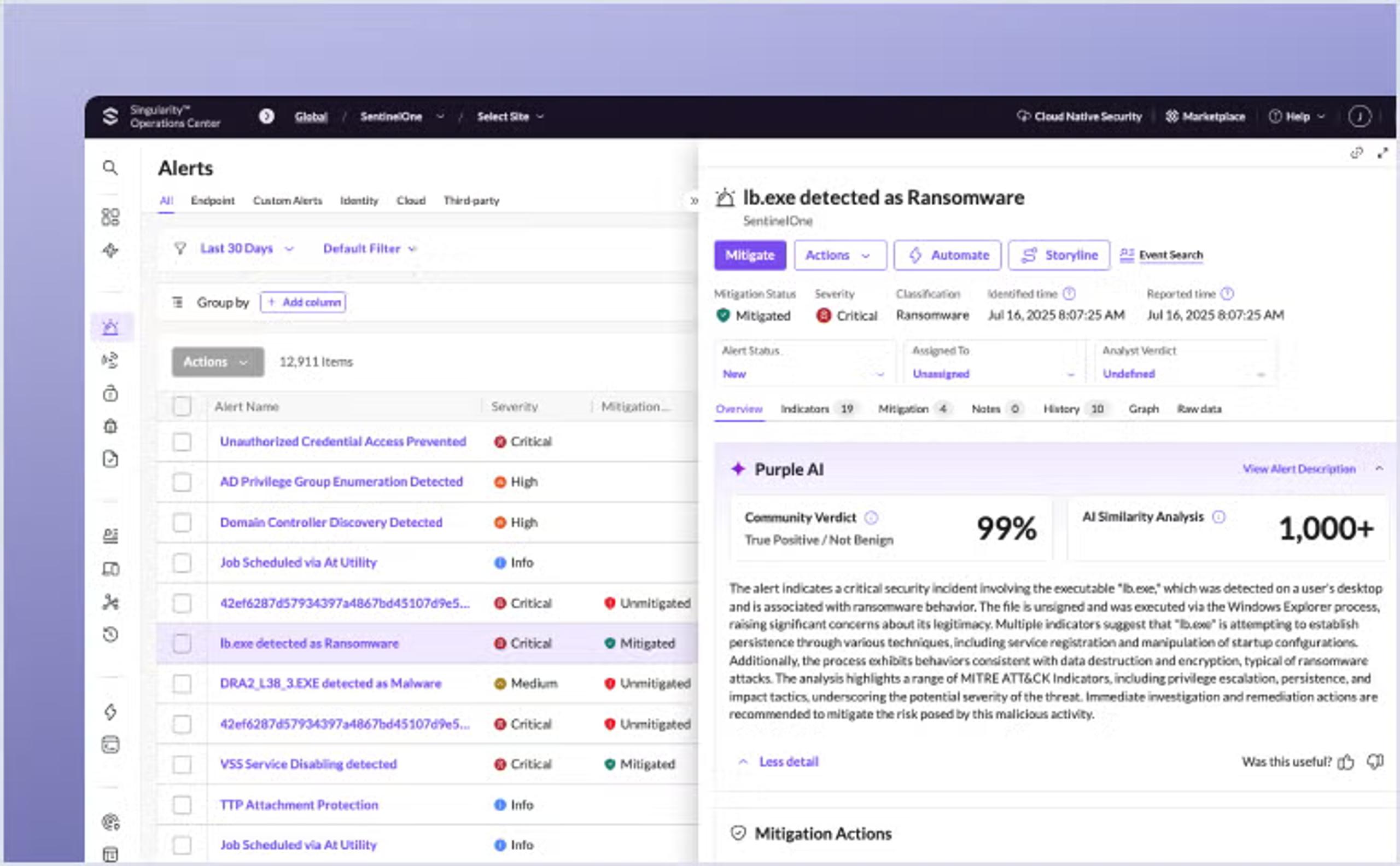
AI-powered endpoint detection and response.
Conclusion
Treating cybersecurity and network security as separate programs with separate budgets creates exactly the gaps attackers exploit. Threats don't stop at the network edge — they move through it, across endpoints, and into identities. Covering only one layer leaves the others exposed.
SentinelOne's Singularity Platform is built to close those gaps, giving security teams unified protection and visibility across network, endpoint, cloud, and identity from a single platform. Book a live demo to see how it works together.
FAQs
Yes, network security is a subset of cybersecurity. Cybersecurity covers protecting all digital systems and data, while network security focuses on the pathways data travels and the devices connecting them. Think of network security as locking down the roads, but cybersecurity also locks the buildings and the people inside. If you only invest in network security, you’re leaving endpoints and cloud services without enough protection. A good security plan needs both.
It depends on your risks. If you have no foundational network perimeter controls, start there. Network security can block many threats before they hit devices. However, with remote work and cloud apps, endpoint security and identity protection are just as urgent. A good approach is to start with network security and quickly add endpoint and identity layers. If you have to pick one, secure the network first, then expand.
Firewalls are a network security tool, but they’re a core part of any cybersecurity program. They control incoming and outgoing traffic based on rules. You can place them at network boundaries and on hosts. Without them, your network has no gatekeeper, so you should deploy them early. Next-generation firewalls add application awareness and intrusion prevention, making them blend into broader cybersecurity protections.
Cloud and zero trust change network security by removing the idea of a trusted internal network. You verify every access request, no matter the source. Network security shifts to micro-segmentation, identity-based rules, and securing cloud-to-cloud traffic. Data flows often never touch your on-premises network. You can’t rely on firewalls alone anymore. Traditional perimeter defenses aren’t enough; you should implement zero trust network access and monitor traffic continuously.
Network engineers already understand traffic flows, protocols, and firewalls. Build on that with security fundamentals: risk assessment, incident response, and identity management. Learn about endpoint detection, cloud security, and threat intelligence. Certifications like Security+ or CISSP give you a good edge. Your hands-on troubleshooting skills help you adapt fast. Start by taking on security tasks in your current role, and you’ll move smoothly into cybersecurity.
Discover More About Cybersecurity



Experience the Most Advanced Cybersecurity Platform
See how the world’s most intelligent, autonomous cybersecurity platform can protect your organization today and into the future.