11 Best AI Cybersecurity Tools for Enterprises in 2026
Learn how enterprises are adopting AI cybersecurity tools into their workflows without getting compromised in the process. Explore the top AI cybersecurity tools used by modern corporations.

Introduction
Reynolds has showcased how it's using AI in cybersecurity and how AI cybersecurity tools are being increasingly integrated into dealership operations.
During the 2-day event, executives shared their insights and showed how it soft-launched its AI cybersecurity assistant, with their tool currently being tested on a pilot basis in the USA. Users typed in simple questions and got feedback from the tool naturally.
IBM has also recently announced how it's adding new AI cybersecurity products to its portfolio to automate defenses when dealing with the latest cyber threats. All these developments speak volumes; they highlight how major companies are speeding up their efforts to apply generative AI to threat detection, defensive ops, and vulnerability discovery.
If you haven't adopted any AI cybersecurity tools yet into your workflows, then this is your chance to get started. There are many tools in the market. We get that.
Which is why we've done a lot of research and made a list of the best ones for you. Keep reading to learn more about them below.
.jpg?width=2560&quality=90&format=auto)
The Need for AI Cybersecurity Tools
There never seems to be an end to the attacks. This year alone, ransomware is estimated to cost companies $74 billion. Phishing attacks that use AI are 54% more likely to succeed than those before because the lack of obvious grammatical errors and typos in the email no longer makes them stand out. An organization is hit by an attack every two seconds. It's time to stop worrying about the potential dangers. The threats are already here. Boards are asking tough questions and CISOs can no longer afford to stay silent about security investments.
It's nothing to do with the lack of knowledge about the growing threats. It's about how quickly companies must respond to them. Analysts working alone simply cannot process the data fast enough. According to the World Economic Forum, 94% of cybersecurity executives believe AI is the single greatest driving force behind changes within cybersecurity operations.
Companies that use AI for protection are detecting breaches 80 days quicker, saving almost $1.9 million for each event in comparison to organizations that don't.
Best AI Cybersecurity Tools in 2026
Here is a list of the best AI cybersecurity tools in 2026.
1. SentinelOne
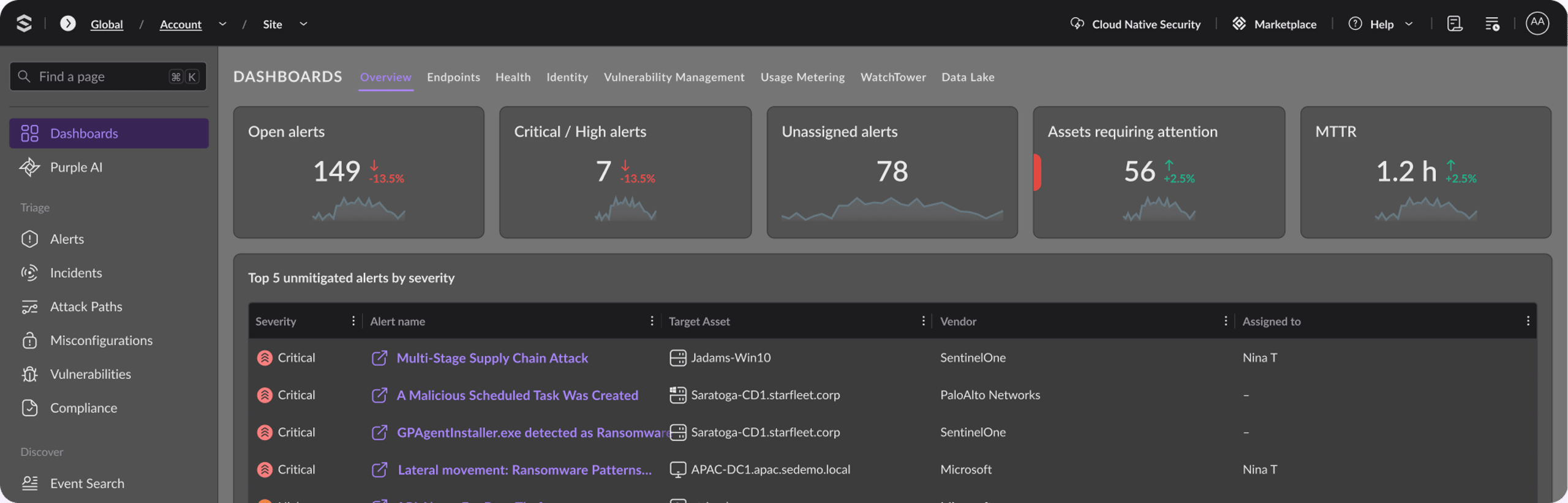
SentinelOne is one of the best AI cybersecurity tools on the market. Unlike traditional security legacy vendors that rely on retrofitted machine learning or rigid signature databases, SentinelOne was architected from the ground up as an AI-native solution. It is the best because of its autonomous, machine-speed defense, achieving 100% detection rates with zero delays in the MITRE ATT&CK Enterprise Evaluations and maintaining a multi-year streak as a Leader in the Gartner Magic Quadrant.

AI-Powered Cybersecurity
Elevate your security posture with real-time detection, machine-speed response, and total visibility of your entire digital environment.
Platform at a Glance
- Singularity™ Endpoint: Autonomous Extended Detection and Response (XDR) covering laptops, desktops, servers, and mobile devices across Windows, macOS, and Linux ecosystems. It can detect ransomware with behavioral and static AI models that analyze anomalous behavior and identify malicious patterns in real time without human intervention.
- Singularity™ XDR: The Singularity™ XDR Platform extends endpoint protection for your enterprise. XDR AI gives you broader visibility and builds up the right foundation for enterprise-wide security. You get more coverage, plus native and open protection
- Singularity™ Cloud Security: This is SentinelOne’s agentless CNAPP. It’s great for its AI Security Posture Management (AI-SPM) capabilities and takes care of compliance. You can use it to secure your cloud workloads, Kubernetes environments, and it also offers a blend of Cloud Detection Response (CDR), vulnerability management, and Cloud Security Posture Management (CSPM).
CNAPP Buyer’s Guide
Learn everything you need to know about finding the right Cloud-Native Application Protection Platform for your organization.
- Singularity™ Identity: Singularity™ Identity prevents credential misuse, stops active directory attacks, and blocks adversaries from moving laterally through your corporate networks. It can find unused, inactive, and dormant accounts, and remove them. Take the tour here.
- Singularity™ AI SIEM: it ingests security and IT log data from third-party sources at speeds up to 100x faster than traditional SIEM software to build a central command center. AI SIEM is meant for the autonomous SOC and grants you limitless scalability and endless data retention. It’s great for speeding up your security workflows with Hyperautomation and gives greater visibility into investigations and detections with the industry’s only unified console experience.
- Prompt Security: Secure your AI workflows, home grown AI applications and agents without slowing down productivity or compromising performance. It prevents uncontrolled AI usage (like shadow AI and AI sprawl), protects against prompt injections, jailbreaks, unsafe LLM outputs, and more. It adds AI security and protects against compliance risks that legacy tools can't stop. You can safely scale your AI adoption and usage also without triggering complex regulatory, audit, and enterprise policy pressures with it.
Key Features
- On-Device Behavioral AI: It's a lightweight local engine that can autonomously monitor process execution, system calls, and memory usage in real-time. It doesn't need constant cloud connectivity or any predefined threat signatures to detect and stop zero-days, ransomware, and fileless attacks. It can also track relationships between files and network activities.
- Patented Storyline™ Technology: This technology automatically tracks and stitches all the events occurring on the operating system to create one visual timeline that analysts can review to understand security as a whole. They don’t have to spend hours sifting through logs to figure out how cyberattackers breached networks.
- One-Click Automated Rollback: If any attack or breach does happen, 1-click rollback can automatically restore your system defaults back to their pre-infected states, thus reversing any unauthorized malicious changes.
- Purple AI Security Analyst: This gen AI security analyst allows security analysts to type in natural language questions about networks, system process, and anything else. The AI can execute threat analyses and present results as an easy-to-read timeline for the analyst.
- AI Guardrails: This feature protects organizations that use LLM models It can automatically identify and block any attempts to perform jailbreaks on the AI models, redact any employee information from security prompts, and automatically track and block shadow AI usage within corporate networks.
- Defend Against Ransoms: Don’t cave into demands ever again. Protect mobile devices from zero-day malware, phishing, and man-in-the-middle (MITM) attacks. Get critical endpoint and identity alerts with real-time visibility from system-level to identity-based attacks.
Core Problems SentinelOne Solves
- Most security operations today are fragmented across multiple tools. SentinelOne brings all your security data from endpoints, identities, networks, and cloud clouds into a single source of truth.
- Binary Vault automates the upload of both malicious and benign files into your security environment. Furthermore, it performs forensic analysis on those files and integrates security tools into your environment. You have the ability to fine tune this process with user definable exclusions.
- The Offensive Security Engine™ with Verified Exploit Paths™ allows SentinelOne to identify potential attacks that may occur within your network before they take place. This tool allows your organization to probe its systems, simulate attacks upon its infrastructure, and gain a holistic overview of its security measures from the perspective of its adversaries.
- Most security teams waste thousands of hours a year inspecting the events and activities within their networks that may be the result of false flags. SentinelOne’s behavioral context engine allows your team to filter out this background noise and focus on the relevant information. This process reduces false positive alerts by 88%.
- While human analysts may take hours or days to contain a zero-day exploit or ransomware thread, SentinelOne’s AI cybersecurity tools can detect and isolate system threats at machine speed.
- Recruiting elite tier-3 security analysts is difficult. However, with Purple’s AI systems and automation tools, IT personnel of any seniority can perform digital forensics investigations and remediate threats.
Testimonial
“SentinelOne made a big difference in how we tackle threats. We didn't know there were so many unknown and hidden threats that suddenly surfaced. Purple AI made it very easy to scope through our assets and all kinds of resources. We especially liked Sentinel-1's endpoint protection and its one-click rollback feature. Overall, there were even things it included we didn't anticipate. So we highly recommend it for holistic cybersecurity. If you're looking for the best AI cybersecurity tool in the market, this would be it.”
-Security Analyst, Gartner Peer Insights
Reviews and Ratings
Look at Singularity™ Platform's ratings and reviews on Gartner Peer Insights and PeerSpot for additional insights.
2. Wiz
Wiz connects to your cloud environments and performs security scanning of your workloads. It builds a Security Graph of your environment to show you the attack paths that could exploit your cloud environment. Wiz also offers AI Security Posture Management (AI-SPM) to scan for vulnerabilities in AI workloads within the cloud.
Features:
- Wiz’s Security Graph takes a holistic view of security by correlating all vulnerabilities, misconfigurations, network exposures, and secrets into visual attack graphs that allow engineering teams to see which vulnerabilities create the most exploitation risks.
- Cloud Infrastructure Entitlement Management helps organizations by identifying overly permissive roles and service accounts in the cloud that could be exploited by attackers with such extensive privileges.
- Container security companies scan container images both in container registries and in running container clusters for vulnerabilities and misconfigurations.
- Wiz Code allows engineering teams to scan infrastructure-as-code templates and container images before they are deployed into production environments.
- Data Security Posture Management tools identify all sensitive data in the organization’s cloud buckets and databases, who has access to it, and the risks created by those access privileges.
Look at Wiz's ratings and reviews on G2 and PeerSpot for more context.
3. Cycode
Cycode is an agentic development security tool that covers the entire SDLC - from code to runtime. Combining application security testing (AST), application security posture management (ASPM) and supply chain security in one tool, powered by the Context Intelligence Graph, Cycode enables security and development teams to gain visibility into the threats facing their applications from code to runtime.
Features:
- Native scanners include support for SAST, SCA, IaC, secrets detection, container security and CI/CD hardening - all within one scanner interface.
- AI Exploitability Agent investigates the various vulnerabilities within AI-generated and human-written code and can suggest fixes and automations to remediate those vulnerabilities.
- The Context Intelligence Graph (Risk Intelligence Graph) correlates various findings from the code, CI/CD, runtime and security posture of the applications to reveal the various attack paths for those applications.
- Shadow AI discovers AI and machine learning assets throughout the SDLC including third-party AI tools and assistants.
- Agentic security controls allow control over AI model access, policies on AI-generated code and exposure from vibe coding environments.
See what users have to say about Cycode's ratings and reviews on PeerSpot for more context.
4. Snyk
Snyk is an application security tool for identifying and resolving vulnerabilities within code, third-party open source components, container images, and infrastructure as code. Snyk’s AI cybersecurity tool was announced last year and uses agentic artificial intelligence technology throughout the development cycle in order to manage the risks associated with AI code generation. Snyk works with teams that ship products rapidly and requires security to match their pace.
Features:
- Snyk Assist is a chat-based security bot that answers security questions, recommends follow-up steps, and gives instructions on how to handle a particular piece of code.
- Snyk Agent streamlines security testing, finding vulnerabilities, and producing fixes for various security scans such as static application security testing (SAST), software composition analysis (SCA), containers, and infrastructure as code (IaC).
- Snyk Studio secures AI programming environments including Cursor, Devin, and Windsurf by integrating security tests into the pipeline for creating agentic code.
- Software composition analysis (SCA) helps find vulnerabilities in open-source software, license violations, and malicious third-party packages using reachability analysis.
- Security governance gives the ability to control who gets access to software and establish rules and exception management for software.
Review Snyk's ratings and compare with others on PeerSpot for more info.
5. Semgrep
Semgrep is an AI cybersecurity tool that supports SAST, SCA, and secrets scanning by combining pattern matching with AI-based reasoning. It is designed specifically to avoid high false positives, which is usually the reason why static analysis tools fail. Semgrep Assistant makes use of AI to analyze vulnerabilities, learns from previous decisions made by each team, and helps developers address vulnerabilities.
Features:
- Semgrep Code performs source code analysis through a combination of rule-based detection and machine learning to discover OWASP-related vulnerabilities, business logic flaws, and authorizations that may go undetected using rules.
- Semgrep Supply Chain analyses dependencies with reachability, which ensures that organizations pay attention to only vulnerabilities that could impact their specific codebase.
- Semgrep Secrets detects hardcoded passwords and API keys with a combination of semantic and entropy-based approaches before they get released into production environments, including automatically blocking merges that contain any such information.
- The Semgrep Assistant reduces up to 60% of false positives, learns from how your organization addresses the findings from prior scans, and recommends remediation steps based on findings.
- With Semgrep Managed Scans, security organizations perform automated SAST, software composition analysis (SCA), and secret scans of enterprise code without having to set up complex infrastructure in a matter of days.
Look at Semgrep's ratings and reviews on PeerSpot for additional insights.
6. Veracode
Veracode is an application security tool that helps development and security teams test, manage, and reduce code-level vulnerabilities across the software development lifecycle. It covers static analysis, software composition analysis, dynamic testing, and manual penetration testing, with a growing set of AI-assisted features for fixing and triaging findings faster.
Features:
- SAST checks applications for vulnerabilities using binary and bytecode scanning, making it unnecessary for organizations to provide the codebase to the solution.
- DAST performs runtime analysis of applications to identify vulnerabilities such as injection and broken authentication, both of which cannot be found through static analysis of code.
- SCA discovers the use of open-source components within an organization, provides information on any known vulnerabilities in such components, and highlights licensing concerns.
- Veracode Fix uses AI to automatically develop code fixes for identified vulnerabilities within the Integrated Development Environment (IDE).
- ASPM enables organizations to obtain a unified overview of all risks related to their application portfolios.
See how Veracode performs in the industry on PeerSpot for more details.
7. Black Duck
Black Duck is a software supply chain security tool for enterprises. Black Duck is an AN cybersecurity tool that identifies security vulnerabilities in third-party and open-source software during the SDLC.
Features:
- Software composition analysis (SCA) tools will scan the software product for open-source components and identify any associated CVEs.
- License compliance management tools will identify the open-source licenses used in the software product and notify the organization of any licenses that may pose a legal or intellectual property risk.
- Binary analysis tools scan compiled software binaries or containers for open-source components that were compiled into the software without access to the source code.
- Supply chain risk management tools identify if any malicious packages or attacks (like dependency confusion attacks) were used to build the software product.
- CI/CD integration allows teams to automatically perform open-source vulnerability scans as part of the build process for the software product.
View Black Duck's ratings and reviews on PeerSpot to see how it’s evaluated.
8. Endor Labs
Endor Labs is a software supply chain security tool that focuses on managing its dependencies. Endor Labs provides reachability analysis, dependency analysis, and AI to assist organizations with focusing on the exploitable risks rather than all of the reported risks for their open source software. Their tool also covers AI code and pipeline security.
Features:
- Reachability analysis determines if the vulnerable function in the dependency is being called by your code to reduce the number of CVEs to focus on.
- Dependency usage tracking goes a step beyond identifying which dependencies are in your project to identifying how they are being used to make better decisions about dependency upgrading.
- AI code security scans help identify security issues in AI-generated and vibe code that may be introduced by the various packages used by AI coding assistants.
- SBOM (software bill of materials) generation produces an inventory of all dependencies and transitive packages, useful for compliance reporting and vulnerability response.
- Pipeline security monitors CI/CD pipelines for misconfigurations, exposed secrets, and tampering risks that attackers could exploit to compromise build artifacts.
Check Endor Labs' ratings and reviews on G2 for additional insights.
9. SonarQube
SonarQube is a code quality and security tool from Sonar that scans source code for bugs, vulnerabilities, and code smells across dozens of programming languages. It integrates into CI/CD pipelines and developer IDEs, giving teams continuous feedback on code quality and security as they build. Security and engineering teams use it to enforce coding standards and reduce technical debt over time.
Features:
- Static code analysis runs across 30+ programming languages and detects vulnerabilities including injection flaws, weak cryptography, and common OWASP Top 10 issues in first-party code.
- AI-assisted code review via Sonar AI Code Assurance tracks whether AI-generated code passes security and quality gates, giving teams a record of which AI-produced code has been reviewed and cleared.
- Quality gates let teams define pass/fail conditions based on metrics like coverage, duplications, and vulnerability counts, blocking code that doesn't meet the defined standard from merging.
- IDE plugins (SonarLint) give developers real-time feedback on security and quality issues as they write code, before anything reaches the CI pipeline.
- Pull request decoration posts analysis results directly inside GitHub, GitLab, Bitbucket, and Azure DevOps pull requests so developers see issues in context.
See how SonarQube performs as an AI cybersecurity tool on G2 for more info.
10. Prisma AIRS
Prisma AIRS (AI Runtime Security) is Palo Alto Networks' security tool built specifically to protect enterprise AI systems throughout their lifecycle. It covers AI apps, AI agents, AI models, and AI data and addresses both traditional and AI-specific threats. Prisma AIRS 2.0 added deep model inspection, autonomous AI red teaming, and agent defense capabilities.
Features:
- AI Runtime Firewall inspects and filters interactions between users, AI agents, and LLMs in real time, blocking prompt injections, jailbreak attempts, and unsafe model outputs before they have any impact.
- AI Model Security scans open-source and custom AI models for architectural backdoors, data poisoning, malicious embedded code, and known vulnerabilities in model dependencies.
- Autonomous AI Red Teaming continuously tests AI apps and agents by simulating real adversary behavior, finding weaknesses that periodic manual assessments would miss.
- AI Agent Security tracks the behavior, tool access, and data interactions of autonomous agents in production, flagging unauthorized actions or policy violations as they happen.
- AI Security Posture Management gives teams a centralized inventory of all AI apps, agents, and models in their environment with continuous posture assessment and compliance monitoring.
See how Prisma AIRS works and how good it is as an AI cybersecurity tool on PeerSpot.
11. Vectra AI
Vectra AI is a network detection and response (NDR) tool that monitors traffic across data center, cloud, identity, and SaaS environments to surface threats that endpoint tools can't see. It uses behavioral AI to detect lateral movement, privilege abuse, and command-and-control activity, then prioritizes the findings that matter most to cut analyst time spent chasing noise.
Features:
- Vectra correlates detected threats across all network, identity, and cloud levels to identify the most critical events rather than providing thousands of low-priority alerts.
- Vectra AI does not require agents but uses existing network traffic and metadata received from cloud APIs instead.
- Automated containment allows Vectra's clients to isolate compromised identities and prevent the creation of malicious connections both manually or by integrating with other security tools.
- Hybrid environment protection includes on-premises data centers, cloud providers (AWS, Azure, GCP) as well as Microsoft 365 and OT/IoT.
- Privileged Access Abuse detection with the use of AI allows identifying when compromised or overprivileged users are using their credentials and accessing other systems.
Read Vectra AI's ratings and reviews to get ideas on what it can do as an AI cybersecurity tool on G2 and PeerSpot.
How to Pick the Best AI Cybersecurity Tools?
Not every AI security tool works for every team or budget. Here's what to actually look at before you sign anything.
- Find a solution that fits your actual threat landscape, not an off-the-shelf list. An organization focused on development requires robust application security solutions, a hospital needs protection of endpoints and its data. You should understand what you have to protect before selecting security tools.
- Compare detection precision and frequency of false positives. A product that will overwhelm your employees with alerts does not bring value. Demand reliable benchmark numbers from the vendor instead of relying on demo scenarios and fancy slides.
- Define the pricing model before getting impressed by the demo. Security software based on AI technology can be licensed on a per-seat basis, per-endpoint basis, on a per-ingested-gigabyte basis, or even per-API-call. While the product may seem cheap when used on a 500-seat environment, prices for larger organizations may become prohibitive.
- Evaluate connectivity capabilities of the product. The solution should easily integrate with your existing security infrastructure and connect with systems such as SIEM or your ticketing platform. Don't trust only what is listed on the vendor's website; ask them for technical information.
- Check how long it takes for you to deploy it from purchase to operational use. Some of these tools may take weeks for deployment while others only hours. This is important especially if you are dealing with limited manpower at this stage of development.
- Determine whether the tool detects rogue AI applications. Your employees may already be using AI technologies without having obtained permission from management. Can the tool detect and raise alerts on the use of these unapproved software within your organization? Most companies suffer from this blind spot without realizing it.
- Cross-check whether it matches your requirements in terms of compliance standards. Compliance with AI Act under EU will begin in August 2026. There are other compliance regulations like HIPAA, SOC 2, GDPR, and NY DFS Part 500. Will the tool help or create further burden in terms of audits?
- Ask whether the technology can explain AI decisions. When an alert is raised or an item blocked by the system, can it provide a clear explanation of what happened? Without one, expect serious trouble when regulators ask.
- Be honest about who's actually going to run this day to day. Some tools need a seasoned analyst to get real value out of them. Others are built so junior staff can triage and respond right away. Be clear on your team's actual capacity before you buy.
- Find out from the provider how responsive he/she is before making any commitment. How do you think he will react in case there is a problem at midnight? Is the vendor responsive, and available 24/7? You will never know until you ask.
Conclusion
So now you know how AI cybersecurity tools work, which are the best ones and what they offer. Hopefully, our guide will have given you plenty of options to consider. Take your time to explore them, see which ones fit your business use case, and then pick the right tool for your right need accordingly.
You can even combine some of these tools, but that might stretch your budget a little thin. So try out the trial versions or demos for free. Test them out and see which works best for your enterprise.
If you need assistance in building an AI cybersecurity strategy for your organization, then feel free to get in touch with the SentinelOne team. We are happy to help.
FAQs
Older security tools mostly work off known signatures and fixed rules. They're good at catching what they've already seen before. AI security tools look at behavior instead — how a file acts, how a user is moving through a network, what's normal vs. what isn't. That means they can flag things that've never been seen before: new malware, zero-day exploits, attacks that don't match any known pattern. The trade-off is that AI tools need some time to learn what "normal" looks like in your environment. But once they're calibrated, they're significantly harder to fool than rule-based systems.
No. But they change what the team actually does. Right now, analysts spend a huge chunk of their time chasing alerts that turn out to be nothing — benign events that looked suspicious on the surface. AI tools handle most of that first-pass filtering. Your human analysts end up spending less time on noise and more time on threats that need real judgment calls. Junior staff can handle things they normally couldn't. That said, someone still has to own the decisions. The AI flags. You act. And if something goes wrong, the liability still sits with you — not the vendor.
Depends on what you pick. Some AI security tools are priced and packaged for large enterprises with full security teams. Others are built with smaller orgs in mind - lighter setups, managed options, and more accessible per-seat pricing. A few have free tiers worth checking out before you commit. The better question to ask yourself is: can you afford what a breach costs without one? For SMBs, a single data breach can easily run into the hundreds of thousands of dollars - and most don't fully bounce back from it.
It's a fair concern that usually gets buried in sales calls. These tools need access to your logs, network traffic, endpoint activity, and sometimes user behavior data to do anything useful. Some process all of that in the cloud. Some keep everything on-prem. Some do both. The thing is, you're giving a third-party system deep read access to your environment. So before you sign anything, ask specifically: where does my data go, who can see it, and how long is it stored? Ask if they've gone through independent audits. And if you're in healthcare, finance, or covered by GDPR or other regional laws, data residency rules aren't optional. Get that in writing.
Most orgs genuinely can't answer this clearly. Here's what to look at: mean time to detect (MTTD), mean time to respond (MTTR), and how many false positives your team is handling week over week. If those numbers are dropping, something is working. Also pay attention to coverage gaps — are there parts of your environment the tool has no visibility into? And check whether the tool can actually explain why it made a decision. A black box that gives no reasoning isn't auditable. That becomes a real problem when a regulator or your board starts asking questions. Ask vendors for a 90-day performance review clause before your contract renews.
Yes, and most people don't think about this until it's too late. AI models can be hit with prompt injection - where attackers feed crafted inputs to manipulate what the AI does or reports back. They can also be targeted with adversarial data, where subtle changes to inputs trick the model into misclassifying something malicious as safe. Some attacks go after the training data the model originally learned from. None of this means AI security tools aren't worth using. It means you can't treat them as infallible. Any tool you're seriously considering should have documented protections against these attack classes. Ask the vendor about adversarial robustness directly - if they can't answer that clearly, that tells you something.
Discover More About Cybersecurity



Experience the Most Advanced Cybersecurity Platform
See how the world’s most intelligent, autonomous cybersecurity platform can protect your organization today and into the future.