DDoS Attack vs DoS Attack: Key Differences Explained
DoS vs DDoS attacks both aim to take you offline, but they differ in origin, speed and scale. Learn how DDoS attack vs DoS attack patterns compare and what defenses enterprises need in 2026.

TL;DR
- DoS is a system-on-system attack, which means an attack comes from a single source. DDoS involves several systems, meaning that the attack comes from multiple sources.
- In DoS, the attacker will flood the target will excessive traffic and exploit vulnerabilities to cause service disruptions. In DDoS, the attacker will distribute his attack on a wider scale and launch it across different geographic locations.
- DDoS attacks are much more powerful than DoS and a lot more complex as well. Every DDoS is a DoS, but not every DoS attack is a DDoS. DDoS attackers use botnets to amplify the power of DoS attacks.
- Simple DoS attacks can just bust DNS servers but DDoS uses brute force so you can't guard against them with mere encryption or input validation.
Ubuntu recently hit an outage after a DDoS attack. The public-facing infrastructure was completely taken down. Bluesky also blamed DDoS attacks for server outages. And it's not just these big companies, even startups and small businesses are struggling around the world to ensure business continuity. Clients lose respect and they steer clear once reputation takes a hit and services go offline. There is a right and wrong way to go about mitigating these threats. DDoS also has many similarities to DoS attacks and those are new to this space can get confused between these two methodologies.
If you don't know the difference between DoS vs. DDoS attacks, then this guide is for you. We even go over their legal complications and everything else you need to know about them.
What is a DoS attack?
A Denial-of-Service (DoS) attack is a cyber assault that's done to make your machine, network, or website unavailable to your users. It will overwhelm you with excessive traffic, requests, and cause your site and systems to slow down, crash, and fail to respond.
Here are the main types of DoS attacks you should be aware of.
.jpg?width=2560&quality=90&format=auto)
Types of DoS Attacks
A DoS attack always originates from a single system. That single source saturates a target with malicious traffic or exploits a protocol weakness until the service stops responding. Attackers use a handful of techniques to pull this off. You will most often see these four.
Teardrop Attacks
Teardrop attacks fragment IP packets and then send overlapping, malformed fragments that the target cannot reassemble. Older operating systems crash or reboot when they encounter these packets. Modern systems typically reject them, but unprotected legacy servers inside a network still make attractive targets.
Flooding Attacks
Flooding attacks direct a high volume of traffic at a server, network link, or application. Attackers can use ICMP echo requests (ping flood), UDP packets, or HTTP requests. The traffic consumes all available bandwidth or server resources. A single machine sending sustained HTTP GET requests can exhaust a poorly configured web server within minutes.
IP Fragmentation Attacks
These attacks exploit how network devices reassemble fragmented IP packets. The attacker sends fragments that hold overlapping offsets or incomplete sequences. Routers and firewalls that buffer fragments to reassemble them run out of memory and block legitimate traffic. Fragmentation attacks often bypass packet inspection because inspection engines see only partial data.
SYN Floods
A SYN flood abuses the TCP three-way handshake. The attacker sends a stream of SYN packets, often with spoofed source IP addresses. The target allocates resources for each half-open connection and waits for an ACK that never arrives. When the connection table fills, the server denies all new requests. SYN floods remain one of the most common single-source DoS techniques. Attackers also lean on ping of death and application-layer DoS, where they misuse a web application’s resource-heavy functions to kill availability from a single endpoint.
What is a DDoS attack?
A Distributed Denial-of-Service (DDoS) attack takes the same goal as a DoS and multiplies it across hundreds or thousands of compromised systems. Attackers build botnets by infecting devices with malware and using them as traffic agents. They also amplify traffic by bouncing requests off misconfigured DNS, NTP, or Memcached servers. Reflectors and amplifiers let a small request produce a much larger response aimed at the victim.
Multi-source traffic makes detection and mitigation harder. When traffic enters your network from a single IP, you block it. When it arrives from 50,000 residential IPs and spoofed addresses worldwide, signature-based filters and simple rate limits fail.
Types of DDoS Attacks
DDoS attacks target different layers of your infrastructure and are highly scalable. Below are the different types of DDoS attacks you should know about:
Application Layer DDoS Attacks
Application layer attacks target Layer 7. Attackers send slow HTTP POST requests, resource-intensive API calls, or HTTP floods that mimic legitimate user behavior. Because the requests look valid, these attacks slip past simple volumetric thresholds. A single server handling login attempts can appear busy, not under attack.
Volumetric Attacks
Volumetric attacks aim to consume all available bandwidth. Attackers use botnets to push massive amounts of UDP traffic, ICMP floods, or amplified DNS responses toward your network edge. If your pipe fills, legitimate packets drop before they reach your data center. These attacks measure traffic in gigabits or terabits per second.
Protocol Attacks
Protocol attacks exploit weaknesses in Layers 3 and 4. SYN floods, Smurf attacks, and ping of death all fit here. Attackers consume server connection tables or overwhelm stateful firewalls and load balancers. Because protocol attacks target network infrastructure, you need to filter them upstream or with dedicated scrubbing appliances.
DDoS vs. DoS Attacks: Real World Examples
You’ll know the difference between DoS and DDoS attacks when you take a look at actual incidents. Let’s cover some recent and real-world examples of DoS and DDoS attacks below:
- Around early 2026, a 31.4 Tbps attack was publicly disclosed by the Aisuru-Kimwolf botnet. The super botnet had infected between 1 to 4 million devices. It targeted Android TVs, routers, and IoT cameras. Even major infrastructure providers like Cloudflare and others had hit peak rates of 205 million requests per second (rps).
- Q1 2026 showed us Operation Sindoor and Middle East conflicts happening. Geopolitical tensions had triggered state-aligned waves of DDoS attacks. Over 149 hacktivist DDoS attacks hit 110 companies across 16 countries in just 72 hours. Attackers used the carpet bombing strategy to go after financial institutions. A Middle Eastern financial institution received over 1.25 trillion requests over 6 days, all of which looked like legit traffic, thus bypassing their traditional filters.
- Low-intensity DoS attacks happen every 15 minutes these days. Last year, DoS attacks went up by 4x due to reconnaissance probing threats. Attackers used single VPN instances to launch SYN floods and targeted specific authentication and login endpoints. They exhausted server resources, caused authentication failures, and timed-out TLS handshakes for legit users. When AI is used for starting DDoS vs. DoS attacks, things become more complicated. These DDoS vs. DoS attack real-world examples are just the tip of the iceberg of what's in store for organizations in the near future (if they don't prepare themselves to defend against and mitigate them).
Key Differences Between DoS and DDoS Attacks
When you compare DDoS attack vs Dos attack patterns and angles side-by-side, four factors stand out: Here are the key differences between DoS vs. DDoS attacks:
Source distribution and traffic volume
DoS involves just one device or IP. With DDoS, however, attackers deploy bots, amplifiers, and reflectors to produce geographically dispersed traffic. While the volume in a DoS can go into gigabits per second, DDoS may involve multiple terabits.
Speed and impact
The effect of a DoS depends on how quickly services are degraded or whether the attack exploits any vulnerability, causing services to go down immediately. However, DDoS is capable of bringing down the service in mere minutes, depending on the sheer volume of requests that flood the systems instantly. DDoS also causes collateral damage to ISP networks, affecting other customers as well.
Traceability and legal handling
There is a single IP involved in DoS attacks, which can be spoofed but tracked by law enforcement. It is difficult to identify the command-and-control server in DDoS attacks. Finding the IP and then tracing back to the individual behind DDoS attacks is challenging because it requires cross-jurisdictional investigations and forensic analysis of many devices. Thus, the process takes more time and is more complicated than in the case of DoS attacks.
Mitigation tools and requirements
Preventing DoS involves blocking or dropping the attacker's IP or fixing bugs in the application. Preventing DDoS requires establishing scrubbing centers, using cloud-based traffic filtering tools, WAFs, and collaboration with the ISP. It also involves rerouting traffic through scrubbing scrubbing networks and forwarding only clean traffic.
DoS vs DDoS: Key Differences
Check out this Dos vs DDoS attack comparison table for a quick overview between DoS vs DDoS. It covers DDoS attack vs. DoS attack factors at a glance:
| Factor | DoS Attack | DDoS Attack | Example Scenario |
| Source | Single machine or IP | Botnet of thousands or reflected amplification | Mirai botnet vs. single Slowloris script |
| Traffic volume | Low to moderate (Mbps) | High (Gbps to Tbps) | Memcached amplification reaching 1.35 Tbps |
| Attack technique | SYN flood, ping of death, app layer exhaustion | SYN flood, UDP flood, HTTP flood, DNS amplification | Repeated login requests from one IP vs. multi-vector volumetric assault |
| Detection difficulty | Easier; one noisy IP stands out | Harder; distributed IPs resemble legitimate traffic patterns | Rate limiting one IP vs. tuning behavioral analytics across regions |
| Mitigation | Block IP, patch vulnerability, rate limit | Use scrubbing center, anycast distribution, upstream ISP filtering | Null-routing a single IP vs. redirecting all traffic through a cloud scrubbing service |
| Traceability | Often traceable to an individual | Obscured by botnets and spoofed addresses | Law enforcement subpoena for one ISP vs. multi-country investigation |
| Downtime potential | Minutes to hours if unmitigated | Hours to days if defenses are insufficient | A single server crash vs. global service outage |
Impact of DoS vs DDoS Attacks
Any downtime means loss of revenue. An e-commerce website down for an hour may lead to hundreds of thousands of dollars worth of lost revenue as well as SLA violations leading to mandatory credits. Such figures will go up from this year as companies rely more on their real-time digital services. Any downtime also affects public perception as well as invites legal trouble if customer data is indirectly harmed.
Apart from the financial consequences, a DoS or DDoS attack impacts all other services. Any large volumetric DDoS attack not only brings your primary internet link down but also cuts off any connections to your site via a VPN or cloud API services, rendering them useless. Your employees cannot access any internal applications and any automated monitoring system goes quiet. DDoS attacks act like a smokescreen to hide the real intrusions.
They distract and make it tough to restore networks. Hackers create chaos to scrape deeper and perform higher-level data breaches. They can end up installing malware and cause multi-region outages as well. All this leads to a long-term drop in customer trust. All corporate and critical infrastructures and services like government portals and banking services and apps get affected.
Best Practices to Prevent and Detect DoS and DDoS Attacks in 2026
Effective DDoS vs DoS mitigation starts with network architecture and continuous monitoring. You need controls that catch both single-source exploitation and distributed floods. Here is a list of the best practices to follow to prevent and detect both DoS and DDoS attacks this year:
- Deploy network-level rate limiting on routers and firewalls to cap connections from a single source.
- Use anycast network distribution so traffic is absorbed across multiple geographic points instead of hitting one origin server.
- Integrate a cloud scrubbing service that can process and filter traffic before it reaches your network edge.
- Place a web application firewall (WAF) in front of critical apps to filter malicious Layer 7 requests.
- Configure your CDN to absorb bursts and serve cached content when origin servers are under stress.
- Set baseline traffic patterns and use anomaly detection that flags sudden spikes in requests, unusual geographic distribution, or protocol mismatches.
- Harden DNS infrastructure with redundant, anycasted resolvers and enable response rate limiting.
- Run regular stress tests and red team exercises that simulate both DoS and multi-vector DDoS scenarios.
- Build playbooks that define when to fail over to scrubbing services and how to communicate with your ISP.
- Monitor endpoint and workload telemetry for signs of opportunistic intrusion during an active DDoS event, because attackers often use noise as cover.
How to Respond to Active DoS vs. DDoS Attacks
If you are not sure how to respond to active DoS vs. DDoS attacks, then our tips will help. Do these:
- Activate your incident response runbook and declare the severity level immediately.
- Contact your ISP or cloud provider and share traffic samples so they can begin upstream filtering.
- Divert inbound traffic through your scrubbing center or DDoS mitigation service if one is in place.
- For a single-source DoS, drop or blackhole the offending IP at your network edge.
- Preserve logs, flow data, and packet captures; these support post-incident forensics and law enforcement referrals.
- Notify internal stakeholders - SOC, networking, application owners, and communications; so they can prepare status updates or decide on the next course of action.
- If customer-facing services are impacted, publish a short, factual status page update with an estimated restoration time.
- Block obvious attack signatures with WAF rules or ACLs while you watch for changes in the attack vector.
- After the attack, gather the evidence chain and decide whether to file a report with law enforcement or national CERT.
- Conduct a post-incident review within 48 hours. Update runbooks, tighten rate limits, and adjust alert thresholds based on what you observe.
How SentinelOne Improves DoS and DDoS Resilience?
SentinelOne's Singularity Platform is powered by Autonomous Security Intelligence (ASI) — the intelligence fabric built into the foundation of the platform that identifies malicious behavior, automates critical work, and responds to threats at machine speed. Across endpoint, cloud, identity, and AI surfaces, ASI gives security teams the tools to detect and stop DoS and DDoS threats before they escalate. Singularity™ Endpoint includes built-in firewalls and intrusion prevention systems (IPS) that autonomously filter network traffic and proactively block DoS attack patterns such as port scans.
Singularity™ XDR Platform uses AI and machine learning to detect unusual behavior patterns at machine speed. It correlates telemetry from endpoints, identity data, and cloud visibility to identify which devices are behaving like botnet relay nodes and when.
If your attackers are using any AI tools to launch DDoS or DoS attacks, then Prompt Security can weed them out and prevent them from carrying out unauthorized agentic AI actions.
Singularity™ Network Discovery (formerly Ranger) can monitor network traffic and identify unauthorized or rogue devices that take part in distributed attacks. SentinelOne also integrates with third-party partners like Imperva to bring you specialized DDoS scrubbing and API protection for large-scale volumetric attacks.
For deeper investigation, Purple AI lets analysts ask natural language queries across their entire security stack — surfacing attack patterns, behavioral signals, and response workflows without needing to know complex query languages. According to IDC research, Purple AI helps organizations identify security threats 63% faster, reduce remediation time by up to 55%, and deliver up to 338% ROI over three years (IDC, July ‘25). It also gives teams the broadest visibility across their enterprise security stack with built-in threat hunting capabilities.
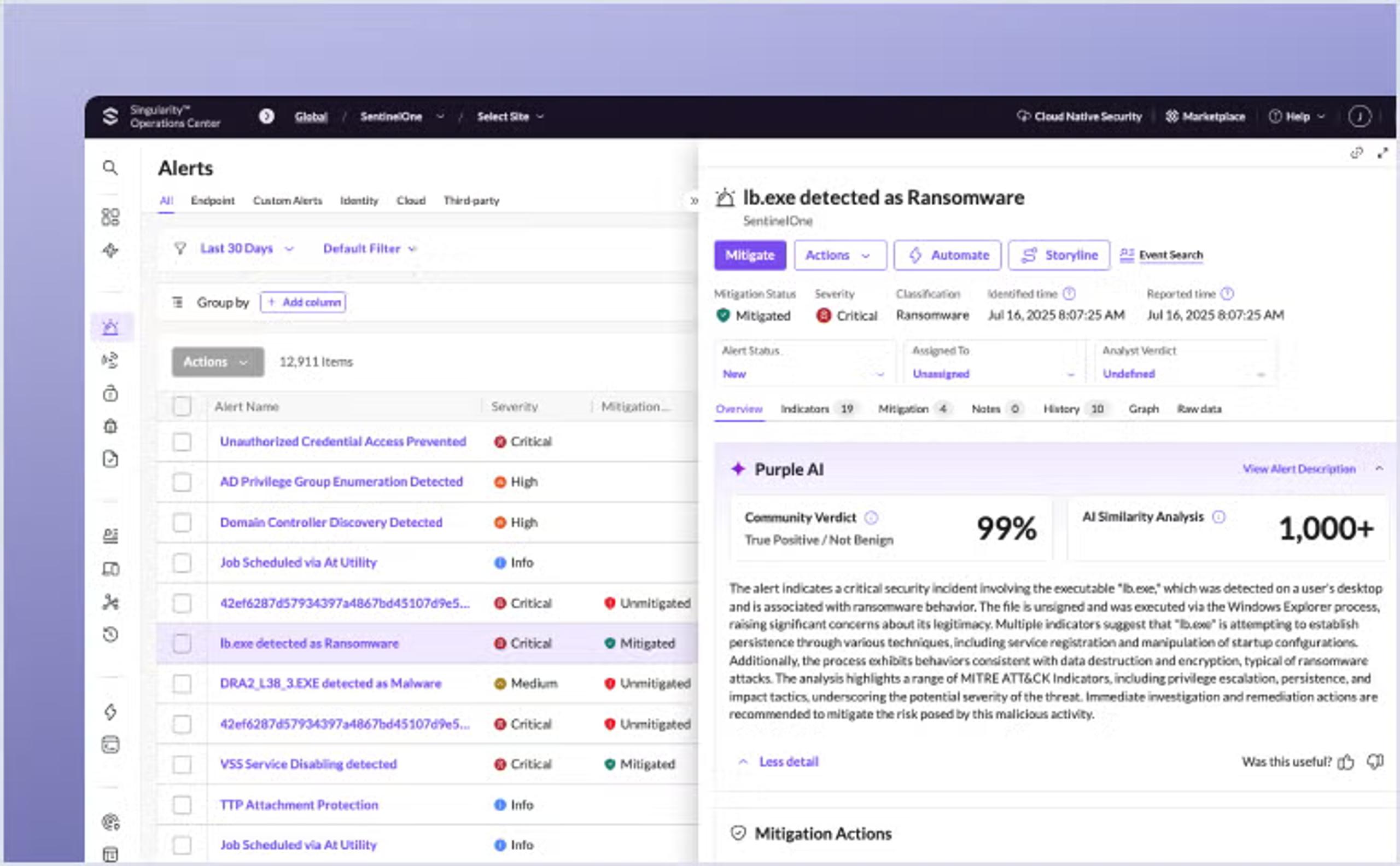
AI-powered endpoint detection and response.
Conclusion
DoS attacks originate from a single system while DDoS attacks use thousands of compromised devices, making them far more powerful and harder to trace. Stopping them requires defenses that operate faster than the attacks themselves — autonomous protection that spans network, endpoint, cloud, and identity without leaving gaps between tools. SentinelOne combines AI-native detection, machine-speed response, and unified visibility into a single platform so your team can respond before an attack causes lasting damage. Book a live demo to see how SentinelOne protects against DoS and DDoS threats.
FAQs
A DDoS attack is more dangerous than a DoS. A DoS uses one source, so you can block it after identifying the IP. DDoS floods your network from many compromised devices, making it much harder to stop. The traffic can overwhelm your servers, with no single source to blacklist. You can face hours of downtime without protection.
Not always, but almost all serious DDoS attacks use botnets. A botnet is a network of infected devices that attackers control remotely. They can launch massive floods of traffic from thousands of endpoints without the owners knowing. You could technically launch a DDoS manually from a few servers, but that isn’t common. For a real, sustained attack that knocks you offline, a botnet is the tool they will use.
Yes, small businesses are common targets. Attackers know smaller companies often lack the defenses of large enterprises. You might be hit by a DDoS as part of a ransom demand, or just to disrupt your operations. If your website goes down, you lose money and customers. A good protection plan matters, even if you think you’re too small to be noticed.
ISPs and cloud providers can filter malicious traffic upstream before it reaches your network. They have larger bandwidth and scrubbing centers to absorb junk traffic. A cloud DDoS protection service reroutes your traffic through filters. Your ISP might blackhole your IP during an attack to save their infrastructure, but that takes you offline. You need a service that scrubs traffic without dropping your connection.
Endpoint detection and response tools aren’t built to stop DDoS attacks. They watch for threats on devices like laptops and servers, not network-level floods. A DoS or DDoS saturates your internet pipe, which an EDR can’t control. A good EDR can spot if a trojan infects your machine and uses it to join a botnet. But for attack mitigation, you need network-level defenses, firewalls, and cloud scrubbing services.
Discover More About Threat Intelligence



Experience the Most Advanced Cybersecurity Platform
See how the world’s most intelligent, autonomous cybersecurity platform can protect your organization today and into the future.