AI XDR: How SentinelOne Connects Endpoint, Identity & Cloud
AI XDR puts machine learning at the center of detection and response, correlating endpoint, identity, and cloud signals on one data lake. See how SentinelOne applies it.

Key Takeaways
- AI XDR puts machine learning at the center of detection and response, correlating endpoint, identity, cloud, network, and email telemetry on one normalized security data lake.
- Cross-surface correlation links weak signals into a single case. That closes the blind spots groups like Scattered Spider exploit and cuts false positives.
- Investigation and response get faster because analysts work one connected evidence chain instead of stitching together separate consoles.
- AI XDR depends on governance, provable correlation coverage, and humans controlling consequential actions. Reserve autonomous response for well-understood, low-blast-radius scenarios.
- SentinelOne delivers AI XDR through the Singularity Platform, taking analysts from first signal to containment in one case.
What Is AI XDR?
In November 2023, the FBI and CISA detailed how Scattered Spider (UNC3944), a cybercriminal group that targets large companies and their contracted IT help desks, works its way through identity, cloud, and endpoint environments. The group tricks help desks into resetting passwords and multi-factor authentication (MFA) tokens, registers its own MFA for persistence, adds a federated identity provider, and spins up cloud instances for lateral movement. If you track only one surface at a time, you miss how the attack actually unfolds. Stopping it takes a platform that reads every surface at once.
AI XDR is AI-native extended detection and response: security operations built so machine learning drives detection, response, and cross-surface correlation from the design stage. Telemetry from endpoint, network, identity, email, and cloud lands in one normalized data model, and models run across that combined data.
Cross-surface correlation is the payoff: one platform links signals that would otherwise sit in separate consoles, so a single operation shows up as a single case.
How AI XDR Relates to Cybersecurity
Attackers stopped respecting product boundaries years ago. Scattered Spider compromises an identity, pivots to cloud, and steers around endpoint sensors in one operation. Endpoint-only visibility misses the identity pivot, and identity tools miss the cloud instance creation. AI XDR closes that seam by correlating weak signals across layers into one case, and that shared context also cuts the false positives siloed analysis generates.
Core Components of AI XDR
AI-native XDR is only as strong as the layers feeding it, and each layer maps to a stage attackers use: the endpoint they land on, the identity they hijack, the cloud they pivot into.
- Endpoint detection and response (EDR): A lightweight agent captures process creation, dynamic-link library (DLL) loads, registry writes, and network sockets, then streams telemetry to a data lake. Behavioral analysis finds fileless malware, ransomware, and living-off-the-land activity that signatures miss. If you need the baseline first, start with endpoint detection and response before mapping endpoint telemetry into XDR workflows.
- Identity threat detection and response (ITDR): Continuous monitoring of user identities and access patterns, including privilege use, finds credential misuse as it happens. This layer also watches machine identities like service accounts, application programming interface (API) keys, and container roles that are often over-permissioned and rarely reviewed. This is where identity threat detection closes the gap between access management and endpoint security.
- Cloud detection and response (CDR): Cloud monitoring watches for unusual instance creation and API enumeration, plus suspicious role behavior on storage that holds sensitive data as software-as-a-service (SaaS) and public cloud footprints expand. This layer adds the cloud threat detection context you need because attackers often move from identity to workloads before endpoint alerts look severe.
Network telemetry rounds out the picture with command-and-control patterns and lateral movement. Every layer then feeds a security data lake, which holds native and third-party telemetry in a shared schema such as the Open Cybersecurity Schema Framework (OCSF), so correlation engines have one place to reason across.
CISA’s Zero Trust Maturity Model places EDR as a device-pillar control inside a broader multi-pillar architecture. AI XDR applies the same logic to detection. Each layer covers its own ground, and correlation works only because every layer writes into one schema.
How AI XDR Works
Those layers only earn their keep once something reasons across them. AI XDR does that with a pipeline that turns raw, multi-source telemetry into one finished case, and each stage adds context the next one depends on.
- Data collection: The platform gathers telemetry from endpoints, identity providers, cloud platforms, email, firewalls, and network sensors.
- Normalization: Events land in a unified schema so cross-source rules can run against them.
- Correlation: Machine learning links related events across layers into one incident, such as a suspicious login on the identity layer tied to a PowerShell execution on the endpoint. That cross-surface correlation hands analysts one timeline instead of a separate queue per layer.
- Threat analysis: Behavioral analytics and threat intelligence find known and unknown activity.
- Response: From one workflow, the platform contains and remediates across layers: it isolates an endpoint, revokes a token, or blocks a domain, then feeds outcomes back to sharpen future analysis. Reserve autonomous response for well-understood actions where the blast radius is predictable.
Three techniques sit under this pipeline. User and entity behavior analytics models normal patterns and flags deviations, graph-based methods correlate those anomalies across different data types to reduce false positives, and multi-agent systems triage the resulting alerts. In security operations centers (SOCs) facing high alert volume, specialized agents gather and weigh evidence before analysts adjudicate cases.
Response has a reference point in government guidance, too. CISA’s SIEM and SOAR guidance describes how SOAR applies predefined playbooks when a matching security event fires. Those automated actions streamline the work of human incident responders without replacing them. The guidance also warns that a poorly configured SOAR can mistake normal activity for an incident and isolate systems on its own, which is exactly why response boundaries matter.
Key Benefits of AI XDR
The return on AI XDR shows up in analyst time and alert accuracy. Connecting evidence across layers changes four things a SOC feels in its daily work.
- Fewer false positives: Cross-domain analytics link weak signals across layers, which raises accuracy on stealthy activity that any single tool would miss.
- Faster investigation, less strain: Autonomous triage and enrichment hand analysts a connected attack story sooner and take over low-risk evidence gathering. That cuts the grind that drives burnout and frees senior analysts for higher-value work.
- Cross-surface visibility: One case ties endpoint and identity evidence to cloud context, which closes the blind spots that let Scattered Spider operate across layers. That wider scope is the heart of XDR fundamentals and the clearest break from single-tool workflows.
- Tool consolidation: One platform replaces the swivel-chair work of correlating across disconnected consoles.
These gains hold only when governance and data quality match the platform’s power, with response boundaries set before automation expands.

Unleash AI-Powered Detection and Response
Discover and mitigate threats at machine speed with a unified XDR platform for the entire enterprise.
AI XDR Risks and Limits
AI XDR adds new risks, and ignoring them erases the benefits.
Governance can lag deployment. CISA’s joint guidance on integrating AI in operational technology (OT) sets out four principles: understand AI, consider how it is used, establish governance and assurance frameworks, and embed safety and security practices. That last principle includes integrating AI into incident response plans. The guidance was written for OT, but its sequence carries over to any team putting AI into security operations..
You also have to protect the models. CISA’s Joint Cyber Defense Collaborative (JCDC) AI Cybersecurity Collaboration Playbook warns that model poisoning and data manipulation can exploit AI systems because they rely on data-driven, non-deterministic models. Even a well-protected model needs watching once it is deployed. NIST’s 2026 report on monitoring deployed AI systems, NIST AI 800-4, lists barriers such as spotting performance degradation and drift, logs fragmented across distributed infrastructure, and human-driven monitoring that struggles to keep pace with rapid rollouts.
Automation maturity is often uneven. A team may run autonomous response for narrow actions yet hold back from full autonomy because operational risk, budget, and staffing set the boundaries. AI absorbs alert overload by design, but it still needs governance and tuning by skilled staff. Every one of these limits is manageable through how a team deploys, governs, and tunes the platform.
Common AI XDR Mistakes
Most AI XDR failures trace back to strategy. SIEM fatigue usually starts when teams build detection rules without involving the responders who act on them. Analysts are left with unclear triage guidance while managers favor speed over precision, and the result is noise, burnout, and lost trust in the platform.
A second pattern is deploying AI without operationalizing it: analysts use it informally while leadership never defines where AI belongs, how to validate its output, or which workflows are ready for augmentation.
Threat hunting is the third casualty. Hunting is research separate from production rule building, so if analysts cannot evaluate AI output or explain why a finding is significant, the hunt produces little.
Underneath all of these is the habit of prioritizing speed over governance, which opens exactly the gap that CISA and NIST guidance describe.
AI XDR Best Practices
In practice, four habits separate programs that scale from programs that stall the first time alert volume outruns headcount.
- Follow a governance framework: The four principles in CISA’s joint guidance on AI in OT carry over to the SOC, so understand AI, assess where it is used, establish governance with continuous model testing, and build safety and security into incident response plans.
- Keep humans in control of consequential actions: Run AI at a supervised level of autonomy, where it manages low-risk triage and enrichment while analysts retain control over high-impact actions. Understandable, explainable output is what builds the trust that makes this split work.
- Measure correlation coverage: Track which attacker techniques your correlation actually catches across cloud workloads and identity systems, so blind spots show up as coverage gaps instead of missed incidents.
- Normalize telemetry and constrain response: Cross-source correlation on a unified schema cuts false positives. Continuous tuning keeps findings accurate, and autonomous containment should run only for well-understood scenarios while complex investigations stay with people.
These practices keep AI XDR dependable under pressure. Applying them starts with knowing what separates AI-native XDR from EDR and traditional XDR.
AI XDR vs. EDR and Traditional XDR
EDR, traditional XDR, and AI-native XDR often get treated as one purchase, but they split on two axes: how far the telemetry reaches, and where machine learning does the reasoning.
Dimension | EDR | Traditional XDR | AI-native XDR |
Primary scope | Endpoint telemetry only | Endpoint plus network, identity, cloud, email | Same multi-surface scope, correlated in one data model |
Role of AI/ML | Behavioral analysis on the host | Often added to an existing rules engine later | Central to detection and response, including correlation from design |
Correlation | Depth on a single host | Cross-source rules across layers | ML-driven correlation across combined, normalized data |
Blind spot exposure | Misses identity and cloud pivots | Reduces gaps, depends on rule coverage | Links weak cross-surface signals into one case |
Data foundation | Host data lake | Multiple integrated sources | Unified normalized data lake as the reasoning layer |
EDR gives depth on the host. Traditional XDR adds breadth across layers. AI-native XDR makes machine learning the engine that reasons across that breadth. That is the architecture SentinelOne built.
Stop Attacks with SentinelOne AI XDR
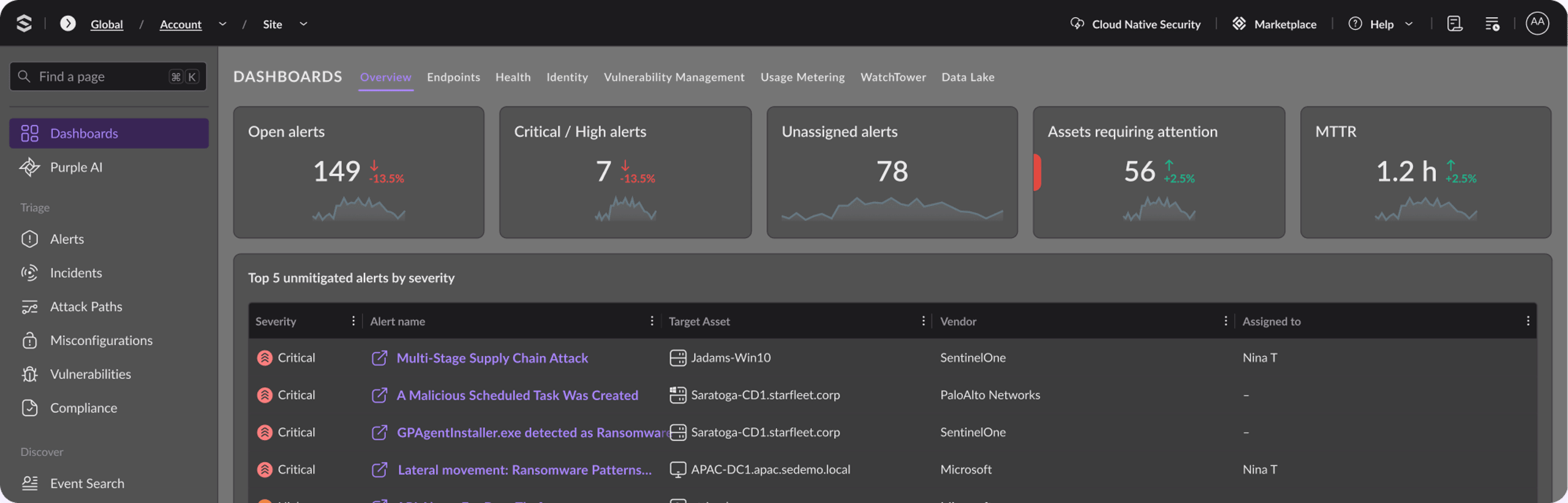
SentinelOne delivers AI XDR capabilities through the Singularity™ Platform. Teams typically start with Singularity Endpoint and add identity, cloud, and third-party data over time, while Singularity AI SIEM pairs the same XDR capabilities with long-term log retention and compliance reporting. Either way, the platform correlates identity and endpoint telemetry with cloud context on one data foundation, so a cross-surface operation reads as a single case instead of scattered alerts.
The operational outcome is speed. In an IDC Business Value study, Purple AI™ customers identified threats 63% faster and remediated 55% faster. That speed comes from analysts working one connected evidence chain instead of stitching consoles together.
Each layer maps to a product. Singularity Endpoint runs a single lightweight agent for endpoint protection and EDR. Singularity Identity and Singularity Cloud Security add credential, role, workload, and access context. All of it flows into a security data lake, Singularity Data Lake, built on an OCSF schema, with the AI SIEM tier handling analytics. Purple AI drives investigation across that data. Then Singularity Hyperautomation, built directly into the Singularity Platform, turns each verdict into no-code response workflows across endpoints, cloud workloads, identity, and integrated third-party tools.
Request a SentinelOne demo to see how the Singularity Platform correlates signals across your own telemetry. AI XDR works when you connect the data, govern the models, and keep response boundaries clear.
Singularity™ XDR
Discover and mitigate threats at machine speed with a unified XDR platform for the entire enterprise.
Conclusion
AI XDR puts machine learning at the center of detection and response and correlates endpoint, identity, cloud, network, and email on one normalized data lake. That is how it closes the cross-surface blind spots that let groups like Scattered Spider move undetected.
The payoff is fewer false positives and faster response, but it depends on governance, coverage discipline, and humans controlling consequential actions. SentinelOne delivers these AI XDR capabilities through the Singularity Platform, so analysts can work one connected case from first signal to containment.
AI XDR FAQs
AI XDR streams telemetry from identity providers and cloud APIs alongside endpoint agents into a normalized data lake, then applies machine learning to link weak signals across layers. When Scattered Spider registers a new MFA token after a help desk reset, spins up a cloud instance, and runs lateral movement tools, the platform ties those events into one incident timeline.
From that single case you can revoke the token, isolate the endpoint, and terminate malicious instances.
AI XDR and AI-native XDR are often used interchangeably, but the label alone does not show how a product is built. Architecture is what separates true AI-native XDR from traditional XDR with machine learning added later. AI-native XDR embeds models into the correlation engine itself and reasons across a unified data lake from day one.
Traditional XDR often bolts machine learning onto rule-based workflows after the fact, with models running inside individual product silos before forwarding alerts. The test is whether telemetry normalizes into one schema before correlation runs, and whether models operate on combined data rather than one surface at a time.
Before deploying AI XDR, put four governance controls in place: an inventory of where AI touches decisions, explicit criteria for validating AI output, named accountability for AI-assisted actions, and feedback loops that flag model drift or adversarial manipulation early.
Version and log model changes so a bad call can be traced to its cause. Treat this as a prerequisite and finish it before the platform starts acting on its own.
Supervised autonomy works best for AI XDR response actions: AI handles low-risk triage and enrichment while analysts retain control over consequential actions. Apply autonomous response only to well-understood scenarios with predictable outcomes and a small blast radius, such as isolating a compromised endpoint or blocking a known-bad domain.
Keep humans in the loop for complex investigations and edge cases that need contextual judgment, especially actions that could disrupt critical systems or data.
Measure AI XDR effectiveness by tracking mean time to detect (MTTD) and mean time to respond (MTTR) alongside false-positive rates. Then check how much of your cross-surface correlation coverage you can actually prove against known attacker techniques.
Useful supporting metrics include alert triage time, incidents requiring escalation, layers correlated per incident, analyst hours saved, and containment success rate. Reviewing missed correlations after major incidents shows whether your tuning is improving or drifting, and keeps the numbers honest enough to defend at budget time.
Discover More About XDR


Ready to Revolutionize Your Security Operations?
Discover how SentinelOne AI SIEM can transform your SOC into an autonomous powerhouse. Contact us today for a personalized demo and see the future of security in action.