
Edge Infrastructure Under Siege: What Two Independent Datasets Reveal About Who's Exploiting Your Perimeter
A joint Tenable-SentinelOne analysis of 93 CVE-actor attribution pairs reveals that both state-sponsored actors and cybercriminals independently converge on the same edge infrastructure.
It is the shared attack surface where state-sponsored threat actors and financially motivated criminal groups independently converge — not the province of a single adversary category, and not exclusively a nation-state problem, despite two years of headlines about China-nexus actors targeting Ivanti, Fortinet, and Palo Alto Networks. The data here tells a different and much broader story. One focused on vendors vs CVEs.
Key Takeaways
- Two independent observation systems, Tenable exposure telemetry across thousands of customer containers and SentinelOne DFIR casework across 66 CVEs, converge 79% on the same vendor attack surfaces despite minimal CVE-level overlap.
- Twelve CVEs in the combined dataset have confirmed multi-nexus attribution: state-sponsored and criminal actors independently exploiting the same vulnerability, across five nexus categories (China, Russia, DPRK, Iran, ransomware).
- The exposure picture is flatter than the headlines suggest: Fortinet, the vendor most associated with edge-device attacks in the press, sits mid-pack on container-grain exposure (25%) — well behind F5 (54%) and in a tight 10-point band with Check Point, Ivanti, and Citrix.
- 54% of customer environments running F5 products have at least one exposed, actively-exploited CVE; Citrix customers show the slowest remediation patterns at 461 days median time to patch.
- Remediation complexity, particularly of high priority CVEs, leads to a statistically significant 24-day remediation gap, leaving large windows of opportunity for attackers.
- The same product lines get hit again and again: Ivanti EPMM and Ivanti Connect Secure each show a newly exploited CVE roughly every 8.5 to 13 months.
- Leverage multiple defense-in-depth strategies: patch as quickly as possible, but also minimize the attack surface (feature-set minimization) and run endpoints in protect mode to better stop lateral movement from attacks that gain initial access.
The Convergence is the Story
Twelve CVEs in the combined dataset have confirmed multi-nexus attribution: state-sponsored and criminal actors independently exploiting the same vulnerability, across five nexus categories. Four examples illustrate the pattern:
| CVE | Product | Actors (Nexus) | Significance |
| CVE-2026-15409 | SonicWall SMA1000 | UTA0533 (unattributed) + INC Ransomware | Espionage-to-ransomware succession on an active zero-day |
| CVE-2023-42793 | JetBrains TeamCity | APT29 (Russia) + Lazarus (DPRK) | Two state-sponsored actors from different nations on the same CVE |
| CVE-2024-3400 | PAN-OS GlobalProtect | UTA0218 (China) + INC Ransomware | China-nexus zero-day reused by ransomware operators |
| CVE-2024-24919 | Check Point Quantum | PurpleHaze (China) + Fox Kitten (Iran) | China and Iran independently exploiting the same gateway vulnerability |
The remaining eight confirmed multi-nexus CVEs span Fortinet, Citrix, Cisco, and Ivanti product lines. State-sponsored actors and ransomware operators are not operating in separate vulnerability ecosystems. They share the same entry points into the same products. The breadth of the convergence, not any single actor’s activity, is the finding.
That pattern holds across the full combined analysis. Three conclusions emerge:
Vendor attack surfaces are the persistent exploitation target. The same eleven vendors (i.e., Fortinet, Citrix, Ivanti, Palo Alto Networks, Cisco, Juniper, VMware, Microsoft, Oracle, CrushFTP, and Meta’s React framework) appear in both observation systems at 79% convergence, and all seven edge-product vendors converge. Serial exploitation timing on Ivanti products shows the vulnerability-to-exploitation pipeline refreshing at 8.5 to 13-month intervals on the same product lines. This is structural, not episodic. Patching the current CVE does not remove the vendor attack surface from the threat landscape.
State-sponsored and ransomware actors converge structurally. Twelve CVEs with confirmed multi-nexus attribution span all five nexus categories and cross the state-criminal divide. Defending against one actor category on edge devices necessarily requires defending against all of them, because the attack surface is shared. An organization that patches only for nation-state TTPs leaves itself exposed to ransomware operators exploiting the same vulnerability, and vice versa.
High-priority CVEs take more time to remediate, not less. Across Tenable’s 238-CVE high-priority list, high-priority CVEs carry a median remediation time of 146 days, compared to 122 days for all other CVEs — a 24-day gap that is statistically significant. The edge-appliance-specific subset (52 CVEs) shows a consistent 8-day gap in the same direction, which was not statistically significant, but suggests the direction may hold for edge appliances too. External data corroborates the pattern: the 2026 Verizon Data Breach Investigations Report (DBIR) found that median patch time increased from 32 to 43 days year over year, even as exploitation overtook credential theft as the number one initial access vector, and the 2025 DBIR, which incorporated Tenable RSO’s remediation trend analysis across 17 edge-related CVEs, found that only 54% of edge device KEVs were fully remediated. The explanation is structural: edge devices are the network boundary, so patching a VPN gateway or firewall means downtime for every user behind it, and change management gates multiply. These devices also resist standard patching workflows because they do not run endpoint agents, often require firmware-level updates with manual validation, and frequently lack active support contracts. The result is that the devices most worth patching are operationally the hardest to patch — and as the high-priority queue grows (the 2026 DBIR reports 50% more critical vulnerabilities to patch than the prior year), everything on it waits longer.
Background
Edge and perimeter devices occupy a uniquely consequential position in enterprise architecture. VPN gateways, firewalls, remote access appliances, and application delivery controllers sit at the boundary between trusted and untrusted networks. They are very often the first component an attacker touches and, for many organizations, the last component that gets patched. When one of these devices is compromised, the attacker inherits its network position: inside the perimeter, with access to internal resources, often without triggering endpoint detection.
This analysis combines two independent datasets to demonstrate that convergence. Tenable contributes exposure telemetry from the Tenable One Exposure Management Platform, covering thousands of customer containers and measuring what edge infrastructure is deployed, what is vulnerable, and how long it remains unpatched. This dataset extends Tenable Research’s ongoing analysis of edge device exposure trends, including the remediation telemetry Tenable contributed to the 2025 and 2026 Verizon DBIR reports. SentinelOne contributes findings from its digital forensics and incident response (DFIR) practice, documenting which threat actors actually exploit which vulnerabilities, observed firsthand inside compromised environments. Neither dataset was built for this analysis; each was constructed independently for different operational purposes.
The finding that makes this analysis compelling is not about any single CVE or any single actor. It is the structural convergence: two independent observation systems, looking at the problem from opposite sides, arrive at the same conclusion about which vendor surfaces are under persistent, broad exploitation, and by whom. (For how each dataset was built and scored, see the Methodology appendix below.)
What’s Exposed: The Vulnerability Surface
Tenable’s exposure telemetry provides the vulnerability-side view. All exposure metrics reported here use container-grain measurement: the percentage of customer environments (organizational containers) with at least one asset vulnerable to a given CVE as of Aug. 15, 2026, relative to total exposed containers over the preceding 14-month period. This measures breadth of organizational exposure to edge-product vendor vulnerabilities, not raw asset counts, across the sampling window.
This section covers 15 vendors in three groups: seven confirmed in both independently compiled corpora, two confirmed in SentinelOne’s casework but absent from Tenable’s attributed corpus, and six “candidate” vendors surfaced by a broader screen of Tenable telemetry. The candidates are not part of the convergence finding, but two, F5 and Zimbra, show broader customer exposure than most of the confirmed seven, so omitting them would understate the breadth of at-risk edge infrastructure.
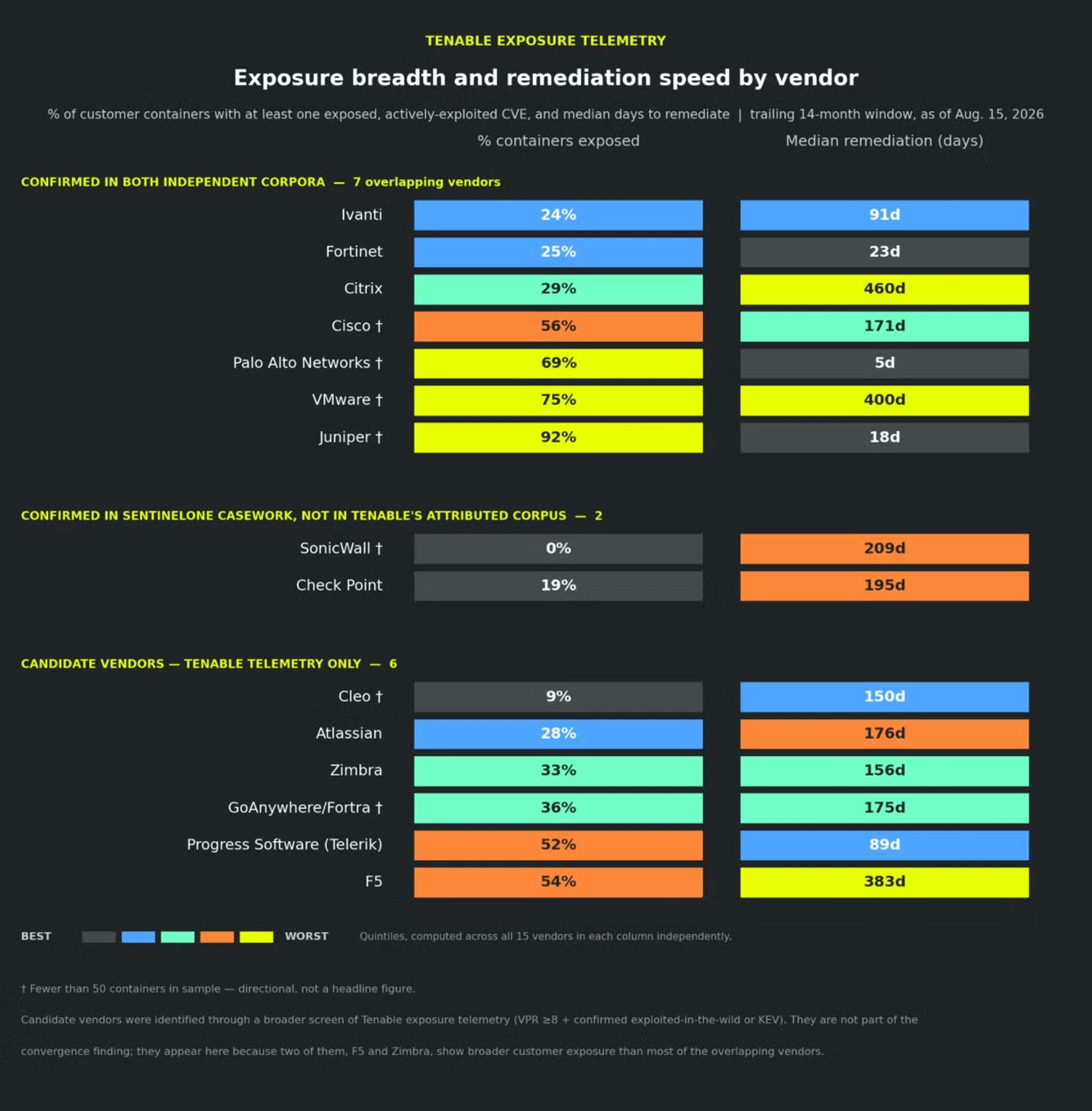
F5 and Citrix lead for different reasons. Among vendors with statistically robust sample sizes, F5 customers are the most broadly exposed: 53.8% of 2,784 monitored customer environments running F5 products have at least one actively exploited CVE present. Citrix customers show the slowest remediation patterns: a median of 461 days to patch, with 71% of affected environments still carrying unpatched Citrix CVEs after a full year. F5 leads on scale of exposure; Citrix leads on persistent exposure.
The mid-pack is flatter than expected. Check Point (18.6%), Ivanti (24.1%), Fortinet (24.9%), and Citrix (28.8%) cluster within a 10-point band at container-grain. Fortinet, which dominates headlines, is mid-pack by this measure.
Thin-sample vendors show extreme rates but require caution. Juniper (91.7%), VMware (75.0%), Palo Alto Networks (69.2%), and Cisco (56.2%) all show container-exposure proportions above 50%, but each has fewer than 50 in-sample containers. These statistics are real directional signals, but should be considered within the context of the relatively low sample size.
Serial exploitation is structural. Two clean serial-exploitation sequences appear in the dataset: Ivanti EPMM (approximately 8.5 months between successive exploited CVEs) and Ivanti Connect Secure (approximately 13 months). Same product line, new vulnerability, repeat exploitation. Tenable Research has published advisories on both Ivanti exploitation sequences, tracking each CVE from initial disclosure through active exploitation, and the exposure data here extends that analysis with organizational remediation timelines not available at the time of the original advisories. The next one is coming.
Who Exploits What: The Threat Actor Landscape
This is not a targeted effort by a specific group. Edge infrastructure is a core focal point of attack across a broad range of threat actors and nexus categories. The combined Tenable-SentinelOne corpus documents exploitation by actors spanning five nexus categories: China, Russia, DPRK, Iran, and criminal (financially motivated). All five categories independently target the same vendor surfaces. Every attribution in the corpus is bucketed into one of three confidence tiers derived from a five-dimensional rubric evaluating attribution directness, evidence provenance, recency, exploitation role, and source corroboration. Confidence tiers, from high to low, are: DIRECT, TECHNIQUE-ALIGNED, or INFERRED.
Actor density scales with vendor exposure. Fortinet products face the broadest actor surface: 29 distinct threat actors across five nexus categories. Citrix follows with 22 actors across five categories, Ivanti with 19 across four, Palo Alto Networks with nine across three, and Check Point with six across two. Every focal vendor has confirmed exploitation from multiple nexus categories. No single vendor’s exposure is attributable to a single adversary group.
China-nexus actors are the highest-confidence case study, appearing across nine vendors in the corpus, with four DIRECT-tier attributions from the scored dataset alone. But the analytical value here is not that China targets edge devices. That is well established. The value is that China, Russia, DPRK, Iran, and ransomware operators all target the same edge devices, as the examples above illustrate. The governed attribution methodology is what allows this claim to be made with precision: we can distinguish confirmed multi-nexus convergence (DIRECT-tier evidence on both sides) from assessed convergence (INFERRED, requiring corroboration).
What Incident Response Sees That Telemetry Can’t
Exposure data shows which appliances are reachable, vulnerable, and unpatched. Incident response looks at what happened when attackers got in: what they accessed, what they took, and where they went next. In SentinelOne DFIR cases involving edge infrastructure, attackers used credentials stored on the appliances and the access those appliances already had to reach internal systems.
Credential Theft from Edge Appliances
Across three engagements, threat actors reached the management plane of FortiGate appliances and created rogue administrative accounts. In two, they also exported device configurations and extracted credentials that could be used to move further into the network. Two of these three are documented in detail in FortiGate Edge Intrusions.
In one of those two, the exported configuration contained LDAP bind credentials for a directory service account. The account was later used in the environment. A few hours later, the threat actor added two computers to the domain. Neither had a Service Principal Name, which is unusual for a legitimate domain join. The mS-DS-CreatorSID attribute on both accounts pointed back to the stolen service account.
We saw similar activity on an Ivanti Cloud Services Appliance in late 2024. A China-nexus actor chained CVE-2024-8963 with CVE-2024-8190 before the first public disclosure in the chain. After gaining access, the actor collected SSH keys and other stored credentials. That engagement is documented as Activity F in Follow the Smoke.
These appliances did not provide conventional endpoint telemetry. We had to follow the activity into authentication records, newly created Active Directory objects, and the later use of credentials taken from the appliances.
When the Initial Access Vector Cannot Be Confirmed
In December 2025, Fortinet disclosed CVE-2025-59718, an authentication bypass in its FortiCloud SSO integration affecting FortiOS and other products. Several weeks later, Fortinet disclosed CVE-2026-24858. This second flaw allowed an attacker with a FortiCloud account and a registered device to log into devices belonging to other customers when FortiCloud SSO was enabled.
That overlap mattered in one of the three engagements above. The appliance was running a version affected by both CVEs, but the available logs did not show when or how the attacker first gained access. The earliest retained malicious activity showed a rogue local administrator account. A few minutes later, a domain administrator authenticated from the appliance’s VPN address pool. Exposure data showed that the appliance had been vulnerable to both CVEs, but that alone did not establish how it was compromised. We treated both as possible, not confirmed, initial-access vectors.
Abuse of Trusted Management Access
In one SentinelOne DFIR engagement involving a FortiManager appliance, CVE-2024-47575 allowed an unauthorized device to register with the appliance through the management protocol. Two log entries, seconds apart, recorded the rogue registration and the settings change that followed. The threat actor then staged an archive of managed-device configurations that could expose credentials, addresses, and details about the network. The actor had been present for about a month before the customer detected the activity.
In a separate engagement, a threat actor chained SQL injection, pass-the-hash authentication, and authentication bypass against an internet-facing SonicWall GMS console (CVE-2023-34133, CVE-2023-34132, and CVE-2023-34124). The actor created administrative accounts on a platform operated by a managed service provider, then used existing shared access to enter multiple customer environments. Most of the resulting traffic was advertising-related, leading us to assess that the infrastructure was being used for click fraud.
The actors were after different things. One collected configuration data and information about the network. The other used the access to turn systems across several environments into proxies. In both cases, the actor inherited the access that the organization had already granted to the management platform. These cases show the difference between the two views: exposure telemetry finds the vulnerable device, while incident response shows what was taken from it and where the attacker went next.
What to Do About It
Patch F5 and Citrix edge devices immediately. These two vendors combine the highest exposure rates with the slowest remediation timelines across statistically robust samples. Look for strategies to reduce the remediation time, particularly for weaponized CVEs. Additionally, reduce the attack surface by minimizing the enabled feature set on these devices and aim for defense in depth by running endpoints in protect mode to limit lateral movement opportunities.
Audit Ivanti Connect Secure and EPMM deployments. Serial exploitation on observed 8.5 to 13-month cycles means the next exploitable CVE in these product lines is a question of timing, not probability. Organizations running Ivanti edge products should assume they will face a new actively exploited vulnerability within the next year and plan patching capacity accordingly.
Implement edge-device-specific patch SLAs. The delayed remediation paradox demonstrates that general priority frameworks do not translate into faster patching on the devices that sit at the network boundary. Edge devices and network infrastructure warrant dedicated remediation timelines that are shorter than the organizational default and commensurate with the elevated risk.
Treat edge device exposure as a cross-signal priority. Attribution, severity, and exposure volume identify different CVEs as “top priority.” Organizations need all three signals for complete coverage. A vulnerability management program that prioritizes exclusively by CVSS will systematically underweight CVEs with strong exploitation evidence but modest severity scores, and vice versa. The Tenable One Exposure Management Platform enables this cross-signal approach by combining vulnerability severity, exposure intelligence, asset context, and exposure data into a unified prioritization view.
Identifying Affected Systems
Tenable customers can use the Tenable Vulnerability Watch dashboard to monitor classifications for all CVEs discussed in this analysis. A list of Tenable plugins for the vulnerabilities discussed in this analysis can be found on the individual CVE pages at tenable.com/cve as they are released. This link displays all available plugins for each vulnerability, including upcoming plugins in our Plugins Pipeline.
Get more information
- Tenable Vulnerability Watch
- SentinelOne Threat Research (PurpleHaze, SonicWall SMA1000)
- FortiGate Edge Intrusions – SentinelOne
- Follow the Smoke – SentinelOne
- CISA Known Exploited Vulnerabilities Catalog
Join Tenable’s Research Special Operations (RSO) Team on Tenable Connect for further discussions on the latest cyber threats.
Learn more about Tenable One Exposure Management Platform, the exposure management platform for the modern attack surface.
Appendix: Methodology and Corpus Construction
How the corpus was built. Tenable’s 33-CVE corpus was derived by combining and deduplicating vulnerabilities with the highest exploitation volume and broadest actor adoption; SentinelOne validated CVEs across 14 vendors, and their 66-CVE landscape view reflects 12 months of DFIR casework with false positives removed. Combined, the two datasets identify 82 distinct CVEs, 17 of which appear in both. Layered on top of these sources is a governed attribution corpus of 93 CVE-actor pairs spanning approximately 39 named threat actors and five nexus categories.
Why Tenable tracks these CVEs. Tenable’s set comes out of exposure management. A CVE enters it through the Vulnerability Watch program, which classifies vulnerabilities under active or likely to be exploited, and is additionally scored with a Vulnerability Priority Rating (VPR). The question being answered is prescriptive: of everything actually deployed across customer environments, what should be prioritized and patched first? Threat-actor attribution is layered on afterward from definitive and confidence-scored sources (e.g., Federal cybersecurity advisories).
Why SentinelOne tracks these CVEs. SentinelOne’s set comes from the opposite direction: incident response. A CVE earns its place in their 12-month DFIR landscape because responders found it used in a real intrusion — the initial access vector in a case someone called them about. The question being answered is forensic: what happened here, and who did it? Coverage is shaped by who engaged them, not by install base.
What “overlap” means here. Overlap was measured at two levels, and the answer changes sharply depending on which level you use.
At the level of the individual vulnerability, the two sets barely intersect. Only 17 of 82, or 21%, of CVEs are common to both. Tenable and SentinelOne are, for the most part, not looking at the same vulnerabilities. However, the datasets converge at the product level. Eleven of the 14 vendors in Tenable’s focal CVE set appear in SentinelOne’s 12-month DFIR landscape – a 79% convergence: Fortinet, Citrix, Ivanti, Palo Alto Networks, Cisco, Juniper, VMware, Microsoft, Oracle, CrushFTP, and Meta’s React framework. That’s 79% convergence at the vendor level against 21% at the CVE level. Three vendors did not conform: Apache and SAP were absent from SentinelOne’s casework, and the one Progress case they worked on was closed as a false positive. Narrow the comparison to edge and remote-access infrastructure specifically, and the convergence is a perfect 100%. Tenable’s corpus independently identified seven edge vendors (i.e., Fortinet, Citrix, Ivanti, Palo Alto Networks, Cisco, Juniper, and VMware). All seven appear in SentinelOne’s casework. Two teams, working from unrelated evidence for unrelated purposes, arrived at the same seven vendors while sharing roughly one CVE in five.
Why the distinction matters. “Different vulnerabilities, same vendors” is not a weaker version of “same vulnerabilities.” It is a different and more actionable claim. Had both datasets converged on the same individual CVEs, the story would be that a specific handful of vulnerabilities is being widely exploited: patch those and the problem shrinks. What the data actually shows is that state-sponsored and criminal operators are independently arriving at the same small set of edge and remote-access product vendors, then finding their own separate ways in. The durable target is the vendor attack surface. Patching this quarter’s Ivanti CVE does not remove Ivanti from anyone’s target list.
All third-party product names, logos, and brands mentioned in this publication are the property of their respective owners and are for identification purposes only. Use of these names, logos, and brands does not imply affiliation, endorsement, sponsorship, or association with the third party.
Related Articles