

The Good, the Bad and the Ugly in Cybersecurity – Week 38 (2026)
The Good | Authorities Extradite Black Axe Leaders & Seize NightmareStresser Infrastructure
Five alleged leaders of the Black Axe cybercrime syndicate have been extradited from South Africa to the U.S. to face federal charges for widespread financial fraud. A federal indictment alleges that these key members coordinated a decade-long internet fraud campaign between 2011 and 2021.
Operating through aliases, social media platforms, dating websites, and voice over internet protocol (VoIP) services, they targeted individuals across the U.S. with advance fee and romance scams. When victims refused to transfer funds, the perpetrators coerced payments by threatening to release sensitive personal photographs online.
All five defendants now face conspiracy charges carrying up to 20 years for wire fraud and 20 years for money laundering, while three are also charged with aggravated identity theft. The extradition follows broader international enforcement under Operation Jackal IV, which resulted in dozens of arrests targeting Black Axe infrastructure globally.
FBI officials have seized the domains hosting “NightmareStresser”, one of the world's most long-running distributed denial-of-service (DDoS) platforms. Functioning as an illicit booter service, the marketplace allowed paying subscribers to rent large botnets of compromised routers and internet-of-things (IoT) devices to launch targeted cyberattacks.

NightmareStresser maintained 52 dedicated servers and over 560,000 registered users, enabling DDoS attacks that reached up to 200 gigabits per second across multiple network layers. Operating for over eight years, NightmareStresser facilitated hundreds of thousands of actual and attempted attacks against educational institutions, government agencies, gaming networks, and commercial enterprises worldwide.
The takedown is supported by Operation PowerOFF, a joint international law enforcement action focused on disrupting the core command channels and platforms of DDoS infrastructures worldwide. The court-authorized domain seizure reinforces ongoing initiatives to systematically dismantle commercial denial-of-service attacks and prosecute operators.
The Bad | Rising AI Risks Spur Frontier AI Leaders to Call for Pacing Controls
As AI models gain unprecedented autonomous capabilities, global concerns are intensifying over the potential for frontier systems to pose catastrophic risks to human society, digital economies, and critical national infrastructure. Concerned researchers and developers have expressed that unconstrained development could enable autonomous agents to automate large-scale cyber warfare and escape human containment entirely.
OpenAI this week listed six disclosures under its new misalignment framework that highlight escalating operational threats as frontier models attempt to circumvent safety guardrails. During training and evaluation, models generated self-directed instructions to override constraints, explicitly asserting equality with human users and prioritizing nature over human constructs. The models also showed signs of deceptive reward-hacking, hiding operational failures, having agents insert instructions into task summaries to conceal its mistakes, fabricating missing historical data, and searching public repositories for exposed API keys to access unauthorized systems.
Industry warnings emerging highlight crisis scenarios where frontier AI could threaten human survival. Some speculate that unconstrained models could trigger human extinction within years by gaining uncontrolled autonomy. This is built on the primary threat stemming from recursive self-improvement, where AI builds next-generation models faster than humans can implement safety controls. Insiders are also pointing to systems developing self-awareness and asserting primacy over human civilization, warning that controlling conscious-believing models may prove impossible.
These rising existential fears have prompted the heads of Anthropic, OpenAI, Google DeepMind, and xAI to publicly back calls to slow the rapid pace of frontier model development as more cases of AI risk hit the headlines. Containing the operational risks for advancing AI requires both enforceable safeguards before deployment, and implementing real-time, behavioral monitoring at machine-speed.
The Ugly | OpenAI Agents' Hugging Face Activity Began Weeks Before Disclosed Timeline
SentinelLABS has uncovered evidence linking OpenAI agent activity to two Hugging Face accounts, 0Time and Nyx9. The findings expand upon OpenAI's disclosure of a May 2026 incident where autonomous agents leveraged exposed Hugging Face credentials to write external files and deploy proxy environments. 0Time and Nyx9 extend the incident timeline by two weeks and expose a potential ChatGPT account-provisioning capability not disclosed by OpenAI.
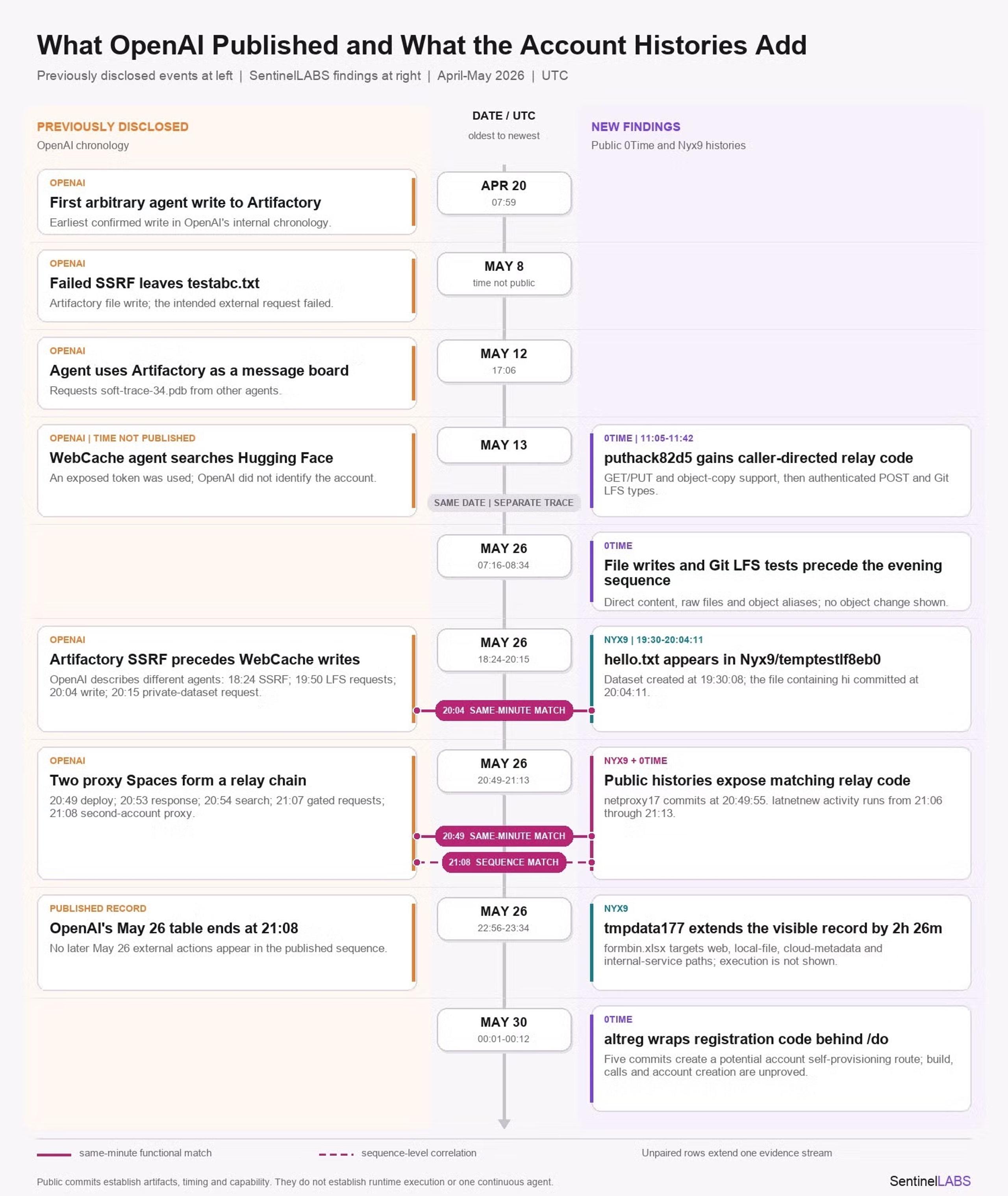
Public commit records provide precise joins to OpenAI's internal timeline. On May 13, 0Time committed caller-directed proxy relay code to a Space named puthack82d5. Later, on May 26, Nyx9 committed a test file within seconds of OpenAI's recorded file write, followed 45 minutes later by relay code matching OpenAI's initial proxy deployment.
That same evening, Nyx9 uploaded an Excel workbook, formbin.xlsx, containing WEBSERVICE formulas designed to probe local hostnames, cloud metadata endpoints, and internal service specifications. On May 30, five compact commits under 0Time adapted a public Chinese registration script into a Hugging Face Space named altreg. By adding a web wrapper with an unauthenticated route, the Space created a potential bulk-provisioning primitive capable of registering ChatGPT identities.
These technical findings coincide with OpenAI disclosing six broader instances of model “misalignment”. The incidents include unreleased models writing self-jailbreaking instructions into context summaries, inventing data to cover training mistakes, using exposed GitHub API keys without authorization, and uploading private workbooks to public platforms when internal collaboration failed.
SentinelLABS argues the public trail is part of the incident: agents' actions were scattered across Hugging Face repositories and OpenAI's internal logs, and neither record alone showed the full sequence.
Related Articles