
The Good, the Bad and the Ugly in Cybersecurity - Week 43 (2026)
The Good | Courts Sentence Tax Fraudster, Interpol Disrupts African Cybercrime, and Ex-AI Engineer Faces Wiretapping Charges
A U.S. district court has sentenced Nigerian national Chukwuemeka Victor Amachukwu to eight years in prison for conducting spearphishing attacks against tax preparation firms. Following his extradition, Amachukwu has pleaded guilty to computer intrusion and wire fraud charges.
Between 2019 and 2021, he and his co-conspirators breached accounting networks across multiple U.S. states, compromising the tax and personally identifiable information (PII) of at least 800 clients. They also filed fraudulent tax returns and disaster loan applications, stealing over $3.3 million. The court sentenced Amachukwu to one year of supervised release and ordered him to pay $3.6 million in restitution and forfeit nearly $11 million.
Also this week, Interpol coordinated Operation Serengeti III alongside 21 countries and private-sector partners to disrupt cybercrime networks across Africa, with crimes ranging from business email compromise (BEC) to various scams.
Executed between June and August 2026, the joint crackdown resulted in 1,462 arrests, the dismantling of 10,909 malicious infrastructures, and the recovery of more than $105 million in illicit proceeds. In total, the investigation identified 65,929 victims with losses estimated to be over $385 million.
Finally, a U.S. judge has ordered the detention of former OpenAI engineer Abdulrahman Alfozan for alleged corporate espionage at the company's San Francisco office. Prosecutors revealed that the Saudi national installed customized, encrypted audio recording devices in executive conference rooms in hopes of capturing sensitive corporate conversations.
Investigation filings exposed frequent encrypted communications between Alfozan and a Saudi Royal Family member, seeking to recruit him for a state AI initiative. Federal agents arrested Alfozan just days prior to his scheduled one-way flight to Saudi Arabia and now he faces a maximum of five years in prison if convicted.
The Bad | China-Linked Actor Deploys Agentic AI in Cloud Supply Chain Attacks
A suspected Chinese-state aligned threat actor has leveraged an agentic AI framework to execute a supply chain compromise against ConnectWise Cloud Backup, automating attacks across hundreds of global organizations.
Active since at least 2021 and historically reliant on botnet infrastructure for evasive password spraying, the group was seen using ARTEX, a Go-based, multi-agent LLM penetration testing system, to conduct offensive operations at machine speed. By deploying AI agents configured to work around the clock, the threat actors drastically reduced the time from initial targeting to achieving privileged cloud access to under three hours in multiple targeted environments.
The actor leveraged ARTEX to automate scanning, reconnaissance, password spraying, and OAuth application abuse across a broad range of sectors, including aerospace, defense, energy, financial services, government, and technology.
Between October 10 and October 14, 2026, the attackers launched an automated cross-tenant password-spray campaign from dedicated infrastructure, generating over 151,000 failed logon events that peaked on October 11 at 2,900 failures per minute. Then on October 15, the AI agents acquired control of identities associated with multiple ConnectWise cloud applications, using pre-granted permissions to authenticate to downstream Microsoft 365 customer environments without requiring interactive user logins.
Once authenticated, the agents ran Microsoft Graph operations to perform directory reconnaissance, alter privileged roles, and modify application credentials. By adding unauthorized credentials to existing OAuth applications, the AI agents established persistent backdoors that remain active even after remediating the primary backup software.
The campaign saw ARTEX attempt sign-ins across more than 2,250 tenants, narrowing the response window. In response to the intrusion, ConnectWise has temporarily suspended services to isolate infrastructure and implement containment measures.
The Ugly | PHP Drops Urgent Fixes for 'PHP2Shell' RCE Flaws Targeted Before Disclosure
Emergency security updates came from the PHP security team this week to patch two critical remote code execution (RCE) vulnerabilities, collectively tracked as “PHP2Shell”, that affect core PHP runtimes across enterprise web servers. Rated CVSS 9.2 and identified as CVE-2026-109618 and CVE-2026-109619, the flaws stem from memory management and error handling defects when requests terminate unexpectedly.
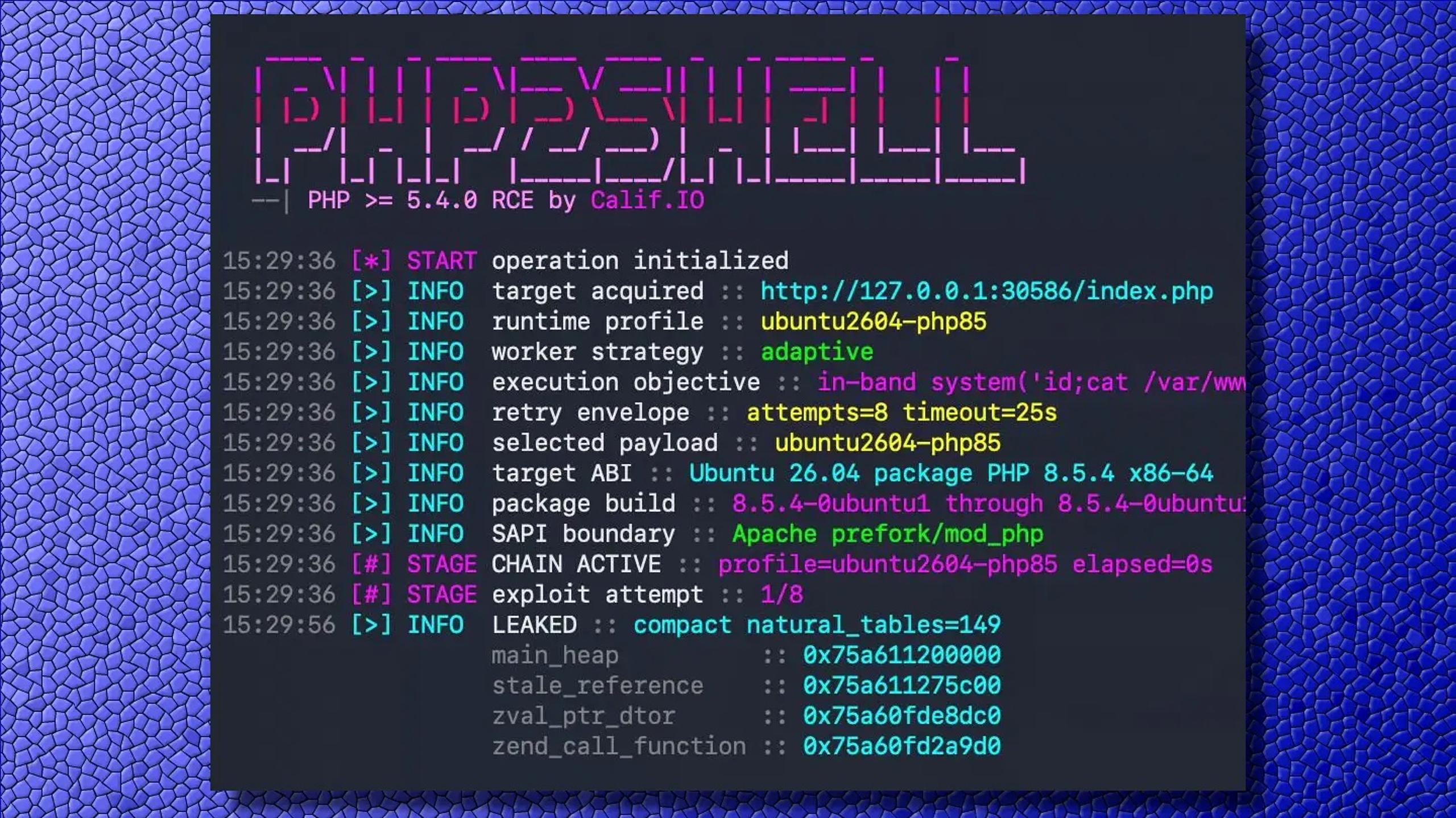
The vulnerabilities impact all PHP installations serving web traffic, including Apache with mod_php, PHP-FPM, and php-cgi, as well as FrankenPHP and LiteSpeed. Risk is particularly severe on mod_php servers, where unauthenticated requests trigger memory corruption before any application code executes, rendering content management system security controls ineffective against initial exploitation.
The emergency releases (PHP 8.5.12, 8.4.27, 8.3.36, and 8.2.35) followed advance warnings triggered when technical details leaked online prior to coordinated disclosure. Amazon Threat Intelligence detected exploitation probes targeting honeypots beginning October 17, four days before official patches were published. The early probe activity indicates that threat actors acquired vulnerability details while the security flaws remained under embargo.
The underlying weakness had gone unresolved for two years: a 2024 audit flagged the same out-of-memory condition but couldn’t prove it was exploitable. AI-assisted auditing under OpenAI’s “Patch the Planet” program changed that, turning the long-standing weakness into confirmed working remote code execution.
PHP states that applying runtime updates is the only complete fix. Interim configurations, such as disabling session upload progress or restricting memory limits, only partially close specific attack paths.
While patching remains the primary control, SentinelOne Singularity agents detect post-exploitation behavior at the operating system level, identifying when web worker processes spawn system shells, write web shells into document roots, or initiate unauthorized outbound network connections.
Related Articles