
One Target, Two Flags | Rival Espionage Actors Converge On Pakistani Law Enforcement
China and India ran separate espionage operations against the same Pakistani police force, each drawn by different stakes in Pakistan's internal security.

Executive Summary
- SentinelLABS has been tracking sustained cyberespionage activity against several Pakistani law enforcement organizations, taking place from February 2024 to April 2026.
- All these actors converged on Balochistan Police over this period, bringing both a partner and an adversary of Pakistan to the same police force in a province shaped by a separatist insurgency and the regional tensions it has drawn in.
- At Balochistan Police, the compromised assets included servers hosting web applications that manage police and citizen data, such as criminal and biometric records.
- A suspected China-nexus actor planted implants in one of the web applications, which serves both police staff and citizens, weaponizing a tool of Pakistan’s police digitalization against its users.
- Pakistani law enforcement organizations attract cyber collection because they hold information on Pakistan’s internal security that regional powers have an incentive to pursue.
- For China, the likely primary concern is the safety of its nationals, the target of repeated deadly attacks Pakistan has failed to prevent, leading Beijing to assess that threat for itself rather than rely on its partner alone.
- For India, the strongest motive is probably its rivalry with Pakistan, with Balochistan Police offering insight into the security posture of a Pakistani province prominent in wider mutual accusations over cross-border support for militancy.
Overview
Suspected China- and India-nexus threat actors carried out intrusions into several Pakistani law enforcement organizations between 2024 and 2026. Our analysis of C2 netflow data revealed that suspected China- and India-nexus threat actors operating PlugX, ShadowPad, Cobalt Strike, and Remcos infrastructure have converged on this victim class.
All of these threat actors were active against Balochistan Police, the principal police force serving the Pakistani province of the same name, at various points between 2024 and 2026. The affected assets spanned network appliances and servers hosting web applications that manage biometric records, hotel and tenant registrations linked to national identity records, criminal case files, and personnel records. A suspected China-nexus threat actor also compromised one of these web applications, deploying custom implants masquerading as a portal update. The application is used by police staff and by citizens interacting with law enforcement through it, and the compromise put both user groups within the threat actor’s reach.
When multiple cyberespionage actors operate against law enforcement institutions of a single state, the convergence itself is a signal of target value. What draws them is a particular kind of institution: one that holds the government’s internal security picture, what it knows about the threats inside its borders, and how it acts against them. Each of the states suspected to be behind the activities covered in this post has its own stake in the threats monitored by Pakistani law enforcement.
Strategic Motives | Distrust and Accusations
The China-nexus activity is most likely motivated primarily by concern for the safety of Chinese nationals. Their presence across Pakistan is substantial, tied in large part to the China-Pakistan Economic Corridor (CPEC), Beijing’s flagship Belt and Road infrastructure program in the country. Chinese nationals have been the target of repeated deadly attacks, some of which were claimed by the Balochistan Liberation Army (BLA), a Baloch separatist group opposed to China’s presence in the Pakistani resource-rich southwest. Notable attacks include the October 2024 Karachi airport attack and the March 2024 suicide bombing in northwestern Pakistan.
The attacks have fueled explicit Chinese dissatisfaction with Pakistani counter-militancy performance. In October 2024, China’s Ambassador to Pakistan publicly called them “unacceptable”, warning that the security situation was the main obstacle to CPEC. The threat to Chinese nationals remains unresolved. As recently as January 2026, China’s Minister of Public Security and Pakistan’s Interior Minister agreed to expand counterterrorism coordination, deepen police training exchanges, and establish a special unit in Islamabad to protect Chinese nationals.
Pakistani law enforcement is a natural collection target for China. The data it holds would let China assess the security environment its nationals face independently, rather than relying on a partner whose protection has repeatedly fallen short.
For the India-nexus activity, which was focused on Balochistan, the strongest motive is probably the adversarial security relationship between India and Pakistan, in which the province is a recurring flashpoint. Pakistan has long accused India of backing the Baloch insurgency, describing the BLA as an “Indian proxy“, a charge it has not publicly substantiated and that India denies. India, in turn, accuses Pakistan of backing the militant groups behind attacks in Indian-administered Kashmir, which Pakistan denies.
The Baloch insurgency is a front in the antagonism between the two states, and Balochistan Police would hold the operational record of how Pakistan manages the province’s security. For India, that material could offer visibility into a conflict at the center of the accusations and counter-accusations between them.
Balochistan Police is the same law enforcement institution the China-nexus actors were active against, approached from the opposite direction. To China, it is the police force of a partner that cannot be trusted to protect Chinese nationals in Balochistan. To India, it is the police force of a rival, with deep insight into the security of a province central to the friction between the two states.
Intrusions Into Pakistani Law Enforcement Organizations
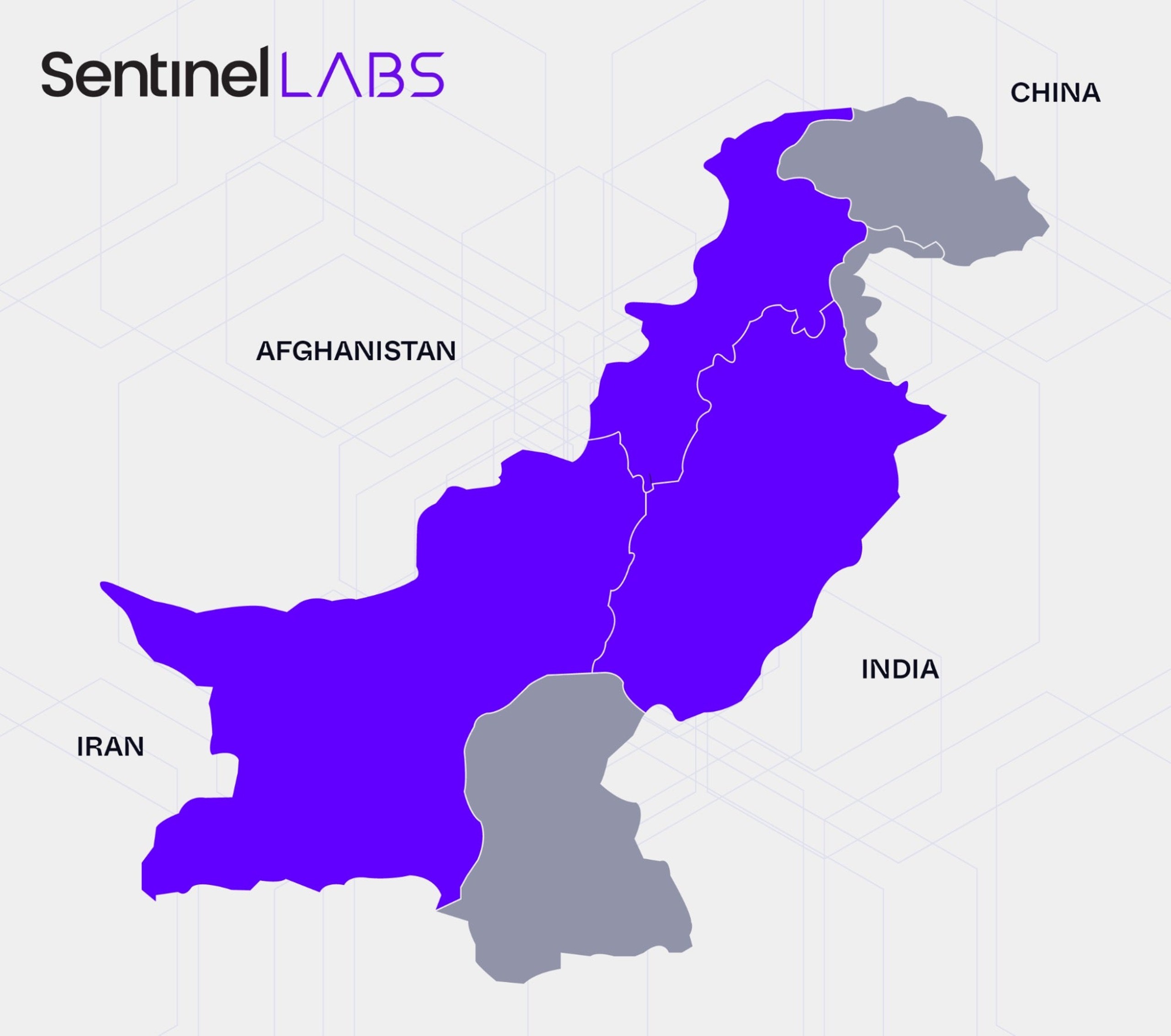
We observed the highest concentration of intrusions at Balochistan Police. They affected network appliances and web servers hosting several of its web applications, one of which, the Complaint Management System (CMS), drew particular attention. The next two sections discuss the impacted assets in greater detail.
We also identified compromised infrastructure associated with several other Pakistani law enforcement organizations:
- the Khyber Pakhtunkhwa Police, the police force of Khyber Pakhtunkhwa province;
- the Islamabad Police, which serves the Islamabad Capital Territory;
- the Punjab Safe Cities Authority (PSCA), an autonomous government body that operates the integrated command, control and communication system for the police in the major cities of Punjab province.
We group the C2 activity we observed against all these targets into four clusters, each associated with a single malware family or tool: PlugX, ShadowPad, Cobalt Strike, and Remcos.
Because we cluster based on tooling, not on actor attribution, the number of threat actors behind each C2 activity cluster differs. We associate the Remcos cluster with a single actor, while the PlugX, ShadowPad, and Cobalt Strike clusters are built on shared or commodity tooling and may each involve more than one operator.
The table below presents the constituent servers of each C2 activity cluster, along with the first and last dates on which any of its servers communicated with Pakistani law enforcement infrastructure. The figure that follows shows how each cluster’s activity was distributed across the targeted organizations over time.
C2 activity cluster | C2 servers | First seen | Last seen |
PlugX | 172.111.233[.]36, 172.111.233[.]96, 172.111.233[.]12, 172.111.233[.]105, 172.111.233[.]26, 172.94.9[.]49, 172.94.9[.]43, 172.94.9[.]19, 45.74.6[.]17 | 27 February 2024 | 28 September 2024 |
ShadowPad | 45.125.32[.]218 | 5 November 2024 | 29 November 2024 |
Cobalt Strike | 142.171.183[.]8, 193.42.25[.]65 | 12 October 2024 | 5 December 2025 |
Remcos | 89.31.121[.]220 | 13 January 2026 | 9 April 2026 |
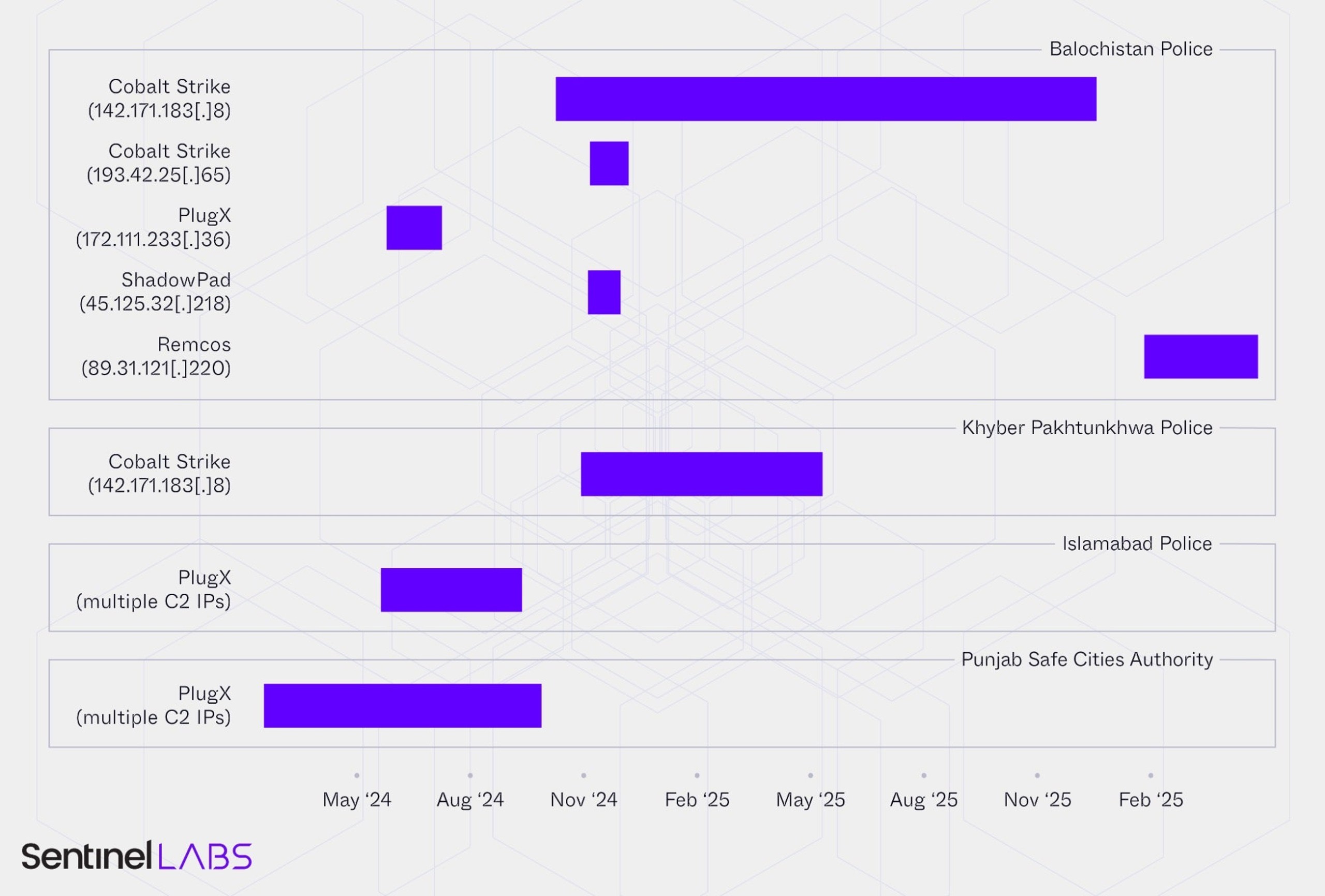
The sections below cover the basis for each cluster’s attribution and its broader victimology. The observation windows we present there are generally wider, spanning all per-cluster victims.
C2 Activity Cluster | PlugX and ShadowPad
PlugX and ShadowPad point to China-nexus cyberespionage groups on the basis of the tooling itself, since both are backdoors shared among multiple such groups. The victimology we observed for PlugX (between 27 February and 28 September 2024) and ShadowPad (between 3 August and 1 December 2024) reinforces this assessment.
Beyond Pakistani law enforcement, victimology for PlugX and ShadowPad includes government, foreign affairs, defense, nongovernmental, and research entities across South, Southeast, Central, and East Asia, the Arabian Peninsula, and Southeast Europe, consistent with China-aligned collection.
C2 Activity Cluster | Remcos
We attribute the Remcos C2 server 89.31.121[.]220 to a suspected India-nexus threat actor, which Recorded Future tracks as TAG-179. Its infrastructure, tooling, and TTPs overlap to varying degrees with those of the threat actors tracked by Kaspersky as Mysterious Elephant and by Qihoo 360 as APT-C-08 (a.k.a. Bitter).
Our data shows that TAG-179 has been intensifying its activities and diversifying its TTPs since early 2025. This trend aligns with the prior research from Kaspersky and Qihoo 360, which documents in detail the tooling and infection chains used across 2025 and 2026.
Notably, Qihoo 360 describes a chain that delivers a Remcos backdoor configured with the same server that constitutes our Remcos C2 activity cluster (89.31.121[.]220). The IOC table of this report lists several lure files and backdoor components that we associate with TAG-179.
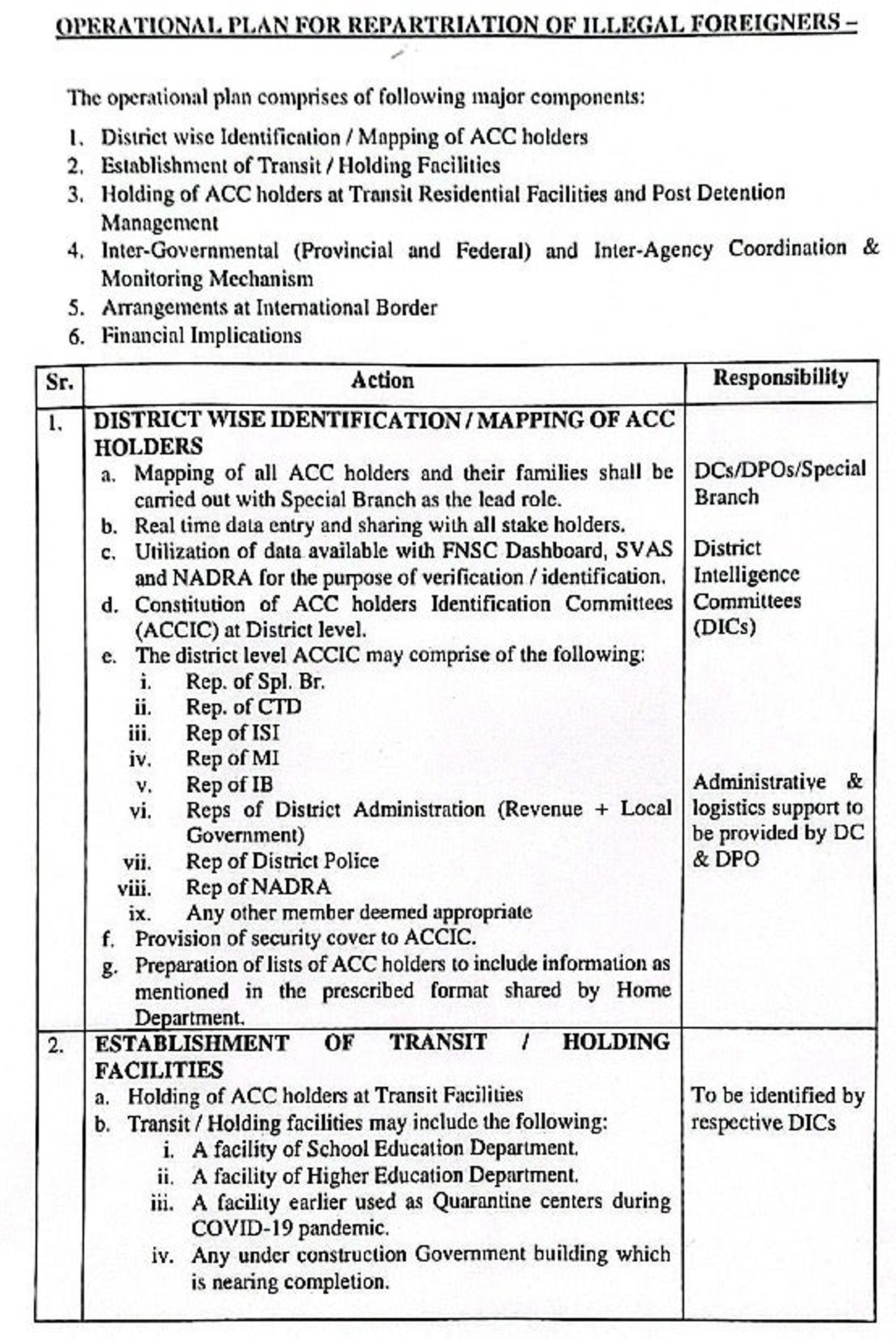
Among the lures is one with direct relevance to Pakistani law enforcement: it displays a decoy document posing as an operational plan for the repatriation of illegal foreigners, including Afghan Citizen Card (ACC) holders. These are Afghan nationals who have been granted temporary registration in Pakistan and are targeted for deportation under Pakistan’s Illegal Foreigners’ Repatriation Plan.
The decoy document outlines coordination among district-level police forces, the National Database and Registration Authority (NADRA, an agency of the Pakistani Ministry of Interior), and Pakistani intelligence organizations. Its subject matter is consistent with the Pakistani law enforcement victimology of TAG-179, making it an example of a plausible lure against this target class.
Within our observation window for the Remcos C2 activity (from 20 November 2025 to 21 April 2026), the victimology outside Pakistani law enforcement includes government, defense, foreign affairs, intelligence, research, and manufacturing entities across South and Southeast Asia, and the Middle East.
C2 Activity Cluster | Cobalt Strike
Although Cobalt Strike is a commodity tool that carries no inherent attribution, we attribute with medium confidence both servers in this C2 activity cluster to China-nexus threat actors.
The C2 traffic to 142.171.183[.]8, spanning 13 September 2024 to 5 December 2025, reveals victimology extending beyond Pakistani law enforcement to government, academic, telecommunications, and non-governmental entities across South, East, and Southeast Asia, the Middle East, and South America, in line with a China-aligned targeting profile. Among these entities are Tibetan Buddhist organizations in Taiwan, a long-standing Chinese cyberespionage interest.
For 193.42.25[.]65, we observed C2 communications only with Balochistan Police infrastructure, taking place between 7 November and 5 December 2024. 193.42.25[.]65 also served as next-stage infrastructure for one of two implants deployed on the Balochistan Police CMS web application. We trace these implants to a Chinese-speaking developer through related samples sharing the same development environment, a topic we discuss in greater detail in a later section.
Balochistan Police | Compromised Assets
Across the four C2 activity clusters, C2 communications involving the following Balochistan Police assets took place between 2 June 2024 and 9 April 2026:
- two network appliances;
- web servers hosting several Balochistan Police web applications;
- a Fortinet FortiMail appliance that had served as Balochistan Police’s primary inbound email gateway.
At the time of this activity, the FortiMail appliance was no longer the designated inbound email gateway, but it remained operational on the network and may have continued to process outbound or internal mail relay traffic. Its compromise may therefore have additionally exposed email traffic it processed.
Many of the web applications hosted on the affected servers are part of the Smart Police Station initiative, an EU-supported effort to modernize Balochistan policing and improve how it serves the public through digitalization. Throughout the threat actor activities, the web servers hosted a mix of public-facing applications through which citizens and businesses access policing services, alongside restricted police applications protected by firewalls against unauthorized external access.
The table below summarizes the application functions as described in publicly available documentation.
Application | Function |
First Information Report (FIR) | Application for FIR registration and management. FIRs are documents prepared by police upon receiving information about the commission of a cognisable offence. |
Human Resource Management Information System (HRMIS) | Personnel database managing officer service records, transfers, postings, payroll, and performance evaluations. |
Anti-Vehicle Lifting System (AVLS) | Database for tracking stolen vehicles, their recovery, and investigation. |
HotelEye | System for hotel guest check-in logging, integrated with NADRA identity records to notify police when individuals with criminal records check in. |
Criminal Record Management System (CRMS) | Criminal records database with fingerprint-based biometric matching. |
Tenant Registration System (TRS) | Landlord-tenant registration platform integrated with criminal records. |
Complaint Management System (CMS) | Platform for registering, tracking, and resolving citizen complaints, from reports of crime and loss of documents to complaints about police misconduct. |
If the threat actors could reach the data stores backing these applications from the compromised servers, the data they could obtain would span police personnel records, criminal case files, biometric records, stolen vehicle records, hotel guest check-in records, tenant registration records, and citizen complaints. Together, it would provide broad visibility into Balochistan Police’s operational posture, capabilities, and intelligence activities.
Balochistan Police | CMS Compromise
The CMS web application, accessible at cms.balochistanpolice[.]gov[.]pk and hosted on one of the affected Balochistan Police web servers, was also compromised. Based on shared infrastructure and a common focus on Balochistan Police, we associate this intrusion with the threat actor operating 193.42.25[.]65, a constituent of the Cobalt Strike C2 activity cluster.
The landing page at cms.balochistanpolice[.]gov[.]pk features a login interface and a separate search form.
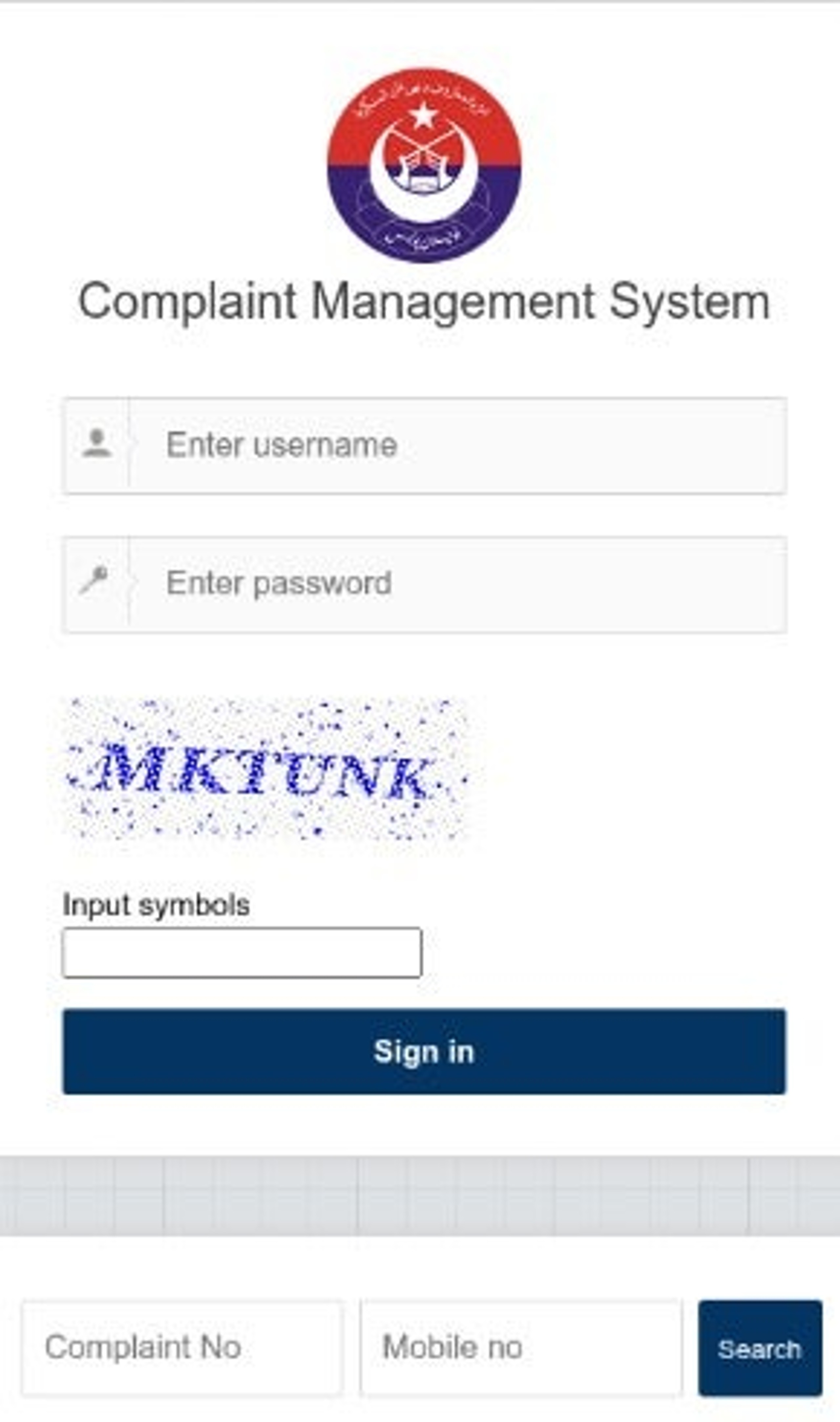
Access behind the login interface is highly likely restricted to law enforcement personnel. Stolen login credentials for the portal, which we retrieved from information stealer logs published on the dark web, reveal a consistent naming convention across the recovered usernames: a ps- prefix (most probably denoting “police station”) followed by a district or city within Balochistan, such as ps-barkhan.
In contrast, the search form, which posts to /Complaint/PublicSearch and accepts a complaint reference number and mobile number, is evidently intended to allow citizens to check the status of a filed complaint.
We therefore assess with high confidence that the CMS application serves two distinct user groups: law enforcement personnel and citizens.
Based on VirusTotal data, two variants of an implant named cms_plugin.exe were uploaded to cms.balochistanpolice[.]gov[.]pk/client%20scripts/ in late 2024, one written in the Rust programming language, the other compiled as a .NET executable. The Rust executable is a malware stager that downloads a payload from 193.42.25[.]65 and executes it. We could not retrieve the next stage at the time of analysis.
The .NET executable masquerades as 360Safe.exe, a component of the endpoint security software 360 Safe Guard from the Chinese vendor Qihoo 360. It reflectively loads an assembly implementing an AsyncRAT client, which is configured to use 41.216.188[.]140 as its C2 server. The assembly has a PDB path of D:\codedome\case\six\Client\Client2\obj\Debug\Client2.pdb.
Pivoting on the D:\codedome prefix, we identified multiple additional samples highly likely built in the same development environment. Several are AsyncRAT clients that share implementation patterns with the one embedded in cms_plugin.exe, such as variable naming and string obfuscation, reinforcing a common origin beyond the shared PDB prefix. Some contain Chinese-language terms in pinyin in their PDB paths, such as xinshi (likely 新式, “new type” or “new variant”), and one includes log messages in simplified Chinese. These indicators point to a Chinese-speaking developer behind the samples linked by the D:\codedome prefix, including the one deployed on the Balochistan Police CMS application.
Pivoting on the cms_plugin.exe filename, we identified a third malware stager functionally similar to the Rust variant, also downloading the next stage from 193.42.25[.]65.
Both cms_plugin.exe samples downloading from 193.42.25[.]65 display the message Update Complete! Please refresh the page upon execution, mimicking an update for the CMS portal.
The fake update prompt, combined with the cms_plugin.exe filename and the hosting location in the portal’s /client scripts/ directory, indicates that the implants were targeted at users of the CMS platform: police staff, citizens checking complaint status, or both. Successful infection would grant the threat actor access to the victim’s device. In the case of police personnel, this could provide a foothold into internal police networks and access to operational data beyond the CMS platform. In the case of citizens, it would enable surveillance of those who have filed complaints through the platform.
Conclusion
The intrusions we cover in this post show how domestic security institutions can become high-value intelligence targets when the threats they monitor overlap with foreign intelligence requirements. Balochistan Police sits at such an intersection, attracting cyberespionage activity from both a partner and an adversary of Pakistan. For China-nexus actors, access to its systems could support independent assessment of threats to Chinese nationals and interests in the country. For India-nexus actors, such access provides visibility into how Pakistan manages security in a province central to its adversarial relationship with India.
The compromise of the Complaint Management System web application adds a second dimension to the activity against Balochistan Police, extending the threat actor’s reach beyond the initially compromised environment. By hosting implants in a portal used by both citizens and law enforcement personnel, the threat actor turned a tool built to make policing in Pakistan more accessible and accountable to the public into a malware delivery mechanism. This weaponization widened the collection surface from the application and its data to the users interacting with it.
The multi-actor convergence on Balochistan Police points to a structural consequence of digital policing. Systems built to centralize records, workflows, and public interaction can also centralize intelligence value by bringing together operational, institutional, and civilian data across connected environments. Law enforcement infrastructure in that setting is no longer just the digital backbone of policing but intelligence terrain, and it will be treated as such by any adversary who can reach it.
Indicators of Compromise
SHA-1 Hashes
Value | Note |
000fad96a85dd6933c22d3dbec9aed47b7f1f066 | Backdoor launcher (TAG-179) |
08570471f39bb6725f07b8cddbea99ed48c22686 | Backdoor launcher (TAG-179) |
23f4766c011d193f076dfc735dc460e2a41ead79 | Backdoor launcher (TAG-179) |
23f6781919a50b118d8d4e6a7e9ae63b71ecc885 | cms_plugin.exe |
2bab40c55637398f0497cff9c8cbea564d595c7f | Lure file (TAG-179) |
4039454c9189e64285e93fc075a30b93f814b5b5 | cms_plugin.exe |
47f8cb0c2dcf62702f58cfc1603d6325755f6820 | Backdoor launcher (TAG-179) |
539bd79fbb684edea94eb37518134b97e94b9dd8 | Lure file (TAG-179) |
58cb2d95063b9df807b7aa8dc106b74ce988a491 | cms_plugin.exe |
5d60ff36ff519c2e13e7f66cfa0bb46be79592a7 | Backdoor (TAG-179) |
63b88d00331de88af696dfb7a896935d830e485f | Backdoor (TAG-179) |
6fe2e74d009abbd56de01fd7404a1245e9b47c79 | Lure file (TAG-179) |
71757adba833b46f961e840d0f055bcce0b529c4 | Lure file (TAG-179) |
8c329db96e093fa25268e078405a33c518dbb5c9 | Backdoor (TAG-179) |
c6c197e61079a0a33108c2c87b5e3c7056a138ec | Lure file (TAG-179) |
d66ab0cd2e44dc8389c111b7ed34c7bcb0b35311 | Backdoor (TAG-179) |
IP Addresses
Value | Note |
142.171.183[.]8 | Cobalt Strike C2 server |
172.111.233[.]105 | PlugX C2 server |
172.111.233[.]12 | PlugX C2 server |
172.111.233[.]26 | PlugX C2 server |
172.111.233[.]36 | PlugX C2 server |
172.111.233[.]96 | PlugX C2 server |
172.94.9[.]19 | PlugX C2 server |
172.94.9[.]43 | PlugX C2 server |
172.94.9[.]49 | PlugX C2 server |
193.42.25[.]65 | Cobalt Strike C2 server |
41.216.188[.]140 | AsyncRAT C2 server |
45.125.32[.]218 | ShadowPad C2 server |
45.74.6[.]17 | PlugX C2 server |
89.31.121[.]220 | Remcos C2 server |
URLs
Value | Note |
https[://]cms.balochistanpolice[.]gov[.]pk/client%20scripts/cms_plugin.exe | Implant-hosting URL on the Balochistan Police CMS portal |