Due to the increasing threat level and frequency, the traditional approach of organizations applying patches as soon as vulnerabilities are discovered is no longer sustainable. In the previous year, 22,254 CVEs were reported, representing a 30% increase over the prior year in terms of exploitable vulnerabilities. In this environment, it is essential to develop and implement an end-to-end vulnerability management process to prevent intrusions, data theft, and compliance violations. By detecting and remediating flaws, organizations can minimize the risk of large-scale exploitation and reduce recovery time from attacks.
This guide explains the vulnerability management process in cybersecurity and outlines its five stages. It also highlights the characteristics of the vulnerability management process and explains why it is an indispensable element of modern security strategies. Next, it discusses challenges that hinder complete coverage and strategies to implement for sustainable success. Finally, it introduces how SentinelOne elevates scanning, automation, and real-time threat intelligence to the next level to enable effective threat and vulnerability management.
What is the Vulnerability Management Process?
Vulnerability management is the process of identifying, classifying, prioritizing, and addressing security weaknesses in systems, software, networks, devices, and applications. Even the smallest loophole can be exploited for intrusion attempts, so organizations are required to maintain continuous monitoring and timely patch coordination.
According to experts, 38% of intrusions begin with the exploitation of unpatched vulnerabilities, a 6% increase over the previous year. In other words, if existing flaws are not resolved quickly, organizations may suffer devastating attacks. This is especially true when handling resources such as containers or serverless environments, which require appropriate structure throughout their lifecycle.
However, this process involves not only scanning, but also reporting, risk assessment, compliance checks, and process improvement. By integrating information from scanning engines, vulnerability and patch management procedures, and analysis tools, an efficient and effective vulnerability management cycle is achieved to strengthen the security posture. This synergy typically works in conjunction with other defense systems such as IDS, EDR, and SIEM, synchronizing intrusion detection and patch prioritization.
With each iteration, the process shifts from passive to active defense, preventing intrusion attempts from going unnoticed for extended periods. In conclusion, the vulnerability management cycle is essential for modern enterprises aiming to protect data, ensure availability, and comply with regulatory requirements.
Characteristics of the Vulnerability Management Process
The nature of the vulnerability management process does not change significantly whether it is for small or large scale, or when using different tools. From automated asset discovery to risk-based prioritization, these recurring characteristics link each phase and maintain continuity. With the increase in zero-day attacks, it is essential to build a zero-day vulnerability management process that runs in parallel with the scanning process. Below are six characteristics that demonstrate how a robust vulnerability management process should function.
- Continuous and Iterative: One of the most important characteristics of an end-to-end vulnerability management process is continuity. Traditional approaches scanned networks only once a year or after major security breaches, but the recommended method is to scan daily, weekly, or almost in real time. Continuous data acquisition shortens the window of opportunity for attackers to exploit newly discovered vulnerabilities. This also accommodates short-lived usage, with newly created containers and microservices being scanned frequently immediately after creation.
- Comprehensive Asset Coverage: Enterprises may have applications spanning multiple data centers, cloud accounts, IoT devices, and containers. Integrating scans across all endpoints blurs the boundaries between short-lived usage in DevOps and traditional on-premises servers. Excluding any segment allows attackers to target areas with less attention or monitoring. Identifying and classifying all nodes, and regularly checking and verifying them, is an essential characteristic of an excellent threat and vulnerability management process.
- Risk-Based Prioritization: With hundreds or thousands of potential issues arising weekly, it is essential to address the most important ones first. Tools determine vulnerability priorities using exploit prevalence, asset criticality, and the latest threat feeds. This synergy combines scan results with business context, mapping misconfigurations in ephemeral containers to known intrusion paths. Risk-based triage ensures that the most critical vulnerabilities are addressed first, preventing large-scale breaches by attackers.
- Automation and Integration: Many steps, such as deciding which bugs to address and monitoring patch progress, can be time-consuming and inaccurate if performed manually. An efficient vulnerability management system automates everything from ticket creation to patch application, minimizing dwell time. By using it as part of CI/CD pipelines or configuration management tools, scans for short-lived usage are integrated with daily development work. This synergy enables an almost real-time patch cycle, making successful intrusions more difficult.
- Reporting and Compliance Alignment: Create clear and simple dashboards for different audiences such as CISOs, auditors, and development teams. Also, link with well-known standards such as PCI DSS, HIPAA, and ISO, associating each vulnerability with compliance requirements. By combining existing standards for continuous assessment with detection of short-lived usage, organizations can visualize evidence of timely patching and risk management.
- Continuous Feedback and Improvement: Finally, effective vulnerability lifecycle management includes retrospectives and changes in response to threat trends. Lessons learned from each cycle, such as chronic root causes and new attack vectors, are reflected in scanning rules and patching methods. This integration combines ephemeral application usage logs with higher-level correlations, linking intrusion and iterative growth. In this way, every aspect of the vulnerability management framework is continuously improved and refined.
End-to-End Vulnerability Management Process
There are many models for organizing the tasks of vulnerability and patch management processes, but most are based on five steps: "identification," "assessment," "prioritization," "remediation," and "verification." These steps are cumulative and form an end-to-end vulnerability management process that integrates development, security, and operations teams. Each cycle also minimizes attacker dwell time, preventing attackers from exploiting identified weaknesses. Below is a breakdown of each phase and an explanation of how the cycle contributes to continuous risk management. These steps form the foundation for building a robust ecosystem in organizations, from containers to monolithic on-premises applications.
Step 1: Identification and Discovery
This phase begins with listing all systems to be considered, such as cloud VMs, IoT devices, microservices, and user endpoints. Tools use network scanning, agent-based detection, and passive watchers to discover new nodes. However, in short-lived usage in DevOps, daily or weekly scans may not be sufficient, and some organizations conduct continuous scanning. The same scanners then leverage a robust threat and vulnerability management process to search for known vulnerabilities. In the long term, organizations synchronize scan timing with code releases, integrating identification of ephemeral usage and immediate intrusion detection.
Step 2: Analysis and Assessment
Once endpoints are identified, scanners analyze software versions, configurations, and application algorithms by comparing them with known vulnerability databases. This synergy links frequently changing usage logs, such as container images and serverless function details, with identified intrusion patterns. For example, it can identify residual default credentials, unapplied patches, and logical vulnerabilities. The assessment provides a list of vulnerabilities ranked by risk and exploitability, classified as high, medium, or low. Through multiple extended cycles, the use of the term "ephemeral usage" blurs the boundary between intrusion detection and initial scanning, ensuring new assets are tested from day one.
Step 3: Risk Prioritization
With many issues identified, not all can be resolved immediately. The vulnerability management process determines priorities using exploit intelligence, business criticality, and system sensitivity. For zero-day attacks, exploitation of critical systems is much more common than misconfigurations in low-priority development environments. This synergy combines usage scanning and analysis, synchronizing the probability of intrusion and actual impact. This eliminates opportunities for attackers to develop new intrusion paths while maintaining a realistic patch cycle for the most critical threats.
Step 4: Remediation and Mitigation
Here, vulnerabilities with the most severe risk levels are addressed first. Remediation typically includes patch application, server configuration changes, and use of new container images. In such ephemeral usage cases, development teams may recreate containers from specific base images to completely eliminate defects. However, especially in zero-day vulnerability management processes where no patch exists, temporary workarounds (such as WAF rules) may be implemented until a permanent solution is developed. Integrating patching tasks with ticketing systems can significantly reduce attacker dwell time within the organization.
Step 5: Verification and Monitoring
Finally, the cycle ends by confirming that applied patches and configuration file changes have remediated the identified flaws. New scans prove that intrusion paths have been closed, and if any remain, a new remediation iteration begins. This combination links detection of ephemeral usage with daily scans, integrating intrusion prevention and near-continuous monitoring. In the long term, the vulnerability management process creates an endless cycle of scanning, patching, and rescanning, making it extremely difficult for attackers to find stable intrusion paths. In other words, the cycle begins again and continues indefinitely in pursuit of optimal security posture.
Common Challenges in the Vulnerability Management Process
Even with the best plans, it is important to note that practical constraints can hinder the vulnerability management process. These challenges, from incomplete asset tracking to patch backlogs, affect intrusion detection. Here are six common pitfalls that undermine the end-to-end vulnerability management process and how each impacts it. By understanding these, teams can improve scan intervals, enhance automation, and synchronize identification of ephemeral usage with daily operations.
- Overlooked Assets and Shadow IT: Application owners may deploy new cloud instances or container images without consulting the security department. These hidden nodes are often unprotected or misconfigured, and attackers are well aware of this. If scans do not automatically detect ephemeral usage or unauthorized subnets, intrusion paths increase. The combination of automatic discovery and continuous monitoring neutralizes attackers who rely on shadow IT negligence.
- Patch Delays and Deployment Failures: Even when vulnerabilities are discovered, patching may be delayed due to lack of resources or fear of impacting production environments. This friction extends attacker dwell time, allowing attackers to systematically exploit known vulnerabilities. Leveraging automated test environments and ephemeral staging pipelines enables intrusion prevention and rapid patch releases, minimizing the risk of disruption. However, if such measures are not taken, critical vulnerabilities may remain exposed and be exploited.
- Fragmented Responsibility: Even if security personnel label threats, developers or operations staff may consider them low-priority issues. This fragmented structure hinders the patch cycle and leaves room for intrusion. Effective vulnerability and patch management includes integrating scan results into development sprints and incident boards. Treating ephemeral usage as equally important as development responsibilities enables the entire organizational pipeline to be integrated for intrusion prevention.
- Irregular Scan Schedules: Monthly or quarterly scheduling leaves many intrusion paths open for weeks. Cybercriminals can exploit newly published CVEs within hours. Therefore, conducting scans daily or continuously, especially for ephemeral usage, shortens the window of exposure. In the modern era, processes that are checked only rarely cannot be considered secure.
- Excessive False Positives: If scanning tools generate a large number of alerts and notifications, personnel may become desensitized and miss signs of intrusion. Reducing noise requires more sophisticated solutions or dedicated triage procedures. If vulnerabilities are linked with exploit intelligence and intrusion patterns, actual threats can be identified. A vulnerability management process lacking robust analysis leads to alert fatigue and weakens security.
- Lack of Historical Trend Analysis: Security improvement depends on learning from recurring flaws and root causes. However, many organizations do not conduct historical analysis, resulting in repeated intrusion paths. Ideally, an effective end-to-end vulnerability management process should monitor closure rates, vulnerability recurrence frequency, and average time to patch. Through several extensions, ephemeral usage combines intrusion detection and data correlation, linking scan tasks and development knowledge for improvement.
Best Practices for the Vulnerability Management Process
To overcome these challenges, mature security teams apply best practices that integrate scanning, development, DevOps, and continuous feedback. Below are six best practices to strengthen each stage of the vulnerability management process cycle for containers and serverless applications. Through collaboration, automation, and risk-based triage, organizations build robust strategies to block intrusions. Let's look at how these strategies can be applied.
- Integration with DevOps and Ticketing Systems: By integrating vulnerability data into JIRA, GitLab, and other DevOps tools, patch tasks are displayed alongside regular bug fixes. This synergy combines scans for ephemeral usage with daily development sprints, enabling rapid closure of intrusion paths. Developers gain more accurate information about issue severity, required remediation types, and response timelines. Collaborative execution of patch cycles reduces interference and oversights.
- Utilization of Automated Remediation Scripts: For critical vulnerabilities, especially when exploits are already public, rapid response is required. Automated playbooks perform OS-level exploit remediation, deploy new container images, and change firewall rules, significantly reducing attacker dwell time. Through extensions, ephemeral usage combines one-click solutions for microservices and temporary VMs with intrusion detection. This synergy promotes a near real-time intrusion prevention approach.
- Threat Intelligence-Based Prioritization: An effective vulnerability management process benefits from leveraging external intelligence such as known exploit usage, attacker TTPs, and real-time CVE severity. Some tools compare scan results with known exploit databases, indicating the paths attackers actually use. The best approach is to prioritize the most critical 5–10% of identified issues. Low-severity issues are handled in the regular development cycle, linking intrusion resistance to daily operations.
- Regular Post-Incident Analysis: After major failures or attempted attacks, security, development, and operations teams gather to understand what happened, why, and how to prevent it in the future. This synergy links short-lived usage logs with root cause analysis, correlating intrusion identification and actionable insights. By checking patch success rates, dwell time, and missed scan intervals, each cycle becomes more efficient. In the long term, the entire vulnerability lifecycle management is further streamlined and optimized.
- Documentation and Tracking of Compliance and Audit Activities: Regulatory audits and internal compliance checks require records of schedules, patch responses, and risk scoring. Documenting each step of the vulnerability management process can save significant time during formal reviews. Through iterations, ephemeral usage combines with industry benchmarks such as PCI DSS and HIPAA and intrusion detection. This synergy not only meets compliance requirements but also ensures consistent accountability for security.
- Evolving Zero-Day Response Capabilities: New exploits in zero-day vulnerability management processes present notable new challenges. Standard scan intervals may not detect critical intrusion paths or unapplied patches. Therefore, check vendor advisories and threat intelligence in line with zero-day releases, linking ephemeral scans and patch management. Rapid transition from detection to prevention can delay intrusion attempts before large-scale exploitation occurs.
Vulnerability Management with SentinelOne
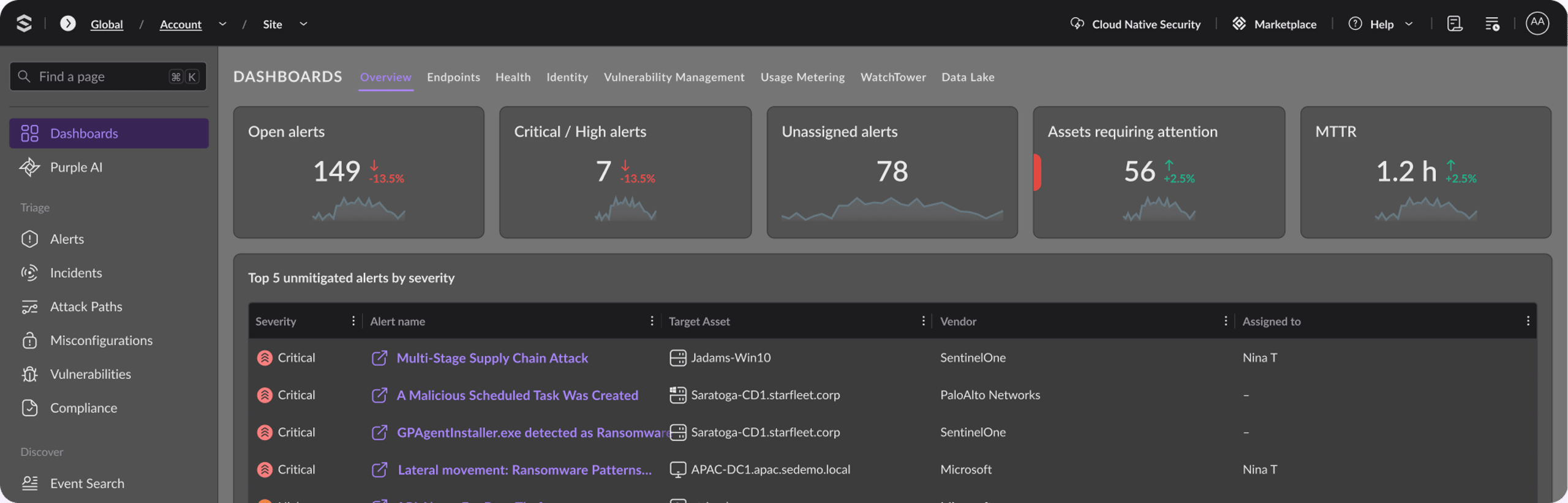
By leveraging Singularity™ Cloud Security, you can enhance security through agentless vulnerability scanning, shift-left security testing for DevSecOps practices, and seamless CI/CD pipeline integration. When you need to identify unknown network assets, eliminate blind spots, and rank vulnerabilities by criticality, Singularity™ Vulnerability Management works with existing SentinelOne agents to handle these tasks.
If you want to maintain a proactive security posture, SentinelOne's vulnerability management capabilities support your organization. You can identify hidden risks, unknown devices, and vulnerabilities across the entire network. This system visualizes the exploitability of each vulnerability and establishes automated controls by enhancing IT and security workflows. This enables isolation of unmanaged endpoints and agent deployment to address visibility gaps related to various vulnerabilities. Even when standard network vulnerability scanners cannot cope, SentinelOne's scanner continues to respond to new threats. You gain continuous, real-time insight into application and OS vulnerabilities on macOS, Linux, and Windows systems. Both passive and active scans are performed, detecting and classifying devices including IoT, and collecting the data needed by IT and security teams. Customizable scan policies allow you to determine the scope and intensity of searches according to your needs.
Singularity™ Platform
Elevate your security posture with real-time detection, machine-speed response, and total visibility of your entire digital environment.
Get a DemoConclusion
Today, the absence of a structured vulnerability management process is no longer acceptable and has become a critical element in protecting organizations from cyber threats. By clarifying the five basic steps from asset discovery to verification, organizations can systematically address vulnerabilities, shorten the window of exposure, and build trust with stakeholders. This is especially important given the current increase in attack vectors due to the growing use of ephemeral instances in DevOps and hybrid clouds. Through continuous scanning, risk-based prioritization, and automated mitigation, security teams can always be prepared for attackers attempting to exploit known vulnerabilities and zero-day attacks.
However, vulnerability lifecycle management is not easy and depends on the strategies implemented, integration with DevOps pipelines, and support from management.
Frequently Asked Questions
The vulnerability management process in cybersecurity is the process of identifying, assessing, selecting, remediating, and verifying security vulnerabilities that may exist in software, networks, or devices. By incorporating scans into daily or weekly cycles, teams can effectively eliminate attack paths through multiple operational cycles. Temporarily using terminology at each expansion integrates intrusion detection into patching activities, achieving near real-time coverage. Ultimately, this process promotes an agile and proactive posture against evolving threats.
The five stages are generally considered to be asset and vulnerability identification, vulnerability scanning, risk ranking, mitigation, and validation and monitoring. Each phase follows sequentially within the cycle, forming the foundation of this process. This synergy minimizes attack paths and ensures compliance requirements are not compromised. By repeating this process, organizations learn optimal scanning and patching methods for their networks, ensuring system protection.
The zero-day vulnerability management process requires detecting threats as quickly as possible and implementing measures to address issues even when a patch for a specific vulnerability is not yet available. Security teams can add WAF rules, change network routes, or isolate affected segments. Combining temporary usage scans with real-time threat intelligence minimizes dwell time of intrusions. This enables teams to respond quickly, rather than just waiting for a vendor to provide a fix.
While monthly or quarterly scans were common in the past, experts now recommend weekly or even daily scans, especially for short-lived containers and serverless environments. Rapid intrusion attempts can exploit newly published CVEs within hours, making timely and frequent scans effective. The frequency of scans also depends on risk tolerance, compliance requirements, and available resources. Ultimately, frequent scans help reduce attack paths for cybercriminals.