
Iran War Cyber Threat Landscape | A Midyear Assessment on What Matters
In April, SentinelLABS’ Tom Hegel published an initial assessment of the first five weeks of the conflict. Three months later, the evidence supports refinement.

In April, SentinelLABS’ Tom Hegel published an initial assessment of the first five weeks of the conflict. Three months later, the evidence supports refinement.
Executive Summary
- The cyber risk remains quieter than the public narrative. It rests on persistent access, trusted administration, service-provider pathways, selective disruption, and personas that magnify technical effects.
- Iran-linked activity is not a single threat set. MOIS, the IRGC Intelligence Organization, the IRGC Cyber-Electronic Command, personas, surveillance operators, and opportunists pursue distinct missions.
- The principal strategic risk is access optionality. The same compromised account, service provider, or remote-management foothold can support intelligence collection, downstream targeting, or selective disruption as tasking changes.
- MOIS-linked personas such as Handala, Homeland Justice, and Karma combine intrusion, destruction, disclosure, and coercion. Their impact claims frequently outpace independently verified evidence.
- OT risk remains exposure-driven. Internet-facing PLCs, weak credentials, and poor remote-access governance have enabled real disruption, but interface access alone does not demonstrate process manipulation or physical effect.
- Inside Iran, shared-service concentration, connectivity controls, and limited disclosure obscure the incident picture. External operations, domestic control, and resilience failures intersect there.
A Working Taxonomy
“Iran-linked” is a broad analytic descriptor, not a single actor or command structure. Iran’s cyber ecosystem spans operators tied to the Ministry of Intelligence and Security (MOIS), the IRGC Intelligence Organization, and the IRGC Cyber-Electronic Command, plus state-aligned collectives, domestic-surveillance clusters, and opportunists. These entities differ in command relationships, missions, targeting, tradecraft, and risk tolerance.
Public naming adds complexity. Vendors assign different labels to overlapping activity sets, and some names refer to actor clusters while others describe campaigns, personas, malware families, or infrastructure.
We offer the following as a working crosswalk, rather than a claim that every label is a one-to-one alias, that every organizational relationship is proven, or that the picture is static.
Cluster and corresponding labels | Mission |
Void Manticore. Labels: Red Sandstorm; Storm-0842; Banished Kitten; TAG-145. Personas: Handala Hack Team; Homeland Justice; Karma/KarmaBelow80 | MOIS-linked destructive, hack-and-leak, and influence operations through public personas |
MuddyWater / SeedWorm / Boggy Serpens / Mango Sandstorm | MOIS-subordinate espionage and access enablement |
APT34 / OilRig / Hazel Sandstorm / Evasive Serpens | Persistent regional espionage, commonly associated with MOIS |
Screening Serpens / UNC1549 / Smoke Sandstorm / Nimbus Manticore. Campaign: Iranian Dream Job | Espionage via recruitment-themed social engineering, aligned with IRGC strategic priorities |
APT42 (Mandiant). Cross-references: Agent Serpens (Unit 42); Educated Manticore (Check Point) | IRGC-IO-linked high-trust social engineering and cloud collection |
Cavern Manticore | Espionage via service-provider and RMM pathways; MOIS link at moderate confidence, single-vendor reporting |
TAG-182. Related, but not aliases: Ferocious Kitten; Domestic Kitten/GreenEcho; Rampant Kitten | Surveillance of dissidents and diaspora; no sponsor publicly attributed with confidence |
CyberAv3ngers / Storm-0784 / CL-STA-1128 | IRGC-CEC-affiliated opportunistic OT targeting |
Predatory Sparrow / Gonjeshke Darande | Comparison case only: destructive anti-Iran operations, widely reported as Israel-linked |
We base our distinction on mission rather than branding. In practice, we can identify several recurring mission sets:
- persistent espionage and access enablement;
- destructive, coercive, and influence operations through public personas;
- high-trust social engineering and cloud compromise;
- surveillance of dissidents and civil society; and
- opportunistic targeting of operational technology.
These categories overlap, but they offer a more reliable basis than actor names for assessing intent and prioritizing defenses.
1. The Durable Threat Is Access Optionality
Three months of headlines have tracked leaks, defacements, and outages. However, there is a quieter accumulation of access that matters more, where a foothold gained for collection today can be converted to disruption tomorrow or whenever tasking changes.
For example, activity attributed to the MOIS-linked Seedworm/MuddyWater cluster began in early February, before the opening strikes. Affected environments included a U.S. bank, a U.S. airport, nonprofits, and the Israeli operation of a U.S. software supplier serving defense and aerospace customers. Researchers identified multiple backdoors and an attempted transfer of data to commercial cloud storage.
Because that activity preceded the kinetic campaign, it is tempting to call every intrusion wartime pre-positioning. In practice, the evidence supports a narrower reading. We might know access was gained before the strategic picture changed, but that doesn’t tell us what the compromise was originally for. A compromised supplier may expose customer identities and trusted administrative paths, but it’s only a software supply-chain compromise if there is evidence that downstream customers, builds, updates, or distribution were affected. What matters is that the operator had options once the conflict escalated.
A similar timing pattern appears in Screening Serpens. Unit 42 identified six new RAT variants deployed between February and April against apparent targets in the United States, Israel, the UAE, and the wider Middle East. The campaigns continued the actor’s tailored recruitment lures while adding AppDomainManager hijacking, and the conflict appears to have increased tempo without creating the espionage mission.
This is also why high-trust people are part of the enterprise perimeter. Long-running APT42 operations have targeted journalists, researchers, NGOs, academics, activists, and government-linked individuals. One compromised cloud account holds organizational context, relationships, and internal deliberations, and can yield collection, impersonation, lateral targeting, and entry into the wider organization.
Third party reporting extends that logic to service providers. Check Point’s July reporting on Cavern Manticore described intrusions in which existing RMM access and compromised IT-provider environments opened paths into targets. Check Point assesses an MOIS relationship based on technical and operational overlap with MuddyWater and Lyceum; public corroboration remains limited, so the mapping should remain moderate-confidence.
SysAid itself was not compromised, and no SysAid vulnerability was involved. The actor already had access and abused a legitimate deployment feature, and in many intrusions the weakness is the authority already granted to an administrator, service account, RMM agent, identity provider, or support organization rather than the product itself.
The war has also not displaced Iran’s standing regional requirements. Previously documented APT34 activity against Iraqi government infrastructure shows a durable mission of collecting political, diplomatic, and telecommunications intelligence from neighboring states. Iraq and the Gulf are not peripheral theaters simply because the visible strikes occur elsewhere.
Our assessment is that Iran’s most valuable cyber asset is optionality. Persistent access can support immediate collection, future tasking, transfer to another operational element, or disruption when political value exceeds operational cost.
At least one recent Handala wiping script was assessed as likely AI-assisted, and Iranian operators are likely using generative systems to accelerate coding, translation, lure development, and impersonation. The evidence supports an efficiency multiplier rather than a separate mission set.
2. Persona Operations Are Operational Infrastructure
Iran-linked intrusions are often claimed in public by personas with hacktivist-style brand names like Handala Hack Team or Homeland Justice. We observe that these personas provide threat actors with more than just post-intrusion propaganda. They serve as reusable operational infrastructure, supporting attribution masking, coercion, disclosure, intimidation, and amplifying claims.
A meaningful portion of higher-impact public activity resolves to personas of the MOIS-linked Void Manticore apparatus. In March, the U.S. Department of Justice seized four domains associated with Handala, Homeland Justice, KarmaBelow80, and a related “Red Wanted” operation, identifying shared leak infrastructure, Iranian IP ranges, and a common playbook combining destructive intrusions with data publication, doxxing, and threats.

That evidence supports treating Handala Hack Team, Homeland Justice, and Karma as related fronts within a common MOIS-linked system, and Check Point has also documented collaboration involving Scarred Manticore. Treating the personas as interchangeable aliases in a strict CTI sense goes further than the evidence allows. Personas can serve different geographic, linguistic, or operational purposes, and the same apparatus may retire, merge, or repurpose brands as requirements change.
It is worth noting that following the March 2026 infrastructure seizure(s), Both Handala and Homeland Justice personas have continued to establish new infrastructure, and communications channels for influence and narrative control purposes. Handala, in particular, has been consistent with regards to communication over the observed timeline.
A more defensible model has three layers:
- State-managed persona systems combine intrusion, destructive effects, data theft, leaks, threats, and messaging under deniable brands.
- Ideologically aligned networks may coordinate targets, amplify claims, or share stolen material without evidence of direct tasking.
- Opportunists and service sellers enter for attention, access sales, or revenue, relying on DDoS-for-hire, recycled data, and low-impact defacement.
These layers interact. An opportunist may sell access to a state operator, and a persona may amplify a third party’s claim, none of which proves shared organization. Treating direction, alignment, collaboration, brokerage, and amplification as synonyms inflates actor counts and obscures the operators with real access.
The March attack on Stryker is the clearest public case for this layer. Stryker confirmed global disruption to its Microsoft environment affecting ordering, manufacturing, and shipping. Early statements said no malware had been detected; a later update clarified that the actor used a malicious file to execute commands and conceal activity, though the file could not spread inside or outside Stryker’s environment.
Handala claimed responsibility, and the Justice Department later stated an MOIS-controlled Handala domain was used to claim the March 11 destructive attack. Stryker did not attribute the incident to Handala or validate the actor’s quantitative claims of device destruction and data loss. Those remain actor assertions rather than confirmed findings.
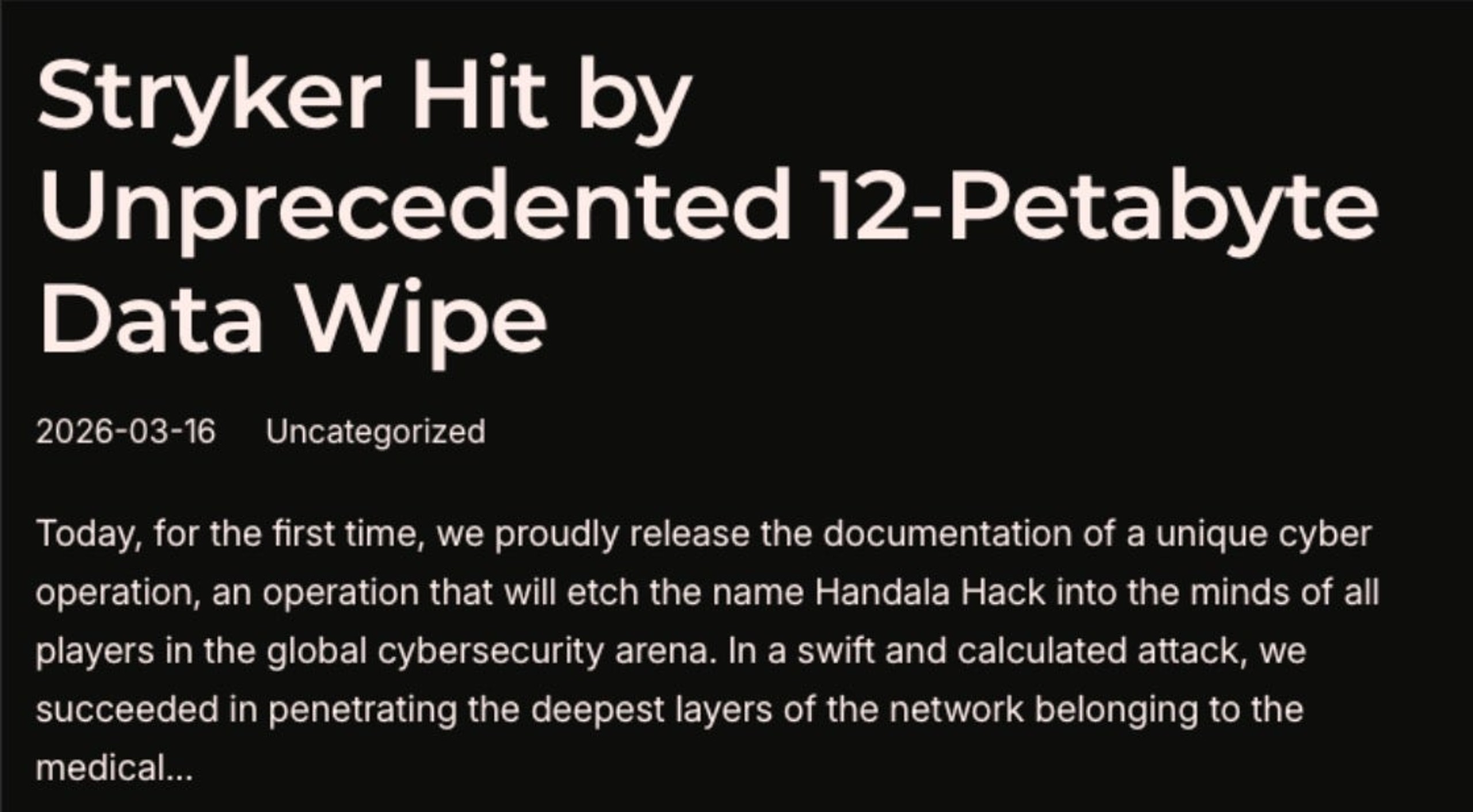
The public claim is part of the operation. Victim lists, leak samples, countdowns, doxxing, and unverifiable impact figures impose reputational and psychological costs before technical scoping is complete. These are all fundamental steps in the personas’ playbook to help craft and control the narrative and potentially sway the sentiment of the public. In a persona-led incident, publication and personal targeting may begin while responders are still establishing blast radius.
3. OT Risk Is Real, and Evidence Quality Matters
The strongest public evidence of wartime Iran-linked activity against U.S. operational technology is the April 7 joint advisory on internet-facing Rockwell Automation and Allen-Bradley PLCs, documenting activity against government facilities, water and wastewater organizations, and energy environments, in several cases with operational disruption and financial loss.
Two U.S. cases show why cyber-physical reporting needs exact boundaries. On April 7, CISA, the FBI, NSA, EPA, Energy Department, and U.S. Cyber Command warned that Iran-affiliated actors were exploiting internet-facing Rockwell Automation/Allen-Bradley programmable logic controllers. The agencies reported manipulation of project files and HMI/SCADA displays, operational disruption, and financial loss across multiple critical-infrastructure sectors. That is a confirmed cyber-physical campaign described by multiple government agencies.
The June California Water Service case is narrower. Handala claimed that it had hacked the utility and could have interrupted water service. Analysis of the actor’s published material supported access to customer billing data and an internal RTKBase/NTRIP GPS-correction environment used by field crews. Cal Water said it was investigating and that preliminary findings showed no known operational disruption to water, wastewater, or billing. The supported finding is potentially significant IT and field-support-system access—not demonstrated control of treatment, chemical dosing, or water distribution.
We should be cautious about attribution. The advisory described Iranian-affiliated cyber actors and referenced earlier IRGC Cyber-Electronic Command activity associated with CyberAv3ngers. Separately, Unit 42 maps the cluster it tracks as CL-STA-1128 to CyberAv3ngers and Microsoft’s Storm-0784 label. Those assessments are compatible, but they do not prove that every exposed PLC or claimed compromise involved the same operator.
Pro-Iran channels keep publishing images and videos appearing to show access to HMIs, SCADA interfaces, and industrial engineering software. Some may be genuine unauthorized access, but others may not. Analysts should apply an evidence ladder, in which each rung requires evidence beyond the one before it.
- Provenance and target validation: Can the organization, system, location, and timeframe be independently established?
- Interface visibility: Can the actor display a login page, dashboard, or management interface?
- Authenticated interaction: Can the actor navigate the live interface or query current values?
- Write or control capability: Can the actor change a setting, logic file, operating mode, or command value?
- Process effect: Did the change alter an operational process outside the interface?
- Physical or safety consequence: Did the process change produce a verified real-world outcome?
Stronger claims need logs, process data, engineering review, operator testimony, timestamps, configuration evidence, or independent confirmation of the outcome. These personas will falsify or embellish claims at times for various reasons. It is crucial that we scrutinize claims for validity, accuracy and technical viability.
Regardless of which actor is behind any given incident, the attack surface is well-documented: Internet-facing PLCs, unmanaged HMIs, remote engineering services, default credentials, permissive vendor access, and poorly segmented management networks. Any of these can create opportunities for meaningful disruption. In some environments, what separates a low-skill intrusion from a serious incident is the authority exposed to the internet rather than attacker capability.
Evidence quality should determine how an incident is described, not whether an exposed control path is closed.
4. Inside Iran | Concentration Risk, Underreporting, and Surveillance
Iran is also on the receiving end of this conflict, and the picture inside the country is shaped by more than just foreign intrusions. Shared-service concentration, connectivity controls, domestic surveillance, and weak disclosure increase both operational risk and analytic uncertainty.
Banking: The Dependency Is The Strategic Finding
In this context, Iran has experienced at least two officially reported banking disruptions this past June, but public record does not establish these as a one continuous intrusion.
On June 14, Iranian authorities reported that an attack on shared communications infrastructure disrupted services at four banks: Bank Melli, Bank Tejarat, Bank Saderat, and the Export Development Bank of Iran, with no unauthorized access to or deletion of customer data identified. A second reported attack on June 23 disrupted card services at three of the same banks, affecting ATMs, point-of-sale terminals, and mobile applications. These overlaps are notable, but timing and claims alone are not enough to prove a coordinated, multi-stage campaign by any one specific actor.
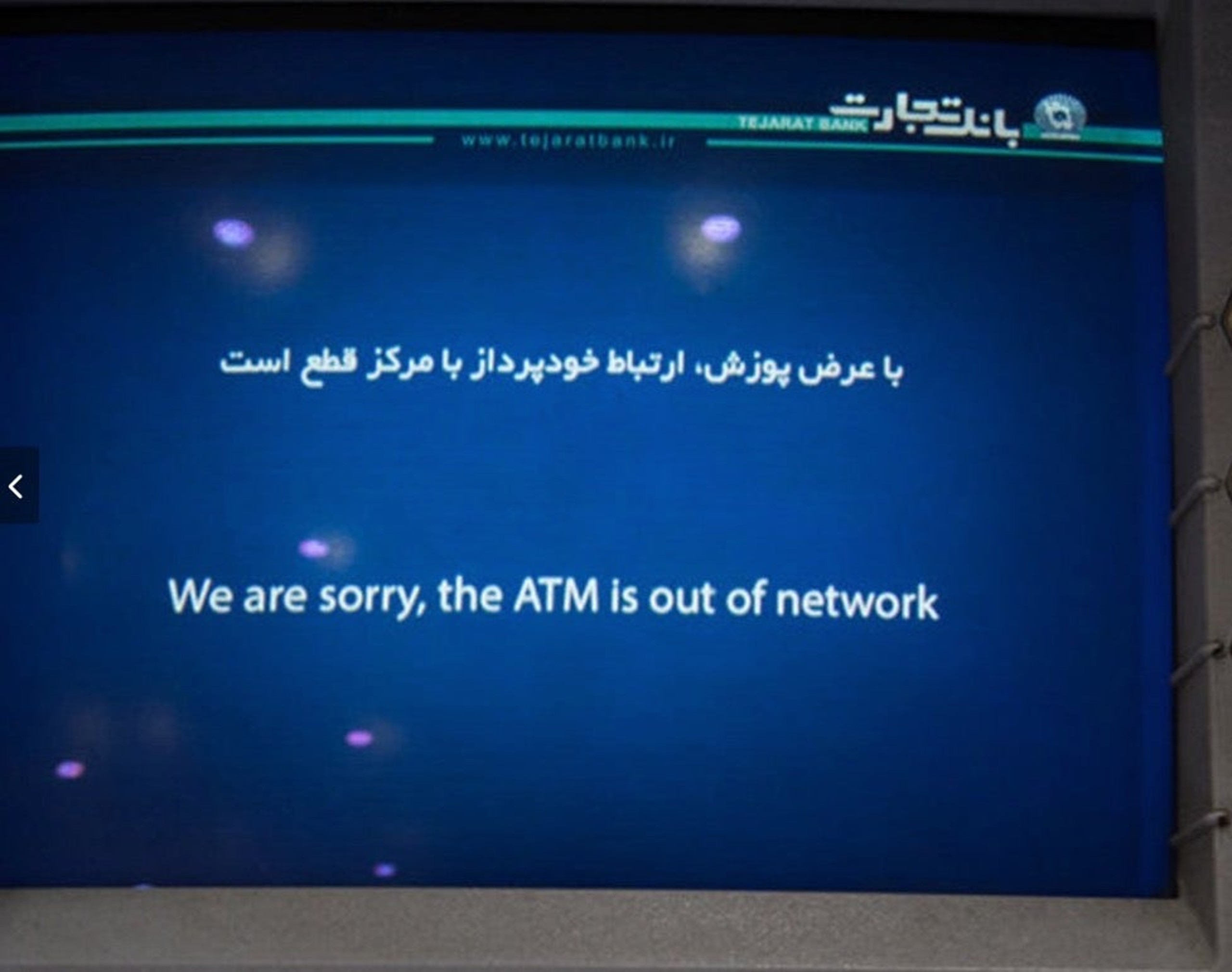
The incidents remain publicly unattributed. Predatory Sparrow is an obvious comparison given prior high-impact operations against Iranian financial targets, but on the available evidence it is not an attribution. The June incidents lacked the public claim, evidence package, and established destructive signature of the group’s better-known operations.
The strongest conclusion is architectural rather than actor-centric. Failure of a shared communications provider, card platform, identity service, or recovery environment can propagate across institutions and become a national public-confidence event, with outage scale reflecting dependency concentration as much as attacker sophistication.
Fallback systems belong to the same risk model, and the lesson is not confined to Iran. A recovery platform is more than an emergency copy of production. Isolation, capacity, data currency, and administrative security determine whether it operates safely under pressure, and a fallback sharing credentials, management tooling, or upstream providers with production may reproduce the failure when needed most.
Surveillance Infrastructure Can Become Targeting Infrastructure
Iran’s surveillance and communications systems are not separate from the conflict. Associated Press reporting, based on intelligence and operational sources, described Israeli access to Iranian surveillance-camera networks supporting the tracking of senior leadership; absent disclosed access paths or technical artifacts, those details should remain described as reported rather than confirmed.
The structural risk outlasts any single account. Camera networks, subscriber records, location histories, and identity databases concentrate information about people and movement, and infrastructure built to monitor a population can become targeting infrastructure for a foreign service.
The relationship also runs in reverse. Disrupting the same communications layer degrades public warning, incident response, and independent reporting, making it a surveillance asset, an intelligence target, a resilience dependency, and a domestic-control mechanism at once.
Public Reporting Is A Floor, Not A Denominator
Banks are the best-documented internal target set in the public record reviewed here, and not necessarily the only one. Incidents affecting telecommunications, energy, or military-adjacent environments may be underrepresented, a collection hypothesis rather than a confirmed count. Iranian reporting is constrained and fragmented, and incidents may be kept private or described too vaguely to distinguish attack from technical failure. The public incident set is a floor, evidence that at least those events occurred rather than a denominator for total activity.
The same logic cuts the other way, though. Knowing that incidents go unreported is not a license to fill the record with rumor, and however many compromises are plausibly hidden inside Iran, they cannot be used to attribute a specific outage, validate an actor’s claim, or turn an unexplained failure into evidence of cyberattack. When collection is thin, the honest answer is explicit uncertainty rather than false precision.
The Blackout Is Both A Collection Gap And An Attack Surface
Iran began restoring international connectivity after an 88-day shutdown, but the return was partial and uneven. A 2026 technical paper found that forwarding-plane null-routing could leave BGP announcements apparently stable, causing route-based monitors to understate the scale of disconnection.
For CTI, telemetry loss is not uniform. External visibility falls while selected domestic services stay reachable, so apparent recovery in one dataset may reflect exemptions or measurement artifacts. The blackout is also not an all-purpose causal explanation. Public evidence does not establish that connectivity restrictions caused the banking compromises or enabled a specific intrusion. Its defensible effects are on visibility, coordination, validation, and trust.
Those effects create a secondary attack surface. Users seeking secure communications or ordinary services turn to VPNs, media players, and utilities from informal channels, and recent TAG-182 activity used exactly such lures to distribute MarkiRAT to Farsi-speaking users inside and outside Iran. Iranian surveillance operators can exploit attempts to bypass connectivity restrictions, while foreign intelligence services and criminals can exploit the same demand, putting journalists, NGOs, diaspora communities, and Iran-exposed employees at risk from several directions.
Our assessment is that the internal Iranian cyber environment is defined by three overlapping risks:
- attack against national and institutional infrastructure;
- concentration of critical services and recovery dependencies; and
- surveillance of people attempting to operate through the resulting disruption.
Treating only the first as “cyberwar” misses a substantial part of the operational reality.
Defender Priorities
For enterprise defenders, the central question extends beyond who is attacking now. It includes which access predates escalation, which trusted paths remain, and what an operator could do with them under different tasking. Review identity, cloud, RMM, and service-provider relationships against that standard, and map shared dependencies: which nominally separate services would fail together, and which recovery paths rely on the same identity provider, carrier, or administrator as production.
For incident responders, persona-led operations weaponize uncertainty. Publication, doxxing, and direct approaches to employees may begin before scoping is complete, so technical response, legal review, communications, and physical-safety support cannot operate sequentially.
For OT operators, the priorities remain clear: remove direct internet exposure; place remote access behind authenticated gateways with phishing-resistant MFA; restrict programming-mode and logic changes; enforce source and time restrictions on vendor access; monitor engineering workstations and industrial protocols; preserve offline project files and known-good configurations; and verify that recovery does not depend on the same identity, virtualization, or management environment that may have been compromised. Defenders do not need to wait for perfect attribution before removing a preventable route to operational disruption.
Outlook
Renewed kinetic escalation is likely to increase intelligence tasking, opportunistic targeting, public claims, and pressure to produce visible effects. It does not fundamentally change the access paths available to Iranian operators. Identity compromise, trusted administration, remote-management tooling, service providers, exposed internet-facing systems, and high-trust individuals remain the mechanisms most likely to produce results.
We assess with high confidence that the near-term base case is continued espionage and access development accompanied by persona-led coercion and a large volume of lower-impact activity. That includes credential theft, mailbox and cloud compromise, recruitment-themed social engineering, exploitation of trusted service relationships, and inflated public claims. Most of it will be operationally persistent but individually less dramatic than the public discussion of “cyberwar” implies.
We assess with moderate confidence that Iran-linked operators will attempt selective disruption where three conditions coincide: usable access already exists, the victim has political or symbolic value, and the expected effect can be achieved without an unacceptable risk of escalation or exposure. Administrative and management systems are particularly relevant because they translate ordinary enterprise access into organization-wide effects.
OT activity will remain dangerous but uneven. The most likely incidents involve exposed systems, weak credentials, poorly controlled remote engineering, or known vulnerabilities rather than sophisticated manipulation of segmented safety-critical environments. A technically simple compromise can still cause serious consequences when the target environment is fragile or excessively connected.
Based on the public record, we assess with moderate confidence that a coordinated, national-scale campaign intended to disable the U.S. power grid or multiple critical sectors simultaneously is a lower-likelihood, high-impact contingency rather than the near-term base case. There is public evidence of repeated targeting, reconnaissance, and exploitation of exposed industrial systems, along with limited operational disruption.
There is no public evidence at the time of writing of the synchronized access, specialized preparation, and cross-sector execution required to support claims of an imminent nationwide grid-down operation.
Official U.S. statements confirm that USCYBERCOM and USSPACECOM layered non-kinetic effects into the opening military campaign to disrupt Iranian communications and sensor networks, but they do not disclose the specific systems, accesses, techniques, duration, or reversibility involved. That is representative of the wider conflict: analysts may know a cyber-enabled effect occurred while lacking the evidence to attribute a particular outage or reconstruct the operation.
Outside Iran, public claims are likely to outpace independently verified effects; inside Iran, consequential effects may outpace public reporting, and attribution will often remain harder than impact assessment.
Analysts should stop treating logos and claim volume as the principal units of analysis. The more useful unit is access plus mission plus dependency, evaluated against evidence quality. Security teams should focus on the trusted pathways that let an otherwise ordinary compromise become wartime leverage.
Assessment current as of 21 July 2026.